With Thanksgiving 2025 arriving tomorrow, and wintry weather in the forecast, my spirits need to re-experience the pleasures of summer and early fall.








With All Due Respect,
Art Giacalone
With Thanksgiving 2025 arriving tomorrow, and wintry weather in the forecast, my spirits need to re-experience the pleasures of summer and early fall.
With All Due Respect,
Art Giacalone
SEQRA – New York State’s Environmental Quality Review Act – turns 50 on September 1st. It isn’t clear whether this milestone should be marked with a celebration or memorial service.
SEQRA’s goal when enacted a half century ago was to motivate government decision makers to consider environmental factors when undertaking or approving projects, activities, or new policies. As recognized by then-Governor Hugh Carey, state and local agencies were not sufficiently considering environmental factors when undertaking or approving various projects or activities. The 1975 statute’s remedy for that deficiency was the Environmental Impact Statement (EIS), a document meant to provide a systematic method for government agencies, project sponsors and the public to consider significant adverse environmental impacts, alternatives, and mitigation.
New York’s courts have long recognized that an EIS is the heart of the SEQRA process, and that the threshold for requiring preparation of an EIS is relatively low. But the need to expend substantial amounts of time and money to prepare an EIS has led developers and government agencies to treat SEQRA’s requirements as a nuisance to avoid.
A tangible measuring stick of the steady erosion in state and local agencies’ commitment to their duty to comply with the letter and spirit of SEQRA is a tally of the number of EISs annually prepared statewide. In 1989, 385 environmental impact statements were produced by local and state agencies. Just five years later, that number dropped by more than half to 167. In 2024, an EIS was required a paltry 27 times statewide despite more than 1,500 local municipalities and a host of state agencies and authorities obligated to comply with SEQRA’s mandates.
The city of Buffalo’s decisionmakers have proven as derelict in their approach to the preparation of EISs as their counterparts across the Empire State. In its 1994 “State of the Environment Report”, the Buffalo Environmental Management Commission frankly concedes that, “Due to a lack of procedural guidelines, and in some cases lack of commitment, the City of Buffalo does not always obey New York state law regarding mandated environmental review procedures. “ Three decades later, that lack of compliance and commitment to SEQRA continues as Western New York’s largest city once again failed to issue any EISs for the entirety of 2024. The only existing mechanism to challenge disregard of SEQRA is a judicial proceeding. Perhaps it is time to establish an official board to review SEQRA decisions and issue binding decisions. Such a step will take legislation in Albany and our governor’s approval.
According to State Comptroller Thomas Napoli’s 2022 report – New Yorkers in Need: A Look at Poverty Trends in New York State for the Last Decade | Office of the New York State Comptroller (ny.gov) – 40% of the children residing in the City of Buffalo live in poverty. That means that four out of every ten children in Buffalo lack adequate resources to meet basic needs such as food, clothing and shelter.
But Buffalo’s youth are not the only residents suffering. In 2019, 30.1% of the population of the “City of Good Neighbors,” or approximately 75,000 human beings, lived below the poverty line. [See U.S. Poverty Rate By City In 2021 (forbes.com.]
Only six other large U.S. cities have a higher poverty rate, including Rochester, NY. While the share of our neighboring city’s population living in poverty, 31.3%, is slightly higher than Buffalo’s, Rochester has been more successful at lowering its residents’ poverty rate. In the five-year period between 2014 and 2019, when Buffalo’s numbers barely budged from 30.9 to 30.1 percent, Rochester saw a meaningful 2.5% drop in its poverty rate, from 33.8 to 31.3%.
Given these dismal statistics, it is disturbing to read Buffalo Mayor Byron Brown’s response to his selection as the next head of Western Regional Off-Track Betting. As reported in the Buffalo News, Brown says he appreciates “the vote of confidence in me and my record of success as mayor of Buffalo.” [See Byron Brown selected as next head of Western Regional OTB (buffalonews.com).]
That sentiment is echoed in the mayor’s statement at the city’s website where Brown takes credit for Buffalo’s “renaissance” and calls Buffalo “a model for urban transformation” and “a city of opportunity for all residents.” [See Office of the Mayor | Buffalo, NY (buffalony.gov).]
It takes some chutzpah to boast of economic prosperity and opportunity for all given Buffalo’s poverty rate, which stood at 30.2% in 2010, the fourth year of Brown’s 18 years as the head of the city’s executive branch, and today continues to hover around 30 percent.
Of course, the city’s legislative body, the Common Council, must also take responsibility. It has rubberstamped virtually all of Brown’s policies, helping to perpetuate an economic environment where 75,000 Buffalonians live in poverty.
The absence of legislative leadership is troubling given the City Charter’s mandate – at Chapter C, Article 4-5 – that the president of the Common Council be elevated to the position of acting mayor when a vacancy in the mayor’s office occurs. The current Council President, Christopher P. Scanlon, has been a staunch ally of Brown and appears equally oblivious to Buffalo’s persistently high poverty rate.
Scanlon’s biography speaks vaguely of “passing legislation that supports and strengthens public safety and economic opportunity, with an emphasis on equity and inclusions.” His lack of vision is reflected in his boast that, “he has ensured that our City’s vulnerable populations are served through his sponsorship of free sports and reading camps.” [See Christopher P. Scanlon | Buffalo, NY (buffalony.gov).]
Buffalonians deserve new leadership that goes beyond the mediocrity of the Brown/Scanlon years and truly seeks to create prosperity for all its residents.
[On May 17, 2024, Right2TheCity included this piece among its “SELECTED MEDIA” posts. I am extremely grateful to its staff for the honor. If you are not already familiar with this informative publication – with the motto “A battle cry to remake the city in our own image” – I recommend that you check out its policy declaration.]
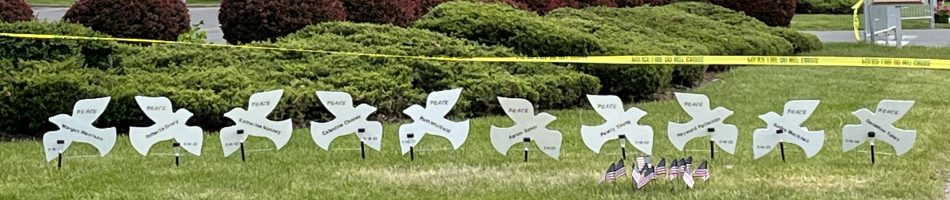
Yesterday, May 14, 2024, was the second anniversary of the horrific events at the Tops Supermarket on Jefferson Avenue in Buffalo, New York. (See 10 dead in Buffalo supermarket attack police call hate crime | AP News.) Many solemn words of remembrance have been spoken and written to mark the passing of two years [see, for example, Plans unveiled for memorial honoring victims of racist mass shooting at Buffalo supermarket (buffalonews.com); Tops unveils ‘honor space’ to commemorate victims of 5/14 (buffalonews.com), and, of special note, Sean Kirst’s 2 years after Buffalo shooting, he can still see every face (buffalonews.com)]. And images of the ceremony officially dedicating Tops Markets’ 5/14 “Honor Space” can be found online. (See, for example, Photos: The dedication of the 5/14 Honor Space (buffalonews.com).)
The aim of this posting is a modest one, to take a closer look at the signage and elements that comprise the “Honor Space”, and to provide links with some background information on the artists who contributed to the memorial.
My remarks will be kept to a minimum.
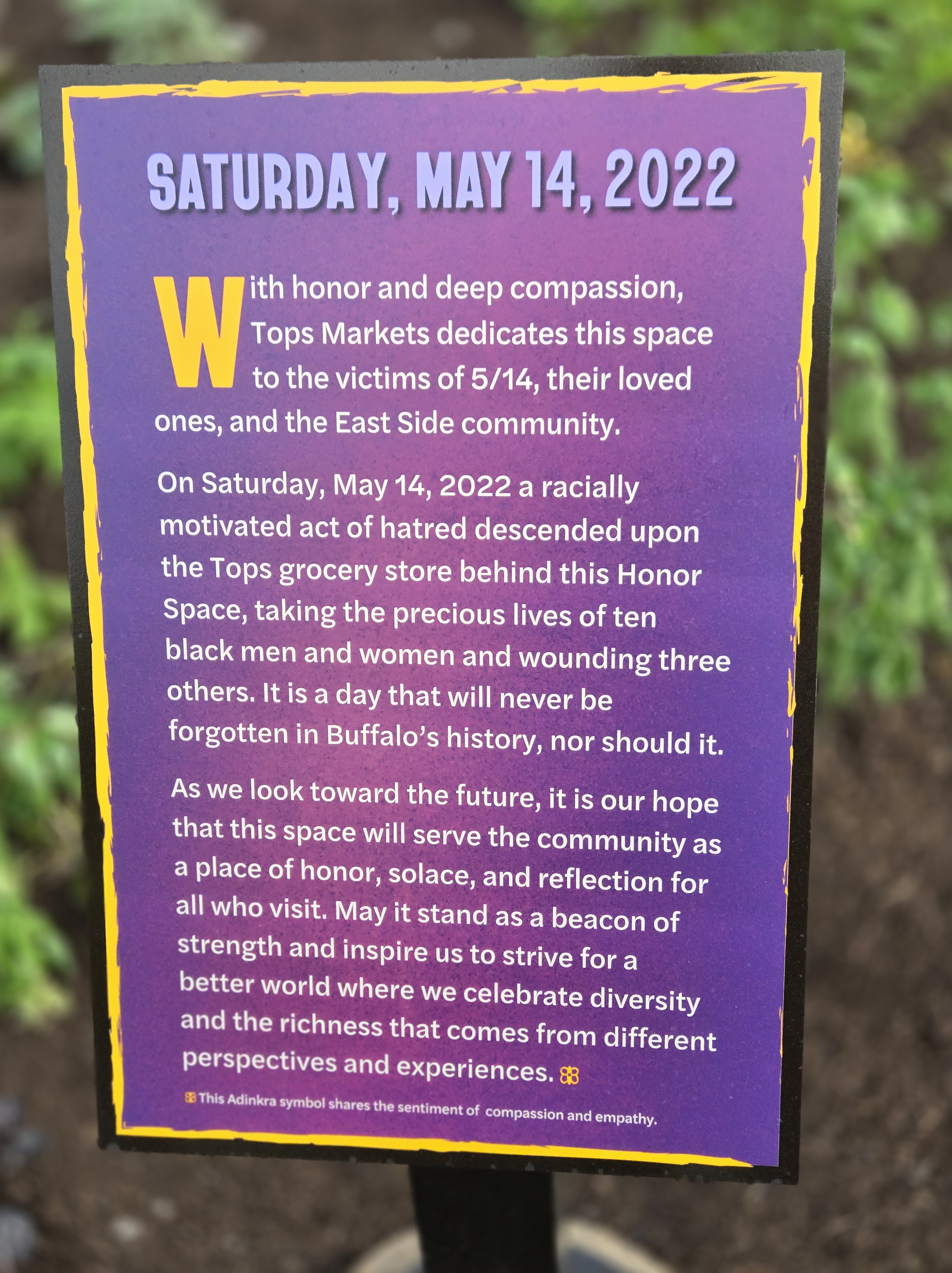
Here’s the description provided by the “friendly” corporate sponsor, Tops Markets:
And the poetry, entitled “Fortress of Peace”, by the City of Buffalo’s 2024 poet laureate, Aitina Fareed-Cooke:

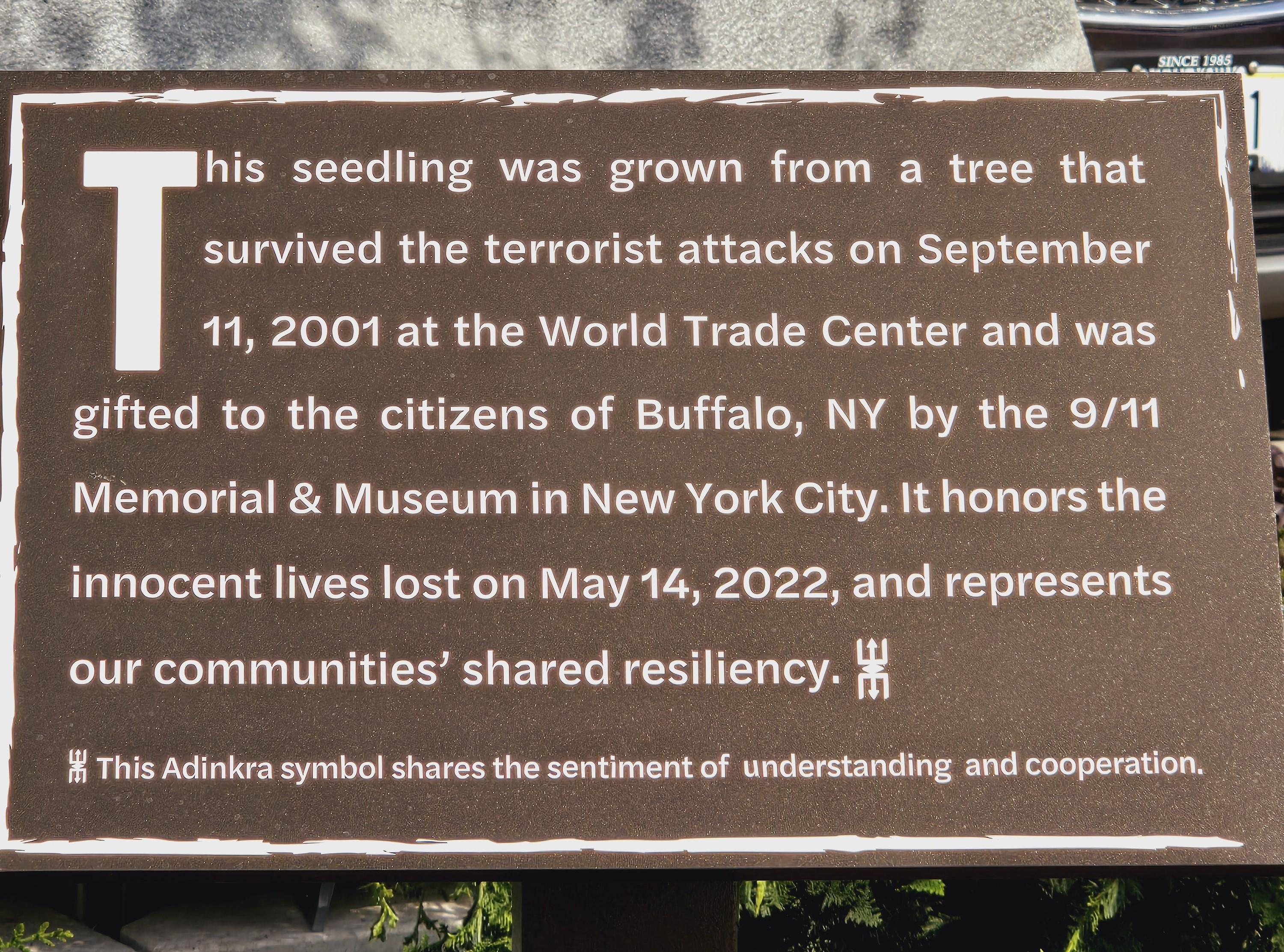
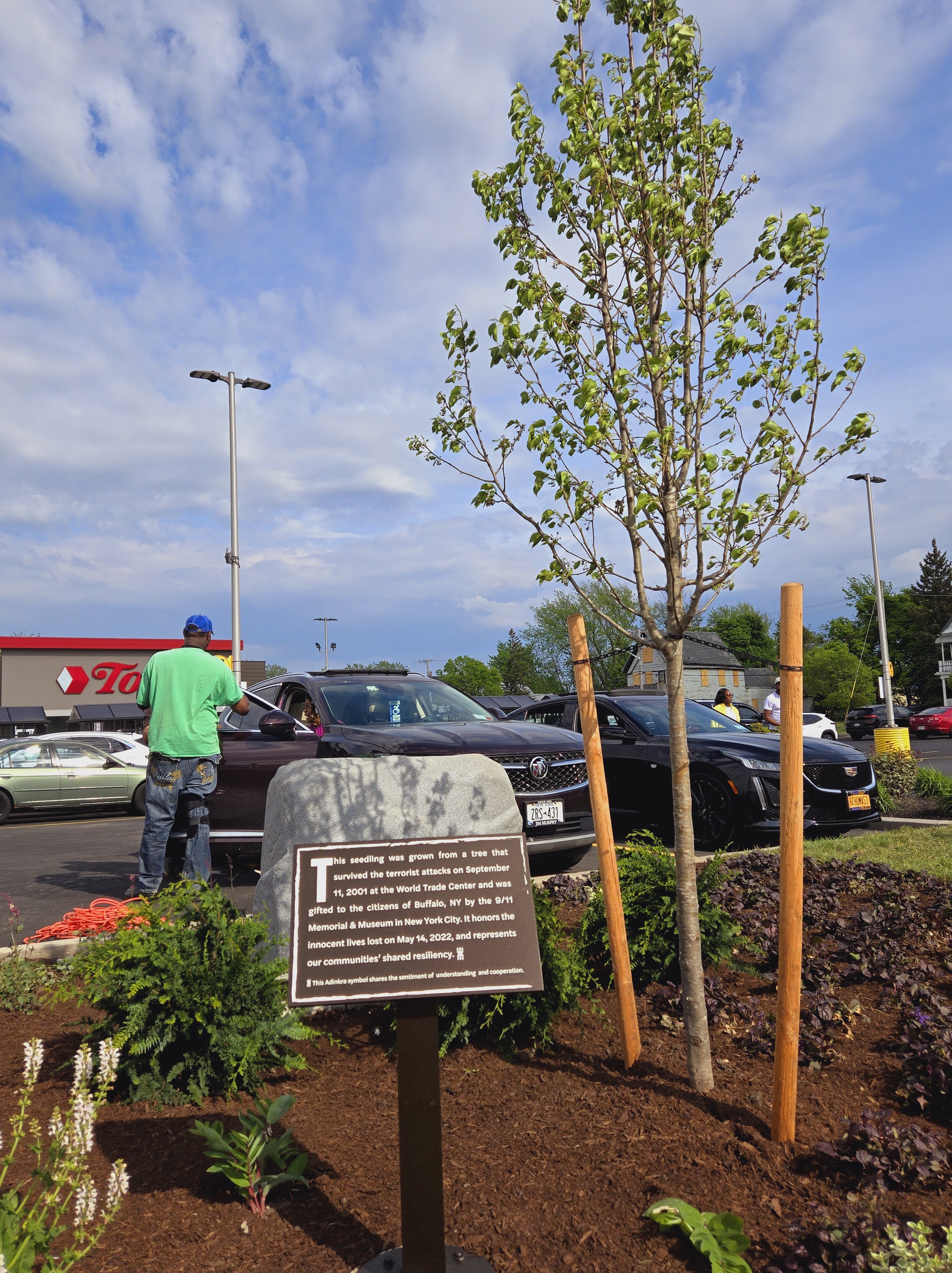
And a sign describing the history of a World Trade Center seedling, and an image of the youthful tree:
Here’s one of ten granite bollards that represent each of the community members who lost their lives on May 14, 2022 [note: you may wish to watch “This American Experience” broadcast from August 2022 for a more personal narrative on the lives of the 5/14 victims: Name. Age. Detail.]:

Throughout the “Honor Space” one will see various Adinkra symbols (some too small for my aging eyes to fully appreciate), each one expressing a sentiment or concept. The symbols originated from the Gyaman people of Ghana and Côte d’Ivoire. Here is a link to information on Adinkra symbols.
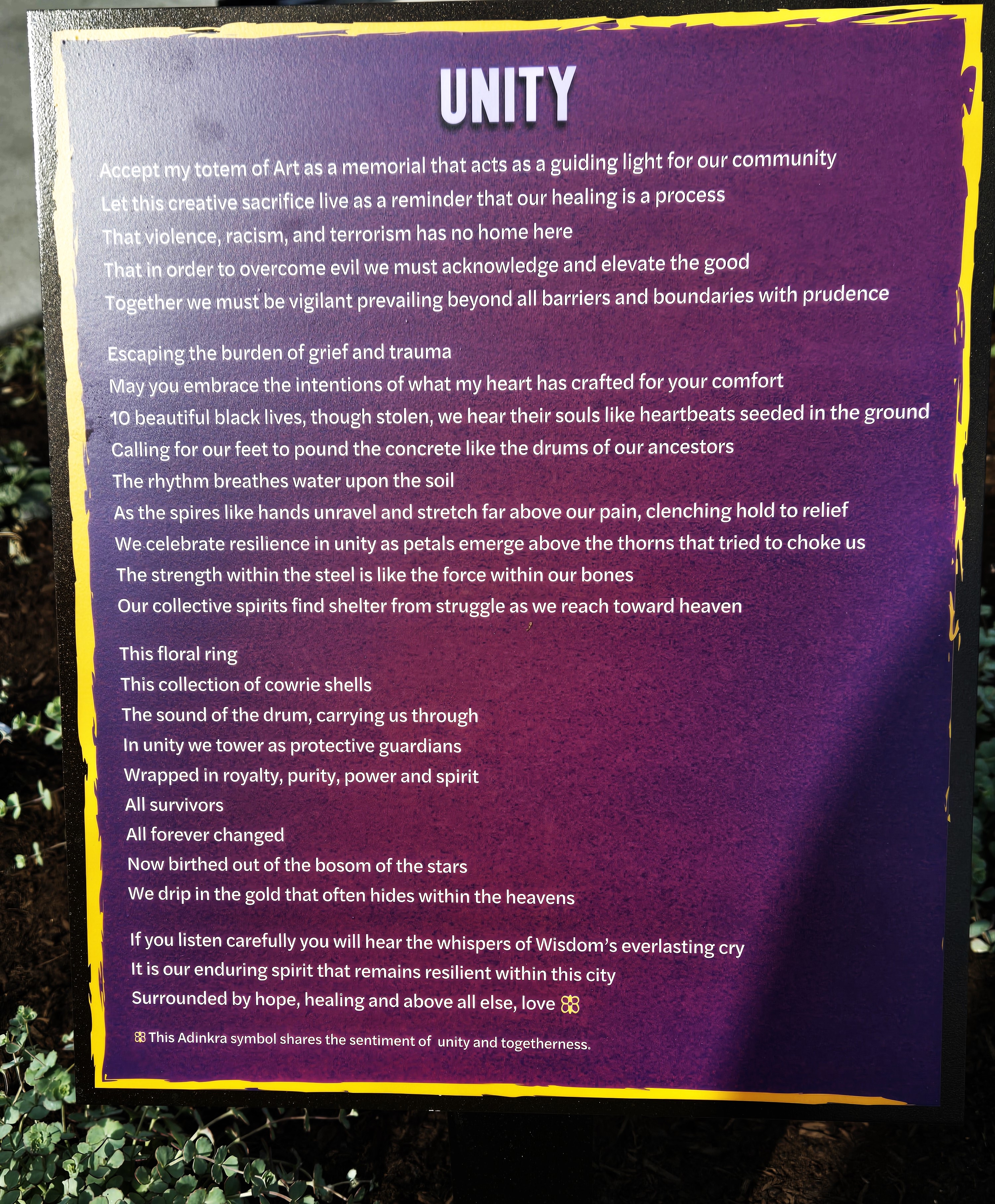
The mother and son team, Valeria Cray-Dihaan and Hiram Cray, contributed the stunning “UNITY” sculpture:
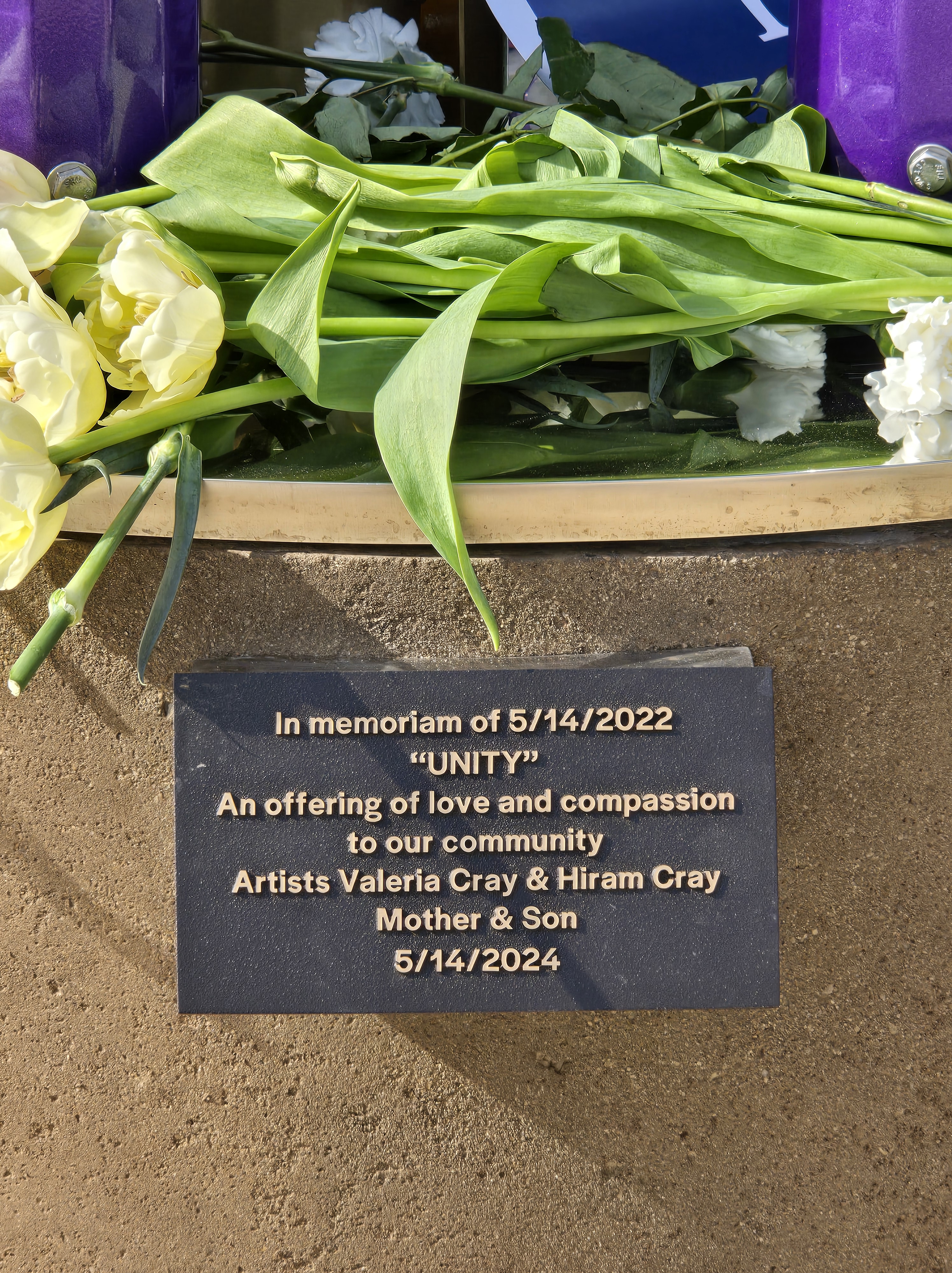

I apologize for the poor quality of the “UNITY” sign that follows, and my uncertainty on whether the words are those of either Valeria or Hiram Cray (or of another artist). I look forward to modifying or expanding this post when I receive clarification:
I’ll end this posting with a photo – from a distance – of several visitors to the Honor Space the afternoon of May 14, 2024 (that I hope adequately protects their privacy):

With all Due Respect,
Art Giacalone
P.S. On May 13, 2024, NY Governor Kathy Hochul and other dignitaries unveiled a rendering of a proposed permanent memorial to the ten human beings who tragically lost their lives on May 14, 2022. Here’s the rendering: Rendering of proposed 05-14-22 memorial. Neither the source of funding, nor the location for the memorial, has been identified.
OK, I’ll admit that “Cheery” was initially a typo on my part – but it accurately describes the good spirits I felt this past Sunday while walking amongst and photographing the cherry and other blossoms behind the Buffalo & Erie County Historic Society building at Elmwood Avenue and Nottingham Terrace.
Here’s hoping that the images that follow have a similar effect on you.









Thanks.
With All Due Respect (and Cheer),
Art Giacalone
Nearly six feet of snow fell at my South Buffalo home between January 13 and 19. It was a week of shoveling and little else as my world was reduced to my driveway, my house, and a view of my across-the-street West Seneca neighbors. I did feel extremely fortunate to have a warm and cozy place to call home. But I dearly missed my daily walks in Cazenovia Park and the freedom of driving to Wegmans, Office Depot, or wherever whenever I wanted.
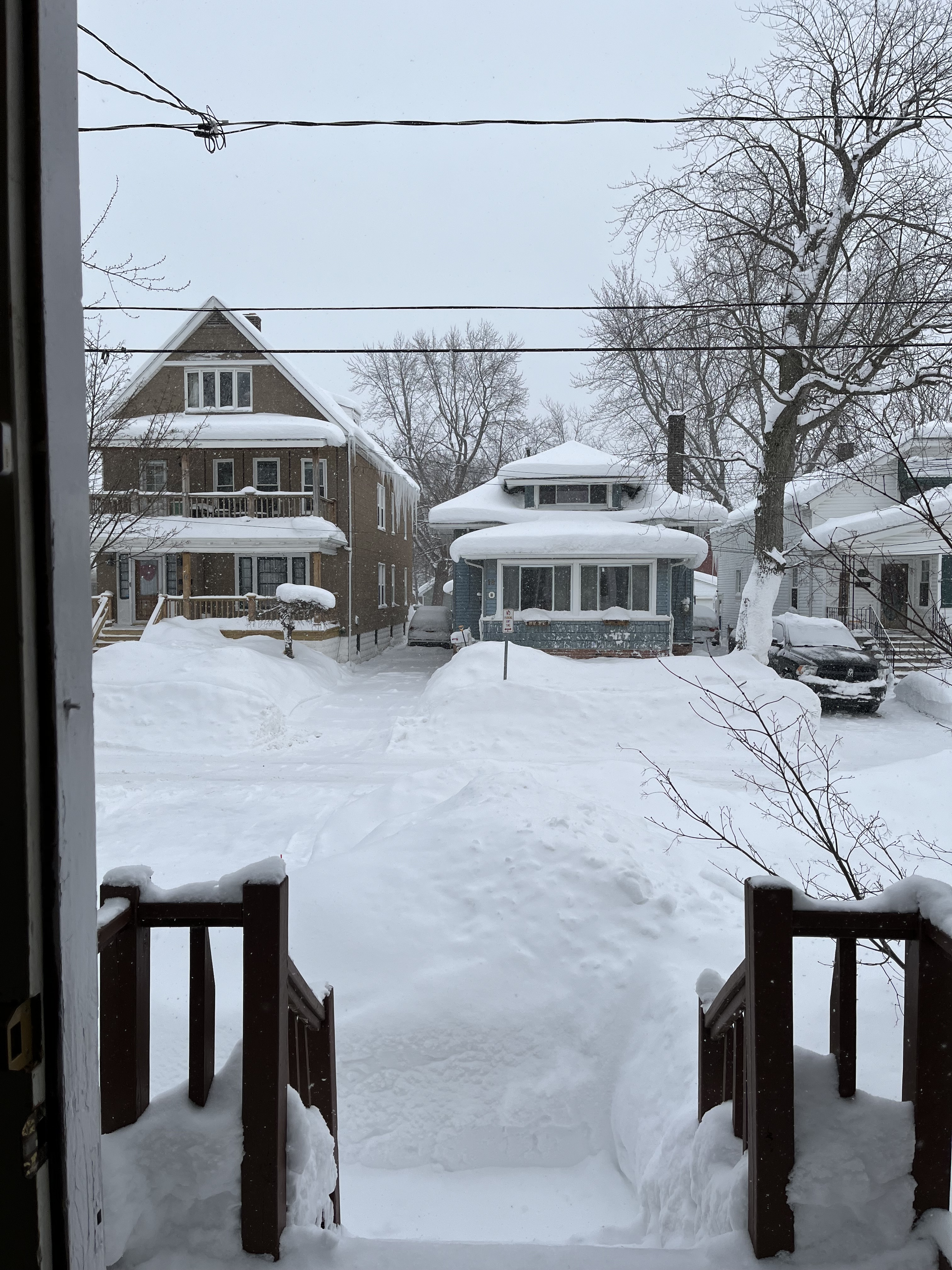 [View from my front porch door 01/19/2024.]
 [My back yard bird bath 01/15/2024.]
 [Feathered friends at my window feeder 01/16/24.]
Mountains of snow and buried cars were eventually removed from nearby streets by the end of the day Saturday, January 20. The next morning the wind chill was a bone-chilling one degree Fahrenheit when crawled out of bed at 8 AM. I impatiently waited a few hours and, seeing that it had warmed to 10 degrees and a “feels like” temperature of zero, I bundled up and headed out my door to walk five blocks to Cazenovia Park.
I wasn’t disappointed. The contrast between the stunning azure skies and the pure white fields and hills (with crisscrossing boot prints and signs of sled tracks), snow-covered picnic tables and bleachers, and suddenly iced-over Caz Creek, was a joy to see and experience after a week of shoveling and “cabin fever.”


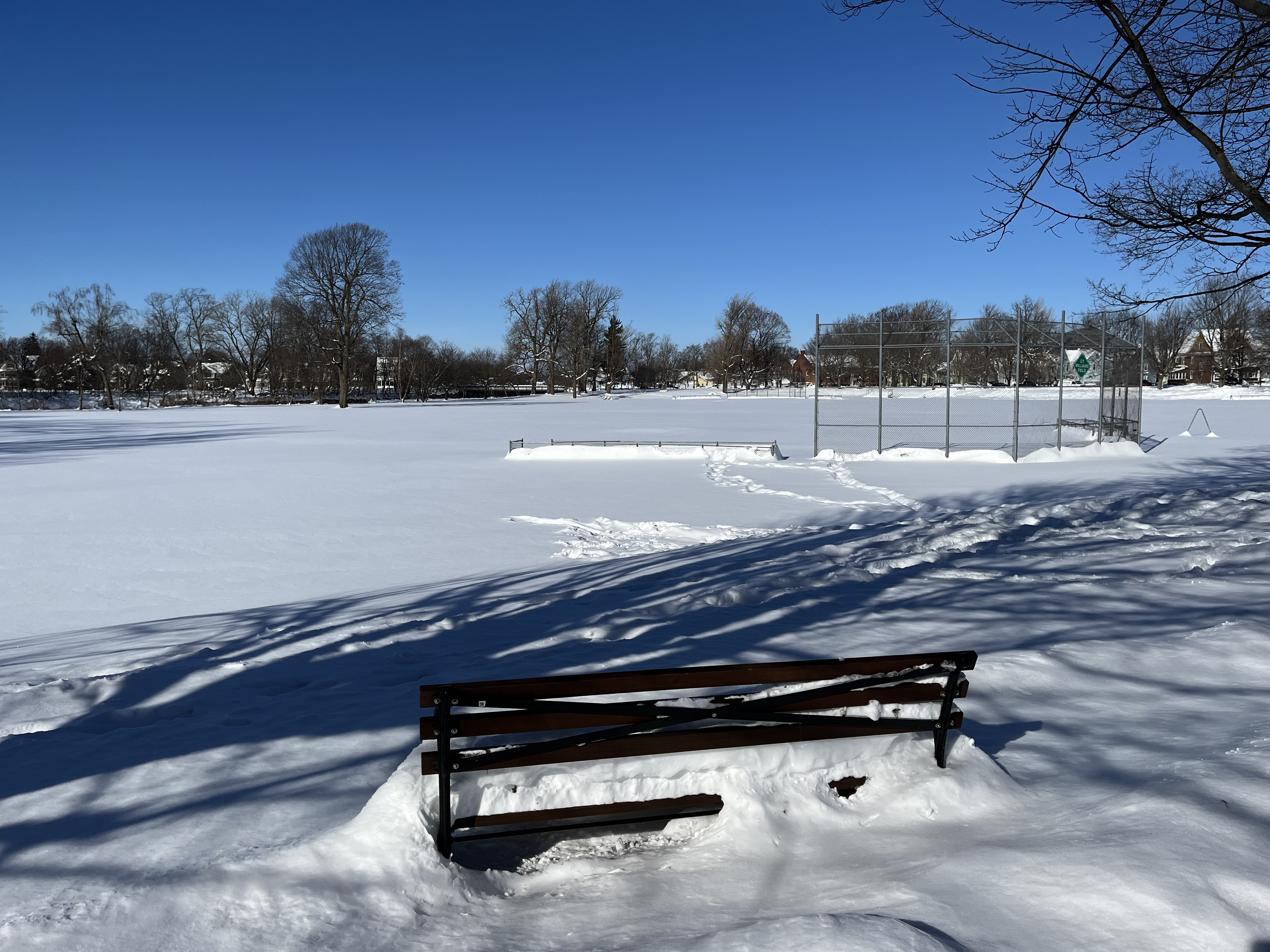


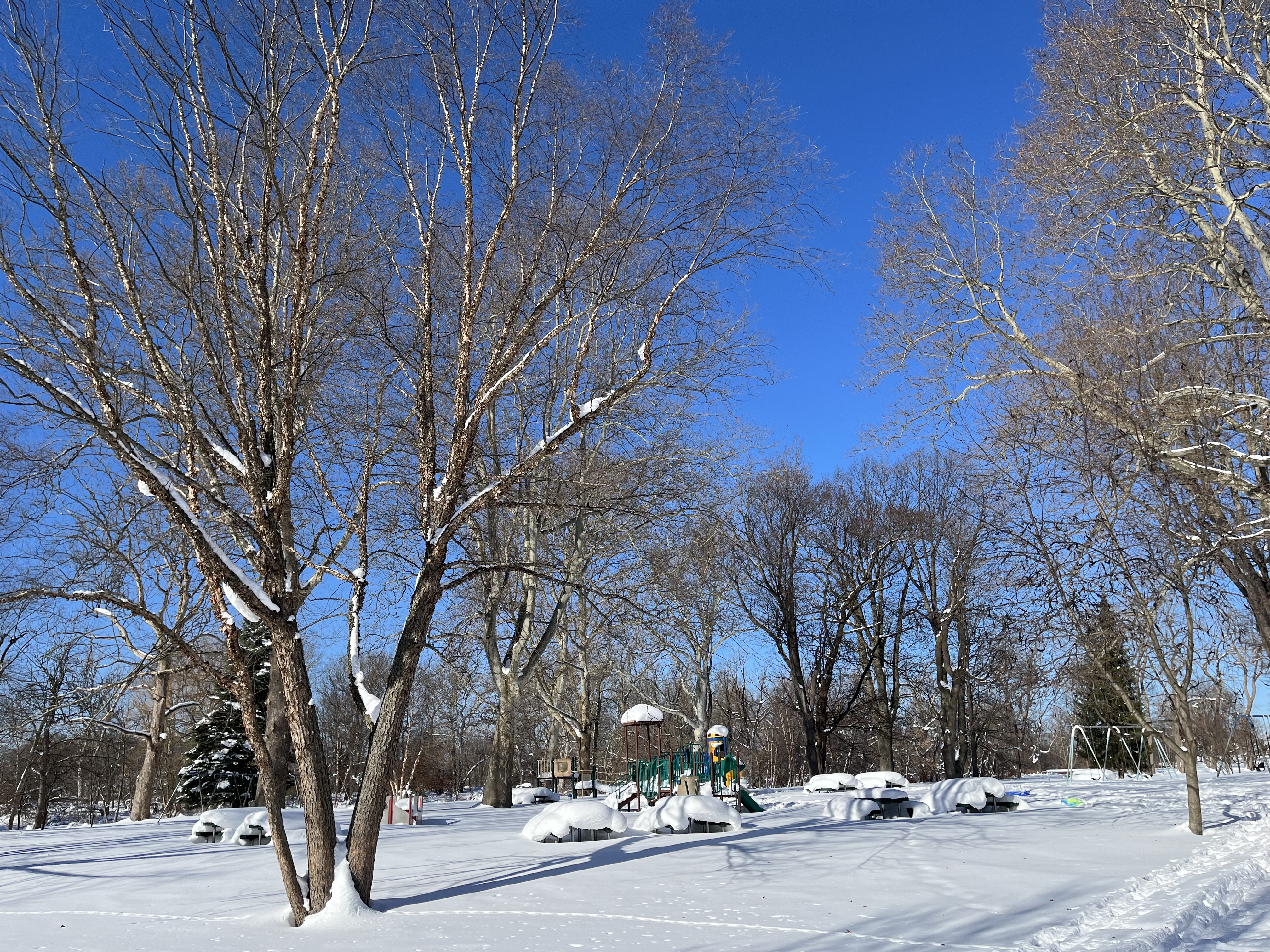
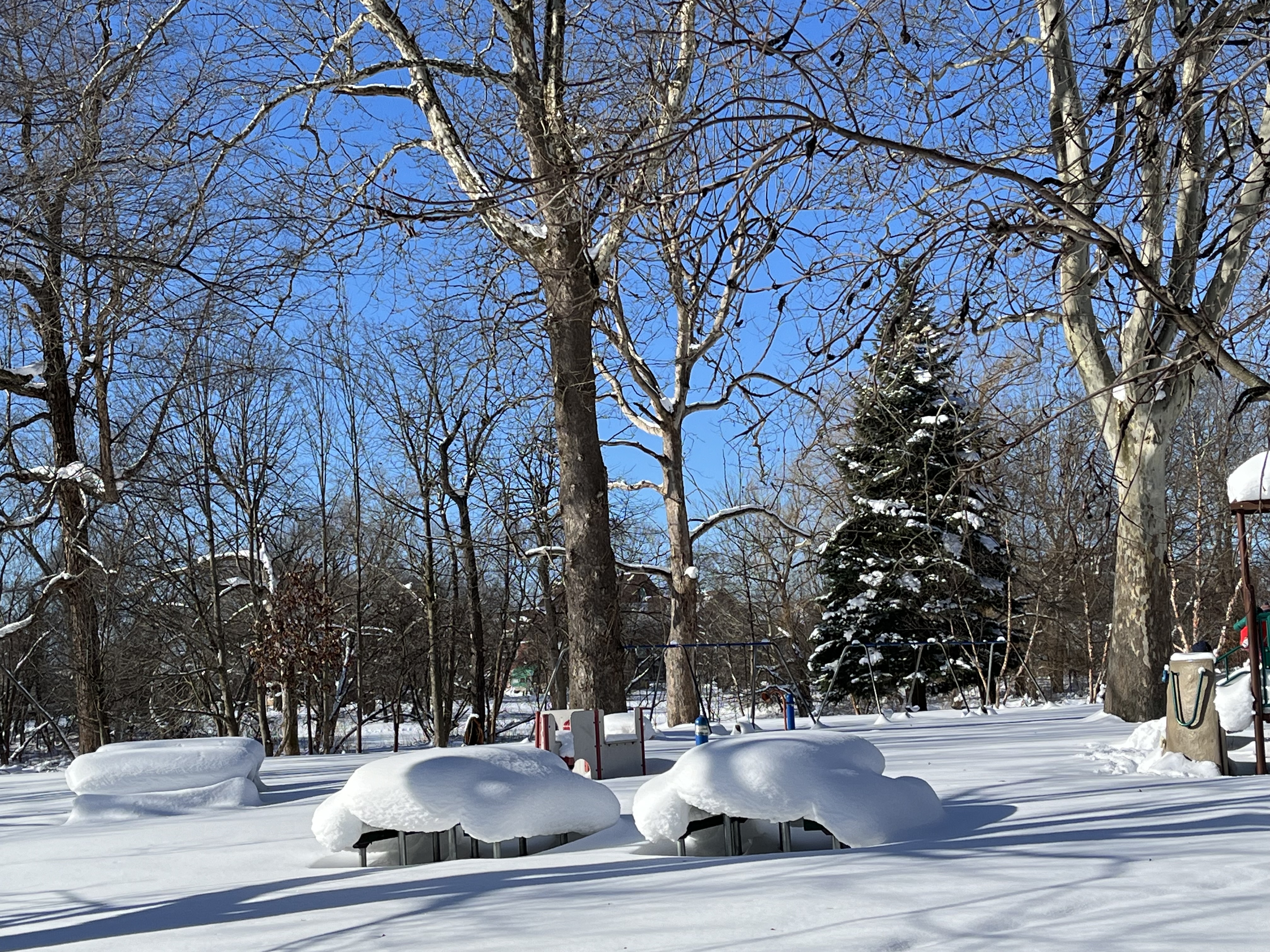


I’m not certain if the team of Olmsted landscape architects had South Buffalo winters in mind when they designed Cazenovia Park, but I’m pleased that this four-season gem adorns and defines my neighborhood.
With All Due Respect,
Art Giacalone
I have taken walks through South Buffalo’s Cazenovia Park virtually every day the past eight years. That welcomed ritual includes an admiring glance at Cazenovia Creek from the vehicular bridge on Warren Spahn Way. Not surprisingly (now that my eyes are wide open), the view changes dramatically depending upon the time of day, weather, presence of clouds, autumn hues, etc.
I’d like to share with you my favorite baker’s-dozen images from the past 80 days or so, working backwards from November 30.
[11/30/2023, 7:47 am]
[11/26/2023, 11:04 am]

[11/25/2023, 5:34 pm]

[10/24/2023, 8:35 am]

[10/22/2023, 5:03 pm]


[10/4/2023, 5:19 pm]
[9/11/2023, 7:47 am]
I hope you enjoyed the view from the Caz Park bridge.
With All Due Respect,
Art Giacalone
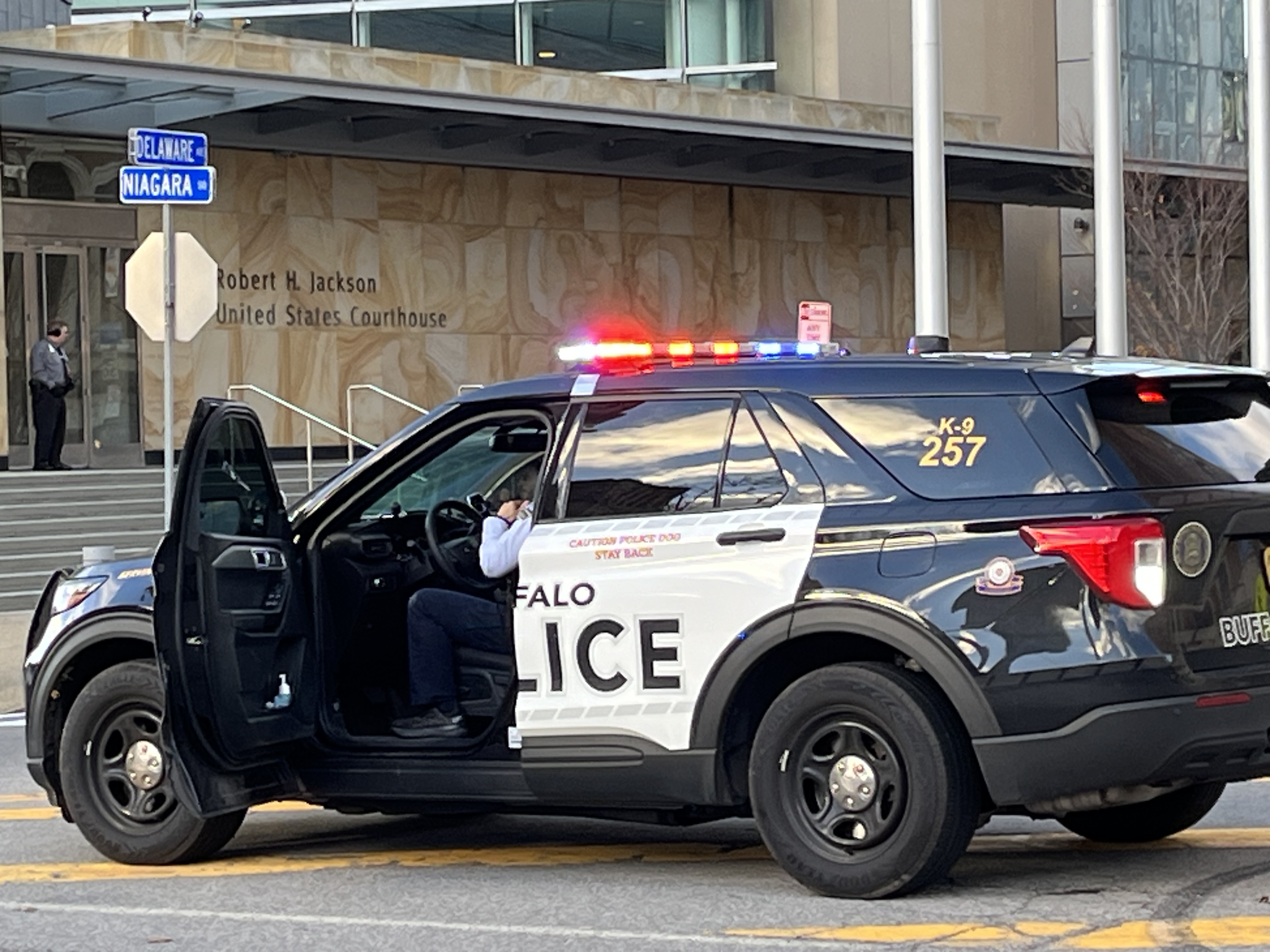
Emotions ranged from anger to sorrow to sympathy at the peaceful “Cease Fire Now” Rally at Buffalo’s Niagara Square on Saturday afternoon, November 18, 2023.
[See U.S. Joe Biden’s Washington Post Opinion 11-18-2023.]


With All Due Respect,
Art Giacalone
I’ve spent way too much time the past decade (or, two or three) lamenting the fact that I chose to become an attorney a half-century ago. The frustrations and disappointments associated with being a “public interest” lawyer – while offering me the “silver lining” of assisting and befriending many courageous and resilient clients – have weighed heavily on my once optimistic nature and view of the world. Nonetheless, I’m trying my best to look beyond such negative moments.
That being said, I decided yesterday – while exploring Buffalo’s Parkside neighbor on a perfect late-September day – that it must have been an incredible opportunity a century or so ago to labor as Darwin Martin’s head gardener. Imagine the sense of satisfaction and pride of being responsible for the development and maintenance of the remarkable grounds of Frank Lloyd Wright’s Prairie-style masterpiece at the corner of Jewett Parkway and Summit Avenue.
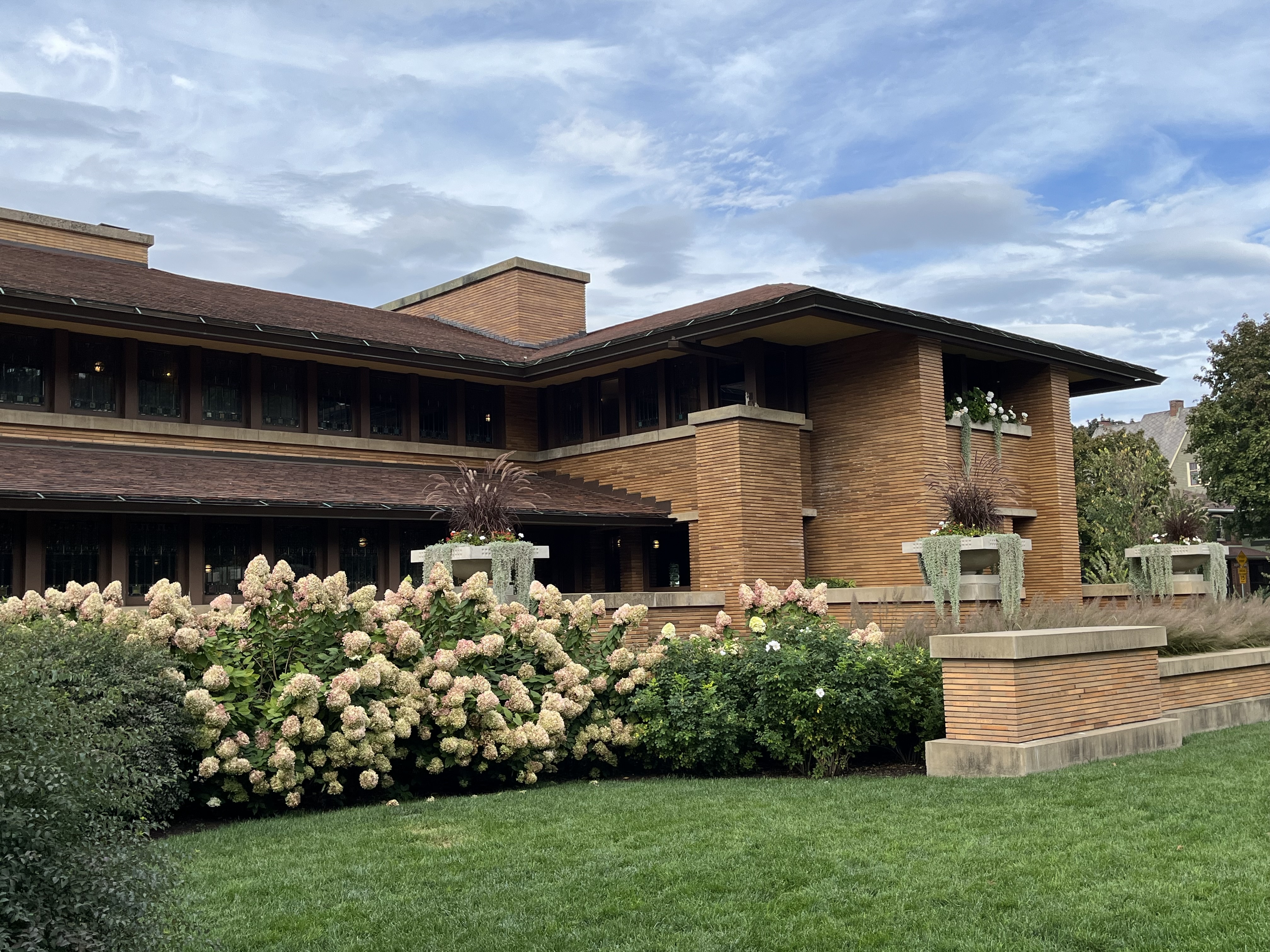

And then, after a hard day’s work, walking a few steps to your home, the Gardener’s Cottage (fronting on Woodward Avenue). Here’s a glimpse:

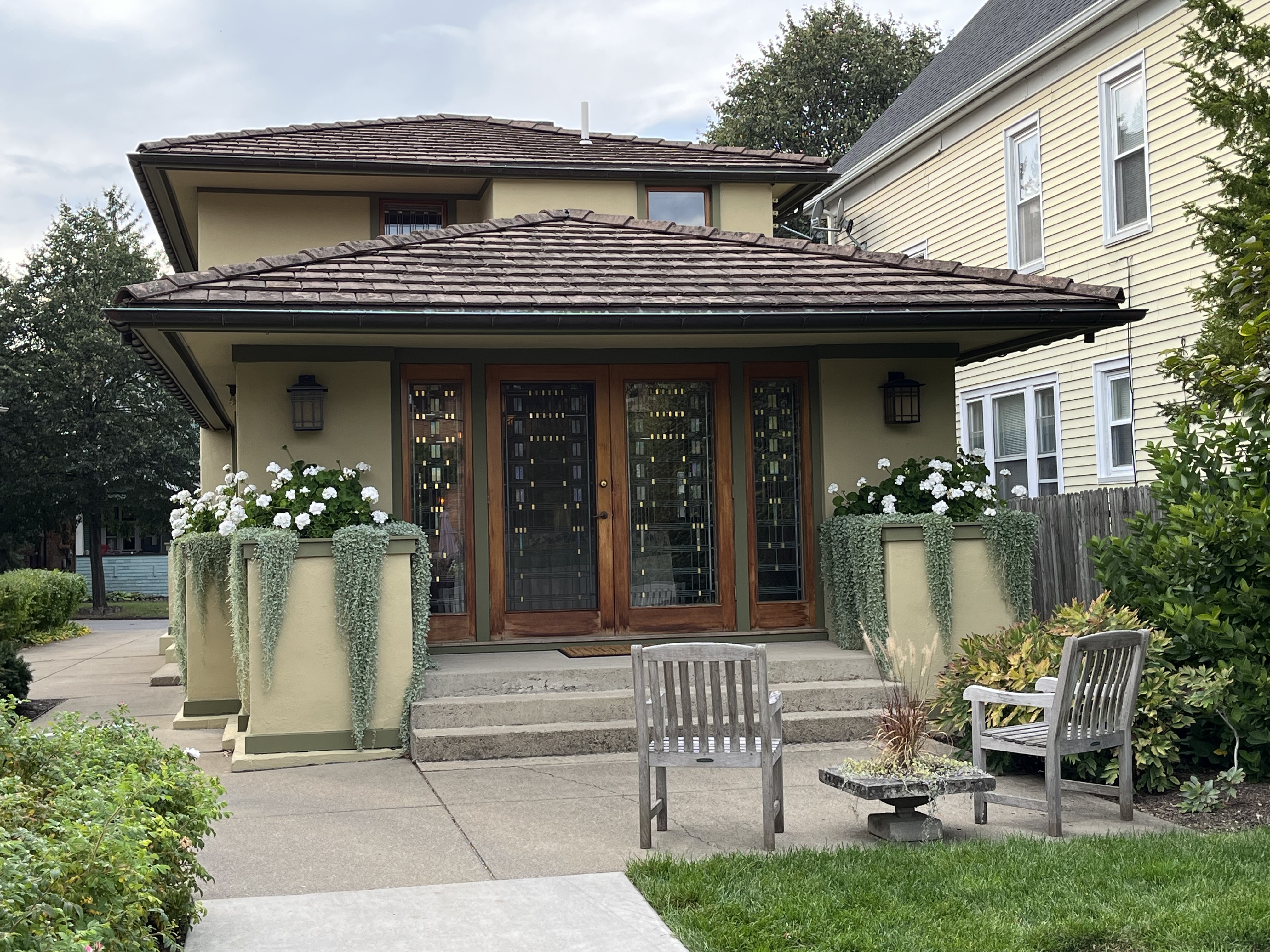







Being Darwin Martin’s head gardener – nice work if you can get it.
With All Due Respect,
Art Giacalone
P.S. This posting assumes – perhaps unrealistically – that Mr. & Mrs. Darwin Martin were pleasant and decent human beings and bosses (and, that Mr. Wright wasn’t overly oppressive in his oversight).
P.P.S. Now that I think about it, despite the challenges of my 47-year legal career, I have had the luxury of being my own boss for much of the past 34 years, choosing the issues to fight, and applying my own standard of ethics. Nice work if you can get it!
[A version of this post was published on-line January 5, 2023 by the Buffalo News under the headline “Bengals’ support for Hamlin shows idiocy of rivalry-hatred“.]
I cringe whenever I hear a sports talk show host or Bills’ fan say they hate an opposing team, its players, or its fans – whether the animosity is directed at the Patriots, the Dolphins, Tom Brady or any other formidable opponent. It is, after all, only a game.
We should be capable of zealously rooting for our team to win, while also acknowledging the talent, and recognizing the humanity, of our on-field adversaries.
The Cincinnati Bengals players, team, fans and organization showed us why hatred is not the appropriate sentiment. As soon as they realized the seriousness of the injury to Bills safety Damar Hamlin – and recognized the frailty of life, even for a young, world-class athlete – their only concern was for Hamlin’s health and well-being.
Let’s hope this tragic incident helps us all to remember the humanity of each and every human being, whether or not he or she is wearing the jersey of an opposing team.
With All Due Respect,
Art Giacalone

 With All Due Respect