New York State’s Department of Environmental Conservation (DEC) is jointly co-hosting a series of “environmental justice listening sessions” with the federal Environmental Protection Agency (EPA). The first session takes place on April 15 from 5 to 7:30 p.m. at the Niagara Arts and Cultural Center on Pine Avenue in Niagara Falls. Attendees will be invited to share their environmental concerns and priorities with agency officials to enable DEC to meet its purported goal of establishing stronger relationships with community leaders and people potentially affected by environmental pollution.
DEC defines “environmental justice” (“EJ”) in a 2003 policy statement, entitled CP-29 Environmental Justice and Permitting, as follows:
“Environmental justice means the fair treatment and meaningful involvement of all people regardless of race, color, or income with respect to the development, implementation, and enforcement of environmental laws, regulations, and policies. Fair treatment means that no group of people, including a racial, ethnic, or socioeconomic group, should bear a disproportionate share of the negative environmental consequences resulting from industrial, municipal, and commercial operations or the execution of federal, state, local, and tribal programs and policies.”
See CP-29 EJ directive (3/19/2003). As expressed in DEC’s EJ definition, “fair treatment” requires that no group of people bears “a disproportionate share of negative environmental consequences.”
DEC’s CP-29 recognizes that SEQRA – the State Environmental Quality Review Act – and, notably, the preparation of Environmental Impact Statements (“EIS”), play a critical role both in creating an “effective” environmental justice program, and in analyzing disproportionate adverse environmental impacts. Not only is adherence to the requirements of “SEQR” – the DEC regulations implementing SEQRA’s legislative mandates, found at 6 NYCRR Part 617 – “strongly encouraged”, the EJ policy directive calls for:
(1) adoption of regulations to establish additional criteria for determining significance pursuant to 6 NYCRR 617.7 (that is, determining whether a “Positive Declaration” must be issued and EIS prepared), and
(2) DEC’s review of the list of “Type 1 actions” at 6 NYCRR 617.4 – that is, proposed projects or policies that carry the presumption that it is likely to have a significant adverse impact on the environment and may require an EIS – to evaluate the need for amendments to include actions that may bear disproportionately on potential environmental justice areas, and to draft regulations based upon the evaluation.
Despite the passage of 21 years since the issuance of CP-29, DEC has neither added criteria for “determining significance” relating to environmental justice concerns, nor added to its list of “Type 1” actions projects or policies that may bear disproportionately on potential EJ areas. Equally disturbing, DEC has accompanied its failure to affirmatively act to strengthen SEQR’s role in creating an effective EJ program with the adoption of a new category of “Type 2” actions at 6 NYCRR 617.5 that may disproportionately burden environmental justice areas. A “Type 2” action is a class of proposed projects that the DEC determines will never have a significant impact on the environment and, as a result, requires no environmental review under SEQR. The problematic addition to the “Type 2” list is found at 6 NYCRR 617.5(c)(14), and excludes SEQR review for the “installation of solar energy arrays” of 25 acres or less at the site of closed landfills, brownfield sites that have received a Brownfield Cleanup Program certificate of completion (“COC”), inactive hazardous waste disposal sites that have received full liability release or a COC, and currently disturbed areas at public-owned wastewater treatment facilities.
Closed landfills, brownfield sites, inactive hazardous disposal sites, and existing public-owned wastewater treatment facilities are precisely the kinds of sites – in light of their historic uses – that require greater, not lesser, scrutiny as likely to place a disproportionate burden on potential environmental justice areas.
SEQRA – despite its many flaws – is the most effective tool available to the public and government decisionmakers to ensure informed assessment of a proposed project’s potential adverse environmental impacts and, as a result, informed and objective decision-making. SEQRA’s primary weapon – characterized by New York’s courts as “the heart of the SEQRA process” – is the environmental impact statement. Despite the critical role of the EIS, DEC has stood by for decades and done nothing to prevent the near extinction of the usage of environmental impact statements.
Consider the following facts. According to DEC’s own data, in 1989, 385 EIS’s were prepared statewide. By 1995, that number had fallen to 171. In 2023, the statewide figure was a dismal 41 EIS’s. To place that last number in context, in 2023, the various state and local agencies issued 948 Negative Declarations, determining that the proposed action was unlikely to have a significant adverse environmental impact. In other words, only 4.32% of the proposed projects and policies under review resulted in preparation of an EIS despite the fact that there is a relatively low threshold for requiring an EIS: an EIS must be prepared if a proposed action MAY have a significant effect on any one aspect of the environment.
[Note: SEQRA defines “environment” broadly to not only include physical conditions such as land, air, water, minerals, flora, fauna, noise and agricultural resources, it also includes socio-economic factors such as resources of archeological, historic or aesthetic significance, existing patterns of population concentration, distribution or growth, existing community or neighborhood character, and human health. See 6 NYCRR 617.2(l).]
Western New York’s compliance with SEQRA is worse than the statewide record. In DEC’s Region 9 – consisting of Niagara, Erie, Wyoming, Chautauqua, Cattaraugus and Allegany counties – only two Positive Declarations requiring preparation of an EIS were issued in 2016, one in Niagara County (by the Town of Lockport IDA) and one in Erie County (by the City of Buffalo Planning Board). Similarly, while 66 Negative Declarations were issued during 2023 by Region 9 lead agencies, only two Positive Declarations – 3.03% of the proposed actions under review – were issued, both in Cattaraugus County by the Town of Persia, and both (coincidentally) regarding proposed solar farms.
Until the DEC and state and local agencies – including the City of Niagara Falls – take their responsibility to fully comply with the letter and spirit of SEQRA seriously, there will be no such thing as an “effective” environmental justice program and no ability to adequately assess and compare a proposed project’s disproportionate adverse environmental impacts.
The U.S. Supreme Court recently issued two decisions within a seven-day period implicating the rights of Indigenous people. The first was Haaland v. Brackeen, on June 15, 2023, regarding the Indian Children Welfare Act. The second was Arizona v. Navajo Nation, on June 22, 2023, concerning water rights.
It is not my intention to analyze these cases in any detail (although I may eventually get around to doing so). My goal here is modest. I’d like to draw attention to the way the court’s opinions – separated by a mere week – disparately characterize the trust relationship between the federal government and (in the words of the U.S.A.’s highest court) “Indian tribes.”
Here’s what Justice Amy Coney Barrett wrote for the majority in Haaland:
[T]he “trust relationship between the United States and the Indian people” informs the exercise of legislative power. United States v. Mitchell, 463 U. S. 206, 225–226 (1983). As we have explained, the Federal Government has “charged itself with moral obligations of the highest responsibility and trust” toward Indian tribes. United States v. Jicarilla Apache Nation, 564 U. S. 162, 176 (2011); Seminole Nation v. United States, 316 U. S. 286, 296 (1942) (‘[T]his Court has recognized the distinctive obligation of trust incumbent upon the Government in its dealings with these dependent and sometimes exploited people’).
And these are the words of Justice Brett M. Kavanaugh’s opinion of the court in Navajo Nation:
To be sure, this Court’s precedents have stated that the United States maintains a general trust relationship with Indian tribes, including the Navajos. Jicarilla, 564 U. S., at 176. But as the Solicitor General explains, the United States is a sovereign, not a private trustee, meaning that
“Congress may style its relations with the Indians a trust without assuming all the fiduciary duties of a private trustee, creating a trust relationship that is limited or bare compared to a trust relationship between private parties at common law.” Id., at 174…
So, while on June 15, 2023 the Supreme Court proclaims that the U.S.A. has “charged itself with moral obligations of the highest responsibility and trust toward Indian tribes,” on June 22, 2023, we are told that the U.S., as a sovereign – rather than a private trustee – can ignore all the fiduciary duties of a private trustee and create “a trust relationship that is limited or bare.”
I find it impossible not to think of the traditional saying long-embraced by various Native American tribes that, “the white man speaks with a forked tongue.” The idiom refers to someone who is lying or hypocritical and, therefore, no longer worthy of trust (much less a trust relationship).
Ironically, both Haaland and Navajo Nation cite to the same 2011 opinion to support their assertions, United States v. Jicarilla Apache Nation. That decision acknowledges two ugly realities facing our nation’s Indigenous peoples: that “the United States retains plenary (that is, absolute) authority to divest the tribes of any attributes of sovereignty,” and, that “the Government has often structured the trust relationship to pursue its own policy goals,” not the best interests of Native Americans.
It’s almost refreshing to hear the U.S. Supreme Court speak the truth. But, for the sake of equity and fairness, we need to devise a strategy to drastically alter this perspective.
[Revisiting my September 5, 2022 post and The Red Dress Exhibit: For three days, ending September 11, the FirstOntario Performing Arts Center in St. Catherines, Ontario, Canada, was home to Celebration of Nations 2022, an annual festival honoring “the heritage, culture and achievements of First Nations, Inuit and Metis peoples of Turtle Island and beyond.” This year’s theme, “Honouring Our Matriarchs: Restoring The Balance,” was chosen as a reminder of the essential role women have played – and continue to play – in the survival and nurturing of Indigenous culture and traditions.
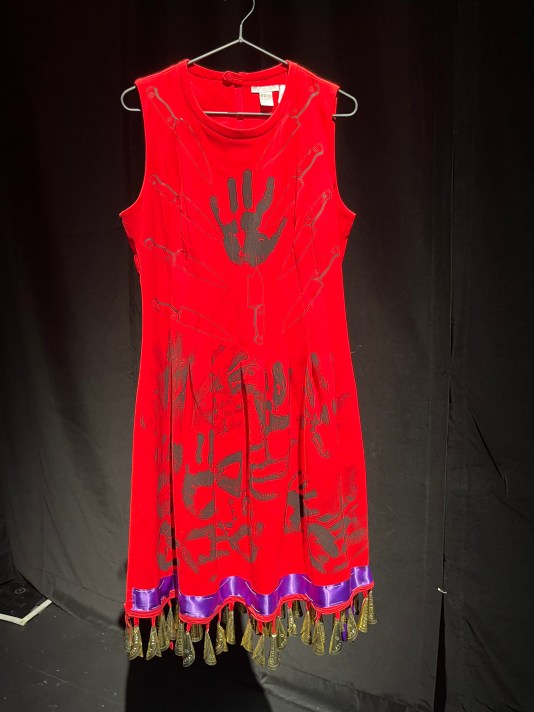
Under the leadership and inspiration of its Artistic Director, Michele-Elise Burnett, this multi-faceted program included a re-imagined presentation of The Red Dress Exhibit that I had visited just a week earlier under blue skies and amidst the trees and greenspace of ArtPark in Lewiston, NY. The Celebration of Nations’ presentation of the exhibit could hardly have been more dissimilar – indoors, encased within a dimly-lit second-floor theater, intentionally confined by black walls and drapes, and punctuated by solitary red dresses suspended from hangers and artificially illuminated from above.
“If Only These Dresses Could Tell Their Story” is the subtitle of both Red Dress exhibits. Aided by detailed narratives of the murdered and missing indigenous women, girls and two-spirit individuals, and enhanced by interpretative material, the thirteen empty dresses do, in fact, communicate profound and heartbreaking messages. While I found the outdoor setting – with living trees, verdant landscape, and flowing river – more conducive to a hopeful, forward-looking, and inspiring message, they both are intensely moving and evocative.
My original posting – displaying the dresses suspended from trees on a sun-drenched day at Lewiston’s ArtPark – will be supplemented below with the stark but poignantly beautiful images of the Red Dresses as viewed in the darkened and shadowy confines of FirstOntario PAC. Please feel free to comment on whether the two distinct settings speak to you in different ways, or, perhaps, if the silence of the Red Dresses overwhelms the “white noise” of their surroundings.]
On September 2, I visited ArtPark, in Lewiston, New York, to experience the first of a three-day program entitled “The Red Dress Exhibit.” The exhibit featured thirteen empty Red Dresses – each unique and stunning – created by 13 Indigenous Peoples from the Western New York and Niagara regions.
As explained by the exhibit’s producer, Michelle-Elise Burnett: “The exhibit is intended to increase awareness for the epidemic of the ongoing horrific systemic racial crimes targeting Indigenous women and girls; to remember the lost lives of the victims; to teach; to give Indigenous women a voice; to inspire a new cross-cultural generation based on inclusivity, compassion, love; and, to collectively offer the MMIWG our love, gratitude create a safe, nurturing and welcoming environment for Indigenous Peoples.”
To help place the horrors of this bi-national scandal into perspective, consider the following statistics compiled by Kenny Lee Lewis (a member of the Steve Miller Band for over 40 years), one of the musicians who performed on September 2:
A preliminary study by Canadian police found that indigenous women — 4 percent of Canada’s female population — made up nearly 25 percent of its female homicide victims in 2012. A 2016 study by the National Institute of Justice (NIJ) found that more than four in five American Indian and Alaska Native women (84.3 percent) have experienced violence in their lifetime, including 56.1 percent who have experienced sexual violence. In the year leading up to the study, 39.8 percent of American Indian and Alaska Native women had experienced violence, including 14.4 percent who had experienced sexual violence. Overall, more than 1.5 million American Indian and Alaska Native women have experienced violence in their lifetime.
I fear that any attempt by me to provide a narrative regarding the 13 Red dresses will do a disservice to the individual MMIWG, their families, and their communities. So – with minimal descriptions – I will let the images speak for themselves (and apologize for not having pictures of each of the beautiful and provocative dresses).
The past few days have been noteworthy (in my mind, at least) for the recognition being shown to the culture and history of Western New York’s first inhabitants, the members of the Haudenosaunee Confederacy – the nations of the Seneca, Cayuga, Onondaga, Oneida, Mohawk, and Tuscarora – and their ancestors. [I admit my cultural ignorance, and offer this link as a useful primer reprinted at the website of the Syracuse Peace Council, “Understanding Haudenosaunee Culture.”]
Three days earlier, July 15, I witnessed something gratifying on a pleasant summer evening in South Buffalo’s Cazenovia Park. As the Buffalo Philharmonic Orchestra’s “Olmsted 200 Celebration” concert was about to begin, Stephanie Crockatt, executive director of the Buffalo Olmsted Park Conservancy, did something that had not previously been done at a BPO concert or BOPC event. She read the following statement to the assembled crowd:
Land Acknowledgement for BPO Concert at Cazenovia Park | July 15, 2022
Before we begin this concert,wewould like to respectfully acknowledge that the land on which we gather is part of the aboriginal territory of the Seneca Nationand the Tonawanda Seneca Peoples.Their continued presence on this landscape is affirmed by The Dish with One Spoon Treaty of Peace and Friendship, and the 1794 Treaty of Canandaigua, between the United States Government and the Six Nations Confederacy. This region is both the traditional and the current home ofthe Seneca, Haudenosaunee, Erie, Wenro,and a host of countless communities over time.
This very site where we listen tothe Buffalo PhilharmonicOrchestra, Cazenovia Park, once held the Seneca Town of Buffalo Creek.A few blocks away from Cazenovia Park at Buffum Street, is Seneca IndianPark, originally the Seneca Indian Cemetery.The Buffalo Creek Treaty of 1842 eliminated the Buffalo Creek Reservation.Wesincerely hope that by recognizing the historical wrongs that have taken place here and far, we will begin to try understanding and healing the traumas that have been inflicted on the Indigenous community, and to celebrate their rich culture and time on Turtle Island. Please join us in showing gratitude for this opportunity to share music and the natural environment of this beautiful land today.
These words of acknowledgement and respect were most fitting given both the location of the concert – the heart of the Buffalo Creek Reservation – and the BOPC/BPO’s stated desire to present “music inspired by nature and nods to the rich tapestry of cultures that make up the Buffalo community.”
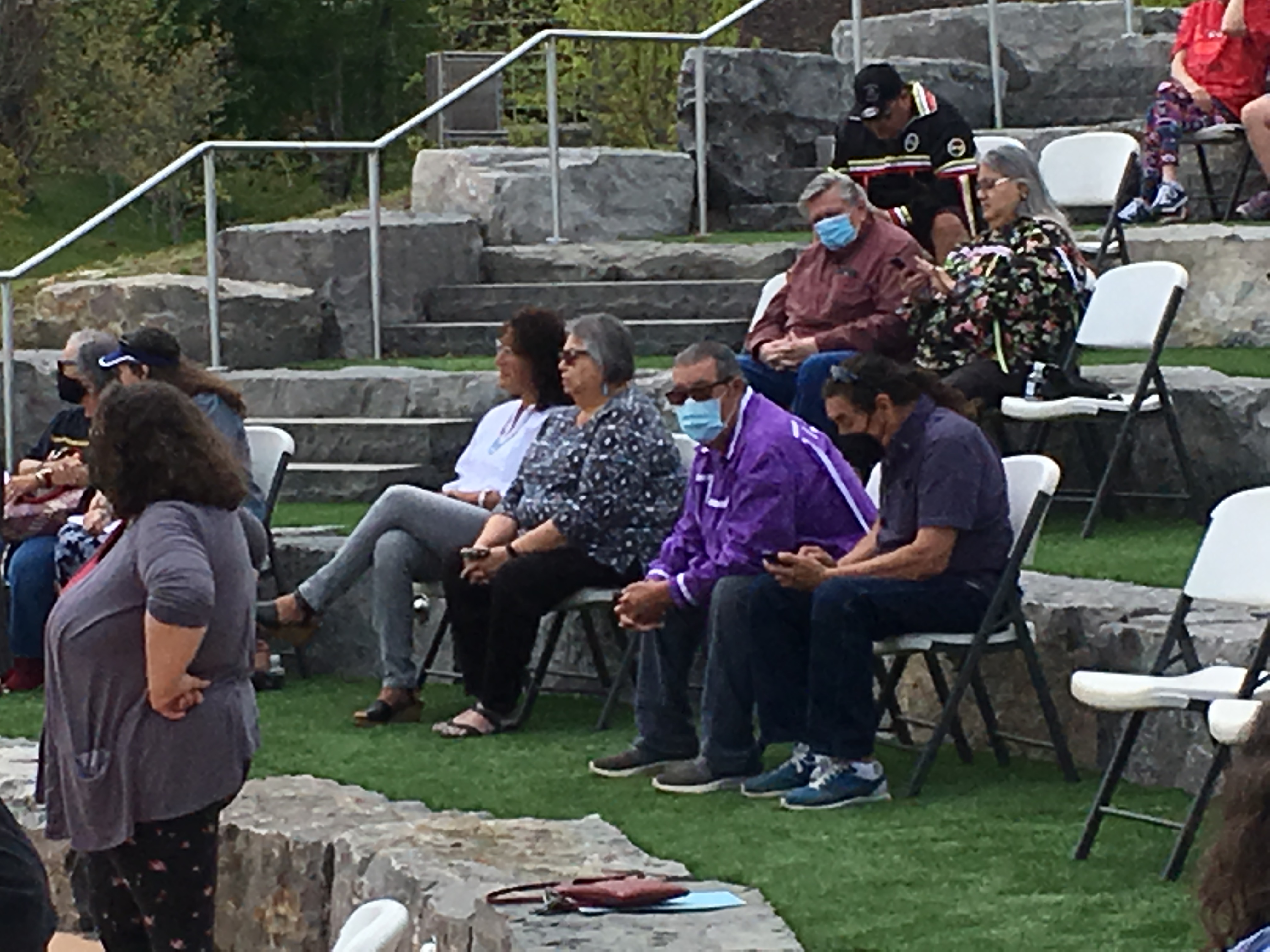
A sliver of the crowd at the BPO’s Olmsted 200 Celebration, Cazenovia Park, 07/15/2022.
“Seneca Indian Park” on Buffum Street, site of an ancient Indigenous burial grounds.
The introductory statement – if my understanding is correct – came to timely fruition thanks to the receptiveness of the BOPC’s executive director, Ms. Crockatt, the focused efforts of BOPC’s marketing communications specialist, Zhi Ting Phua, and the guidance from Joe Stahlman, director of the Haudenosaunee cultural center in Salamanca, NY (known officially as the Seneca-Iroquois Museum).
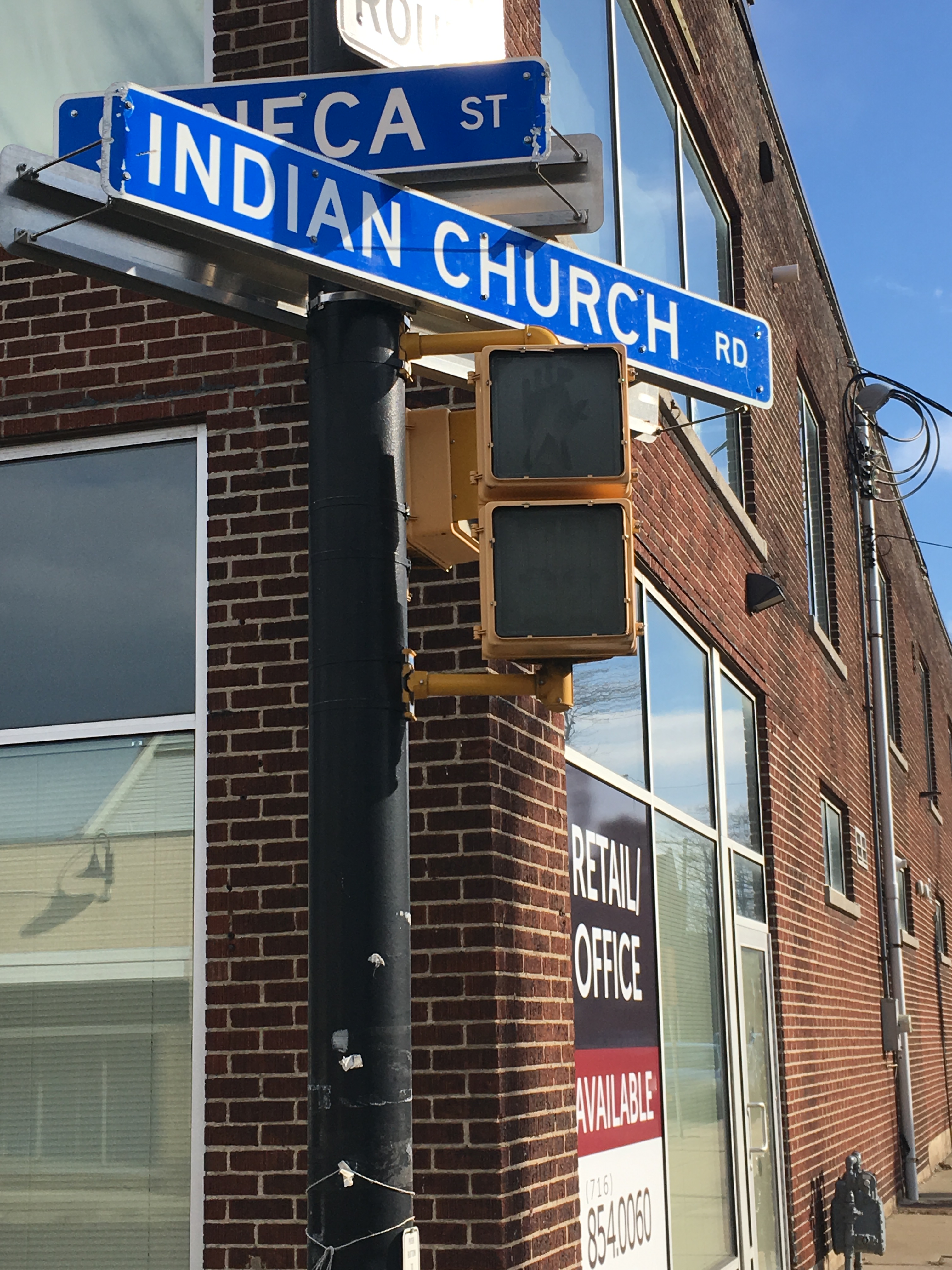
March 2022 is about to step aside to make room for April. In my South Buffalo neighborhood – that is, the stretch of Seneca Street and Indian Church Road graced by its proximity to Cazenovia Park – St. Patrick’s Day is finally far enough in the rear view mirror to be a mere glimmer in my neighbors’ twinkling blue eyes.
From my perspective, it’s time for local officials, businesses and property owners to set aside the “happy talk” about community pride. It is time to actually demonstrate self-esteem and affection for the neighborhood and its residents by addressing the sights and defects that adversely impact its aesthetics and safety.
Here are several suggestions – each found within two blocks of the Seneca Street/Indian Church Road intersection – for immediate spring cleaning, maintenance or repair. [Unless otherwise noted, the accompanying photos were taken by me on March 31 during my morning walk.]
No. 1. Fix the broken pedestrian signal at Seneca and Indian Church Road. For at least a year now, anyone wishing to cross Seneca St. from Indian Church Road (or vice versa) has been forced to navigate this busy, tricky corner without the assistance of the walk/don’t walk signal. The push button on the west side of Seneca Street dangles uselessly from the pole, and the electronic signal is blank.
No. 2. Repair or replace the decorative trash bin next to Shea’s Seneca. The motto is excellent – “Whatever is begun in anger ends in shame.” [Will Smith’s behavior at this past weekend’s Oscars ceremony is a perfect example] But its decrepit appearance inspires one to look the other way rather than give these thought-provoking words consideration.
No. 3. Attractively address the broken storefront window and facade at Seneca and Cazenovia Streets. For well over a year now, pedestrians, cars and buses passing by, and nearby residents (including those at the upscale apartments directly across the street), have been forced to look at a markedly haphazard and unprofessional effort to enclose a vandalized storefront window. The City of Buffalo’s Online Assessment Roll System (OARS) lists the owner of this property as Hook & Ladder Development LLC at 2111 Seneca St., Buffalo, NY 14210.
No. 4. Find a way to restore the vandalized, weathered wooden sculpture of Red Jacket at Cazenovia and Seneca Streets. The following photos were taken last year and shared with various public officials in hopes of inspiring an effort to show due respect for the Seneca statesman Red Jacket. The condition of the statue has continued to deteriorate.
A brief diversion. My morning observations included more than eyesores. While walking through Cazenovia Park, I did take the time to admire this naked and gnarly masterpiece:
No. 5. Remove or tastefully beautify the rusting, peeling retractable “shield” at 2348 Seneca Street. If you are unfortunate enough to depart Cazenovia Park at its Seneca Street exit, wait for or disembark an NFTA No. 15 bus, or drive down Seneca Street just blocks from the West Seneca/Buffalo border during or before the morning rush hour, you are assaulted by the image of a rusting, peeling sight. It has been in this condition for years. The City of Buffalo’s Online Assessment Roll System (OARS) lists the owner of this property as Donald P. King, 2348 Seneca St. Buffalo, NY 14210.
I am hoping that the individuals, officials, and businesses in the position to ameliorate the conditions noted above will promptly and thoughtfully take action. If you agree, reaching out to the following officials may help:
City of Buffalo Council Member Christopher P. Scanlon, 65 Niagara Square, Room 1401, Buffalo, NY 14202; (716) 851-5169; cscanlon@city-buffalo.com.
City of Buffalo Streets Commissioner Michael J. Finn, 65 Niagara Square, Room 502, Buffalo, NY 14202; (716) 851-5636; mfinn@city-buffalo.com.
State Assemblyman Pat Burke, 1074 Union Road, West Seneca, NY 14224; (716) 608-6099; burkep@nyassembly.gov.
State Senator Tim Kennedy, 37 Franklin St., Suite 550, Buffalo, NY 14202; (716) 826-2683; kennedy@nysenate.gov.
September 30, 2021 was “National Day for Truth and Reconciliation” in Canada. The day has been observed for several years by our northern neighbor’s Indigenous peoples. This year, however, marked the first “official” recognition of the day by the Canadian government, a collective response to the shocking news earlier in 2021 that thousands of children forcibly removed from their families died at “residential schools” and were buried in unmarked graves.
The disgraceful practice of removing Native American children from their families and homes and compelling them to attend boarding schools – in order to strip them of their language, culture, and sense of pride – began, not in Canada, but in the United States, and is part of the colonial legacy in both Canada and the USA. This inhumane treatment of Indigenous children (and, thus, their families, clans, and nations) has resulted in intergenerational trauma, as explained by Paul Smith, a freelance writer and citizen of the Métis Nation, in an op-ed piece recently published in the Guelph Mercury Tribune:
Poverty, disproportionate child welfare apprehensions, over-incarceration, low graduation rates, high suicide rates, poor health status are all a legacy of residential schools and ongoing colonial policies. Current treatment of children in all these institutions is a focus for many of the Calls to Action of the Truth and Reconciliation Commission and the Calls for Justice of the National Inquiry into Missing and Murdered Women and Girls.
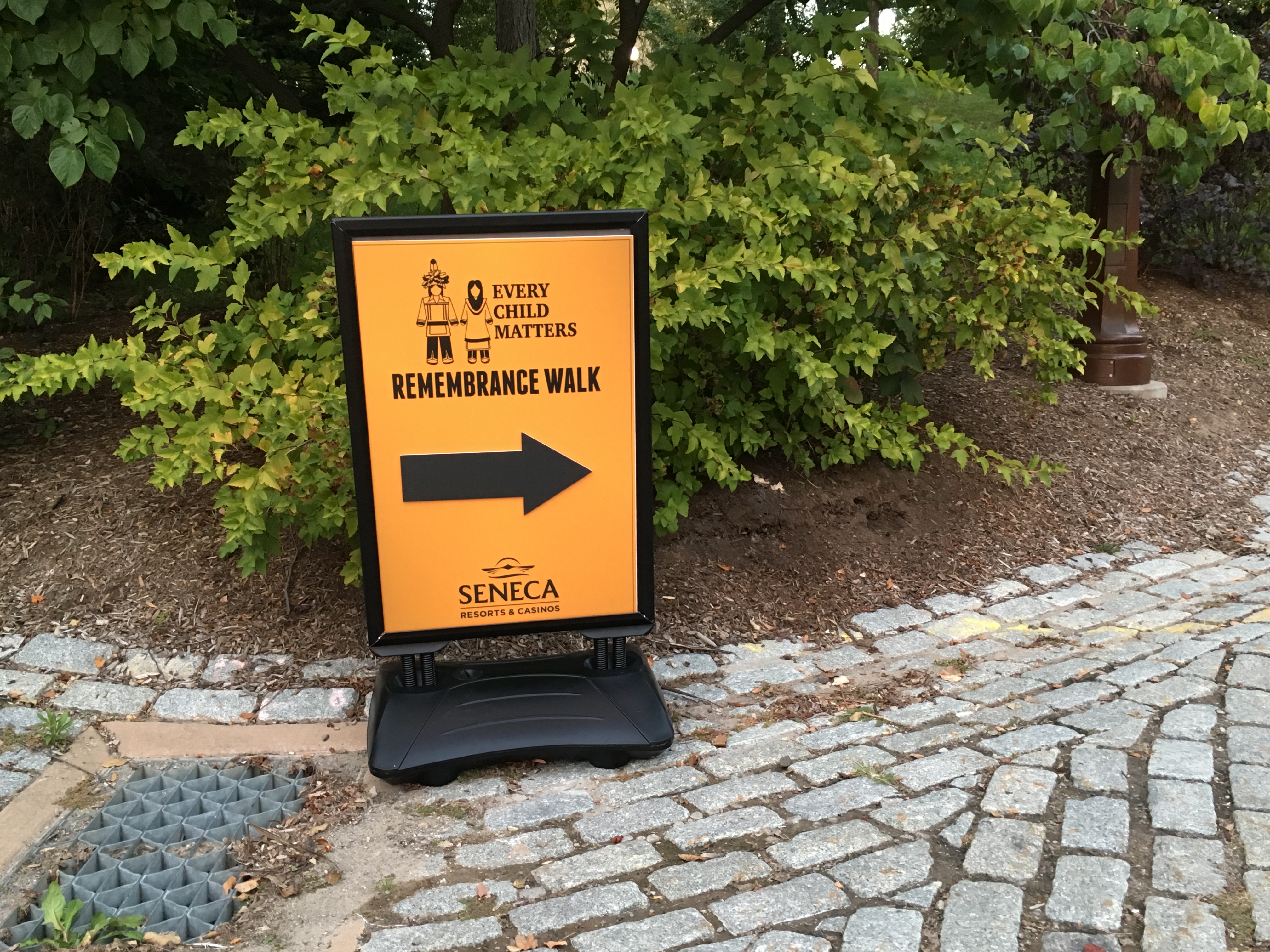
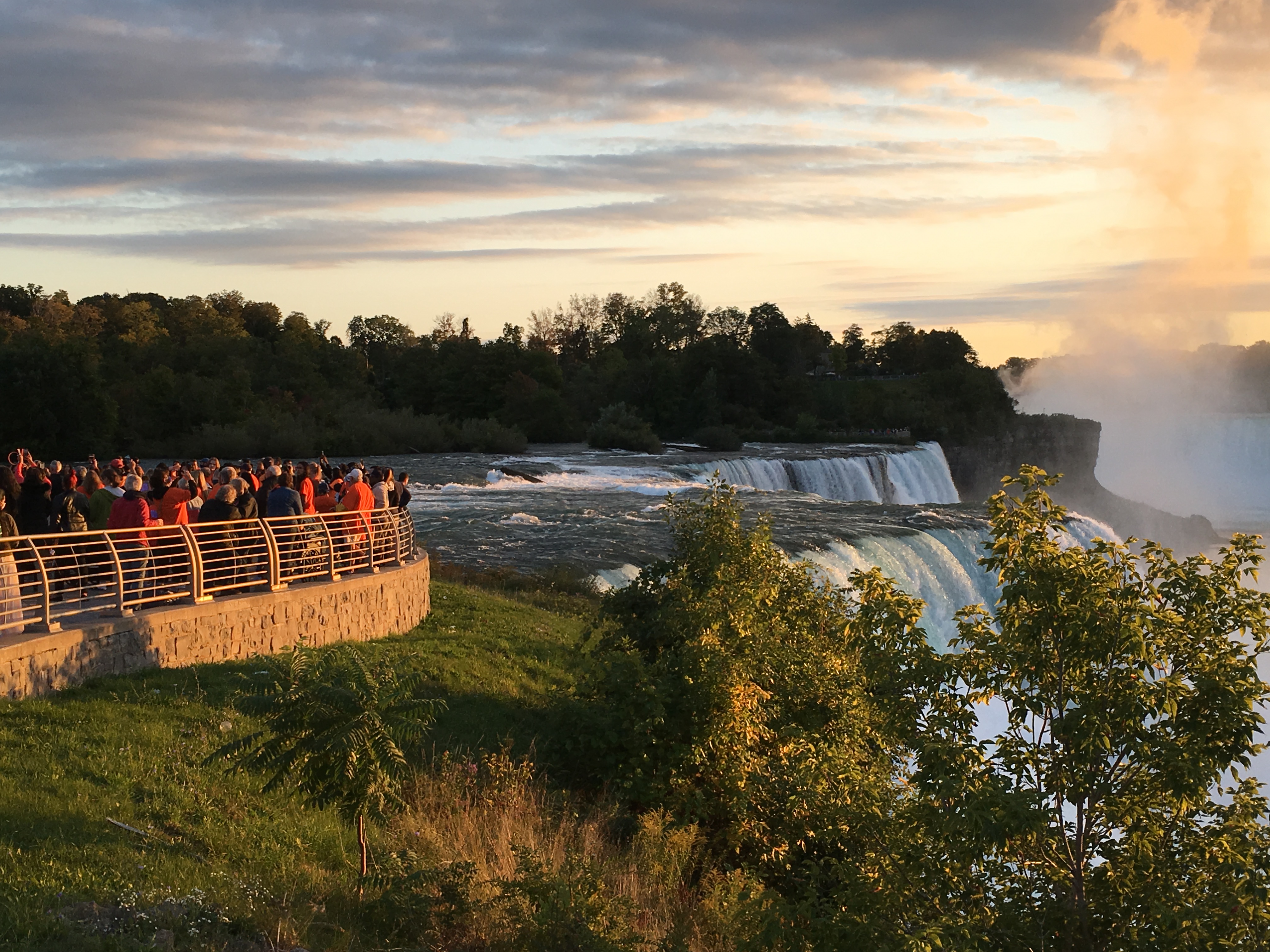
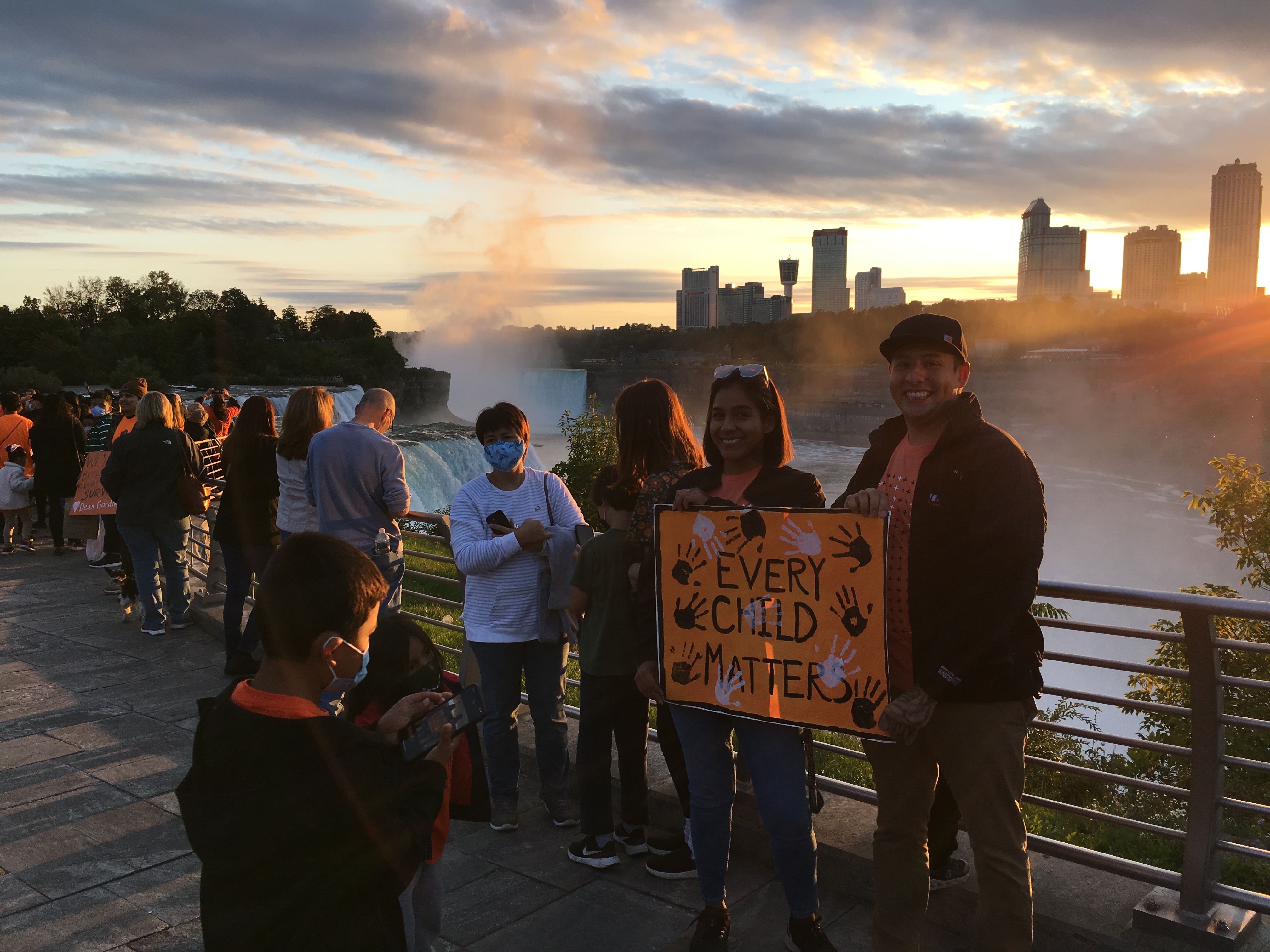
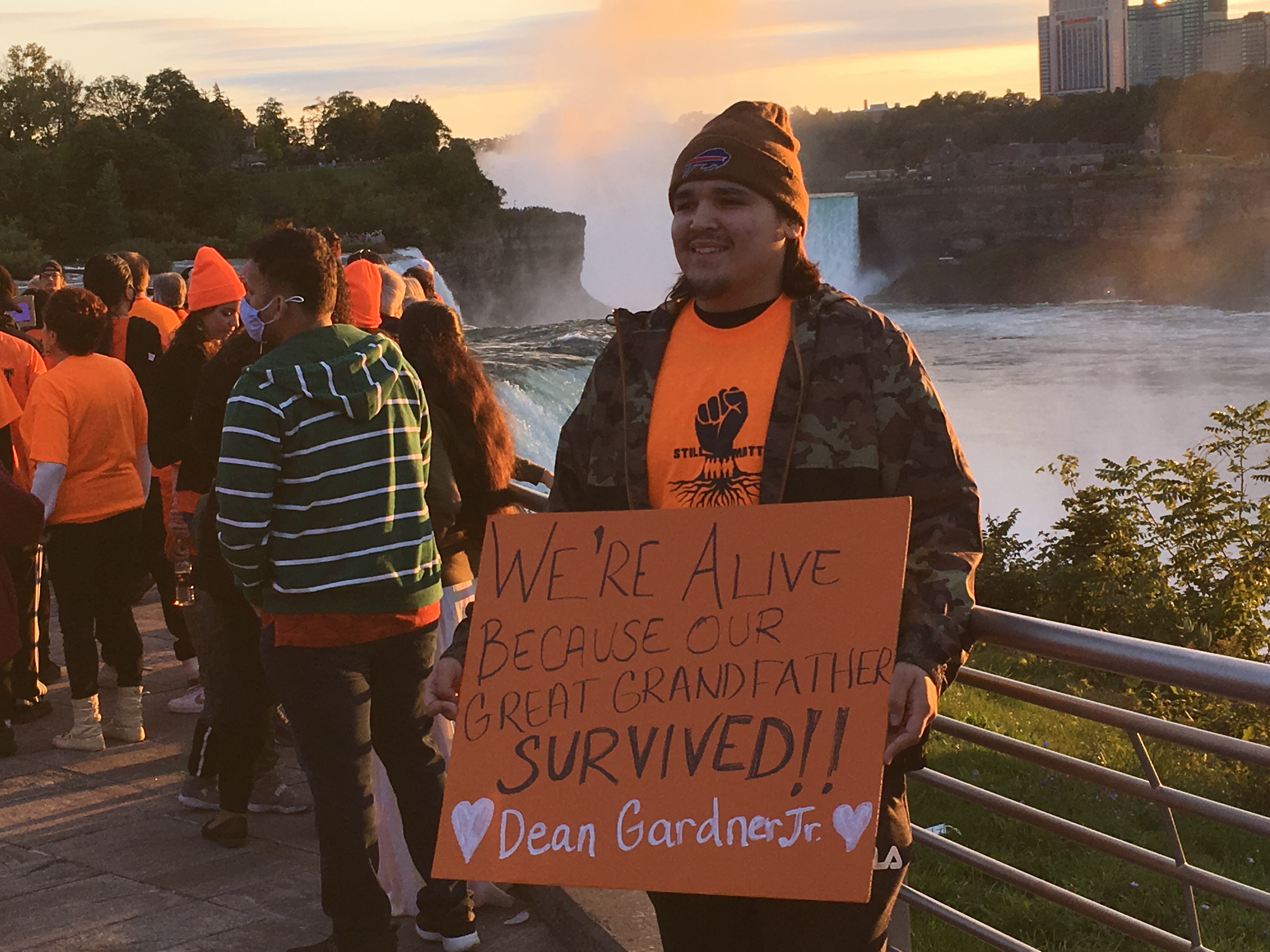
A powerful and irrefutable slogan – Every Child Matters – has become a tangible and accessible symbol of hope and solidarity within the truth and reconciliation movement. A Remembrance Walk – sponsored by the Seneca Gaming Corporation – took place in Niagara Falls, USA yesterday evening in honor of residential school survivors and in memory of those who did not survive. Several thousand walkers participated in the event, many of whom wore orange shirts proclaiming “Every Child Matters.” [Today’s Buffalo News includes an article that explains the symbolism of the orange shirt under the headline, “Students honor Indigenous children victimized in schools.“]
I was among the walkers. And, I was embarrassed by the fact that I had forgotten to wear an orange top until a youthful grandmother, proudly carrying her beautiful, four-month-old grandson so that he also could see the sea of people, assured me that the important thing was that I was there to remember.
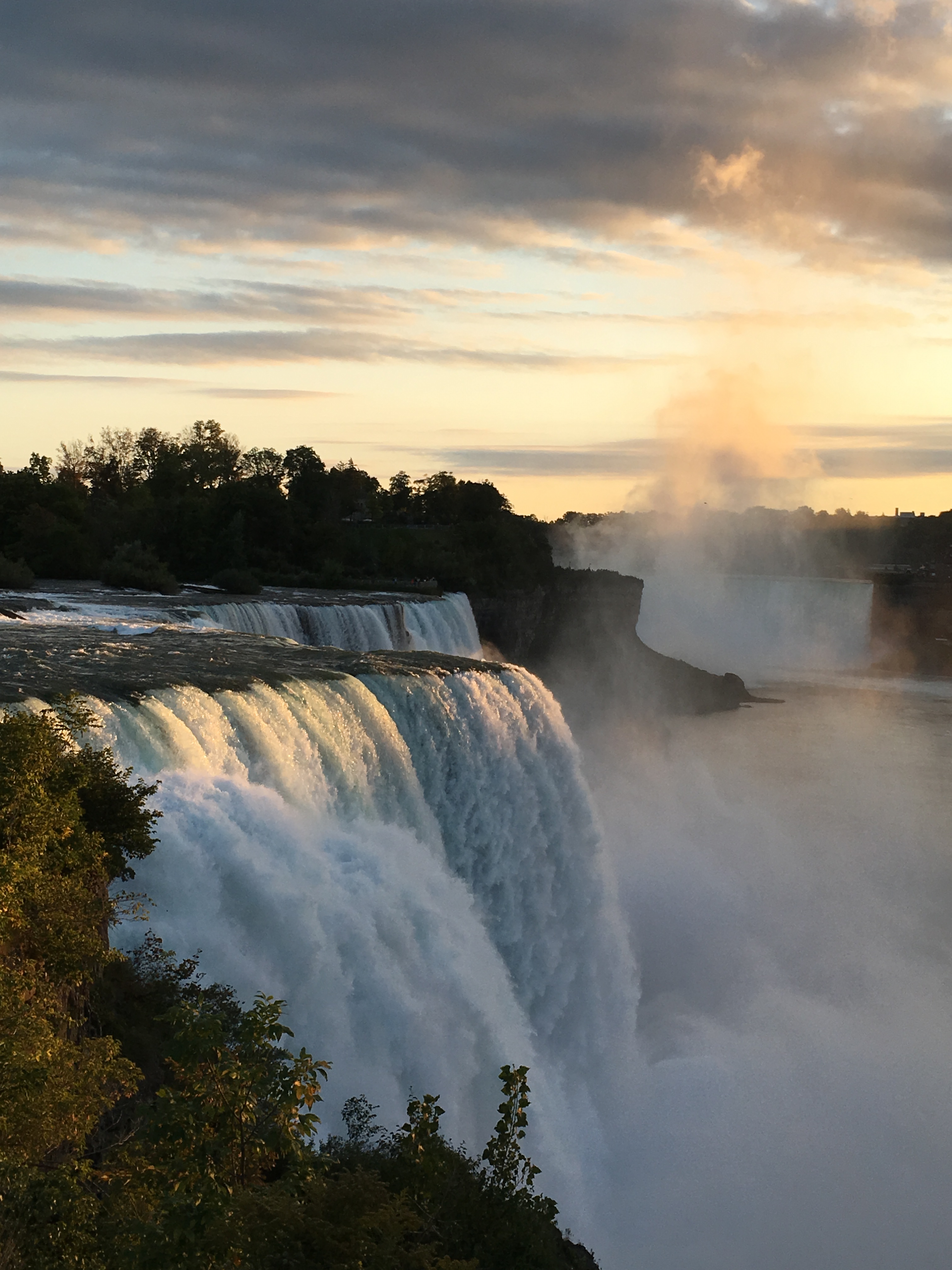
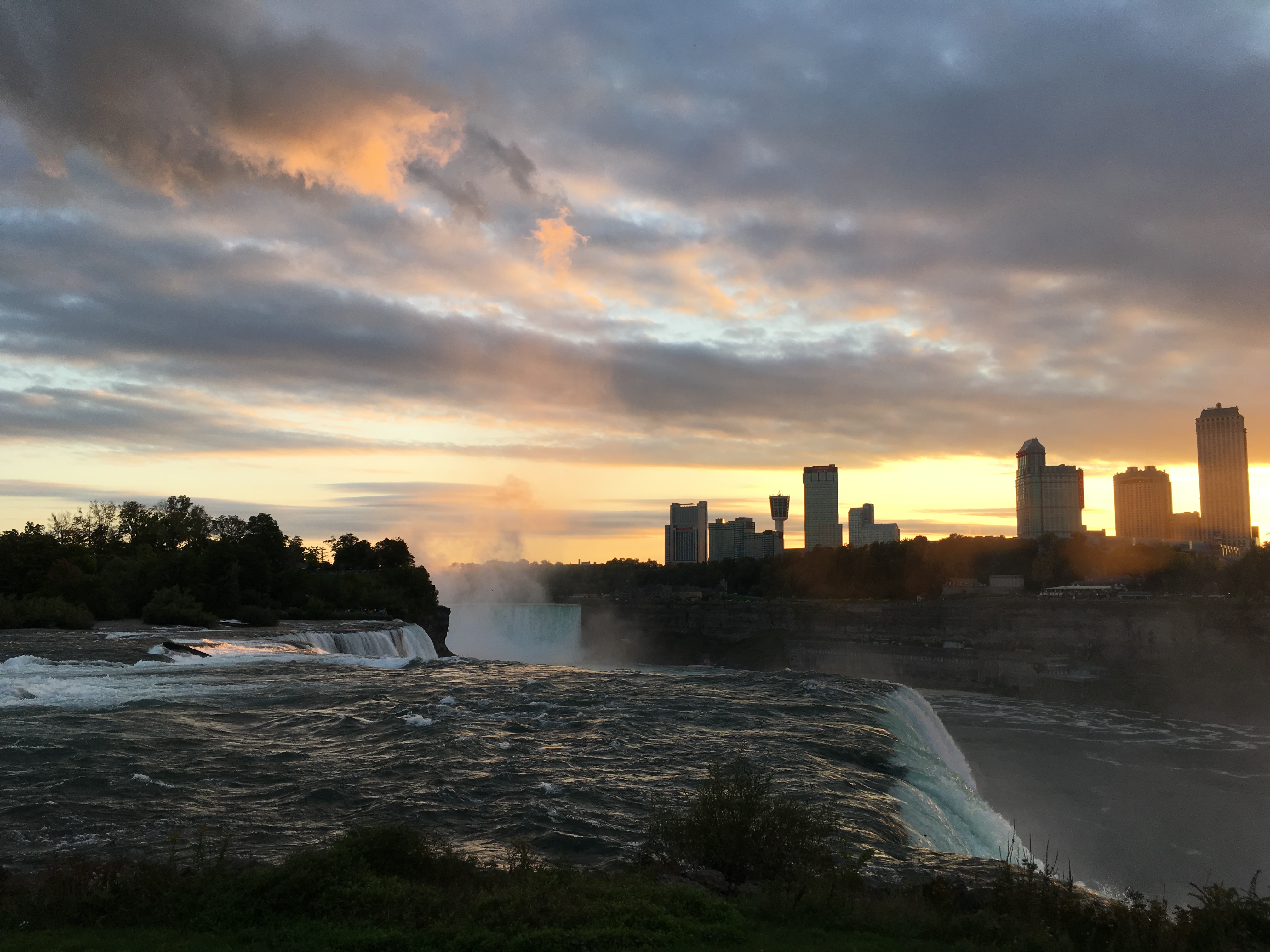
Here are images of the Remembrance Walk, capturing, I hope, not only the warm and embracing mood of the crowd, but the serenity that I don’t ever recall experiencing in the past when visiting Niagara Falls’ famous cataracts.
The May 29, 2021 print version of the Buffalo News includes an article that I had sent to them for its “first-person column” it calls MY VIEW. Here’s a link to the on-line version. I like the heading they chose to use, “Red Jacket’s values still resonate today,” and I am truly grateful to the newspapers for printing my piece. But, I have one major disappointment. The printed newspaper – the column seen by the most eyes – omits the following sentence: “…The media vilified us, showing little regard for the protection of cultural artifacts and Native American beliefs….” I had chosen those words carefully, purposely not identifying the source of the condemnation. What follows is an annotated version of my article, with some images added. When you arrive at the deleted sentence, you will find a link to the primary “media” attack. I think you can guess the source.
Red Jacket’s values still resonate today
No one would mistake this Italian-American lawyer with the famous Seneca, Red Jacket.
I can’t speak of ancestors whose knowledge and respect for this land extend back millennia. [See my maternal grandparents’ 1920 marriage certificate.]
No U.S. president has ever bestowed a peace medal on me, although a local publication named me Western New York’s “Best Gadfly.”
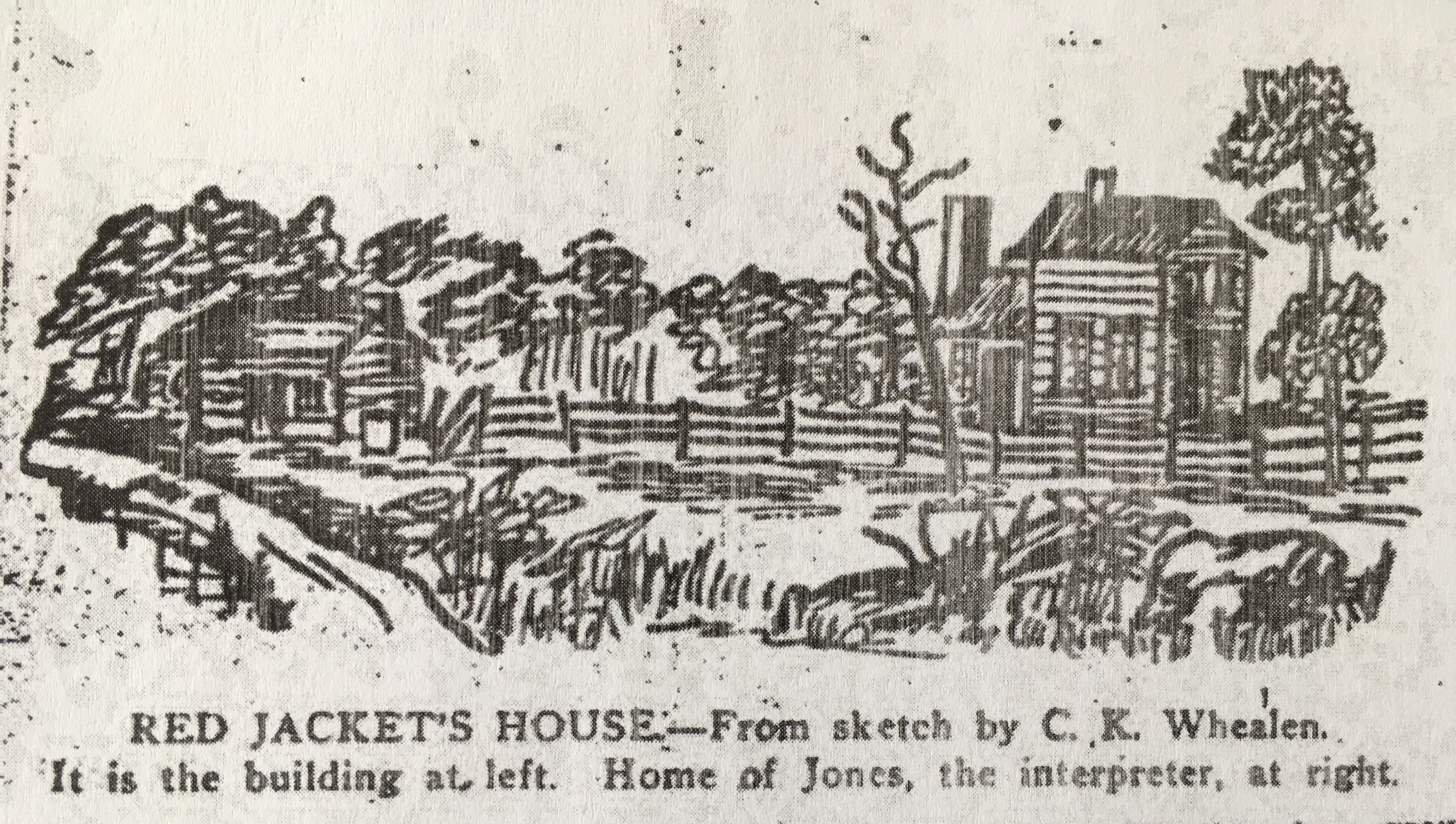
Red Jacket and I were, nonetheless, both born along the Genesee River (although two centuries apart). And, we both chose to spend our later years near what the City of Buffalo now calls the Seneca Indian Park on Buffum Street in South Buffalo. It is the latter coincidence that creates a connection between me and the Seneca spokesman.
The “Seneca Indian Park” – 1.6 acres of serenity, mature trees and gently sloping lawn – is an ancient burial ground, and part of a Seneca village that served as the heart of the Buffalo Creek reservation. Red Jacket adamantly proclaimed that he never wanted to leave the village – not even upon his death. Keeping with his final wishes, he was buried in 1830 beneath a large walnut tree at the west end of the current park.
Red Jacket was an ardent traditionalist and protector of Seneca culture, skeptical of both Christian missionaries and land speculators. I share his views. When I discovered in 2018 that a Buffalo developer and local charter school wanted to build a high school and gymnasium on Buffum Street, a hundred yards from the park, I investigated the project. The State’s historic preservation office had classified the land “archeologically sensitive” due to its proximity to the old burial grounds and Seneca village. [See SHPO 06-19-18 letter re 102 Buffum] The city officials and developer didn’t care, and approved the project without investigating the adverse impacts on cultural and archeological resources.
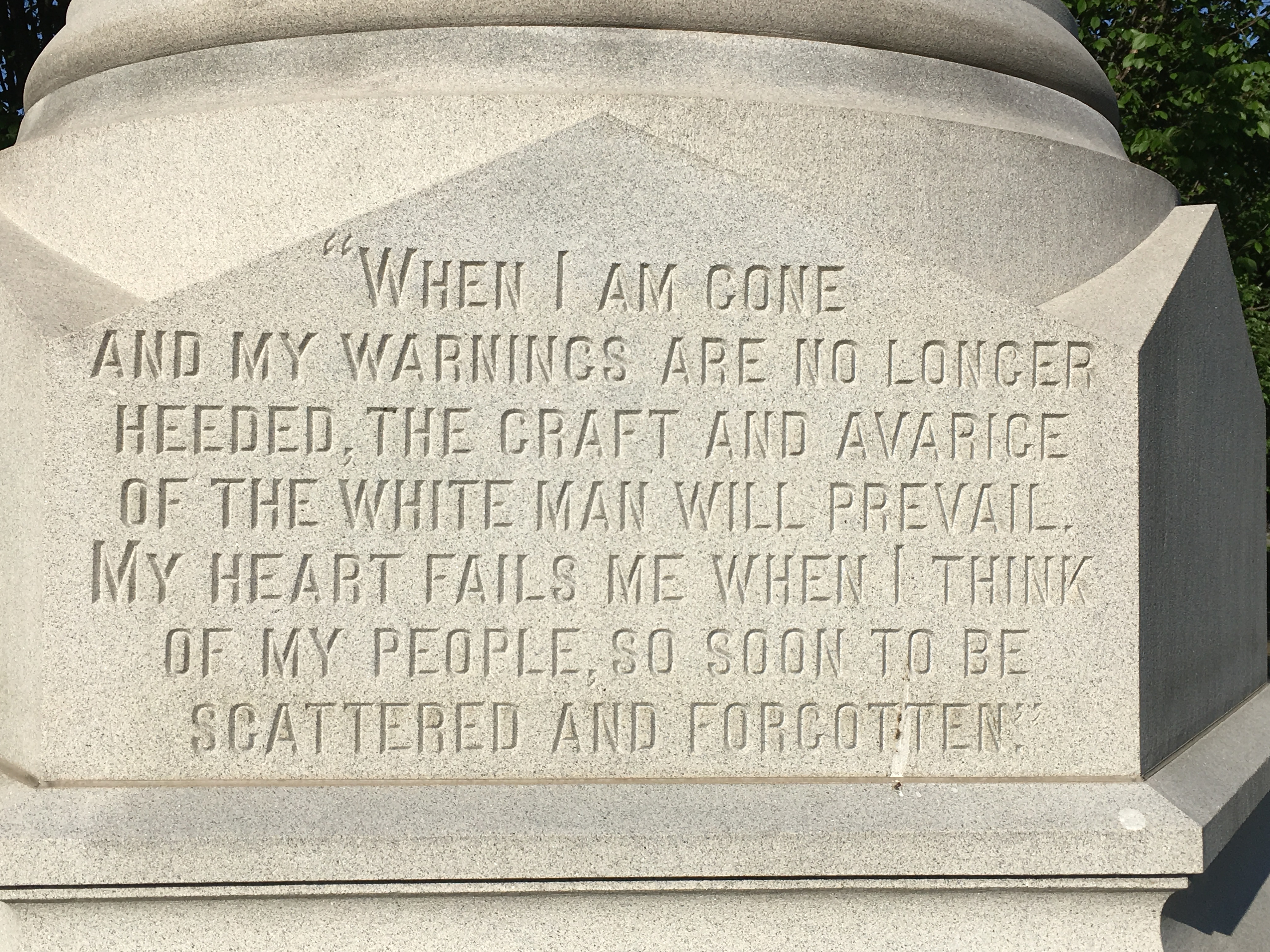
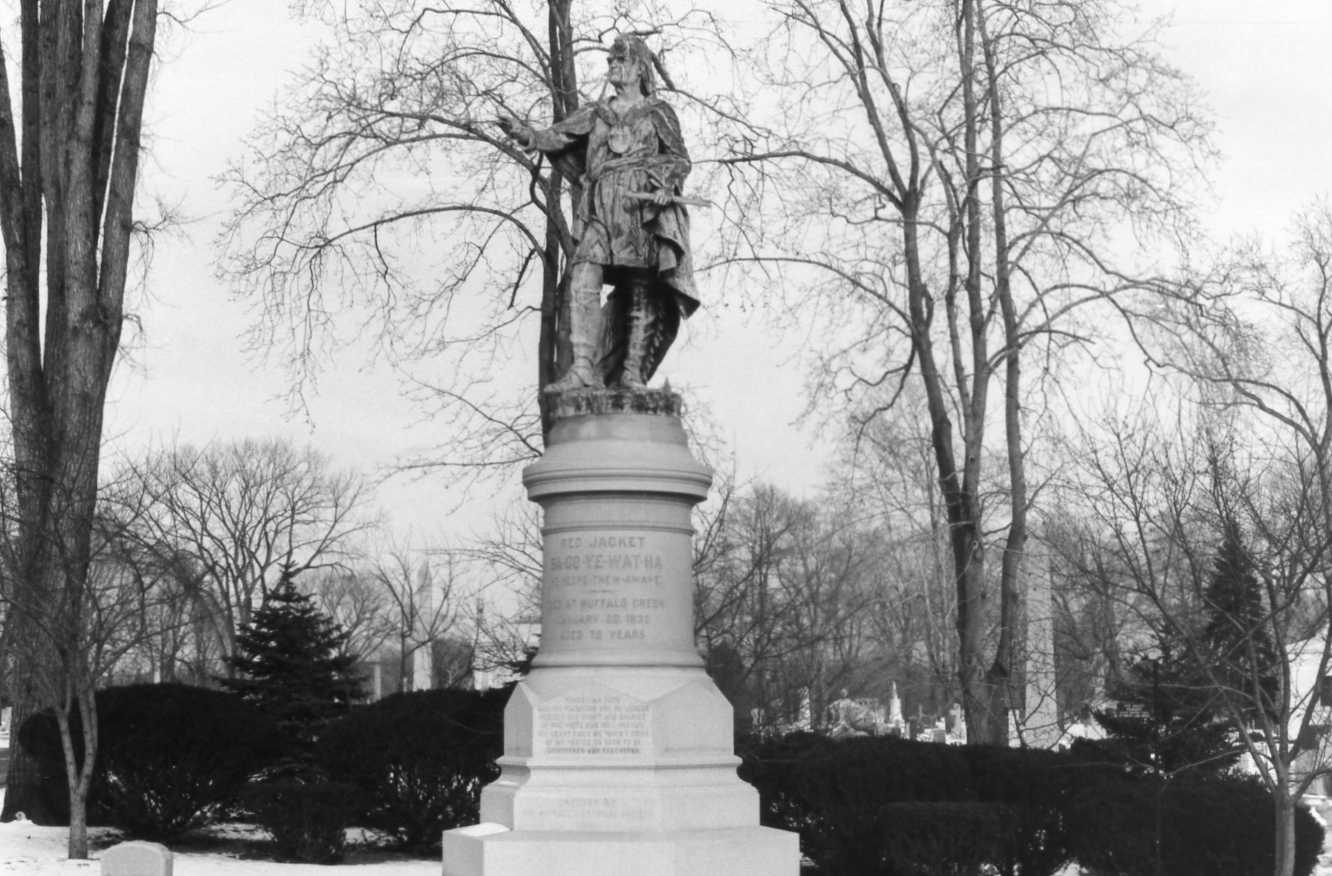
Red Jacket would not be surprised that this positive result required a fight. His skepticism was justified and prophetic. Despite his final wishes, his remains were removed from the Buffum Street site and reinterred near a monument at Forest Lawn Cemetery. Ironically, the following words of the great orator are memorialized there:
“When I am gone and my warnings are no longer heeded, the craft and avarice of the white man shall prevail. My heart fails me when I think of my people, who are soon to be scattered and forgotten.”
His people were scattered 12 years after his death by the “Treaty of 1842.” But, as highlighted by the May 17th ceremony in Salamanca honoring the return of Red Jacket’s Peace Medal to the Seneca Nation, his people have not been forgotten. They continue their fight for the sovereignty reflected in the 1792 symbol of peace.
A hopeful note. On the day after the repatriation celebration, a group of the charter school’s students were visiting the Seneca Indian Park. Their teacher proudly assured me that this multi-racial group had been taught the history of the site, and the importance of respecting the culture and beliefs of all peoples.
The land on which my home was constructed in 1910, on Oschawa Avenue off Indian Church Road at the southeastern edge of the City of Buffalo, is historically part of the Seneca Nation’s Buffalo Creek reservation. My parcel is just a few hundred feet southeast of ancient burial grounds near what is now the corner of Buffum (formerly, Buffam) Street and Fields Avenue. A 1.6-acre portion of the burial site is now called Seneca Indian Park by the City of Buffalo, and was designated a local landmark in 2011 by the City Common Council.
A primary reason for the landmark designation is the site’s affiliation with a Seneca named Otetiani (“Always Ready,” or more commonly known as Red Jacket). Here is an excerpt from the Seneca Indian Park landmark submission papers to justify the creation of the landmark:
Red Jacket was among the most important and influential Seneca leaders of the late 1700s – early 1800s. The village at Buffam Street had two important foci: the prehistoric village site and Red Jacket’s cabin. He lived middle and later years of his life in this village, walking along Buffalo and Cazenovia Creeks, conducting business at the council house a short walk away, even receiving the occasional white visitor. Red Jacket was adamant that he never wanted to leave the village – not even upon his death. He was buried accordingly, beneath a large walnut tree at the West end of the current Seneca Indian Park. Red Jacket’s former burial site is thus far more significant because it is more closely associated with his life and final wishes – indeed his cultural beliefs – than his current resting place in Forest Lawn Cemetery or any other site in Western New York. Buffam Street is significant because it was Red Jacket’s chosen and original burial location. This simple choice articulates the site’s significance even though Red Jacket’s body is no longer buried there. Red Jacket is a person of outstanding importance in Seneca history, the most ardent and recognizable protector of Seneca culture during his lifetime… [Emphasis added.]
(Red Jacket memorial in Forest Lawn Cemetery, Buffalo, NY, photo by Art Giacalone circa 1980)
The landmark submission document also includes the following description of Otetiani/Red Jacket:
… Red Jacket, a prominent and well-spoken Seneca diplomat who lived in Buffalo Creek during the middle and later years of his life, was among the most ardent of Seneca traditionalists. His conservatism showed in his skepticism of Christian missionaries and land sales to speculators… He was involved in most of the land deals during the 1790s, as well as the delicate negotiations with U.S. emissaries interested in securing the Seneca’s neutrality at a time when Indian parties were ravaging American settlers in the Ohio Valley. Red Jacket’s peace advocacy earned him a medal from president George Washington in 1792, and the Seneca remained neutral during the settlement of Western New York.
As you most likely know, on May 17, 2021, the Onöhsagwë:de’ Cultural Center, in Salamanca, New York , hosted a joyous celebration to honor the return to the Seneca Nation of the Red Jacket Peace Medal. I had the honor of sitting outdoors in the sun as part of the crowd attending the “repatriation” ceremony. It was with great pride and respect that the Seneca people welcomed home a truly significant cultural artifact. While I’ll talk a bit about May 17 below, that momentous event is not the focal point of this posting.
(Red Jacket Peace Medal, photo courtesy of Seneca Nation)
The information at the beginning of this piece, regarding the significance to Red Jacket and the Seneca Nation of the Buffum Street area, was provided for a reason. Just four blocks or so from the site of the Seneca Indian Park – at the corner of Cazenovia and Seneca Streets – stands a (larger than?) life-size statue of a Native American. Although the person represented by the wooden sculpture is not identified, he is conspicuously wearing a prominent oval-shape medal around his neck, and, most certainly, is Otetiani or Red Jacket.
There is one major problem, as reflected in the following photos. Over the years, the statue has been vandalized and is significantly damaged:
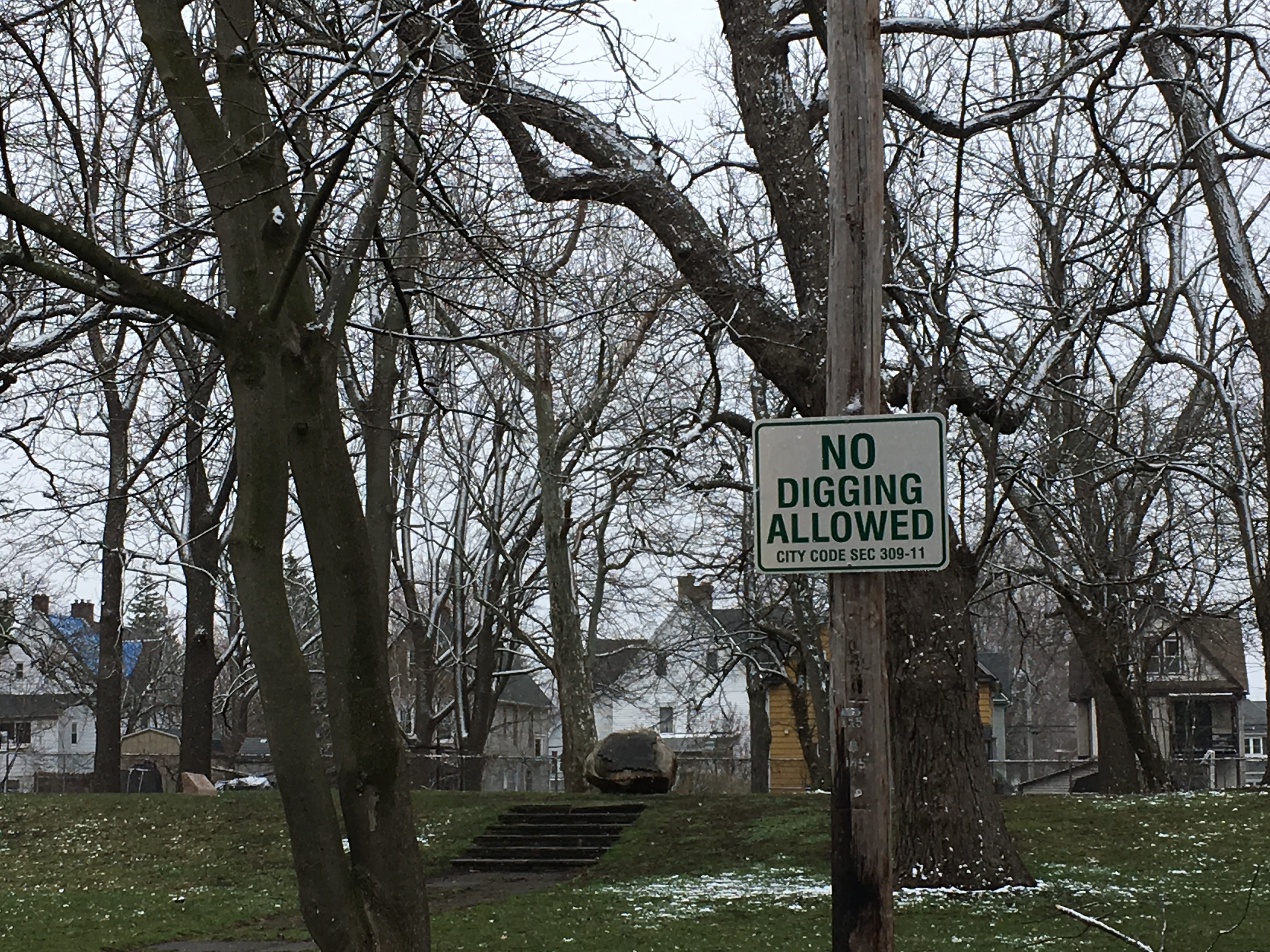
I am unable to identify the sculptor, and am unaware of when or how the statue’s location was chosen. But it stands next to Cazenovia Street in the City of Buffalo’s right-of-way. Officials at the city’s Parks department were cooperative earlier this year when they learned that metal detectorists and artifact-hunters had been digging at the Buffum Street sacred burial site. They responded by putting up a “No Digging” sign.
I have no reason to believe that Buffalo South District Council Member Christopher P. Scanlon and Commissioner of Public Works, Parks & Streets, Michael J. Finn, would not be equally willing to see the statue of Red Jacket returned to its original glory once the sculpture’s current condition is brought to their attention. I urge anyone interested in seeing this restoration project commenced and expeditiously brought to fruition to reach out to these public officials:
Hon. Christopher P. Scanlon, 65 Niagara Square, Room 1401, Buffalo, NY 14202; (716) 851-5169; cscanlon@city-buffalo.com.
Hon. Michael J. Finn, 65 Niagara Square, Room 502, Buffalo, NY 14202; (716) 851-5636; mfinn@city-buffalo.com.
Now let’s get back to the May 17, 2021 celebration.
Seneca Nation President Matthew Pagels, and Cultural Center Director Joe Stahlman, can certainly do a much better job than I explaining the importance to the Seneca people of the “repatriation” of the Red Jacket Peace Medal. So here’s the Seneca Nation’s news release. But I do want to share two quotes that I feel capture the spirit of the day:
“This medal represents what lives inside each and every Seneca — the heart of a sovereign people and our rightful recognition as such,” said Seneca Nation President Matthew B. Pagels. “This is our identity as a Nation. It cannot be owned, bought or sold. It belongs to all of us and is passed from generation to generation so it can live forever.”
“I like to remind the United States that the Haudenosaunee — especially the Seneca – play an important role in your early survival; that is what I see when I look upon the medal,” said Dr. Joe Stahlman, director of the Seneca-Iroquois National Museum. “We need to have moments of reconciliation. There are things from the past that still matter to many of us of here today and we need to talk about them. We need to all heal and find peace.”
I also want to mention a few of the dignitaries in attendance at the repatriation ceremony (frankly, I prefer the term “reMatriation”) who played central roles – alongside Dr. Stahlman and President Pagels – in making the return happen: Melissa Brown, Executive Director, Buffalo History Museum; State Senator Sean Ryan; Robert Jones, Seneca Nation Councilor; and, Walter Mayer, Buffalo History Museum’s Senior Director of Collections.
Lastly, I’ll end this post with images of the rarely-seen reverse side of the Peace Medal (the side closest to Otetiani’s heart) gifted by George Washington to Red Jacket in 1792 (and, reflecting the sky on 05/17/2021); the most significant piece of the cake crafted for the celebration; and, importantly, some of the folk in attendance.
(Peace Medal’s reverse side, photo by Art Giacalone 05/17/2021)
[UPDATE: Here’s an excerpt from a January 6, 2021 email I received from David C. Rotterdam, Chief Content Officer at WNED, in response to the letter printed below:
“Your suggestions on the Our Town Oshawa program were insightful. It’s part of an occasional series of programs we’ve done featuring different communities in Western New York and Southern Ontario. The program is entirely driven by the community volunteers who sign up and agree to participate in the program as one of our producers. We work with the community media to recruit volunteers and then at a series of meetings we brainstorm topics that they all vote on and select the topics they will cover. So while we do get a good range of stories and storytellers – in the case of the Oshawa program the First Nations aspect of the program was very limited. It’s a point well taken as we produce programs in the future that share our culture and history.” ]
Dear WNED/PBS:
A letter recently arrived in my mailbox reminding me that I have been a supporter of WNED/PBS since 1984. I mention this fact only to underscore my admiration and reliance on your fine organization for more than half of my 70-year life span.
November, as you know, is “Native American Heritage Month” at WNED/PBS. The lineup of documentaries and videos has been outstanding, from Lake of Betrayal and The Medicine Game, to The Warrior Tradition and Native Americans: Nature to Nations.
However, to borrow a phrase from the film that motivates this correspondence, “Our Town: Oshawa,” WNED/PBS’ approach to Native American history and culture, no matter how admirable, remains “flawed in some aspects,” leaving room for self-reflection and improvement.
Allow me a moment to digress. In 2015, I moved to a quiet, one-block long street off Indian Church Road in the City of Buffalo named Oschawa (not a typo, at least not on my part) Avenue. I discovered a short time later that my sliver of a parcel was once part of the Buffalo Creek Reservation, and that title to the land had been held by the Seneca Nation of Indians until the misnamed “treaty” of 1842.
Seneca Indian Park, Buffum Street, South Buffalo, NY, USA
I couldn’t help but be curious about the origins of the word “Oschawa”, and soon was reminded of the existence of the City of Oshawa in Canada’s Ontario province, located on Lake Ontario 52 km (about 31 miles) east of Toronto. Thanks to the Canadian Encyclopedia, I learned that the name “Oshawa” is an Ojibwa term describing “that point of the crossing of the stream where the canoe was exchanged for the trail.”
Given my interest in the name “Oshawa” – no matter how it is spelled – I was grateful to receive an email from PBS Passport that brought to my attention the WNED-sponsored film, Our Town: Oshawa. The 2019 piece was described in the following fashion: “Through the lens of these community filmmakers, explore Oshawa’s art and culture, regional landmarks and history, parks and recreation and hidden gems.” Aware of the ongoing November celebration of Native American heritage, I assumed that the 57-minute, 25-second feature would be a fount of information regarding the history and culture – past and present – of the indigenous peoples gracing the Oshawa, ON area. Well, you know what they say about assuming something.
In fact, the hour-long film sheds no meaningful light on the people who lived along the Lake Ontario shore prior to the arrival of the European colonizers.
The word “indigenous” (or, its equivalent) is heard only twice. At the minute and 54 seconds mark, a representative of the Oshawa Museum praises her institution as the only museum that tells “the entire history” of the city, looking at “the earliest indigenous inhabitants all the way to present day.” Regrettably, she then makes only one passing reference to the area’s earliest peoples (at 3:16) when, in describing the second floor of Lakeview Park’s Robinson House, she remarks, “The upper story is completely dedicated to an indigenous gallery.” The camera lingers for less than two seconds on the static exhibit.
The remainder of the film never once utters the term “indigenous” or provides an image reflecting the heritage of Oshawa’s earliest non-European inhabitants. The closest the array of filmmakers/narrators comes to acknowledging the plight of Canada’s First Nation tribes is this above-quoted phrase, expressed by the Oshawa Museum’s representative when characterizing Oshawa’s history: “It’s varied, it’s diverse, it’s flawed in some aspects, but so wonderful in so many ways.”
I had hoped, when the segment of the film focusing on Oshawa’s “Fiesta Week” – touted as “Oshawa’s Multicultural Festival” – began, that information, visually or otherwise, of the indigenous inhabitants’ history or culture would follow. Instead, while “celebrating the different nationalities that make our community our community,” only images of French Canadian, Portuguese, German, Polish, Caribbean, and Ukrainian groups are shown. Absent are the Native American members of the Oshawa community.
I am confident that WNED/PBS can and will do better in the future. Every effort must be made to ensure that the heritage of Ontario’s indigenous peoples is recognized, honored, and respected – not only during Native American Heritage Month – but whenever contributions from members of WNED-TV are used to support local films and documentaries.
The U.S. Supreme Court has historically denied Native Americans the respect owed every human being.
“An ignorant and dependent race.” “Wards of the nation.” “Remnants of a race once powerful, now weak and diminished in numbers.” “Pupils.” “Communities dependent on the United States largely for their daily food, and for their political rights.” Such characterizations of “Indian tribes” – ranging from paternalistic, disrespectful, and disparaging, to outright repugnant – can be found repeatedly in nineteenth- and twentieth-century opinions issued by our nation’s highest court.
This condescension towards North America’s Indigenous peoples has been mirrored in the high court’s rulings. An oft-cited 1885 opinion asserts: “The power of the general government over these remnants of a race once powerful, now weak and diminished in numbers, is necessary to their protection, as well as to the safety of those among whom they dwell.” Adding injury to its many insults, the Supreme Court presumes that the federal government acts in good faith when it breaches the promises it has made in Native treaties, or totally terminates a reservation: “It is to be presumed that in this matter the United States would be governed by such considerations of justice as would control a Christian people in their treatment of an ignorant and dependent race.”
If that statement weren’t repugnant enough, our nation’s top jurists uttered what I consider the ultimate expression of “White Privilege.” Finding itself unable to identify a specific provision in the U.S. Constitution granting Congress, even implicitly, “paramount authority” over Native tribes, the Supreme Court justifies the federal government’s absolute power over the Indigenous population by referring to “the policy of the European nations and the United States in asserting dominion over all the country discovered by them.” In other words, the USA has the power over, and ownership of, the entire country – including Native American tribes – because that’s what White colonizers do, leaving “the Indians” with, at best, a “possessory right to the soil over which they roamed and hunted and established occasional villages.”
[Source unknown. Sentiment understandable.]
In the eyes of the U. S. Supreme Court, Native tribes are not nations, not states, and not sovereigns, but “unique aggregations possessing attributes of sovereignty”. Although an 1823 decision had described Indian tribes as “wholly distinct nations” within whose boundaries “the laws of a State can have no force,” the high court soon departed from the “conceptual clarity” of that view, and “acknowledged certain limitations on tribal sovereignty.”
By 1886, the Supreme Court proclaimed that there exists only two entities with the right of sovereignty, “the government of the United States” and “the states of the Union.” Indian tribes were relegated to a “semi-independent position … not as states, not as nations,not as possessed of the full attributes of sovereignty, but as a separate people, with the power of regulating their internal and social relations.” As recently as 1983, a unanimous decision (delivered by Justice Thurgood Marshall) included the following statement: “[W]e have acknowledged that Indian tribes have been implicitly divested of their sovereignty in certain respects by virtue of their dependent status, that under certain circumstances a State may validly assert authority over activities of nonmembers on a reservation, and that in exceptional circumstances a State may assert jurisdiction over the on-reservation activities of tribal members.“
Despite this less-than-stellar record, our nation’s preeminent court has congratulated itself for “hav[ing] consistently guarded the authority of Indian governments over their reservations.” What it has done, for certain, is consistently remind Native Americans that Congress possesses the power to take that authority away.
Capitol Hill – January 2008
Given the historical context, it was not surprising to see the jubilation among Native Americans and Indigenous rights activists on July 9, 2020, when the U.S. Supreme Court issued its decision – written by Trump-appointee Justice Neil M. Gorsuch – in McGirt v. Oklahoma. The McGirt ruling – described below – came at a time when the U.S. was experiencing (and, continues to experience) nationwide demands to eliminate systemic racism and discrimination, and Native American communities were being (and, continue to be) disproportionately impacted by covid-19.
An Overview of McGirt
At the heart of the case is the relevance today of a series of mid-1800s treaties between the federal government and the Muscogee (Creek) Nation. As with countless other Native treaties, the USA had promised the Creeks (the term the English used to reference the Muscogee people) the proverbial moon.
In exchange for ceding all their land east of the Mississippi river, the U.S. government agreed in an 1832 treaty that “the Creek country west of the Mississippi (located in what is now Oklahoma) shall be solemnly guarantied to the Creek Indians,” that the lands would become the “permanent home to the Creek Indians,” and that “no State or Territory shall ever have a right to pass laws for the government of such Indians, but they shall be allowed to govern themselves.” In the Treaty of 1856, Congress promised that within their lands, with exceptions, the Creek Indians were to be “secured in the unrestricted right of self-government,” with “full jurisdiction” over enrolled tribe members and their property.” Similar promises were made in an 1866 treaty, but the original territory set aside as the “permanent home to Creek Indians” was reduced in size, with the federal government paying 30 cents per acre as compensation.
The question before the court in McGirt was a narrow one. The criminal defendant, Jimcy McGirt – a member of the Seminole Nation of Oklahoma – argued that the sexual crimes for which he had been convicted by the State had been committed within an existing reservation, and, for that reason, under the federal Major Crime Act (MCA), the federal government alone, and not the State of Oklahoma, had the authority to prosecute him. No one disputed the fact that Mr. McGirt’s crimes were committed on lands in northeastern Oklahoma located within the boundaries of the reduced Creek reservation as described in the 1866 Treaty. But Oklahoma argued that the land once given to the Creek Indians is no longer a reservation today, emphasizing, among other issues, that tribe members make up less than 10%-15% of the population of their former domain, and the area, which includes most of the city of Tulsa, had lost its Indian character.
By a 5 to 4 vote, the Supreme Court rejected Oklahoma’s arguments, and concluded that the lands remained “Indian country,” and, for that reason, the State had no right to prosecute Mr. McGirt for his crimes. As explained by Justice Gorsuch, while Congress has the constitutional authority “to breach its own promises and treaties,” and may have “diminished the promised reservation, and at times sometimes restricted and other times expanded the Tribe’s authority,” it has never clearly withdrawn the promised reservation. For that reason, the Supreme Court majority, over a strong dissenting opinion by Chief Justice John Roberts, concluded that it would “hold the government to its words.”
Responses to the McGirt decision
The response to the July 9, 2020 opinion was overwhelmingly celebratory.
David Hill, Principal Chief of the Muscogee (Creek) Nation, told the New York Times: “This is a historic day. This is amazing. It’s never too late to make things right.” A commentator at an influential legal blog, Prof. Ronald Mann of the Columbia law school, wrote: “The decision is a stunning reaffirmance of the nation’s obligations to Native Americans.” The Indian Law Resource Center declared: “This case is a significant victory for tribes, and a strong reaffirmation of the legal force of Indian nations’ treaty rights, land rights, and right to self-government.” A July 12, 2020 article in The Atlantic magazine, under the headline “The McGirt Case Is a Historic Win for Tribes,” proclaims, “In the long Indigenous struggle for justice, McGirt v. Oklahoma might be one of the most important Supreme Court cases of all time.” The article’s author – Julian Brave NoiseCat, a member of the Secwepemc and St’at’imc Nations – quotes the lawyer who represented the Muscogee Nation at the Supreme Court, Riyaz Kanji, as predicting that tribal attorneys “will be quoting that decision for the rest of our lives.” Social media was permeated with declarations of “Native Lives Matter.”
“But experts in Indian law said the decision’s effects would be more muted, and would change little for non-Natives who live in the three-million-acre swath of Oklahoma that the court declared to be a reservation of the Muscogee (Creek) Nation.“
“Not one inch of land changed hands today,” said Jonodev Chaudhuri, ambassador for the Creek Nation. “All that happened was clarity was brought to potential prosecutions within Creek Nation.”
In mid-August, WBFO, Buffalo’s npr station, asked John Kane, a Mohawk activist who hosts a NYC radio show and resides on Seneca Nation territory in Cattaraugus County, his assessment of McGirt’s impact on New York tribes. While Kane considered the ruling historic, he shared the following view:
“[The feds] haven’t wavered at all in their view that they have control. Even as we go from a policy of extermination, to removal, to assimilation, determination, and into self-determination the federal government makes it clear, that when they say self-determination they don’t mean the international standard which is essentially consummates to statehood, they mean internal self-determination.”
Reasons to restrain one’s expectations
I admit to initially being excited on July 9th when I received the “alerts” from the New York Times and Washington Post regarding the McGirt ruling (made sweeter by Gorsuch’s role). But, I am not an expert in Native American law. Now that I have taken the time to read the opinion closely, and to review dozens of the decisions rendered by our nation’s highest court over the centuries, my jubilation has been tempered by the following realities:
First, the issue decided by the Supreme Court was a narrow one. As noted in the Gorsuch opinion, the only question before the court “concerns the statutory definition of ‘Indian country’ as it applies in federal criminal law under the MCA.”
Second, Mr. McGirt’s case is “a contest between State and Tribe,” NOT a question of the power of Congress to limit tribal sovereignty. The assertion by the five-member majority that, “we hold the government to its word,” does not result in a limitation of federal power, but only to the State of Oklahoma’s authority to prosecute crimes against Native Americans which fall within the provisions of the Major Crime Act.
Third, the McGirt opinion acknowledges, but does not directly criticize, Congress’ major broken promises to the Muscogee (Creek) Nation. At one point it states, “By subjecting Indians to federal trials for crimes committed on tribal lands, Congress may (emphasis added) have breached its promises to tribes like the Creek that they would be free to govern themselves.” Likewise, it states:
“While there can be no question that Congress established a reservation for the Creek Nation, it’s equally clear that Congress has since broken more than a few of its promises to the Tribe. Not least, the land described in the parties’ treaties, once undivided and held by the Tribe, is now fractured into pieces.“
Fourth, there is nothing in McGirt that expresses a willingness to hold the federal government “to its word” regarding the multiple ways it has breached the treaty’s promise to the Muscogee (Creek) people of self-governance, or the 1832 treaty’s “solemn guaranty” that the established boundary lines “will secure a country and permanent home to the whole Creek Nation of Indians.” To the contrary, Justice Gorsuch writes, “This Court long ago held that the Legislature wields significant constitutional authority when it comes to tribal relations, possessing even the authority to breach its own promises and treaties.” Not only that, the penultimate paragraph of McGirt reminds the parties (and, the rest of us) that Congress has the authority to undo, if it so pleases, the July 9, 2020 ruling by the high court: “Congress remains free to supplement its statutory directions about the lands in question at any time. It has no shortage of tools at its disposal.“
Fifth, let’s not forget that the Supreme Court presumes the federal government acts in good faith when it deals with Native American tribes.
Bottom Line: Muscogee Creek Nation defeated Oklahoma in McGirt – but Congress still makes the rules and defines the playing field (and, that’s OK with the U.S. Supreme Court).
With All Due Respect,
Art Giacalone
* Note added 03/21/2021: Although the McGirt opinion cites to the 1903 decision in Lone Wolf v. Hitchcock when referencing Congress’s “significant constitutional authority when it comes to tribal relations,” the Lone Wolf opinion does not point to any provision in the U.S. Constitution when it states that Congress has exercised its plenary authority “from the beginning.“ Although Lone Wolf characterizes the authority of Congress over tribal relations as a “political” power, it does not call it a “constitutional” power, or point to any provision in the Constitution for such authority. The expression by the Lone Wolf court of a presumption that, “the United States would be governed by such considerations of justice as would control a Christian people in their treatment of an ignorant and dependent race,” suggests that the U.S. Supreme Court in 1903, and, it appears, in 2020, is basing the power of Congress over “Indian tribes” on the 15th century “Doctrine of (Christian) Discovery.” This repugnant doctrine was described by legal scholar Joseph J. Heath, Esq., General Counsel to the Onondaga Nation, in the following fashion: “For two centuries, the Supreme Court has defined the doctrine of Christian discovery to mean that title to Indigenous lands immediately was transferred to the ‘discovering’, or colonizing European, Christian nations when they landed on the shores of Turtle Island (North America). The Indigenous inhabitants were then left with only a ‘right of occupancy.” Albany Government Law Review, Vol. 10, p. 115 (2017).
This blog is provided for general informational purposes only. It should not be construed as legal advice and is not intended to be a substitute for legal counsel. Persons requiring legal advice should retain a properly licensed lawyer. No attorney-client relationship will be formed based on use of this site and any comments or posts to this blog will not be privileged or confidential. ***************
This blog's author, Arthur J. Giacalone, does not intend or consider the communications at this blog to be ATTORNEY ADVERTISING. The primary purpose of the communication is not for the retention of Mr. Giacalone's legal services. [See definition of "Advertisement" at Part 1200, Rules of Professional Conduct, Rule 1.0(a).] Nonetheless, in case the proper authorities choose to treat this web site as ATTORNEY ADVERTISING, the street address, phone number and email address of the law office of Arthur J. Giacalone are: 17 Oschawa Avenue, Buffalo, New York 14210; (716) 436-2646; AJGiacalone@twc.com.
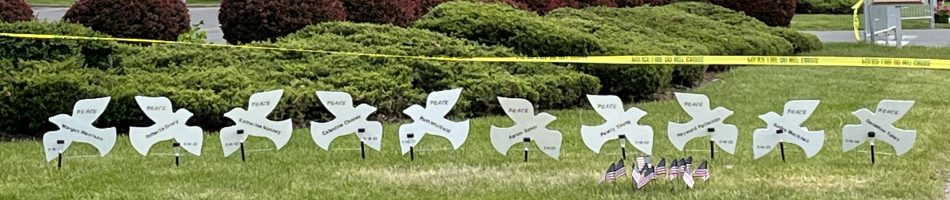


 [Michelle-Elise Burnett (on the left) holds the dress prepared by domestic violence survivor Mary Annette Clause while Mary is interviewed by
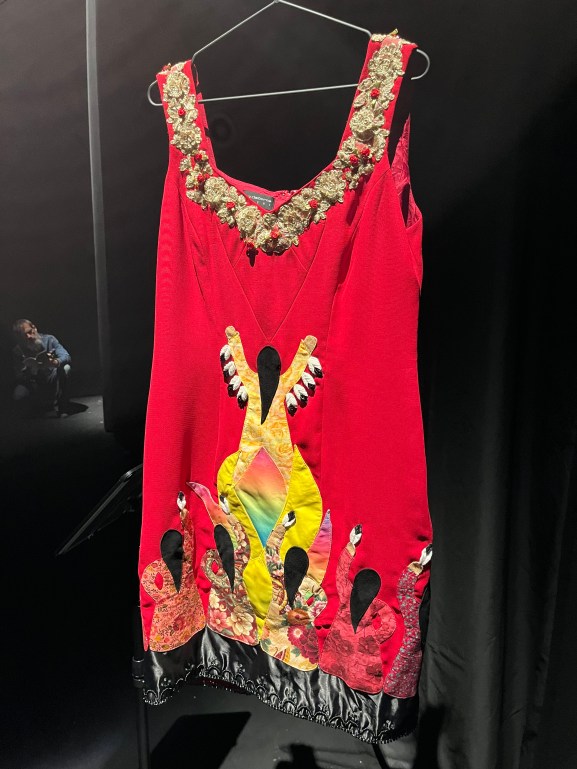 And it’s back side: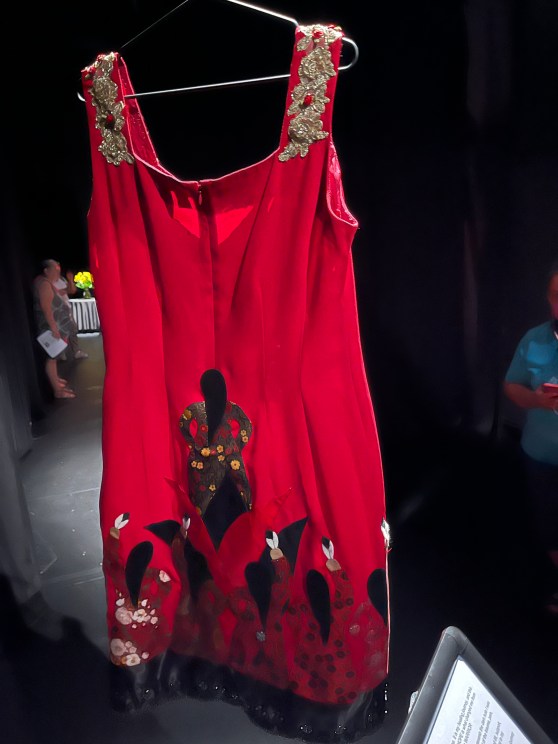
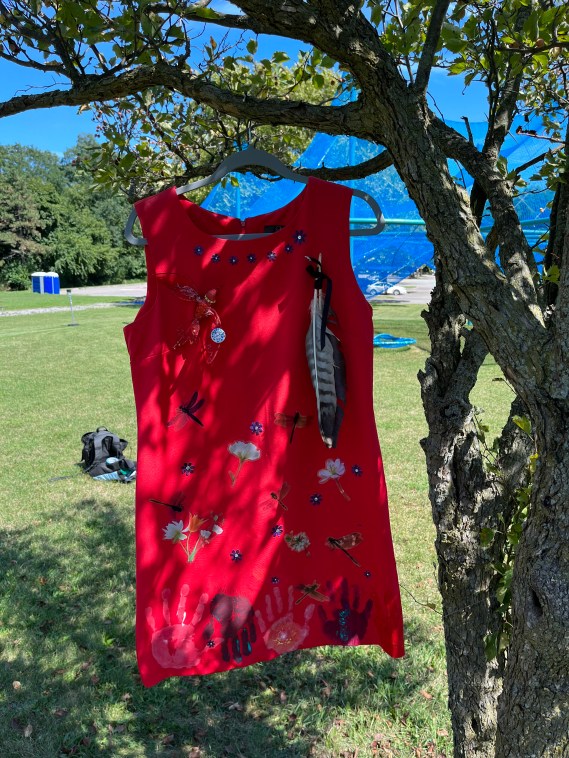

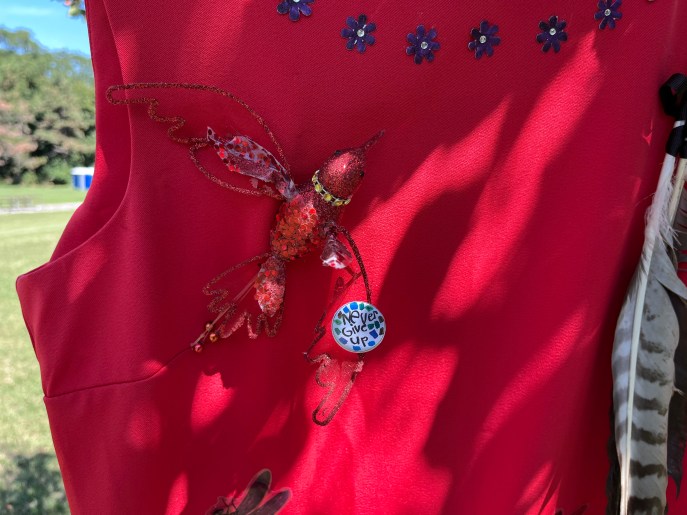 [“Never Give Up!”]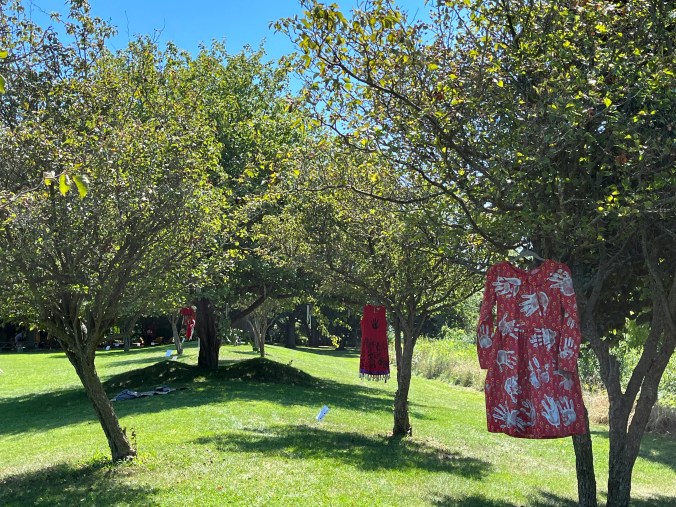
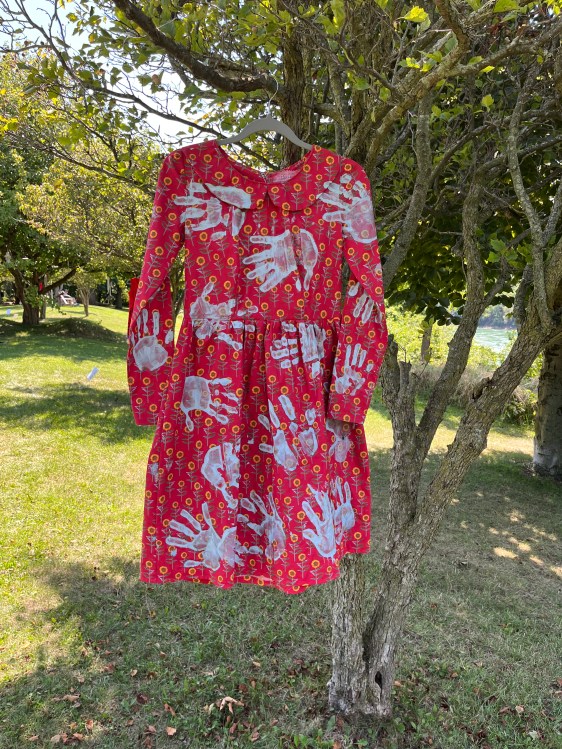 [If I recall correctly, the sunflowers symbolize the source of light, and the ghostly handprints represent the unborn children of MMIWG.]


 A sliver of the crowd at the BPO’s Olmsted 200 Celebration, Cazenovia Park, 07/15/2022.
 “Seneca Indian Park” on Buffum Street, site of an ancient Indigenous burial grounds.













 (Red Jacket memorial in Forest Lawn Cemetery, Buffalo, NY, photo by Art Giacalone circa 1980)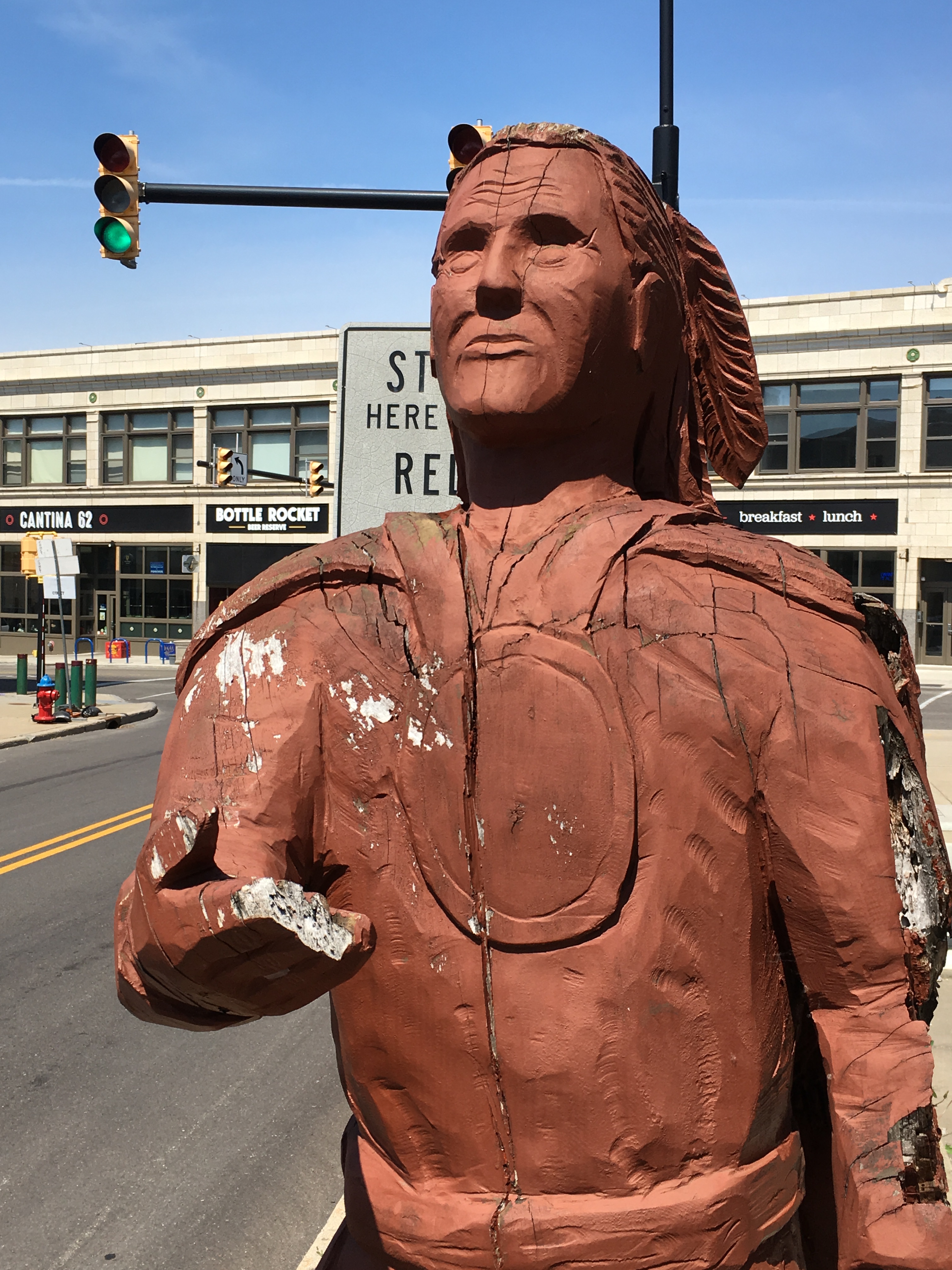

 (Photo by Art Giacalone, 05/17/2021)






 With All Due Respect