With All Due Respect

Photos and musings by Arthur J. Giacalone

  • About The Author
  • About This Blog
  • Pre-WADR Archives

THANK YOU, PRESIDENT OBAMA!!!

Posted by Arthur J. Giacalone on January 17, 2017
Posted in: Uncategorized. Leave a comment

Frankly, I’m at a loss in knowing how to approach this Friday, January 20, 2017.  I do recall the dread that I felt when Nixon was inaugurated, and then Regan, and, more recently, George W.  But nothing in my life has prepared me for the concept of President Trump.

So, as a bridge to Friday, I plan on doing two things on Wednesday and Thursday.  I am going to display the American flag next to my front door.  And, I am going to affix this photo to my front window:

thank-you-pres-obamaI’m unable to plan beyond Thursday.  Please share your suggestions (but, remember, I would like to face the future without resorting to drugs and alcohol).

With All Due Respect (and, an awful lot is due),

Art Giacalone


Smarter opinions needed!

Posted by Arthur J. Giacalone on December 20, 2016
Posted in: Buffalo News, City of Buffalo, Development, Elmwood Village, Green Code. Leave a comment

For years, the Buffalo News editorial staff (as with its reporters) has blindly touted Mayor Byron Brown’s proposed Green Code as Buffalo’s salvation. Now that the City’s legislators, the nine-member Common Council, are ready to approve Buffalo’s new zoning and development ordinance, Western New York’s largest daily newspaper is all upset. An opinion piece published on September 19, 2016 – under the heading, “Smart growth needed” – expresses disappointment that “overly restrictive zoning regulations stand in the way of growth the city needs.” The source of the Buffalo News frustration? A decision to restrict the height of new buildings on Elmwood Avenue to three stories. Developers – such as Ciminelli Real Estate Corp. and Chason Affinity – are whining, and the Buffalo News is more than willing to lobby on their behalf. Let me give you three reasons why the opinion expressed in the editorial is so dumb.

First, although the Buffalo News editorial concedes that the “Elmwood Village already has a certain amount of density,” it insists that, “Residents living in the Elmwood Village should be encouraging density, not discouraging it.” The editorial staff ignores the unassailable fact that the Elmwood Village is already a vital and attractive neighborhood, and that the primary reason for its lure is its livable scale, the balance between historic residential structures and small-scale businesses.

Second, the Dec. 19th opinion piece speaks the truth when it says that the Elmwood Village “has the kind of reputation that struggling neighborhoods envy.” It is also true that many of Buffalo’s neighborhoods would benefit from “denser development that will contribute to growth.” But the Elmwood Village is not one of those neighborhoods. The beneficiaries of denser development on Elmwood Avenue would not be current Elmwood Village residents, but, to the contrary, the only constituency that seems to count at the Buffalo News: developers.

Third, the Buffalo News editorial staff acknowledges that a developer who wishes to construct a building taller than three stories will have the right, under State law and the Green Code, to seek a “variance” from the City’s Zoning Board of Appeals and attempt to prove that the benefits of the proposed project outweigh the detrimental impacts. But they’re upset that such developers “will have to spend more time and money and undergo public scrutiny.” Imagine that, a developer who insists that its project is a benefit to a neighborhood will have to prove that fact in a public forum. Like it or not, Ciminelli, Chason Affinity, and the Buffalo News, such an approach not only sounds like democracy to me, it is also the only way to protect and preserve a community with the historic character and uniqueness of the Elmwood Village.

The State’s Historic Preservation Office has submitted a letter – also dated December 19, 2016 – to the City of Buffalo explaining the detrimental impacts one of the controversial proposals – Chason Affinity’s plans to demolish a dozen structures and build an utterly inappropriate 5-story, 166,000-square-foot monstrosity at the southeast corner of Elmwood and Forest avenues – would have on the Elmwood Village’s historic fabric. I strongly urge Buffalonians and our elected officials to read it: shpo-12-19-2016-letter.

With All Due Respect,

Art Giacalone


Three minutes just isn’t enough

Posted by Arthur J. Giacalone on December 5, 2016
Posted in: Development, Elmwood Village, SEQRA. Leave a comment

The City of Buffalo’s Planning Board conducted a public hearing late this afternoon – Dec. 5, 2016 – concerning the Draft Environmental Impact Statement [DEIS] and design and site application for Chason Affinity’s proposed “1111 Elmwood” mixed-use project at the southeast corner of Elmwood and Forest avenues at the northern boundary of one of Buffalo’s most popular and desirable neighborhoods, the Elmwood Village.  The room was hot and overcrowded, with residents for and against the 5-story, 166,000-square-foot building spilling out into the adjoining hallway. 

First we heard from the developer’s lawyer.  Then the project’s architect, an amiable chap, who felt obliged to spend an inordinate amount of time telling the assembled – with the aid of a PowerPoint presentation –  just how much worse the earlier iterations of the developer’s plans were.  [You can almost be certain that a proposed development is terribly unsuited for a neighborhood if its architect or lawyer is telling tell you how much worse the developer’s original plans were.]  Then the developer spoke.  When it was finally the public’s turn, we were told that we had three minutes each to provide our comments regarding a 160-page DEIS, the dozen or so appendices that accompanied it, and the project’s design and site plan.

Well, anyone who has visited this blog in the past knows that three minutes just isn’t enough for me to share my thoughts.  Fortunately, I had a 14-page letter (with exhibits attached) to hand to the Planning Board chair.  What is important for the public to know is that written comments can be submitted to the City Planning Board – at Buffalo City Hall, 65 Niagara Square, Room 901, Buffalo, NY 14202-3318 – through December 19, 2016.   State law mandates that the Planning Board, as the “lead agency” conducting the environmental review, must respond in the Final EIS to “all substantive comments” it receives regarding the Draft EIS.  If you are interested in my thoughts, READ ON:

December 5, 2016

Re: Chason Affinity’s proposed project at 1111 Elmwood Ave.

Dear City Planning Board:

I am providing these comments to you on behalf of my client, Sandra Girage, the owner of 611 Forest Avenue. Her two-family residence is located immediately adjacent to Chason Affinity’s property at 607 Forest Avenue. My comments will focus primarily on the inaccuracies and omissions in the project sponsor’s Draft Environmental Impact Statement [DEIS]:

FIRST, as an attorney who has been reviewing DEIS’s for over a quarter-century, I knew that the DEIS “accepted” as adequate for public review by this board would be remarkably one-sided and subjective when I read the following statement in the DEIS Introduction: “The FEAF [Full Environmental Assessment From] does not identify any potentially significant environmental impacts associated with the project that would mandate the preparation of an EIS under SEQRA.” [DEIS, p. 14] That statement should have been recognized as a “red flag” mandating a critical assessment of the scope, content, and adequacy of the DEIS prior to its acceptance.

SECOND, the DEIS states that, “The Project aims to transform the Site into one more consistent with prevailing Elmwood Village design standards… [EVDS]” This assertion inaccurately suggests that the EVDS criteria (mixed-use buildings constructed at the sidewalk, etc.) applies to every parcel within its boundaries. That claim is false. As clearly stated at Section 511-155(b)(1) of the City’s zoning ordinance: “The Elmwood Village Design Standards District shall include all commercial properties abutting Elmwood Avenue between Forest Avenue and North Street,” as well as “all commercial properties abutting” specified east-west spurs, including Forest between Richmond and Granger. In other words, the eight residential properties included within Affinity’s twelve parcels – six on Elmwood, and two around the corner on Forest – are NOT included in the EVDS, and, therefore, are not inconsistent with the expressed standards.  [See EVDSD-section-511-155-amended-06-11.]

exh-9-1105-elmwood-11-06-13 exh-11-1095-elmwood-ave-11-06-13 exh-2-605-forest

THIRD, the supposed “Need” for the project lacks factual support, and is full of ironic assertions and mischaracterizations of the Elmwood Village and the City of Buffalo. [DEIS, pp. 14-15] Here are two examples:

*** According to the DEIS, “Like many other cities across the United States, the City of Buffalo has a relatively low supply of housing for newcomers who wish to remain in the City.” No data is provided to support this assertion. And it would probably surprise the head of the Mayor’s Office of Strategic Planning, Brendan Mehaffy. A year ago, during a panel discussion at Medaille College entitled “Is Buffalo really a housing boom town?”, Brendan gushed that, yes, indeed, Buffalo was experiencing a “housing boom” with 3,900 new units having been added since 2012.

*** In the words of the DEIS’ authors, the Elmwood Village “is increasingly desirable due to its intact urban fabric, recognizable thriving commercial district and proximity to high-quality public space.” Ironically, the proposed 166,000-square-foot project would rip apart the “intact urban fabric” by demolishing a dozen century-old buildings that are all “contributing” to the recently listed Elmwood Village Historic District (East)” on the National Register of Historic Places. And, to add insult to injury, Affinity wants to replace the “recognizable thriving business district” with an out-of-scale structure that is the antithesis of the “bohemian atmosphere” praised in a 2009 study prepared by Chason Affinity’s consultant, Pinnacle Advisory Group:

… The existing development in the immediate and surrounding neighborhood consists primarily of single family homes and free-standing homes that have been converted into apartment rentals … [T]he bohemian atmosphere and the numerous independent boutique shops and restaurants have helped to make the area around Elmwood and Forest [avenues] one of the most desirable residential neighborhoods in Buffalo. ”  [Emphasis added.]

exh-5-1115-elmwood-ave-11-06-13

FOURTH, proponents of the existing character of the Elmwood Village will not be fooled by a five-story, 166,000-square-foot building that supposedly has the “appearance of multiple structures” and will “’read’ as a three-story building” [as a result of the 4th and 5th stories being “stepped back”]. The proposed project will be demonstrably out-of-scale and character, and have a much greater density, than the existing Elmwood Village as a whole, and, more importantly for the purposes of SEQRA, the neighborhood immediately surrounding the Chason Affinity project. This board must not be distracted by comparison between the proposed 5-story structure and buildings in other neighborhoods (and, even other cities!), especially if those buildings have a much smaller footprint than the proposed 1111 Elmwood Ave. project. On behalf of my client, I ask you to consider the property information available at the City of Buffalo’s website concerning the existing neighborhood, which demonstrates the following facts:

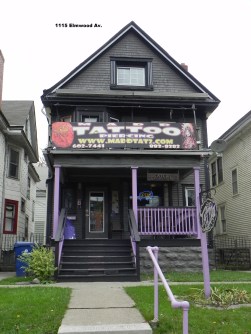
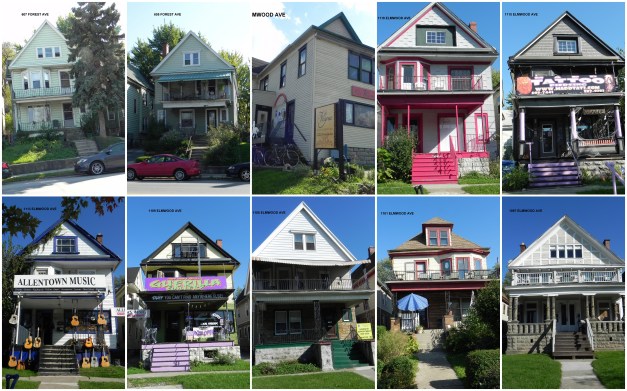
(a) Affinity’s project is grossly inconsistent with the scale and character of the 12 primary structures it would replace. Eleven of the twelve existing structures on the 12 parcels comprising the Chason Affinity project – that is, 1091 through 1121 Elmwood Ave., and 605 and 607 Forest Ave. – are two- and two-and-a-half story structures on single, moderate-size lots. The twelfth structure – at 1111 Elmwood Avenue – is a 1.3-story single-family residence. The twelve structures have a total gross floor area of 34,062 square feet, 20.5% of the total gross floor area of the proposed project, 166,000 square feet. [Attached as Exhibit A is pertinent “Property Information” material re 1091 through 1121 Elmwood Ave., and 605 and 607 Forest Ave.]

recently-updated

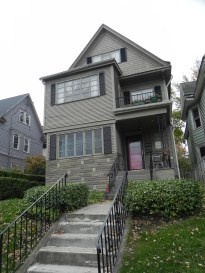
(b) Affinity’s project is grossly inconsistent with the scale and character of the ten adjacent residences on Forest Ave. and Granger Place. Nine of the ten structures on Granger Place [64 through 36 Granger Pl.] and Forest Avenue [611 Forest Ave.] abutting or immediately adjacent to the Chason Affinity property are 2-family residences, and the tenth structure is a three-family residence. The ten parcels are all developed with two- and two-and-a-half story structures on single, moderate-size lots, setback from the public right-of-way by front lawns, and have a total gross floor area of 25,105 square feet, 15.1% of the total gross floor area of the proposed project, 166,000 square feet. [Attached as Exhibit B is pertinent “Property Information” material re 64 through 36 Granger Pl. and 611 Forest Avenue (Sandra Girage’s property.]

photos-with-captions

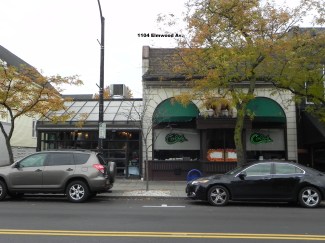
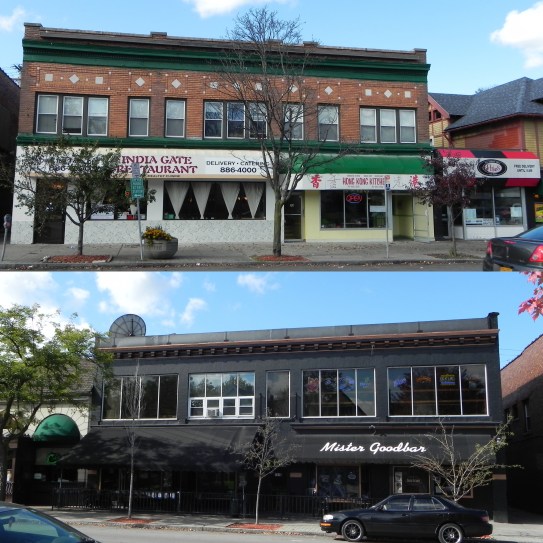
(c) Affinity’s project is grossly inconsistent with the scale of the commercial buildings directly across street on the west side of Elmwood Avenue. The six buildings on the west side of Elmwood Ave. directly across Elmwood from the proposed Chason project – that is, 1122, 1116, 1108, 1104, 1096 and 1094 Elmwood – are all 2-stories in height, and have a combined gross floor area of 35,224 square feet, 21.2% of the total gross floor area of the proposed project, 166,000 square feet. [Attached as Exhibit C is pertinent “Property Information” material re 1094 through 1122 Elmwood Ave.]

picasa exh-32-1104-elmwood-ave-11-06-13

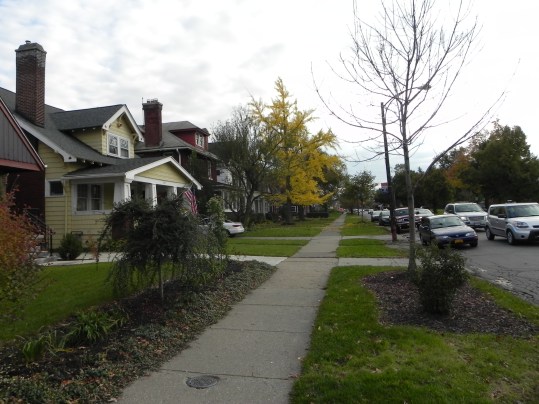
(d) Affinity’s project is grossly inconsistent with the scale and character of the single-family residences on the east side of Elmwood Ave. immediately north of the corner of Elmwood & Forest. Although you would never know it from reading the DEIS, but starting barely 100 feet from the northeast corner of Elmwood and Forest, and extending along the east side of Elmwood for 18 parcels, are eighteen single-family residences. Ten of the twelve residences closest to the Chason Affinity project are 2-story structures, one is a 1.5-story home, and one a 2.5-story home. These dozen parcels are zoned R1, are moderate in size, and the houses are setback from the public right-of-way by front lawns. The total gross floor area of these 12 residences is 25,167 square feet, or 15.2% of the total gross floor area of the proposed project, 166,000 square feet. [Attached as Exhibit D is pertinent “Property Information” material re 1143 through 1187 Elmwood Ave.]

dscn1110

The stunning contrast between the proposed project and the existing neighborhood and community character and scale constitutes a “significant adverse environmental impact.” As a result, this body, as lead agency, is obligated under SEQRA to “incorporate as conditions” to any decision approving the project “mitigative measures” that will avoid or minimize adverse impacts “to the maximum extent practicable.” [6 NYCRR 617.9(b)(7)] More specifically, SEQRA expressly provides all lead agencies with the authority to impose substantive conditions upon an action that are deemed “practicable and reasonably related” to the identified adverse impacts. [6 NYCRR 617.3(b)] In this instance, that would mean strictly limiting the height, square-footage, and footprint of the proposed project.

FIFTH, the DEIS misleads this board and the public regarding the character of the adjoining neighborhood through what it omits. The DEIS appendices include a blue-starred map of properties on Elmwood Avenue with “Residential Only” usage. The project sponsor omits, however, a similar blue-starred map reflecting the fact that each and every property on the Forest Ave. block between Elmwood and Granger adjacent to the project site – including the pair of two-family residences at 605 and 607 Forest that Chason Affinity proposes to demolish – as well as the property directly across Forest from 605 and 607 Forest at 2 Penhurst Park, and each and every Granger Place property to the east of the proposed multi-use project, are utilized solely for residential purposes. Here’s what such a map would look like:

blue-stars

SIXTH, the fact that a dozen “Residential Only” properties – including one single-family, ten two-family, and one three-family houses – adjoin the project site underscores the disservice the DEIS performs when it downplays the adverse impacts that would result during the projected 18-month construction period. The DEIS acknowledges that “[c]onstruction activity noises are expected to result from delivery of materials, installation of materials, and operation of heavy machinery and equipment,” [DEIS, 11] and that, in addition to noise, construction will create adverse air quality, parking and visual impacts [DEIS, p. 58]. Nonetheless, it minimizes the impacts by characterizing them as “short term” or, as in the case of dust, “a temporary nuisance.” [DEIS p. 53] That temporary nuisance, daily from 7AM to 7PM, will feel like an eternity if you are Sandra Girage’s tenants at 611 Forest Ave., or the octogenarian widow who lives at 2 Penhurst Park, or any of the adjacent Granger Place homeowners and tenants.

SEVENTH, the SEQRA regulations state that a DEIS must include “a description of the mitigation measures.” [6 NYCRR 617.9(b)(5)(iv)] Given this mandate, it is wholly inadequate for the DEIS to state that, “A traffic and vehicle access plan will be prepared and used for worker and delivery access to the Site,” and not provide details of the plan. [DEIS, pp. 11, 53] This is especially true given the proximity of nearby residences, the busy nature of the Elmwood/Forest intersection, the existing sparsity of on-street parking, and the admission in the DEIS that, “Large volumes of construction related vehicles are expected Monday through Friday” during the 18-month construction period.

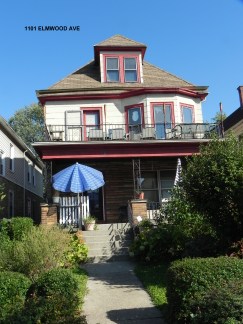
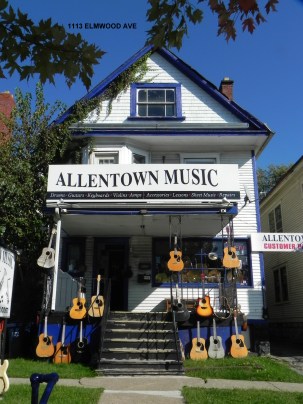
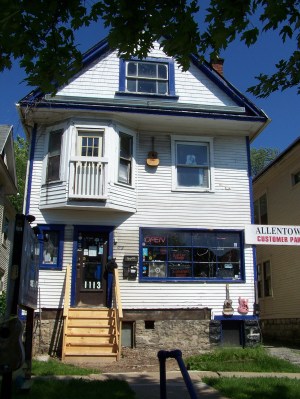
EIGHTH, in an attempt to minimize the historic significance of the dozen primary structures proposed for demolition by Affinity – despite their contributions to the newly recognized Elmwood Village Historic District (East) – the author of the DEIS has the nerve to make the following assertions: “some have been affected by the removal of porches and other building alterations,” and “the Project is expected to enhance the appearance of the existing deteriorating buildings at the corner of Elmwood and Forest Avenues.” What makes these statements so brazen are the following facts: Affinity has owned all but one of these properties (1091 Elmwood) since 2009, and has continued collecting rents from retail and residential tenants throughout much of this period. It is Affinity that is responsible for the current condition of the buildings they want to demolish.  Also, as these before-and-after photos (taken subsequent to Chason Affinity’s purchase of the properties, and prior to the property’s inclusion on the National Register of Historic Places) reflect, it was Affinity that decided to remove – rather than repair – the porches at 1113 Elmwood Avenue:

dscn2339a exh-6-1113-elmwood-ave-11-06-13

It may be inconvenient for the project sponsor, but this board, as the SEQRA lead agency, must keep firmly in mind the words contained in the two April 25, 2016 letters sent to Chason Affinity by the State’s Deputy Commissioner for Historic Preservation, Ruth L. Pierpont (included in Appendix D of the DEIS) regarding ten properties the project sponsor would like to demolish on and near the corner of Elmwood and Forest avenues: “… [T]he National Register [of Historic Places] is the nation’s official list of properties worthy of preservation. Listing on the National Register recognizes the importance of these properties to the history of our country…” The Deputy Commissioner’s statement is in stark contrast to the false assertion at page 15 of the DEIS: “None of these structures have any reported historical or architectural significance.”

NINTH, the DEIS contains no data or analysis to support its conclusion that existing infrastructure “contains excess capacity for additional development.” [DEIS, p. 58] The adjacent residential community has questioned the adequacy of the existing sanitary sewer system for many years. SEQRA and fairness to the existing neighborhood mandate a thorough review of this potential area of environmental concern.

TENTH, the relevant “scale” and comparisons for this board to keep in mind when assessing the proposed project’s height and impacts on the existing neighborhood character and aesthetics are found at in the EVDS, not in Appendix G (Illustrative Scale Design) of the DEIS:

evds-re-scale

As stated at Section 511-155(G)(1)(a) of Buffalo’s zoning code, the predominant height of buildings in the Elmwood Village Design District “is between two and 2 ½ stories,” and “new buildings shall respect the predominant height of buildings within the area.” The fact that the EVDS provision states that “buildings of more than five stories” are inappropriate does NOT mean that Chason Affinity has the right under the existing zoning code to construct a five-story building. This board must also ask the question: Does a five-story structure “respect the predominant height of buildings” in the area? It is my client’s opinion that it does not. If allowed to proceed, the proposed 5-story “1111 Elmwood” project would be between 2.5- and 3-stories taller than the closest building on Elmwood Ave. (Pano’s restaurant at 1081 Elmwood), and on Forest Ave. (Sandra Girage’s house at 611 Forest Ave.), and each of the residences on Granger Place immediately to the rear of the proposed 166,000-square-foot development.

exh-13-1081-elmwood-ave-11-06-13  exh-39-611-forest

ELEVENTH, the “Alternatives Analysis” in the DEIS [DEIS, pp. 55-56] fails miserably in complying with either the letter or spirit of the “reasonable alternatives” analysis mandated by the SEQRA regulations:

617.9 Preparation and content of environmental impact statements

(b) Environmental impact statement content.

…

(5) The format of the draft EIS may be flexible; however, all draft EISs must include the following elements:

(v) a description and evaluation of the range of reasonable alternatives to the action that are feasible, considering the objectives and capabilities of the project sponsor. The description and evaluation of each alternative should be at a level of detail sufficient to permit a comparative assessment of the alternatives discussed. The range of alternatives must include the no action alternative. The no action alternative discussion should evaluate the adverse or beneficial site changes that are likely to occur in the reasonably foreseeable future, in the absence of the proposed action. The range of alternatives may also include, as appropriate, alternative: (a) sites; (b) technology; (c) scale or magnitude; (d) design; (e) timing; (f) use; and (g) types of action. For private project sponsors, any alternative for which no discretionary approvals are needed may be described. Site alternatives may be limited to parcels owned by, or under option to, a private project sponsor;

…

For example, the SEQRA regulations require that, “The description and evaluation of each alternative should be at a level of detail sufficient to permit a comparative assessment of the alternatives discussed.” Rather than meet this standard, the DEIS’ “Alternatives Analysis” provides no meaningful data or detailed evaluation of any kind. Instead we are given clichés about how wonderful the preferred alternative is. The discussion of the “No Action Alternative” repeats the same misleading assertion contained in the DEIS’ discussion of the project’s need and purpose, that is, “that the current structures do not conform to the existing Elmwood Village Design Standards, due to their significant setback form the street.” In fact, the EVDS standards only apply to “commercial properties,” and, therefore, the eight “residential only” properties owned by Chason Affinity are not out-of-compliance. Additionally, the project sponsor has failed to analyze the types of alternatives which would offer a meaningful comparison with the proposed action: a significantly shorter building with a substantially smaller footprint, or an “alternative for which no discretionary approvals are needed” (that is, no rezoning and no variances).

TWELTH, the DEIS is correct when it states that “the Elmwood Village is a thriving neighborhood,” but its claim that the thriving nature of this neighborhood is due to its “evolving mix of architectural styles and building scales” is self-serving and inaccurate. My client believes that the former Director of Zoning for the City of Rochester, Arthur J. Ientilucci, AICP, accurately explained the reasons for the success and attractiveness of the Elmwood Village when he identified the balance the Elmwood Village achieved over the years “between residential and non-residential use both in terms of density, concentration and scale.” As Mr. Ientilucci stated in 2013:

                                                                      …

            “Elmwood Village … is a distinct, recognizable urban district characterized by a mix of residential, boutique and small scale commercial uses… This is an urban neighborhood and not simply a commercial area bounded by residential areas.

            Elmwood Village is a thriving mixed use urban neighborhood with many amenities that are attractive to urban dwellers. … It is a sustainable, intact neighborhood which has been built on certain characteristics and amenities, not the least of which is a healthy diverse residential population and housing stock. It has a high degree of walkability, a factor important to home buyers and dwellers in the emerging, often discussed ‘return to city living’.

            A good deal of the Elmwood Village’s character is derived from the intermingling of small scale commercial uses and a variety of residential building styles affording a wide range of choice for its residents. The harmonious scale, older homes, and connectedness of buildings and uses throughout the area is a significant and attractive attribute. The district appears to have achieved a balance between residential and non- residential use both in terms of density, concentration and scale. This balance appears to have accrued from the residential character of the neighborhood, the scale of its non-residential structures in relation to nearby residential properties, and zoning code limitations on the intensity and scale of commercial use…”

THIRTEENTH, despite efforts in the DEIS to cherry-pick “smart growth” terminology and to ignore goals and principles that weigh against Chason Affinity’s plans, a close look at the City of Buffalo’s Comprehensive Plan – known as “Queen City in the 21st Century” – reveals significant inconsistencies between the proposed “1111 Elmwood” project and Buffalo’s comprehensive plan.   Here are several examples:

(a) The DEIS disregards a truism recognized by the Comprehensive Plan: “Conditions in Buffalo neighborhoods vary widely”:

“… Some are in good shape, attractive as living environments, and competitive as housing markets. Some are in desperate condition, with many dilapidated structures, high vacancy rates, low home-ownership rates, and a proliferation of vacant lots. The rest are somewhere in between…” [Comp Plan, p. 85]

The use of “demolition, rehabilitation and new construction to manage housing stock” is the approach the Comprehensive Plan envisions for neighborhoods in desperate condition. It is not what is proposed for the southeast corner of Elmwood and Forest avenues. While portions of Elmwood Ave. – for example, south of Summer Street – may require revitalization, the planning process utilized by the City of Buffalo in preparing the Comprehensive Plan concluded that the entire east side of Elmwood Ave., extending from the Scajaquada (Route 98) south to W. Utica, only requires actions necessary to “reinforce” the existing conditions, not to “revitalize” or “rebuild” the neighborhood. Not surprisingly, Elmwood Avenue is characterized as a “flourishing mixed-use commercial corridor with small specialty shops and boutiques, unique restaurants, bars and coffee houses,” and “one of the key communities for marketing the City of Buffalo to the region.” [Attached hereto as Exhibit E is a two-page excerpt from the Draft Comprehensive Plan regarding the “Elmwood Planning Community.”]  [Click here:  elmwood-draft-comprehensive-plan.]

(b) As the quote found at p. 23 of the DEIS indicates, the concept of “infill development” is meant as an approach for “reclaiming marginal and abandoned areas.” Demolishing 12 century-old buildings that reflect the history of a neighborhood, and replacing them with a huge structure different in character and scale from its surroundings, is neither “infill development,” nor smart growth.

(c) Chason Affinity’s proposed project violates two guiding principle “specific to the design of good neighborhoods” expressed in the Comprehensive Plan: “Individual architectural projects should be seamlessly linked to their surroundings.” And, “Architecture and landscape design should grow from local climate, topography, history, and building practice.”   [Comp Plan, p. 97, 98] The project sponsor’s preferred alternative does neither.

(d) Chason Affinity’s plan to demolish a dozen structures – despite their contributions to the newly recognized Elmwood Village Historic District (East) – violates another principle “specific to the design of good neighborhoods” identified in the Comprehensive Plan: “Preservation and renewal of historic buildings, districts, and landscapes affirm the continuity and evolution of urban society.” [Comp Plan, p. 98] According to the Comprehensive Plan, preservation of the city’s historic resources – including historic districts – is important for a variety of reasons: it helps sustain the “web of urbanism”; it supports the community’s economic development goals by attracting tourists; and, it contributes to the quality of life that draws people and capital. [Id.]

(e) The Comprehensive Plan specifically calls for “a moratorium on demolitions other than those necessary for the preservation of public health.” [Comp Plan, p. 100]

(f) The density Chason Affinity proposes for its project – 45 to 50 units on a 1.1 acre site – far exceeds the densities envisioned in Buffalo’s Comprehensive Plan. [Comp Plan, p. 106] For example:

* A “mixed-use neighborhood commercial” district would allow mixed residential use with 8 to 16 units per acre, with accessory ground floor non-residential development.

* A “mixed use downtown district (outside of the Central Business District) would allow mixed residential use with 16 to 24 units per acre, with non-residential development.

* Only “mixed use downtown Central Business District” would allow residential use with 24 units or more per acre.

FOURTEENTH, the traffic analysis contained in the DEIS fails to provide an accurate assessment of the real-life impact on the adjacent community of the increase in traffic that would accompany the Chason Affinity project:

(a) By focusing on AM and PM “Peak Hour” trip generation, and omitting an estimate of the total number of trips the project will be generating on a daily basis, the DEIS understates the impact on nearby residents, pedestrians, bicyclists and drivers. My review of the ITE Trip Generation data reveals that, on average, the AM Peak Hour trips from a residential condominium/townhouse development represents only 7 or 8% of the total number of vehicle trips generated by the development throughout a typical weekday. Likewise, the PM Peak Hour figure reflects less than 10% of the total trips generated daily by the average condo/townhouse project. If the trip estimates provided in the DEIS traffic analysis are accurate, the proposed 45 to 50 units at “1111 Elmwood” would generate approximately 400 vehicle trips per day pulling into or out of traffic on already-busy Elmwood or Forest avenue. Similarly, the AM and PM Peak Hour figures for a Specialty Retail Center equal somewhere between 6 and 8% of the traffic generated throughout the entire day. Again, if the trip estimates provided in the DEIS traffic analysis are accurate, the three 2,500-square-foot commercial shops at 1111 Elmwood would add approximately 300 vehicle trips per day to existing traffic.

(b) Despite the fact that the project sponsor’s FEAF states that “During Operations” the proposed development “hours of operation” would be from 7 AM to 7 PM throughout the entire week, Chason Affinity’s traffic consultant has chosen not to include AM Peak Hour trips in its projection of estimated trips for the three specialty retail stores. My review of the ITE Trip Generation data shows that, on average, specialty retail centers generate a larger amount of traffic during the AM Peak Hour than during the PM Peak Hour.

(c) Although the project sponsor’s traffic analysis includes its estimate of the impact of the proposed project on the adjoining commercial property, Pano’s Restaurant, it does not provide an estimate on how the Forest Avenue entrance/exit – which will be accessed by 100% of commercial traffic using the on-site parking facility, and 50% of the residential traffic – will impact vehicles entering or existing either the residential driveway at 2 Penhurst, or the gas station/convenience store driveway at 1131 Elmwood. It is inconceivable that the additional traffic entering and exiting the proposed project will not impact safety and convenience for drivers using existing driveways in such close proximity.

FIFTEENTH, although it claims that the proposed project is “intended to meet the spirit and intent” of the proposed Green Code, the DEIS has conveniently failed to mention an important way in which the proposed project does not comply with the proposed Green Code: In addition to height limitation of three stories, the proposed Green Code, to maintain the character of the Elmwood Village, states the following: “No more than two lots in the Elmwood Village, existing at the time of the adoption of this Ordinance, may be combined for the purposes of new construction in an N-2C or N-2E zone.”

FOR THE ABOVE REASONS, my client, Sandra Girage, respectfully asks this board to take the following steps:

A. Exercise the authority given to you by the SEQRA regulations [6 NYCRR 617.9(a)(7)] and require the project sponsor to submit a Supplemental Environmental Impact Statement [SEIS] that addresses, at a minimum, the following issues not addressed or inadequately addressed in the DEIS:

(i) The impact of the proposed 5-story, 166,000-square-foot project on the character of the single-family residences on the east side of Elmwood Avenue north of Forest Avenue.

(ii) A detailed description of the “traffic and vehicle access plan will be prepared and used for worker and delivery access to the Site,” addressing how such plans would address the adverse impact of an 18-month construction schedule on nearby residences, the Elmwood/Forest intersection, the existing sparsity of on-street parking, and nearby businesses given “large volumes of construction related vehicles [that] are expected Monday through Friday” during the 18-month construction period.

(iii) Objective data and analysis to show whether or not the existing infrastructure, and, in particular, the existing sanitary sewer system contains adequate capacity to handle the proposed project.

(iv) An “Alternatives Analysis” that complies with the requirements of the SEQRA regulation [6 NYCRR 617.9(b)(5)(v)] by providing a description and evaluation of each alternative “at a level of detail sufficient to permit a comparative assessment of the alternatives discussed.” The alternatives described and evaluated, in addition to the “no action” alternative, should include a significantly shorter building with a substantially smaller footprint, and an alternative for which no rezoning or variances are needed.

(v) An expanded traffic analysis that includes trip generation figures on a daily basis (weekday, Saturday and Sunday), in addition to AM and PM peak hours; trip generation during AM peak hours for the three 2,500-square-foot retail stores; and, the impact of the Forest Avenue entrance/exit on the residence at 2 Penhurst and gas station/convenience store at 1131 Elmwood Ave.

B. Utilize the 45-day period provided by the SEQRA regulations between the close of the public hearing and the preparation of the Final EIS [6 NYCRR 617.9(a)(5)] to provide meaningful responses to all substantive comments received regarding the DEIS.

C.  If, following issuance of the Final EIS and SEQRA written findings statement, this board determines that it will approve Chason Affinity’s design and site plan application, fully comply with a lead agency’s obligation under SEQRA to “incorporate as conditions” to any decision approving the project “mitigative measures” that will avoid or minimize adverse impacts “to the maximum extent practicable.” [6 NYCRR 617.9(b)(7)] More specifically, exercise your authority under SEQRA [6 NYCRR 617.3(b)] to limit the height, square-footage, and footprint of the proposed project so as to avoid or minimize the project’s adverse impacts on the existing neighborhood and community character, and the quality of life of the nearby residents.

Thank you.

Respectfully yours,

Arthur J. Giacalone

Enc.

No Sympathy for the Devel(oper)! But Concern for Buffalo’s Outer Harbor

Posted by Arthur J. Giacalone on November 19, 2016
Posted in: Development, Gerald A. Buchheit Jr., Waterfront. 1 Comment

In an article published November 15, 2016, Buffalo Business First – a myopic cheerleader for any and all proposed development projects in Western New York – printed a sob story under the headline, “Legal challenges could stop Queen City Landing project.” Paraphrasing the project’s developer, Gerald A. Buchheit, Jr., Buffalo’s business journal informed the world that, “Prolonged delays, caused by a legal challenge filed against the 23-story Queen City Landing project, could potentially end the project on Buffalo’s Outer Harbor.”

On November 17, 2016, the Buffalo News joined Mr. Buchheit’s campaign. The region’s largest daily newspaper ran a brief article, under the headline, “Freezer Queen demolition mostly done,” in which my clients’ legal efforts to stop the Queen City Landing development is mentioned, and Mr. Buchheit then warns that he is “on a tight schedule” to get the new building constructed and enclosed by the end of 2017.

dscn8004

DSCN8005.JPG

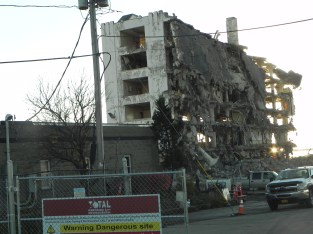
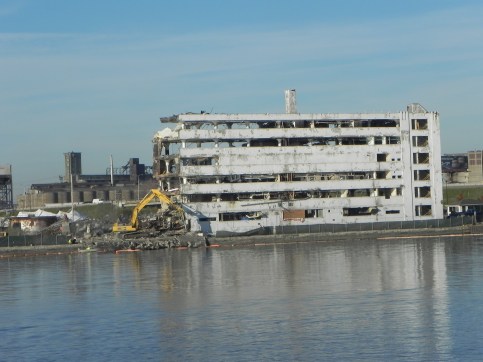
Neither Buffalo Business First, nor the Buffalo News, reached out to project opponents for their perspective on Buchheit’s comments. More importantly, neither publication has bothered to inform its readership about what occurred on the intervening day, November 16th. That was the date a section of the former Freezer Queen wall fell into Lake Erie’s Small Boat Harbor (a state-designated significant bird and wildlife habitat) during the demolition process.  Here’s a photo – from a distance – of the above-water portion of the Freezer Queen debris draping the seawall and immersed in Lake Erie, followed by two photos of a construction vehicle’s efforts to remove the debris from the water (taken by me between 3:15 and 3:45 on the afternoon of November 18th):

dscn7956

dscn7992

dscn8000

The public is left with many questions: Did Queen City Landing’s haste to complete the demolition activities contribute to this mishap? Has all the debris been removed? Has the aquatic habitat or the seawall structure (which – among other functions – holds back the contaminated groundwater) been compromised? Has the State DEC incurred expenses related to this event? Will there be an administrative investigation that could lead to imposition of fines or penalties against the project sponsor, Queen City Landing LLC, and/or its demolition contractor? Were the steps taken on behalf of the project sponsor to prevent this sort of mishap adequate? [Here’s a photo depicting the fencing that stands/stood between the massive Freezer Queen facility and Lake Erie’s waters.]

dscn7981

Answers – if forthcoming at all – will have to wait. But here are the reasons why I have little sympathy for the developer, and grave concern both for the environment and natural habitat areas comprising Our Outer Harbor, and for the integrity of a government decision-making process which allows developers to easily circumvent the very laws enacted to protect our fragile environment:

FIRST, in my opinion, aided by compliant City of Buffalo officials, the project sponsor took steps on November 3, 2016 – in response to my clients’ request to a Justice of the Appellate Division on November 2nd to temporarily stop demolition of the Freezer Queen building – to intentionally destabilize the eastern (front) half of the Freezer Queen facility. By doing so, Queen City Landing provided support to their attorneys’ argument – made before the appellate jurist late on the afternoon of Nov. 3rd – that the entire building was too unsound and unstable to stop the demolition process. [See the Nov. 4, 2016 affidavit-of-David-Sanborn, with a photo of the eastern portion of the building taken late in the day on Nov. 3rd, which ironically states, “[T]he eastern portion of the structure is now structurally unsound and demolition needs to continue without delay in order to prevent portions of the entire structure from falling in a manner whereby debris and portions of the structure will fall into Lake Erie.” Also see my affirmation-in-support-of-preliminary-relief, which, among other things, explains the historic significance of the Freezer Queen building.]

Note:  A few days prior to my clients’ request for a Temporary Restraining Order to halt the demolition, Queen City Landing’s demolition contractor, TOTAL WRECKING, had sent out a press release announcing a “media event” at 1 PM on Friday, Nov. 4, 2016 at the Freezer Queen building to “provide an update on the current phase of the Queen City Landing redevelopment project.” [Click here for the Oct. 31, 2016 media-event flyer.]  It seemed rather peculiar to me the Queen City Landing’s agents would invite the media to assemble at the site of a purportedly unsound and unstable structure.  The event was canceled following my correspondence to the appellate court justice regarding it.

Update 11-21-16:  I received copies of the “clearance-letters-and-demolition-permits” related to demolition of the Freezer Queen facility from the City’s Permit & Inspection Services office on 11/21/2016 in response to my Nov. 11th FOIL request (a remarkably reply).  The papers reinforce my opinion that the project sponsor hastily took steps – following my clients’ Nov. 2nd request for a TRO to halt the demolition – to destabilize the eastern end of the building so that they could advise the appellate court that the entire structure was too unstable and  unsound to halt the demolition process.  Here’s the chronology:  (1) On October 14, 2016, AMD Environmental submitted a one-page “clearance letter” to Queen City Landing’s general contractor and partner, R&P Oak Hill, “for the freezer portion” of the project, following an Oct. 12th inspection, stating that, “asbestos abatement of the freezer portion of the building is considered complete.  A “full report with all sets of analytical” were not provided to R&P Oak Hill.  (2) On October 21, 2016, the City of Buffalo issued a Demolition Permit to Queen City Landing LLC for “Phase I” – removal of “the rear section” of the building ONLY.  The signature line for the Contractor is dated 10/21/2016.  (3) On November 3, 2016, AMD Environmental submitted a one-page “clearance letter” to  R&P Oak Hill, for the “Main Structure Front Production Building,” following an inspection which had taken place that same date, stating that the, “abatement work areas have met clearance standards.”  Once again, a “full report with all sets of analytical” were not provided to R&P OAK Hill.  (4). An amended Demolition Permit adds the following language to its Description of Work section:  “PHASE II DEMO REMAINING 6 STORY FRONT PORTION CLEAN LETTER SCANNED 11/3/16.”  The signature line for the Contractor is dated 11/15/2016.

Note:  Due to its significant role in the history of the industrial Outer Harbor, the Freezer Queen building was eligible for listing on the national register of historic places.

SECOND, in my opinion, Mr. Buchheit and his “silent partners” presented an unrealistic timetable for this sizeable project – a timetable that could only be met if the “hard look” mandated by the State Environmental Quality Review Act [SEQRA] and Buffalo’s zoning laws was circumvented, and no members of the public opposed a 23-story tower on the Outer Harbor. In mid-March 2016, when Buchheit & Co. abandoned their project which had been approved by the City of Buffalo just 3 or 4 months earlier (to add a penthouse floor and re-use the existing Freezer Queen building), Mr. Buchheit told Business First: “I hope we can start this by June. Everyday I am getting more and more excited about the project.”

THIRD, in my opinion, Buchheit and his team of consultants made some unwise strategic choices in an effort to fast-track the approval process, and, by doing so, delayed the proceedings at the City Planning Board. The initial SEQRA documents filed on behalf of the project were wholly inadequate for a project as large and complex as the 23-story tower facility. And the effort by Queen City Landing’s legal counsel to deny that the project site – on the shoreline of Lake Erie, and in the heart of the Outer Harbor – was not located within Buffalo’s Special Coastal Review District (and, thereby, triggering a review of the proposal by the City’s Common Council), showed a lack of due diligence. These procedural oversights added nearly two months to the decision-making process. [See my April 18, 2016 letter-to-the-City-Planning-Board addressing a variety of the procedural issues raised by the Queen City Landing application.]

FOURTH, in my opinion, litigation could well have been avoided had the project sponsor taken the proverbial high road and conceded the need for the comprehensive environmental review called for by SEQRA’s Draft Environmental Impact Statement [DEIS] process. Had the DEIS protocol been diligently followed, the public and the government decision-makers would have had access to meaningful data and information to allow an informed and well-reasoned opinion on whether a 23-story, glass-and-metal tower would adversely impact migrating birds following a globally significant migratory pathway, or the adjacent aquatic habitats, or the existing character of the Outer Harbor parks, walkways, marinas, etc.  A DEIS would also have properly assessed the adequacy of the developer’s proposed mitigation measures.

FIFTH, in my opinion, and, as explained at paragraph “35” of Mr. Buchheits-Nov-14th-affidavit, the proposed project inexplicably remains “in a design and engineering phase,” with “significant decisions to be made on the building foundations, structural steel, finishing materials and operating systems,” as well as “decisions to be made on the attendant inside elements.” One can only wonder the extent of actual due diligence that was performed by the Buchheit team prior to submitting plans to the City of Buffalo in mid-March 2016.  Despite the passage of five-and-a-half months since the May 31, 2016 approval of Queen City Landing’s design and site plan application, so many crucial decisions still need to me made. The magnitude of the project sponsor’s uncertainty about the final details of the project is underscored by Mr. Buchheit’s statement, at paragraph “34” of his affidavit, that “construction costs for the Project are estimated currently between $60 and $85 million.”

SIXTH, in my opinion, the project sponsor’s desire to keep the public and potential residents of the proposed Queen City Landing development ignorant of the extreme winter weather conditions along the Outer Harbor shoreline was demonstrated by its counsel’s efforts to exclude from the court record a one-page document – the vulnerability-study-memorandum submitted by Prof. Margaret Wooster to the City Common Council. That sheet, ultimately made a part of the court record by the lower court judge, includes the following statement:

“The Skyway experienced 156 lane closures between 2003 and 2006, many of these weather related. During extreme weather events where evacuation may be necessary, the Skyway cannot be relied upon as an evacuation route. Outer Harbor residents would need to walk 40 minutes through a heavy industrialized area to reach the nearest community center, church, or school. Lack of amenities such as police, fire stations and grocery stores increases sensitivity, especially during extreme hazard events.  Exposure is also high. A 2014 State Department of Homeland Security and Emergency Services report shows Erie County has high exposure to significant wind and winter weather events due to its proximity to Lake Erie winds, snow and seiche flooding. The Outer harbor is one of the most exposed locations to prevailing weather in Erie County.”

If the Queen City Landing tower does not proceed, Mr. Buchheit and his team will almost certainly blame the pending legal action as the culprit.  An objective assessment, however, would point to the major flaws in the developer’s handling of the project as the primary reason for its demise.

With All Due Respect,

Art Giacalone

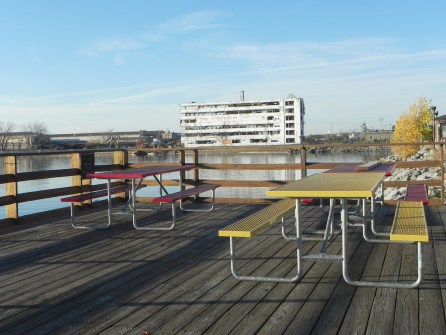
P.S. I took a bike ride and some photographs on the sunny and glorious Friday afternoon we Buffalonians experienced on November 18th (initially, unaware of the debris-in-the-water situation). For those in the community who will miss the historic piece of Buffalo waterfront history that the Freezer Queen facility represents, here are several views of that structure that will soon be extinct:

dscn7962

dscn7953

dscn7964

dscn7975

dscn7978

dscn7980


Chason Affinity’s DEIS for “1111 Elmwood” does not tell the real story

Posted by Arthur J. Giacalone on November 15, 2016
Posted in: Elmwood Village, SEQRA. Leave a comment

Here are my initial thoughts on the Draft Environmental Impact Statement [DEIS] for the “Mixed-Use Condominium/Retail Development” proposed for the southeast corner of Elmwood and Forest avenues.

First, full disclosure: I spent seven years representing six families on Granger Place and Forest Avenue in opposition to Chason Affinity’s prior plans for what the developer calls “the Gateway to the Elmwood Village.”  In 2012, I filed complaints with the City of Buffalo’s permits and inspections office concerning chronic code violations at Affinity’s Elmwood Avenue properties, and I also wrote a letter-to-the-editor questioning the wisdom of Chason Affinity’s proposal to reuse the former Millard Fillmore hospital site as a veterinarian teaching hospital. In response, the Affinity principals had their lawyers obtain an unlawful “gag order” against me from a compliant, now-disgraced State Judge. [For details, see my very first post at this blog in January 2014. Also, here’s the letter-to-the-editor that got the Affinity folks so riled up, and a few photos of the condition of Affinity’s Elmwood Ave. properties three years after they had purchased eleven parcels for nearly $2 million.]

1115-elmwood-replace-deteriorated-roof

dscn1475

dscn1469

My comments concerning the Affinity DEIS – and the developer’s proposed five-story, 166,000-square-foot project – are informed by my love for the Elmwood Village (where I lived for years as a young adult), the knowledge I obtained while representing the Granger Place and Forest Avenue families, and a quarter century representing families in zoning and environmental review matters.

Here are my initial observations (which I hope to supplement as time permits):

FIRST, the supposed “Need” for the project lacks factual support, and is overflowing with ironic assertions and mischaracterizations of the Elmwood Village and the City’s zoning laws. Here are but three examples:

*** According to the DEIS, “Like many other cities across the United States, the City of Buffalo has a relatively low supply of housing for newcomers who wish to remain in the City.” This assertion would probably surprise the head of the Mayor’s Office of Strategic Planning, Brendan Mehaffy. A year ago, during a panel discussion at Medaille College, Brendan gushed that, yes, indeed, Buffalo was experiencing a “housing boom” with 3,900 new units having been added since 2012.

*** In the words of the DEIS’ authors, the Elmwood Village “is increasingly desirable due to its intact urban fabric, recognizable thriving commercial district and proximity to high-quality public space.” Ironically, the proposed 166,000-square-foot project would rip apart the “intact urban fabric” by demolishing a dozen century-old buildings that are all “contributing” to the recently listed Elmwood Village Historic District (East)” on the National Register of Historic Places. And, to add insult to injury, Affinity wants to replace the “recognizable thriving business district” with an out-of-scale structure that is the antithesis of the “bohemian atmosphere” described in a 2009 study prepared by Affinity’s consultant, Pinnacle Advisory Group:

“… The existing development in the immediate and surrounding neighborhood consists primarily of single family homes and free-standing homes that have been converted into apartment rentals … [T]he bohemian atmosphere and the numerous independent boutique shops and restaurants have helped to make the area around Elmwood and Forest [avenues] one of the most desirable residential neighborhoods in Buffalo. ”  [Emphasis added.]

elmwood-forest-looking-south-06-22-06

1109-elmwood-ave

*** The DEIS states that, “The Project aims to transform the Site into one more consistent with prevailing Elmwood Village design standards…[EVDS]” This assertion – intentionally or otherwise – inaccurately suggests that the EVDS criteria (mixed-use buildings constructed at the sidewalk, etc.) applies to every parcel within its boundaries. That claim is false. As clearly stated at Section 511-155(b)(1) of the City’s zoning ordinance: “The Elmwood Village Design Standards District shall include all commercial properties abutting Elmwood Avenue between Forest Avenue and North Street,” as well as “all commercial properties abutting” specified east-west spurs, including Forest between Richmond and Granger. In other words, the eight residential properties included within Affinity’s twelve parcels – six on Elmwood, and two around the corner on Forest – are NOT included in the EVDS, and, therefore, are not inconsistent with the expressed standards.  [See EVDSD-section-511-155-amended-06-11.]

1101-elmwood-ave

1097-elmwood-ave

SECOND, proponents of the existing character of the Elmwood Village will not be fooled by a five-story, 166,000-square-foot building that supposedly has the “appearance of multiple structures” and will “’read’ as a three-story building” [as a result of the 4th and 5th stories being “stepped back”]. The proposed project will be demonstrably out-of-scale and character, and have a much greater density, than the existing Elmwood Village as a whole, and, more importantly for the purposes of SEQRA, the neighborhood immediately surrounding the Chason Affinity project. More specifically, the property information available at the City of Buffalo’s website shows the following:

rendering-of-affinity-project

(a) Affinity’s project is grossly inconsistent with the scale and character of the 12 primary structures it would replace. Eleven of the twelve existing structures on the 12 parcels comprising the Chason Affinity project – that is, 1091 through 1121 Elmwood Ave., and 605 and 607 Forest Ave. – are two- and two-and-a-half story structures on single, moderate-size lots. The twelfth structure – at 1111 Elmwood Avenue – is a 1.3-story single-family residence. The twelve structures have a total gross floor area of 34,062 square feet, 20.5% of the total gross floor area of the proposed project, 166,000 square feet.

recently-updated

(b) Affinity’s project is grossly inconsistent with the scale and character of the ten adjacent residences on Forest Ave. and Granger Place. Nine of the ten structures on Granger Place [64 through 36 Granger Pl.] and Forest Avenue [611 Forest Ave.] abutting or immediately adjacent to the Chason Affinity property are 2-family residences, and the tenth structure is a three-family residence. The ten parcels are all developed with two- and two-and-a-half story structures on single, moderate-size lots, setback from the public right-of-way by front lawns, and have a total gross floor area of 25,105 square feet, 15.1% of the total gross floor area of the proposed project, 166,000 square feet.

photos-with-captions

(c) Affinity’s project is grossly inconsistent with the scale of the commercial buildings directly across street on the west side of Elmwood Avenue. The five buildings on the west side of Elmwood Ave. directly across Elmwood from the proposed Chason project – that is, 1122, 1116, 1108, 1104 and 1096 – are all 2-stories in height, and have a combined gross floor area of 32,060 square feet, 19.3% of the total gross floor area of the proposed project, 166,000 square feet.

picasa

(d) Affinity’s project is grossly inconsistent with the scale and character of the single-family residences on the east side of Elmwood Ave. immediately north of the corner of Elmwood & Forest. The block on the east side of Elmwood Avenue immediately north of Forest Avenue consists, first, of a one-story gas station/convenience store, and then eighteen homes, each of which is classified by the City of Buffalo as a single-family residence. Ten of the twelve residences closest to the Chason Affinity project are 2-story structures, one is a 1.5-story home, and one a 2-story home. These twelve parcels are moderate in size, and the houses are setback from the public right-of-way by front lawns. The total gross floor area of these residences is 25,167 square feet, or 15.2% of the total gross floor area of the proposed project, 166,000 square feet.


dscn1110

THIRD, in an attempt to minimize the historic significance of the dozen primary structures proposed for demolition by Affinity – despite their contributions to the newly recognized Elmwood Village Historic District (East) – the DEIS has the nerve to make the following assertions: “some have been affected by the removal of porches and other building alterations,” and “the Project is expected to enhance the appearance of the existing deteriorating buildings at the corner of Elmwood and Forest Avenues.” What makes these statements so brazen are the following facts: Affinity has owned all but one of these properties (1091 Elmwood) since 2009, and has continued collecting rents from retail and residential tenants throughout much of this timeframe. It is Affinity that is responsible for the current condition of the buildings they want to demolish.  As mentioned above, three- years into its tenure as owners of these structures, Affinity faced a battery of code violation complaints. [See the City’s official notices-of-code-violations-in-2012-at-affinitys-elmwood-ave-properties.] Also, as these before-and-after photos reflect, it was Affinity that decided to remove – rather than repair – the porches at 1113 Elmwood Avenue:

1113-elmwood-ave  no-porch-1113-elmwood-no-1

I hope to add to these comments in the near future.

With All Due Respect,

Art Giacalone


An aftermath of Trump’s victory: the uncertainty and fears of second graders

Posted by Arthur J. Giacalone on November 11, 2016
Posted in: Uncategorized. 2 Comments

My conversations with a half dozen seven and eight year-olds – thirty-six hours after our nation and the world were confronted with the reality of “President Donald J. Trump” – revealed a disturbing consequence of the 2016 Presidential election.

It was about a month ago that I started tutoring second graders in a City of Buffalo elementary school.  An important part of the school’s mission statement is “to promote understanding and tolerance among [Buffalo’s] diverse ethnic, racial and religious groups.”

My nine “tutees” – bright and curious children whose reading skills are a bit behind the national norm for their grade level – are wonderfully diverse (and, so young and vulnerable). The twice-a-week sessions I have with these energetic second graders – in groups of three – have become progressively more comfortable and rewarding.

And it seems that the time and effort this 66-year-old white male has invested in getting to know each child has helped form a sense of trust between tutor and tutees. When I asked each group this past Thursday – Nov. 10th – if anything important had happened on Tuesday, a school holiday, the unfiltered responses I received showed just how much the outside world had penetrated the lives of these innocent 7 and 8-year-olds.

Without any hesitance, an always-cheerful Muslim boy – who had referred to himself as “white” when he was asked a month ago to describe himself – exclaimed: “We all wanted the girl to win. Mr. Trump doesn’t like Muslims. We might all have to move.”

A shy, delicate African-American girl – who has grown more confident in her reading skills with each passing week – frowned and said: “My mother is sad. She voted for Hillary, and now she’s worried.”

A Muslim boy, who told me on my first day at Waterfront that his parents were from Africa, excitedly said: “We are all afraid we’ll have to move. Mr. Arthur, will you have to move?” I was touched by his concern. [Just four short weeks ago he appeared nervous about having to sit next to this stranger.] I told him that I didn’t plan on moving, but, if I did, it would be voluntary. [The group then talked about the meaning of the word “voluntary.”]

The one Muslin girl in my three groups who wears traditional Islamic clothing – a hijab – got up from her seat and emotionally explained that everyone she knew was afraid they would have to go back to Africa: “That’s where he [President-elect Trump] wants to send all Muslims.”

But the anxiety created by this week’s election results was not limited to the Muslim and African-American children I’ve gotten to know and admire the past several weeks. The sole white girl among my tutees – who has twice mentioned how her favorite weekend activity is going to church – had what was perhaps the most sobering comment about the election results: “My mother thinks that this will make her life even harder. And it’s already very hard.”

I don’t have anything profound to say about the results of the 2016 Presidential election. Or the fears and concerns expressed by these lovely children. I am trying not to automatically reach the conclusion that Mr. Trump’s ascendancy to the Presidency is “An American Tragedy.” And I do want to find a way to grit my teeth and give President Trump a chance.

But we adults must search for ways to reassure “my” [“our”!] second graders that our divided nation has the same goal as their elementary school – “to promote understanding and tolerance among its diverse ethnic, racial and religious groups.” And we must all strive to show by our words and actions that we respect each and every human being, no matter the gender, age, race, religion (or, absence thereof), sexual identity, education level, or political persuasion.

With All Due Respect,

Art Giacalone

P.S. By the way, with all three groups on Thursday, these resilient youngsters were able to quickly transition from our election-related discussion to a fun time using an ink pad and rubber stamps to learn about “middle sounds” and rhyming words.

Too Many WNY “Teachable Moments” – Time for “Learnable Moments” with Prof. Stacey Sutton

Posted by Arthur J. Giacalone on October 18, 2016
Posted in: City of Buffalo, Fruit Belt, Gentrification, South Buffalo. 1 Comment

The Moot Senior Center at 292 High Street – in the shadow of the Buffalo Niagara Medical Campus – will host a discussion on Wednesday, October 19, 2016, from 5:30 to 7:00 PM, entitled “Gentrification: A Social Justice Issue,” led by Prof. Stacey Sutton of the University of Illinois, Chicago’s College of Urban Planning & Public Affairs.  As  the event’s flyer, Gentrification-a-social-justice-issue, warmly requests: “Come to listen and to participate; bring your observations, questions, and thoughts regarding urban redevelopment; participate in positive change for Buffalo’s East Side and especially the Fruit Belt neighborhood.”

[Note:  This blog has discussed gentrification-related issues a number of times, including, for example, here, here, and here.]

Regarding the all-too-frequent “teachable moments” we find ourselves subjected to as residents of the Greater Buffalo, New York metropolitan area, what can be said.  As Buffalo News columnist Rod Watson wrote in a November 29, 2012 column, “[T]his is the region that backed the gubernatorial candidate who forwarded racist emails about the president and first lady.” [And, not surprisingly, that unsuccessful candidate for NY’s governorship is now a staunch backer and apologist for an equally unsavory Republican Presidential candidate.] Mr. Watson’s column, entitled “confronting-a-sign-maker-on-harsh-turf,” was a response to a hand-made sign exclaiming “VOTERS RENIGED” displayed in the front yard of a Town of Aurora retiree who was upset with the re-election of Barack Obama as our nation’s President.

Not long after Rod Watson’s column (which had been preceded by an article – “a sign-of-free-speech-or-of-racism?” – by Buffalo News reporter T.J. Pignataro), the conspicuously misspelled “Reniged” was replaced by “Reneged” – although the reverse side of the sign continued to shout: STILL NO PRESIDENT.

dscn2530

dscn2528

A little unflattering publicity, apparently, can bring about some improvement. [At the time, hoping that would be the case, I used the Town of Aurora lawn sign incident as the impetus to write a letter-to-the-editor of the East Aurora Advertiser imploring Village of East Aurora residents (my neighbors, then) not to let “teachable moments” slip away. My missive focused on an unpleasant incident that many men, women and children had observed the previous summer during a soccer game between my twelve-year-old son’s East Aurora team and a team from a Yemini neighborhood in Lackawanna.]  [See advertiser-re-renige-sign-teachable-moment-12-03-12.]

Buffalo’s latest unsavory expression of racial disharmony occurred this past week a mile or two down Seneca Street from my current South Buffalo home. In an October 14th report under the eye-catching headline, “Trump supporter defends noose on his Seneca-Babcock lawn,” Western New Yorkers learned of an angry and unhappy man who erected a noose and gallows in his front yard in front of a Trump campaign sign and under a “#TRUMP MAFIA” banner.

A number of local politicians characterized the display as “clearly a racist symbol meant to invoke painful memories of lynching that have scarred the country for centuries.” In response to the criticism, the disgruntled resident insisted to the Buffalo News reporter that the noose display was not meant as a statement of racism, and that he was not a racist. Nonetheless, Buffalo Common Council Member Ulysses O. Wingo, Sr., who represents the predominantly African-American Masten District, gave the following assessment: “He clearly is sending a message that he doesn’t value black lives. Who else got hung with nooses in America? He is clearly not valuing black lives.”

Fortunately, the noose has been taken down. The avid Trump supporter explained to the Buffalo news that he “came to realize during a Bible class on Sunday afternoon the noose’s historical association with the lynching of African-Americans.” Whether motivated by Bible-class enlightenment, or the harsh media spotlight, removal of an expression of speech that brings such pain to neighbors and the broader community is a positive step.

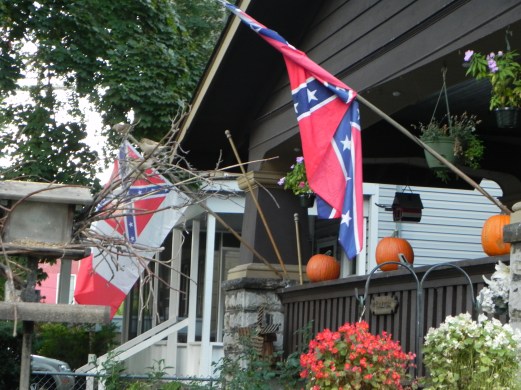
Sadly, the 2012 lawn sign in East Aurora, and the controversial Seneca-Babcock noose and gallows, are far from the only displays of racial animosity in “The City of Good Neighbors.” A house at the corner of Indian Church Road and Parkview Avenue – kitty-corner from the BEREA Church of God in Christ – has displayed a Confederate flag from its front porch most every day for the 15 months that I have lived in the neighborhood. Perhaps in solidarity with the disgruntled Seneca-Babcock resident, the display at the Indian Church Road home was ratcheted up a notch this past week, waving not one, but two Confederate flags – an official one, and a battlefield flag. [There’s a useful history and description of the various Confederate flags at Wikipedia.]

dscn7790

It is time for a break from these dreadful “teachable moments.”  I’m looking forward to Prof. Stacey Sutton’s learnable 90-minute discussion Wednesday evening at the Moot Senior Center.

With All Due Respect,

Art Giacalone

P.S.  The flag display at the northwest corner of Indian Church Rd. and Parkview Ave. in South Buffalo changed on or about October 19th from two versions of the Confederate flag to the following dual symbols of racial intolerance:  trump-confederate-flags


Voices of Neighbors must be heard prior to selling former Buffum St. school

Posted by Arthur J. Giacalone on October 4, 2016
Posted in: Carl Paladino, Christopher Scanlon, City of Buffalo, SEQRA, South Buffalo. 1 Comment

UPDATE:  Much has happened since I posted the following piece.  If this topic is of interest to you, I urge you to read two subsequent postings: https://withallduerespectblog.com/2018/10/15/cant-trust-city-hall-chris-scanlon-to-protect-the-buffum-street-neighborhood/ and https://withallduerespectblog.com/2018/06/11/councilmember-christopher-scanlon-serves-his-political-contributors-ignores-concerns-of-south-buffalo-residents/.

Buffalo’s Common Council – and, in particular, South District Councilmember Chris Scanlon – should not approve the sale of former School No. 70 on Buffum St. to an affiliate of Carl Paladino’s Ellicott Development company without first hearing from nearby residents in this quiet South Buffalo neighborhood – whether or not Mayor Byron Brown’s administration considers the leasing of the closed school property to an existing charter school as an appropriate use. 

My home is less than two blocks from Buffum Street – a well-kept and attractive residential street in the Cazenovia Park section of South Buffalo running three or four blocks between Seneca Street and Fields Ave.  I walk the length of Buffum virtually every day, so I’m very familiar with the lack of traffic on the street, and the presence of two historic gems, the Seneca Indian Park at its eastern end:

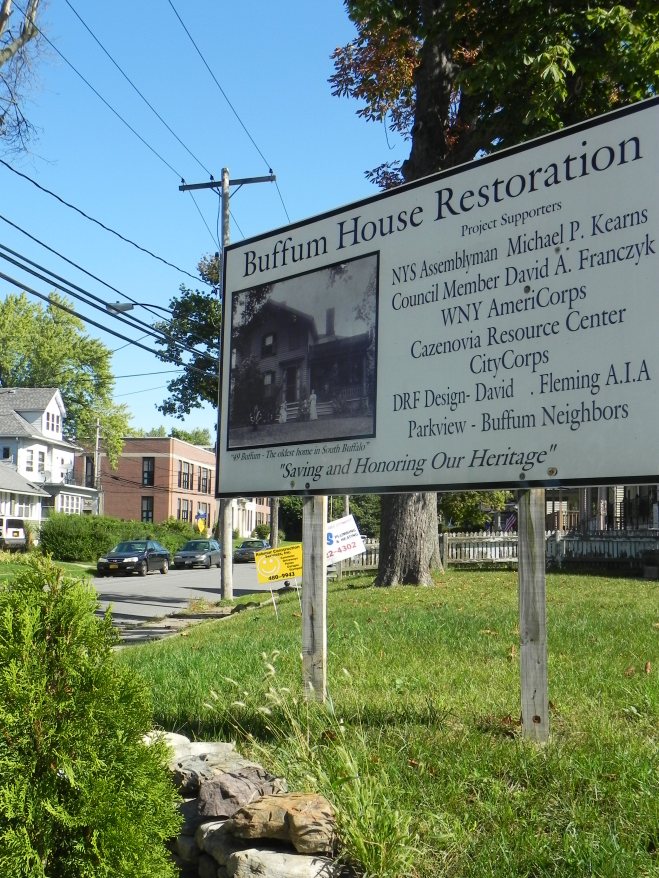
dscn7713and 83 Buffum St. – “The oldest house in South Buffalo” – a block from Seneca St.:

dscn7746

I also am well aware of the presence of the former School No. 70 property on the north side of Buffum:

dscn7724

Built in 1915, and, from all outward appearances, in excellent condition, the former elementary school is situated across the narrow street and four or five houses west of the Seneca Indian Park, and several houses east and across the street from the historic 83 Buffum St. site:

dscn7721

dscn7747

From time to time, I’ve chatted with Buffum Street-area residents about the former elementary school, marveled about the size and beauty of the site, and wondered about its future.  None of the neighbors wished to see the century-old structure sit idle, but all were concerned about an incompatible use:

dscn7726

To my surprise, while checking the City Common Council’s October 4, 2016 agenda (on the afternoon of Oct. 3rd), I discovered the following entry:

2194 : Abandonment and Report of Sale 102 Buffum Former School No. 70 Lot SIze: 437 X Irreg., Assessed Value: Land – $107,700, Improvements – $690,300, Total – $800,000; 1 Samson – Vacant Lot SIze: 255.37 X Irreg., Assessed Value: $9,400 and 123 Zittel – Vacant Lot Size: 10 X 10, Assessed Value: $1,400 (The “Property”) South District
102 Buffum Council attachments map pic and SEQR-09262016111032

I bicycled down Buffum St. after dinner on the 3rd, and, not surprisingly, discovered that the vast majority of neighbors were unaware of the imminent sale of the property to the Ellicott Development affiliate, or the fact that the papers filed with the Common Council offer the following information:

(1) The developer intends to lease the property to “an existing [unspecified] charter school.”  [Note:  The Maritime Charter School, which includes a high school, has been mentioned as a entity in search of a new home.]

(2) Ellicott Development’s plans include construction of a 45,000-square-foot building (including a gymnasium) and an athletic field.

(3) The developer’s “environmental assessment form” fails to mention the proximity of the school property to the Seneca Indian Park, and proclaims that the proposed action would NOT result in “a substantial increase in traffic above present levels.”

The submissions to the Common Council, apparently prepared by the City’s Department of Real Estate in conjunction with the Mayor’s Office of Strategic Planning, also contain the following disturbing statement:  “Pursuant to City Code Chapter 168-5.B(8) the City of Buffalo’s review ordinance exempts the sale of City property, under 50 acres, from SEQR [State Environmental Review Act] review by designating it a Type 2 Action.” 

In my opinion, excluding the sale of all city property under 50 acres in size from the scrutiny and public participation intended by SEQR – which defines “environment” broadly to include the existing neighborhood character and traffic levels – violates the intent and requirements of the State environmental review law.  As such, the exemption is unlawful.  The City of Buffalo’s environmental review ordinance may not provide its residents with less protection than is envisioned by the State’s regulations, which do NOT exclude such significant land dispositions from environmental review.  Also, separating the step of selling the land from the project sponsor’s proposed use of the property constitutes “segmentation” of an action, unlawful under SEQRA.

The neighbors surrounding the former School No. 70 site deserve better from their public officials!

dscn7735

dscn7722

dscn7738

dscn7742

I urge the Common Council to refrain from taking any steps to approve the sale of this significant public asset until the voices of the surrounding neighborhood can be heard.

With All Due Respect,

Art Giacalone


Green Code’s Final Generic EIS threatens SEQRA’s purposes now and in the future

Posted by Arthur J. Giacalone on September 26, 2016
Posted in: City of Buffalo, Green Code. Leave a comment

Common Council’s Legislation Committee will consider whether to “accept as complete” Buffalo Green Code’s FGEIS on Tuesday, September 27, 2016 at 2:00 PM.

You won’t find it yet at the City of Buffalo’s official Green Code website. But, five months after the public comment period for the Green Code’s Draft Generic Environmental Impact Statement (DGEIS) ended, the Green Code’s Final Generic Environmental Impact Statement (FGEIS) has been sent by Mayor Byron Brown’s Office of Strategic Planning to the City’s Common Council for its review and acceptance.

The public can get its first glimpse at the FGEIS – the penultimate step in the State Environmental Quality Review Act (SEQRA) process – by going to the Committee on Legislation’s September 27, 2016 agenda and clicking on FGEIS and its related documents.

It is unclear whether the public will be given the opportunity to speak at the September 27th Legislation Committee meeting – although the Head of the Mayor’s Office of Strategic Planning, Brendan Mehaffy, and the City’s Nadine Marrero, are scheduled to speak in support of a resolution in which “the Common Council Accepts the FGEIS as Complete.” So it is imperative to contact David Franczyk, the Legislation Committee’s Chairman, and your own Common Council member IMMEDIATELY if you are concerned about any of the issues that follow: [Their email addresses are: dpridgen@city-buffalo.com; rfontana@city-buffalo.com; dfranczyk@city-buffalo.com; jgolombek@city-buffalo.com; cscanlon@city-buffalo.com; jferoleto@city-buffalo.com; darivera@city-buffalo.com; rwyatt@city-buffalo.com; uwingo@city-buffalo.com.] 

I.  The FGEIS is NOT, in fact, “complete.”

The Environmental Impact Statement (EIS) for the “Green Code” [officially, the Buffalo Consolidated Development Framework (BCDF)] is “generic,” that is, it is more general than site or project specific EISs. [See 6 NYCRR 617.10.] It is lawful for the City to use a “generic” EIS when considering new development or zoning regulations such as the Green Code when the environmental analysis and data contained in the GEIS is sufficiently detailed to allow the SEQRA Lead Agency – here, the Common Council – and the public to adequately assess the potential adverse environmental impacts of the proposed new regulations and projects allowed pursuant to them.

But here are a number of ways in which the Draft GEIS, and the proposed Final GEIS (which contains little, if any, additional analysis), should not be considered “complete” in its current form:

A.  The DGEIS lacks the assessment and information needed to assist the Common Council and the public to determine which neighborhoods would experience a substantial change in character under the proposed Green Code, or to measure the adverse impacts of such change. It is wholly inadequate to state, as expressed at page 74 of the DGEIS, “The land use maps and zoning analysis discussed … above, demonstrate that the BCDF will not radically change the community character in most areas of the City.” The DGEIS falls far short of the requirements set forth in the Final Scoping Document, that is:

 A goal of the BCDF is to ensure any new development replaces or builds upon the fabric of existing neighborhoods within the City, and to allow complementary and appropriate future development. The DGEIS will evaluate the impact of the BCDF on the variety of neighborhoods. The DGEIS will compare the existing built environment with the potential future allowed developments focusing on building styles, lot sizes and general land uses.

Residents, taxpayers, and Common Council Members are not told which areas of this city would experience “radical change” under the current proposal, who would benefit from such significant transition, and what mitigation measures are available to protect residents from the adverse impacts of such change.

B.  Despite the promise in the Final Scoping Document that, “the DGEIS will evaluate if adoption and implementation of the [UDO] will have adverse impacts to low-income populations,” the DGEIS and FGEIS fail to address a paramount legal and moral issue confronting this city: the extent to which Mayor Brown’s vision for Buffalo – manifested in the “Green Code” – will result in the displacement of low-income, primarily African-American residents from their neighborhoods.

C.  The term “environment” is broadly defined in SEQRA to include – not only physical conditions – but also “existing patterns of population concentration, distribution, or growth, and existing community or neighborhood character.” Nearly three decades ago, our State’s highest court, the New York Court of Appeals, in a case called Chinese Staff and Workers Association v. City of New York, 68 NY2d 359 (1986), held that “population patterns and neighborhood character are physical conditions of the environment under SEQRA” and must be given consideration “regardless of whether there is any impact on the physical environment.” The Chinese Staff decision went on to rule that “potential acceleration of the displacement of local residents and businesses” is an effect on population patterns and neighborhood character that must be analyzed pursuant to SEQRA not only for the actual property involved, but for the community in general.  And these socio-economic impacts must be considered whether the proposed project may effect these concerns “primarily or secondarily or in the short term or long term.” The DGEIS and FGEIS fail to assess the proposed Green Code’s potential for displacing local residents and businesses in the neighborhoods in and in close proximity to growth areas.

D.  The methodology and assumptions utilized in the DGEIS “Build-Out Analysis” (Appendix H, p. 2) are flawed and inadequate to provide meaningful information for the Common Council or the public. For example:

(1) The build-out only considered lands available for development – including “vacant properties and surface lots within the downtown core.” This approach ignores the potential that the developer-friendly Green Code would result in less-dense areas to be demolished (for example, the Fruit Belt residential blocks) and replaced by buildings and projects of greater density, scale, height, etc.

(2) The build-out only considered as-of-right uses, or uses permitted in each zone without the need to obtain a variance. The limited approach fails to take into consideration the proposed Green Code’s unrestrained use of the “special use permit” – the zoning mechanism which places the least burden on an applicant to meet. It also ignores the overwhelming tendency of Buffalo Zoning Board of Appeals [ZBA] to grant variances, whether or not the applicant provides adequate proof to meet the statutory requirements for “area” and “use” variances.

(3) The build-out analysis does not attempt to determine when redevelopment of available lands might occur. This restricted (and, frankly, lazy) approach contrasts with the requirement at 6 NYCRR 617.7(c)(3) of the SEQRA regulations that the significance of a likely consequence of an action be assessed in connection with not only its setting, but also its probability of occurrence, its duration, its irreversibility, its magnitude, and the number of people affected.

(4) Although recognizing that “the city has numerous overlay districts (i.e. “special districts”) to address unique character areas and encompass a portion of one or more zoning districts,” the build-out analysis does NOT consider overlay zoning districts as part of its analysis. This is contrary to the following requirement found in the Final Scoping Document: “The DGEIS will document the differences between the current and proposed zoning ordinances (lot sizes, as of right uses, etc.) including any overlay districts. Inconsistencies will be documented and any adverse impacts to the existing built environment will be identified.” [Emphasis added.]

II.  The most important part of a Final EIS – “the lead agency’s responses to all substantive comments” on the Draft EIS – was apparently prepared by the Office of Strategic Planning, not the Common Council Members, insulating our elected officials from the rigors of carefully assessing the public’s concerns.

The proposed FGEIS’ most critical part is the 140 pages of responses to comments made by the public and agencies concerning the Draft GEIS. They are found at pages 24-163 of the FGEIS.

The SEQRA regulations – at 6 NYCRR 617.9(b)(8) – mandate that a final EIS must consist of “the lead agency’s responses to all substantive comments,” and also state that, “The lead agency is responsible for the adequacy and accuracy of the final EIS, regardless of who prepares it.

Each Common Council Member should be asked whether he has read and approved of each and every response contained in the proposed FGEIS. If he is unable to answer affirmatively to both of these questions, he should not vote to accept the FGEIS as complete.

III. SEQRA’s purpose – to protect our environment by requiring a careful consideration of potential adverse impacts, alternatives and mitigation measures – will be thwarted if the current inadequacies in the DGEIS/FGEIS are not corrected.

As I have previously written, the City of Buffalo has all-too-often failed to comply with the letter and spirit of SEQRA. Unfortunately, given the City’s history of non-compliance, adoption of the presently deficient FGEIS will allow the current Administration to completely circumvent the SEQRA review process with impunity.

Pursuant to the SEQRA regulations – at 6 NYCRR 617.10(d) – once a Final Generic EIS is filed, most proposed projects can be approved by a city’s common council, planning board, zoning board of appeals, etc., WITHOUT ANY SEQRA REVIEW. This regulation – which makes developers very happy, and takes significant power away from nearby residents and property owners – is based on the premise that the generic Environmental Impact Statement has “adequately addressed” each and every project that is allowed “by right” under the newly adopted zoning and development regulations.

Buffalo’s environment and, therefore, its residents, will suffer dramatically if the current FGEIS is accepted by the Common Council given the inadequate analysis of environmental impacts in the DGEIS/ FGEIS, the propensity of the City’s planning staff to support virtually any project proposed by a developer, and the “thresholds for further evaluation” contained in the FGEIS [at pages 21 -1 23 of the FGEIS]. These newly added “thresholds” anticipate that no SEQRA review will be conducted for the vast majority of projects and actions not requiring either a rezoning or use variance. Given the Green Code’s expansion of the “by right” uses allowed in residential neighborhoods, and the many, many uses allowed by “special use permit” under the Green Code, City of Buffalo residents will find their voices greatly reduced, and their quality of life adversely impacted by the whims of developers.

Please take immediate action to contact your Common Council Members, and, if possible, attend the September 27, 2016 Legislation Committee meeting at 2 PM, City Hall, 13th Floor, Common Council Chambers.

With All Due Respect,

Art Giacalone

RIP Chautauqua Amphitheater 1893 – 2016

Posted by Arthur J. Giacalone on September 15, 2016
Posted in: Chautauqua Institution, Stupidity. Leave a comment

We tried in vain to save this historic gem – see the tireless effort by Save The Amp, the press release regarding the Chautauqua Amp lawsuit 01-22-16 and the Article 78 Verified Petition on behalf of Chautauqua Committee to Preserve the Historic Chautauqua Amphitheater and a group of brave residents.  But Chautauqua Institution ended up being beyond the law.

Fortunately, at least, we and all of America have our memories [see, for example, National Trust’s characterization of the Amp as “the heart”of the Chautauqua Institution, and the Amp’s prominent role in CI’s listing as a historic landmark district at amp_national register]:

dscn7480

dscn7479

dscn7483

dscn7478

dscn7459

dscn7453

dscn7475

dscn7455

dscn7452

dscn7445

dscn7449


dscn7473

dscn7461


dscn7468

DSCN1974

dscn7126

dscn7125

dscn0032

dscn7464

dscn7456

With All Due Respect for an American Treasure,

Art Giacalone


Posts navigation

← Older Entries
Newer Entries →
  • CATEGORIES

  • February 2026
    M T W T F S S
     1
    2345678
    9101112131415
    16171819202122
    232425262728  
    « Nov    
  • DISCLAIMER

    This blog is provided for general informational purposes only. It should not be construed as legal advice and is not intended to be a substitute for legal counsel. Persons requiring legal advice should retain a properly licensed lawyer. No attorney-client relationship will be formed based on use of this site and any comments or posts to this blog will not be privileged or confidential. *************** This blog's author, Arthur J. Giacalone, does not intend or consider the communications at this blog to be ATTORNEY ADVERTISING. The primary purpose of the communication is not for the retention of Mr. Giacalone's legal services. [See definition of "Advertisement" at Part 1200, Rules of Professional Conduct, Rule 1.0(a).] Nonetheless, in case the proper authorities choose to treat this web site as ATTORNEY ADVERTISING, the street address, phone number and email address of the law office of Arthur J. Giacalone are: 17 Oschawa Avenue, Buffalo, New York 14210; (716) 436-2646; AJGiacalone@twc.com.
Blog at WordPress.com.
With All Due Respect
Blog at WordPress.com.
  • Subscribe Subscribed
    • With All Due Respect
    • Join 62 other subscribers
    • Already have a WordPress.com account? Log in now.
    • With All Due Respect
    • Subscribe Subscribed
    • Sign up
    • Log in
    • Report this content
    • View site in Reader
    • Manage subscriptions
    • Collapse this bar
 

Loading Comments...