With All Due Respect

Photos and musings by Arthur J. Giacalone

  • About The Author
  • About This Blog
  • Pre-WADR Archives

Buffalo’s “Economic Rebirth” Provides a Dubious Lesson for Upstate New York

Posted by Arthur J. Giacalone on March 19, 2015
Posted in: Andrew Cuomo, Buffalo Billion, City of Buffalo, Corporate Welfare, Development, Howard Zemsky, Jacobs Family, SEQRA, Terry Pegula. 1 Comment

[A version of this post appears in the March 19, 2015 weekly edition of ArtVoice under the title “The Boom, Busted” at http://artvoice.com/issues/v14n11/news_feature.]

We are repeatedly told that Buffalo is undergoing “a dramatic transformation” and experiencing an “economic rebirth” and “building boom” not seen in decades. These self-serving pronouncements are premature and overblown, whether made by the local press, Gov. Andrew Cuomo, or his legion of yes-men (and women) such as Howard Zemsky, CEO of the Empire State Development Corp.

As veteran reporter and Investigative Post founder Jim Heaney observed recently: while Buffalo was in the midst of its “building boom” last summer, the Queen City had 4 construction cranes piercing the sky; Toronto had 154.

More troubling than the Cuomo administration’s hyperbole is the campaign suggesting that the governor’s “Buffalo Billion” tactics should be used as a role model for all of upstate New York. According to Mr. Zemsky, communities need to “learn the lesson of the Buffalo Billion” and transform their economies to be self-sustaining through “real investments that actually create jobs.”

Unfortunately, the true lesson that the public should take from Buffalo’s so-called “economic rebirth” is profoundly troubling and anything but exemplary.

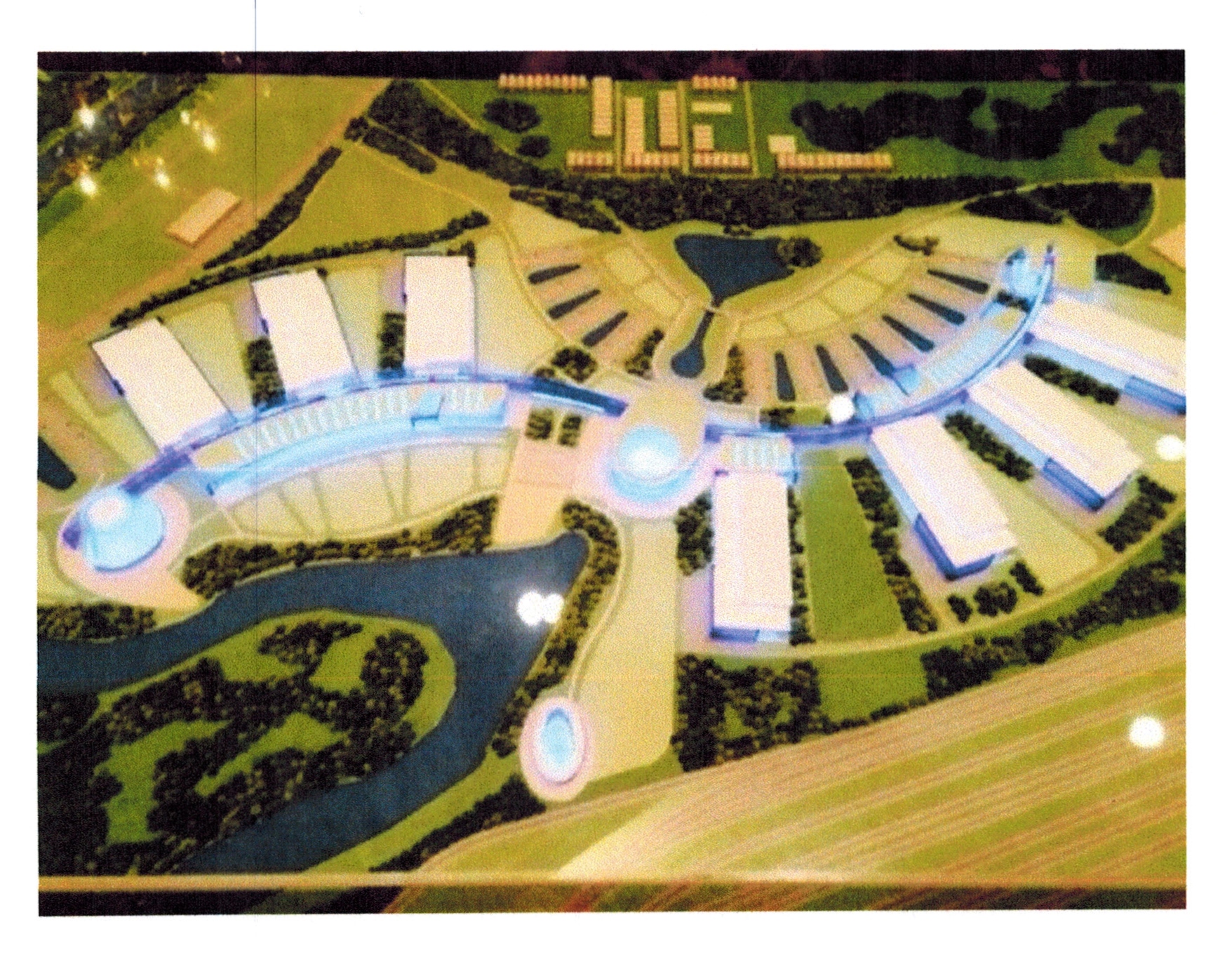
Western New York’s “building boom” rests on a dubious foundation. Three symbols of Buffalo’s “turnaround” – RiverBend’s Innovation Hub at the Outer Harbor:
Model of

Model of “Innovation Hub” at RiverBend

Uniland Development/Delaware North’s mixed-use tower at 250 Delaware Avenue:

250 Delware Ave rendering

and Terry and Kim Pegula’s HarborCenter project on the former Webster Block in downtown Buffalo:

HarborCenter rendering

share two troubling traits:

(1) The government decision-makers “fast-tracked” their approvals by circumventing SEQRA’s Environmental Impact Statement (EIS) process. The EIS is “the heart” of SEQRA (the State Environmental Quality Review Act). When done correctly, the EIS provides a “hard look” at the potential significant adverse impacts of a proposed action, and a detailed description and evaluation of reasonable alternatives and mitigation measures. Importantly, it offers the public a meaningful vehicle for input by mandating a minimum 30-day “public comment period” at an early enough stage in the planning process that true flexibility exists.

Size Matters bar graph

[Graph prepared by Arthur J. Giacalone and James A. Giacalone]

(2) Large sums of taxpayer money and “corporate welfare” have been allocated to the three projects. The State of New York intends to invest $225 million in the Innovation Hub project to provide roads and infrastructure at the site, construct the first two of six buildings, and purchase and own expensive scientific equipment. The Erie County Industrial Development Agency (ECIDA) has agreed to provide billionaires Terry and Kim Pegula an incentive package of nearly $37 million for the HarborCenter development, a 19-story, 650,000-square-foot project, including $28 million in property tax breaks over ten years, $7.5 million in sales tax relief, and $1.2 million in mortgage tax breaks. Additionally, the HarborCenter developers can anticipate receiving $20 million in brownfield-related tax credits for spending $8.7 million to clean up the former parking lot site. Not surprisingly [see the note below], Gov. Cuomo used his influence to make certain that the Jacobs – another billionaire family – obtained a controversial $807,000 in sales tax relief from the ECIDA to subsidize the two-and-a-half block move of the Delaware North Companies’ headquarters from the Key Center in the 500 block of Buffalo’s Main Street to 250 Delaware Avenue. Uniland Development, Delaware North’s partner in constructing the 12-story, 472,320-square-foot mixed use development (with 4-story parking ramp) at the corner of Delaware Ave. and Chippewa Street, obtained $3.2 million in real estate tax relief from the ECIDA.

Note: The Buffalo News reported in 2013 that Gov. Cuomo had received political donations totaling $105,026 since 2006 “from either Delaware North or members of the Jacobs family.”  

The most prominent example of an economic development process that should not be replicated is the Innovation Hub at RiverBend. The governor has promised $225 million – nearly one-quarter of the so-called Buffalo Billion – to this one project. In order to ensure a quick, pre-election start to the centerpiece of Mr. Cuomo’s redevelopment campaign, the College of Nanoscale Science and Engineering (CSNE) – an arm of the State University of New York – allowed construction to proceed on the 90-acre, nearly 1 million square-foot manufacturing and research-and-development complex without preparation of an Environment Impact Statement.

SUNY’s CNSE disregarded SEQRA’s presumption that the comprehensive environment assessment mandated by the EIS process is required whenever a proposed project meets any one of the thresholds for what SEQRA calls a “Type 1 action.” Two of those thresholds are particularly relevant here. The Innovation Hub project involves the physical alteration of 90 acres of land, which is nine times the 10-acre threshold for a “Type 1” action. It also entails the construction of nearly one million square feet of buildings – more than four times SEQRA’s 240,000-square-foot threshold triggering the presumption that an EIS be prepared.

The Cuomo Administration sidestepped its role as steward of our environment despite the RiverBend project’s location along the Buffalo River’s highly sensitive “Area of Concern” [AOC], one of the most toxic hotspots in the Great Lakes region. Buffalo Niagara Riverkeeper, the current AOC coordinator, diplomatically expressed the following concern last May when identifying potential policy “barriers” to accomplishing the goals of the Buffalo River’s Remedial Action Plan [RAP]:

        “Redevelopment planned along the Buffalo River corridor needs to be better integrated at all planning levels with the restoration investments made through the RAP process to date. This will ensure that adequate site-level policies and protections are in place for long-term RAP delisting goals. “

In November 2013, when Gov. Cuomo announced the State’s plan to invest $225 million in the Innovation Hub project, Howard Zemsky, in his capacity as co-chair of the Western New York Regional Economic Development Council, made the following proclamation: “The Buffalo Billion is intended to be transformative. We’re the capital of clean energy in New York State.”

It is rather ironic – if not perverse – that Cuomo and Zemsky have chosen to transform Buffalo into “the capital of clean energy” by ignoring SEQRA’s comprehensive environmental review process. SEQRA was enacted in the mid-1970s to prevent future development from repeating the environmental devastation that eventually led to designation of the Buffalo River’s “Area of Concern” and decades-long remedial action. The decision to place RiverBend’s Innovation Hub in a highly sensitive area along the Buffalo River prior to conducting the proper environmental review to determine if the site is appropriate for such activities is, at a minimum, indefensible and irresponsible. We cannot rationally and responsibly research, develop, and manufacture “clean energy” products if the process of doing so harms the surrounding environs, which includes the Lake Erie shoreline.

Neither the environment, nor New York’s taxpayers, can afford to use the Buffalo Billion or the Queen City’s “economic rebirth” as a role model for future development.

With All Due Respect,

Art Giacalone

Cuomo Attempts to Reduce “Three Men In A Room” to One with his “Linkage” Budget

Posted by Arthur J. Giacalone on February 19, 2015
Posted in: Andrew Cuomo, Development, Political Corruption. Leave a comment

* The Governor’s motivation is political expedience, not the public interest *

New York’s politics have been dominated for years by “Three Men in a Room” – the governor, Senate majority leader, and Assembly speaker.  Preet Bharara, the U.S. Attorney who recently brought charges against one of Albany’s ruling troika, Sheldon Silver, sees the lack of openness and transparency inherent in such concentration of power as a significant detriment to democracy.

But Andrew Cuomo’s approach to this year’s budget makes three-men-in-a-room look downright egalitarian.

With the once formidable Mr. Silver no longer holding the Assembly speakership, the governor has “linked” several controversial and complex issues – including ethics reform and the funding of charter schools – directly to the budget approval process. Mr. Cuomo has replaced Albany’s triumvirate with a new dynamic that looks suspiciously like “One Man in a Room” – where the governor unilaterally calls the shots.

Although the Buffalo News editorial board concludes that, “Cuomo’s linkage of contentious ideas is the right strategy if taxpayers benefit,” Preet Bharara knows just how big an “if” that is.  Through a close examination of the governor’s handling of the Moreland Commission – from Mr. Cuomo’s sudden disbanding of the anti-corruption panel in late March 2014, to reports that the governor’s office had interfered with the commission’s activities – the U.S. Attorney is in a position to assess Mr. Cuomo’s willingness to place political expedience above the public good.

While Buffalonians may lack access to the Moreland Commission files, we have many reasons to be skeptical of the decisions and motives of Gov. Cuomo given the political favoritism, crony capitalism, and deception that appear to permeate his administration’s activities here.

In March 2014, the governor announced that the LP Ciminelli firm would serve as developer of RiverBend, the largest of the so-called “Buffalo Billion” projects. Coincidence or not, two months earlier, LP Ciminelli’s CEO and his wife had donated nearly $30,000 to the Cuomo re-election campaign.

Model of

Model of “Innovation Hub” at RiverBend

Coveting a quick, pre-election start to his flagship “Buffalo Billion” project, the governor was not going to let the state’s environmental review law – SEQRA – get in the way.  In May 2014, construction was allowed to proceed on the 90-acre, nearly 1 million square-foot manufacturing and R&D project without preparation of an environment impact statement. It made no difference that SEQRA presumes that a comprehensive environmental study is required whenever a nonresidential facility such as RiverBend involves alteration of 10 acres or 240,000 square feet of buildings.

Expansion of the Peace Bridge plaza, another of Mr. Cuomo’s priority projects, provides additional reasons to distrust the governor’s actions. As reported in an August 2014 News article, “Plotting at the Peace Bridge,” the audio tape of the Peace Bridge Authority’s April 2014 meeting reveals the deceptive tactics utilized by the governor’s appointees to hasten implementation of his expansion plans.

Andrew Cuomo has demonstrated that he is motivated by political expedience, not the public interest.

With All Due Respect,

 Art Giacalone
Buffalo’s Stadium Options Need Thorough Review

Posted by Arthur J. Giacalone on January 22, 2015
Posted in: City of Buffalo, Development, SEQRA. Leave a comment

  ** SEQRA provides a practical – and legally-mandated – framework for comparing the alternatives, including the “no new stadium” option **

The timing was perfect, given Western New York’s short-term and long-term needs.

The report evaluating potential locations for a future stadium for the Buffalo Bills surfaced just when local sports fans desperately required a distraction from weeks of playoff games without our home team on the field, and from our hockey team’s unprecedented losing streak.

But the report also arrived at a time when no immediate decisions regarding a stadium need to be made. The initial motivation for the analysis, a desire to use the resulting economic impact report to encourage prospective purchasers to keep the Bills in Western New York, evaporated when Terry and Kim Pegula succeeded Ralph C. Wilson, Jr, as the team’s owners. The current stadium, beneficiary of recently $130 million renovation, is more than adequate. And, most of the 10-year stadium lease approved in 2013 by the state, County of Erie, the team and the NFL, lies ahead.

We certainly are lucky that there is no rush. The options and issues to be considered by the stakeholders, including the public, are numerous and complex.

For instance:

Do we really need a new stadium now that the Pegulas have committed to keeping the Bills in Western New York?

Who will ultimately decide whether a new stadium is built?

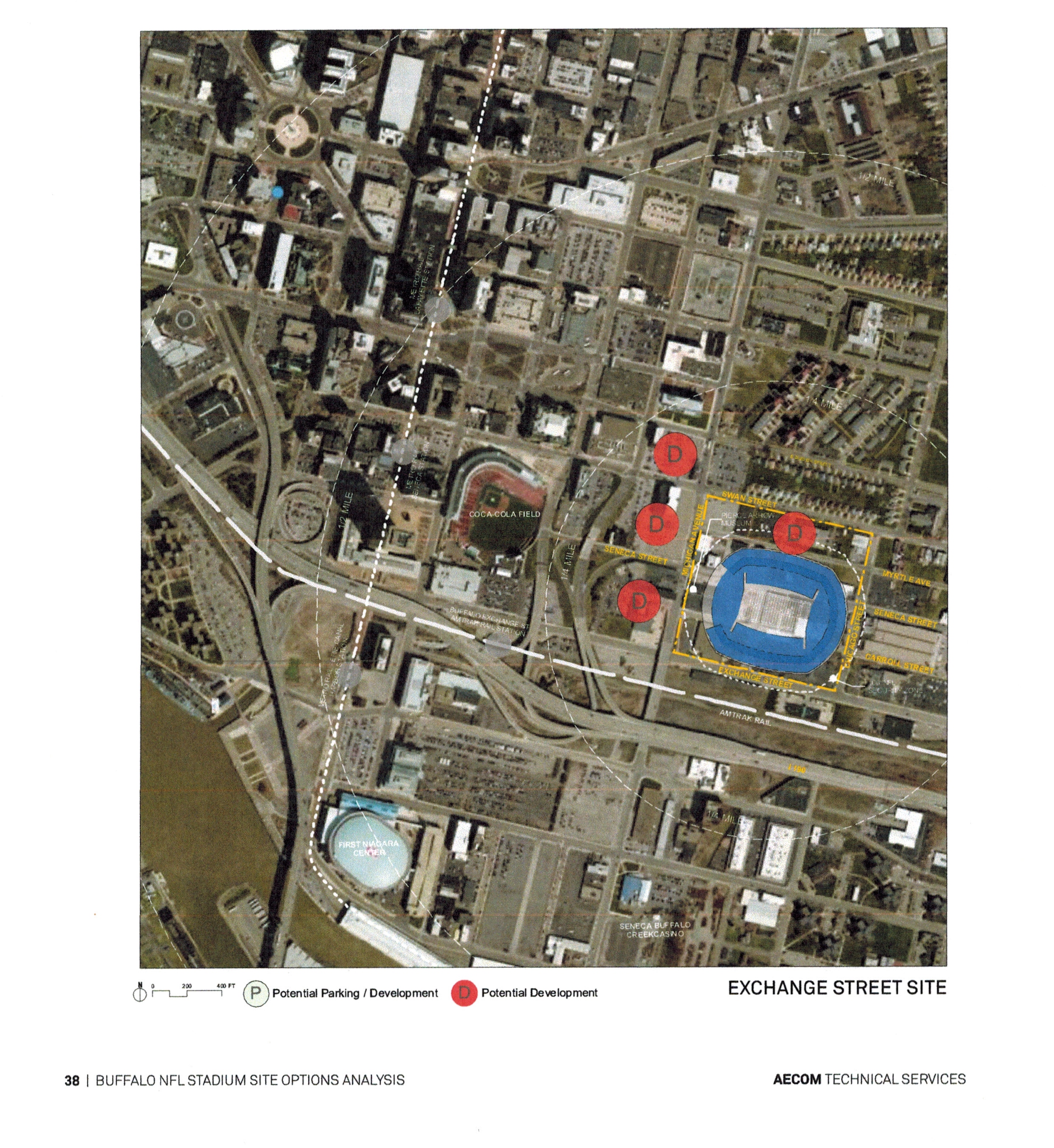
Which of the four “shortlisted” locations identified in the report – the Cobblestone District, the Exchange Street site, Orchard Park, or the South Park site – would be best overall for our region?

Cobblestone District Exchange Street

Existing Stadium South Park-Louisiana St.

Are any of the non-shortlisted sites worthy of further consideration?

Should a new stadium be an open-air, football-focused venue or a domed roof, multi-purpose facility?

If the new venue includes a dome, should it be retractable or non-retractable?

How much of the development costs, if any, should be shouldered by taxpayers when Buffalo’s residents have so many pressing needs?  Etc.  Etc.

[Note: A “No Subsidy” petition is attracting significant support.]   

The ultimate answer to these and other relevant questions will not be found within the four corners of the report prepared by AECOM – an architectural consulting firm based in Los Angeles. Its scope and intended purpose were limited by the contract it entered into with the state last May. The recently released document, officially called “BUFFALO – NFL Stadium Site Options Analysis,” acknowledges its inherent limitations:

“This analysis is intended to be a tool for use by various stakeholders in evaluating various stadium options and not as a definitive statement of positions or recommendations.”

As one might expect, the main goal of AECOM’s analysis was to assess the economic and financial implications of the “shortlisted” locations, the sites considered to have the best potential for hosting a modern NFL stadium:

          “A primary consideration in the evaluation of sites is the business model and resulting space program for the potential stadium facility. A successful return on investment and contribution to the community depend on balancing the number of events held at the facility with stadium program and budget.”

But public and private officials, as well as residents and taxpayers, will need an objective and comprehensive assessment that goes well beyond a proposed stadium’s economic implications if the goal is an ultimate decision that will represent what is best for the entire Western New York community.

The State Environmental Quality Review Act (SEQRA) provides a mechanism for performing such an evaluation – if the analysis is done in a manner that conscientiously reflects the law’s intended purpose. As expressed in the SEQRA regulations:

          “It was the intention of the Legislature that the protection and enhancement of the environment, human and community resources should be given appropriate weight with social and economic considerations in determining public policy, and that those factors be considered together in reaching decisions on proposed activities.”

SEQRA broadly defines “environment.”  For that reason, the environmental review that state and local governmental agencies are obliged to conduct, prior to deciding whether to approve or finance a new stadium for the Buffalo Bills, would not be limited to purely physical conditions.

The analysis would closely look at elements of the environment such as the change in the use or intensity of use of land, adverse changes in air quality, noise and traffic levels, adverse impacts on open space or recreational resources, impacts on significant habitat areas, interference with the movement of resident or migratory fish or wildlife species, and increase in the potential for flooding, leaching or drainage problems. The latter topics are critical given the proximity of two of the shortlisted sites to the Buffalo River and nature preserves.

May 2014 BGC map - excerpt

But the SEQRA review would additionally “take a hard look” at the potential harm to the character of the existing community and neighborhoods, and historic, archeological and aesthetic resources. And the mandated environmental review would also assess impacts on existing patterns of population concentration, including potential displacement of residents from established neighborhoods, an issue of great significance to the Buffalonians who live near two of the shortlisted sites.

Two aspects of SEQRA’s environmental review process would provide the public and officials with useful information when examining the pros and cons of the various options. Once a “preferred” site is identified, the environmental impact statement [EIS] must contain “a description and evaluation of the range of reasonable options” at a level of detail “sufficient to permit a comparative assessment of the alternatives discussed.” The range of alternatives must include the “no action” alternative, that is, an evaluation of the adverse or beneficial changes likely to occur at the proposed site if the decision is made not to construct a new stadium.

The EIS must also describe mitigation measures, that is, conditions that would accompany approval of the project intended to avoid or minimize adverse environmental impacts to the maximum extent practicable.

SEQRA will provide an effective framework to enhance the ability of key stakeholders to assess the myriad of stadium-related options, – from the Pegulas, county, state and city officials, and the NFL, to Western New York businesses and residents (whether or not fans of the Buffalo Bills). But the SEQRA process can easily be hijacked by government agencies and private sponsors with a predetermined agendas.

For the good of the entire region, the public must demand that the letter and spirit of the environmental review process are complied with.       

With All Due Respect,

Art Giacalone

Note:  A version of this post was originally published in the January 22 – 28, 2015 edition of ARTVOICE at http://artvoice.com/issues/v14n3/stadium.

Information Delayed is Information (and Justice) Denied

Posted by Arthur J. Giacalone on January 8, 2015
Posted in: Andrew Cuomo, FOIL, Peace Bridge, Sam Hoyt. Leave a comment

      * The Cuomo Administration’s refusal to provide access to Peace Bridge expansion documents enhances public’s distrust of government *

Gov. Andrew Cuomo acknowledged in his New Year’s Day inaugural speech that trust is “the life-blood of any government.”  That’s quite a statement from a politician whose handling last year of the Moreland Commission understandably led many to question his integrity.  The pervasive lack of trust and confidence in our political leaders explains why in 2014, for the first time ever, “dissatisfaction with government” ranks first in Gallup Poll surveys as the “most important problem facing the U.S,” outranking such dominant issues as the economy, Iraq, unemployment, and healthcare.

Restoring Trust - gray photo0001

A critical element in building and enhancing the public’s trust in its government institutions and leaders is transparency. Government IS the public’s business, and the people have the right to know the process of governmental decision-making and to review the documents and statistics leading to determinations. It was recognition of this principle, and an understanding that access to the records of government is basic to our society, that led to the enactment forty years ago of New York’s Freedom of Information Law [FOIL].

Mr. Cuomo’s lofty characterization of trust as a government’s life-blood rings hollow, as little more than a throwaway line, when one examines his administration’s handling of FOIL requests pertaining to the Peace Bridge expansion decision-making process.

It was in June 2014 that Western New Yorkers first learned of the efforts made by members of Gov. Cuomo’s team to keep the public ignorant of the State’s plans for expanding and enhancing the U.S. plaza servicing the Peace Bridge. Thanks to an advocacy group known as PEER (Public Employees for Environmental Responsibility), an audio tape of the Peace Bridge Authority’s April 25, 2014 board of directors meeting – obtained through FOIL – became available to the public. The taped discussion between the State’s Program Manager for the Peace Bridge, Maria Lehman, and two PBA members, Sam Hoyt and Anthony Masiello, revealed the Cuomo administration’s disdain for transparency, and its secretive strategy to avoid an environmental review process mandated by law.

PEER’s efforts since June 2014 to obtain access through FOIL to correspondence between Ms. Lehman and Mr. Hoyt has been systematically stymied by both the State Department of Transportation and Thruway Authority. Although FOIL anticipates that document requests will be acknowledged within five business days, and then complied with within twenty business days, the Cuomo administration has violated the letter and spirit of FOIL by sending PEER a series of notices each extending the date by which the requested material would be made available by an additional month.

The State DOT has used the same approach to deny me access to information regarding real property and easements transferred by the City of Buffalo to the State in furtherance of plaza expansion efforts. Starting in September 2104, the DOT has extended four times the date that it promised to allow access to the documents requested through FOIL, from the initial date of September 26, 2014 to January 23, 2015.  The repeated extensions violate the requiremetns and intent of FOIL. As noted in an advisory opinion issued in 2010 by NY’s “FOIL Czar,” Robert J. Freeman, “[A]n agency cannot engage in one delay after another… There is no provision [in State law] that permits agencies to indicate extension after extension.”

The Cuomo administration’s delay in providing access to the requested information is both a denial of the requested information, and, in a true sense, a denial of justice. The information being sought is relevant to a lawsuit pending in State Supreme Court brought by my clients, a group of residents residing on Buffalo’s lower west side in close proximity to the Peace Bridge. The court action alleges that the Cuomo administration and the City of Buffalo have engaged in unlawful strategems to avoid examining the cumulative impacts on the health of nearby residents of the various Peace Bridge plaza expansion projects.

DSCN3189 DSCN5041

Only the members of Gov. Cuomo’s administration know whether the information requested through FOIL proves the claims raised by the Peace Bridge neighbors in the current lawsuit. The public has the right to know. And, certainly, so does the Judge.

If Andrew Cuomo truly believed that trust is the life-blood of any government, access to the documents would have been granted months ago. Instead, his administrators appear intent to wait for the court to rule without the benefit of knowledge of the backroom decision-making process.

No wonder “dissatisfaction with government” is so pervasive.

With All Due Respect,

 Art Giacalone

Chautauqua Institution’s Board is Not Above the Law

Posted by Arthur J. Giacalone on January 5, 2015
Posted in: Chautauqua Institution, SEQRA. Leave a comment

New York’s environmental review law must be complied with before Chautauqua’s Amp can be demolished

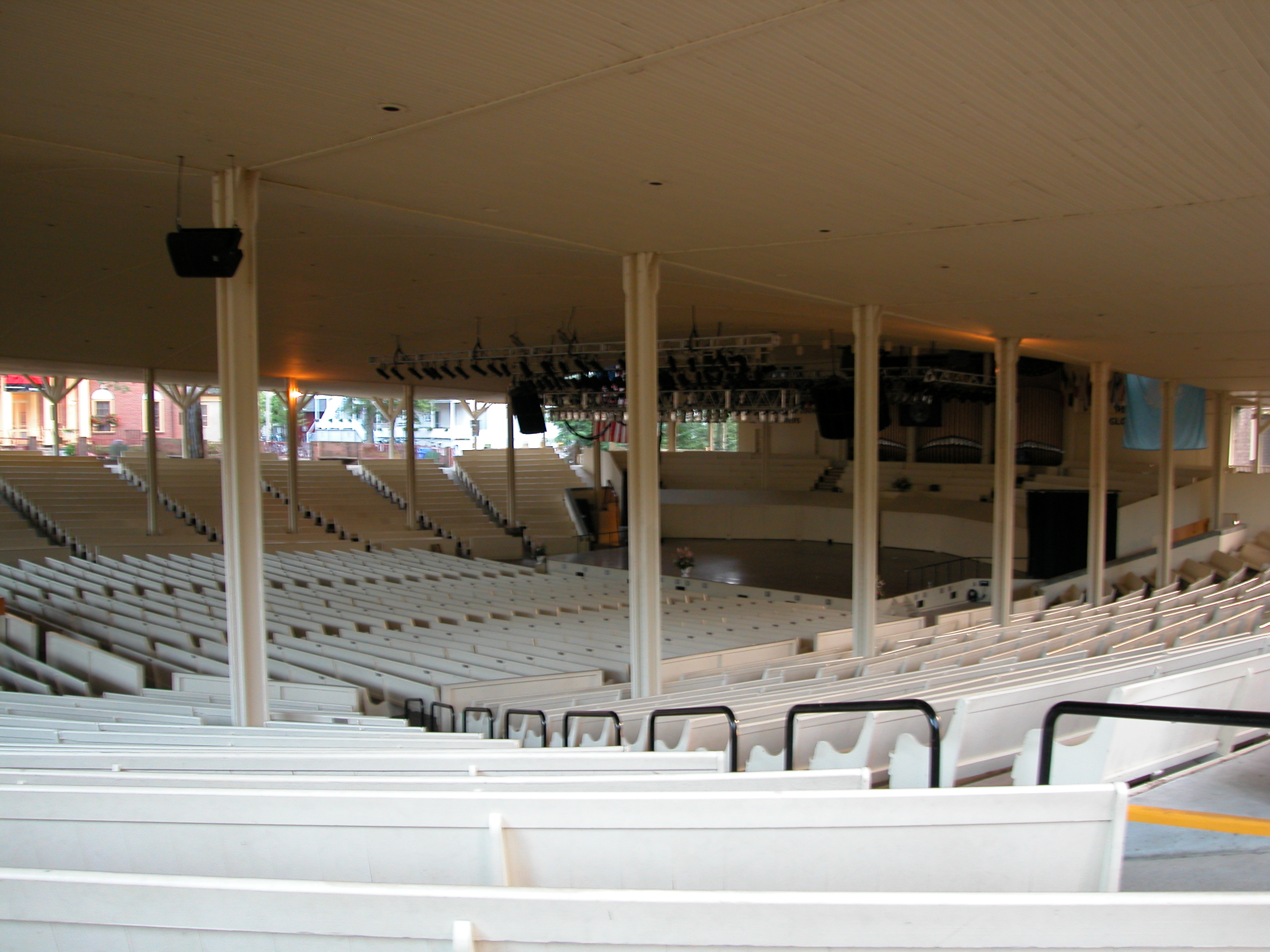
DSCN0043  DSCN1976

[Note:  An extended version of this posting was published in the January 8-14, 2015 edition of ARTVOICE, under the headline, “WHAT’S AN INSTITUTION, ANYWAY? SEQRA must be complied with before Chautauqua’s Amphitheater can be demolished”, at http://artvoice.com/issues/v14n1/news_chatauqua.] 

The Chautauqua Institution’s Board of Trustees is determined to demolish and replace the spiritual heart of this historic lakeside community, the Chautauqua Amphitheater. Pleas to preserve the nationally-recognized 1893 structure, by the State Historic Preservation Office and regional preservation organizations such as Preservation Buffalo Niagara, seem not to have deterred the board from its plan to demolish “The Amp” at the close of the 2015 summer season.

But the Chautauqua Institution’s leadership is not above the law. And the 800-acre campus of the world-renowned cultural and education community is not the board’s fiefdom over which it exercises unfettered control.

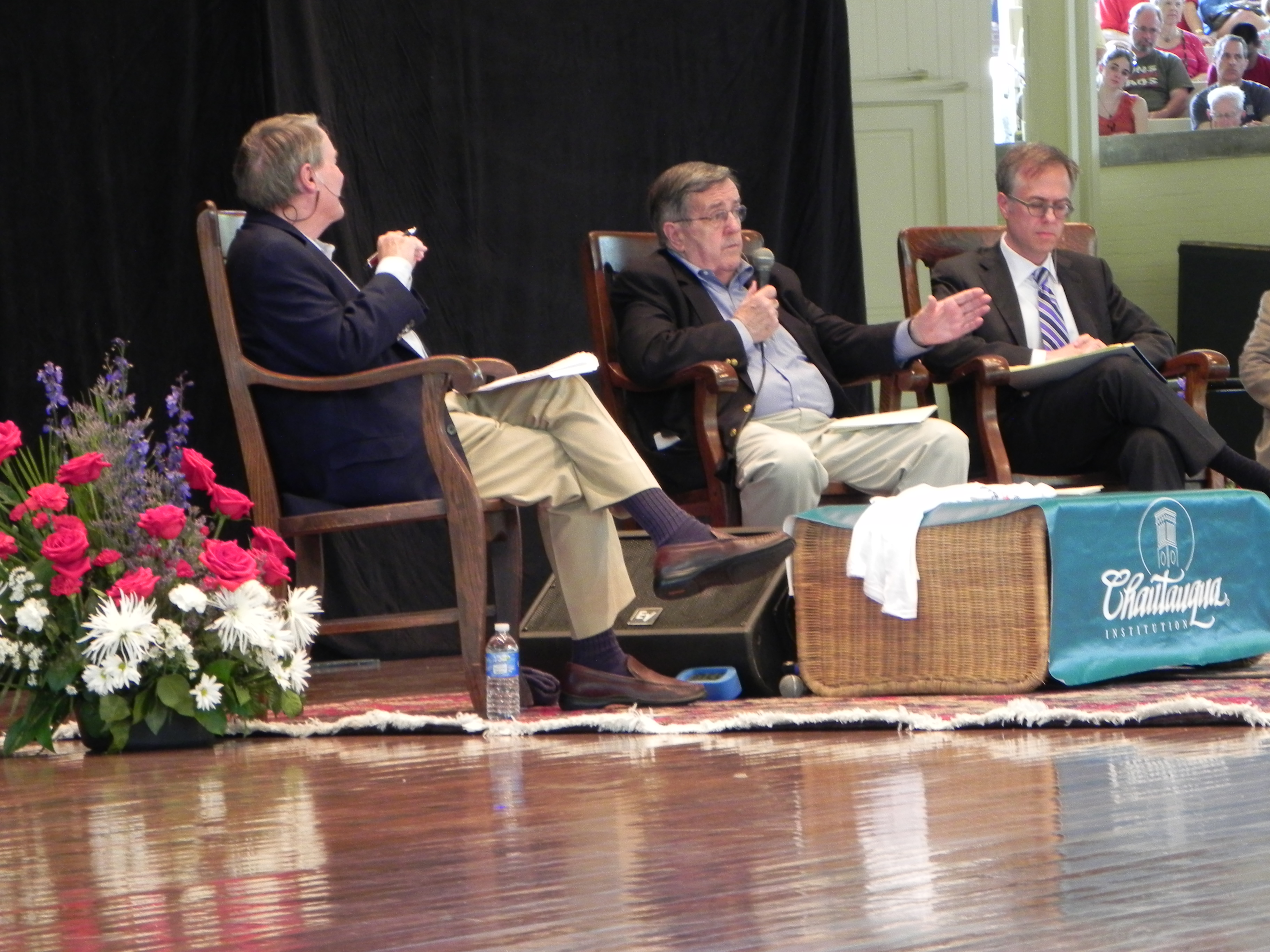
James lectures at Chautauqua

Any decision to demolish and replace The Amp must be preceded by a review of the proposed action by the Town Board of the Town of Chautauqua pursuant to the “Chautauqua Lake Local Waterfront Revitalization Program” [LWRP]. Significantly, that review process will trigger the comprehensive environmental assessment mandated by SEQRA, State Environmental Quality Review Act. The Town of Chautauqua adopted the LWRP in 2008 for the purpose of preserving, enhancing and beneficially using the natural and man-made resources of the town’s unique waterfront areas, including the Chautauqua Institution. Whenever a proposed action is located within the boundaries of the town’s waterfront area, the Town Board is required to make a determination that the project “is consistent with the LWRP policy and conditions.”

Town of Chaut WRA map

DSCN0050

It is difficult to conceive of the Chautauqua Town Board rationally concluding that the planned demolition of The Amp is an action “consistent with” the LWRP. The second of thirteen policies identified in the town’s local law reflects a commitment to protecting historically significant buildings. More specifically, Policy Number 2 expresses a desire to, “Preserve historic resources of the waterfront area of Chautauqua Lake.” The accompanying narrative highlights the fact that the Chautauqua Institution and its contributing buildings are listed as a National Historic Landmark District.

Jim Lehrer-Mark Shields-Michael Gerson 07/08/2012

Jim Lehrer-Mark Shields-Michael Gerson 07/08/2012

Of equal importance, the Town Board will be obligated by State law to comply with the requirements of SEQRA before determining whether demolition of The Amp is consistent with LWRP policy. SEQRA expressly includes “resources of historic or aesthetic significance” in its definition of “environment.” Also, because The Amp project is occurring wholly within a historic district listed on the National Register of Historic Places, there will be a presumption that a comprehensive Environmental Impact Statement is required. The EIS process will provide the public and interested governmental agencies with an opportunity to meaningfully address alternatives to demolishing The Amp, and to comment on the reasonableness of mitigation measures.

Thankfully, the Chautauqua Town Board had the foresight to adopt the LWRP and include the Chautauqua Institution within the boundaries of the local waterfront area, and SEQRA mandates that a proposed action that might adversely impact a significant historic resource be preceded by a comprehensive environmental review.  Within this legal framework, there is hope that The Amp will be preserved for future generations.

With All Due Respect,

Arthur J. Giacalone

PART TWO: Giving Western New York Snow Storms Their Due Respect

Posted by Arthur J. Giacalone on November 20, 2014
Posted in: Uncategorized, WNY Photos. Leave a comment

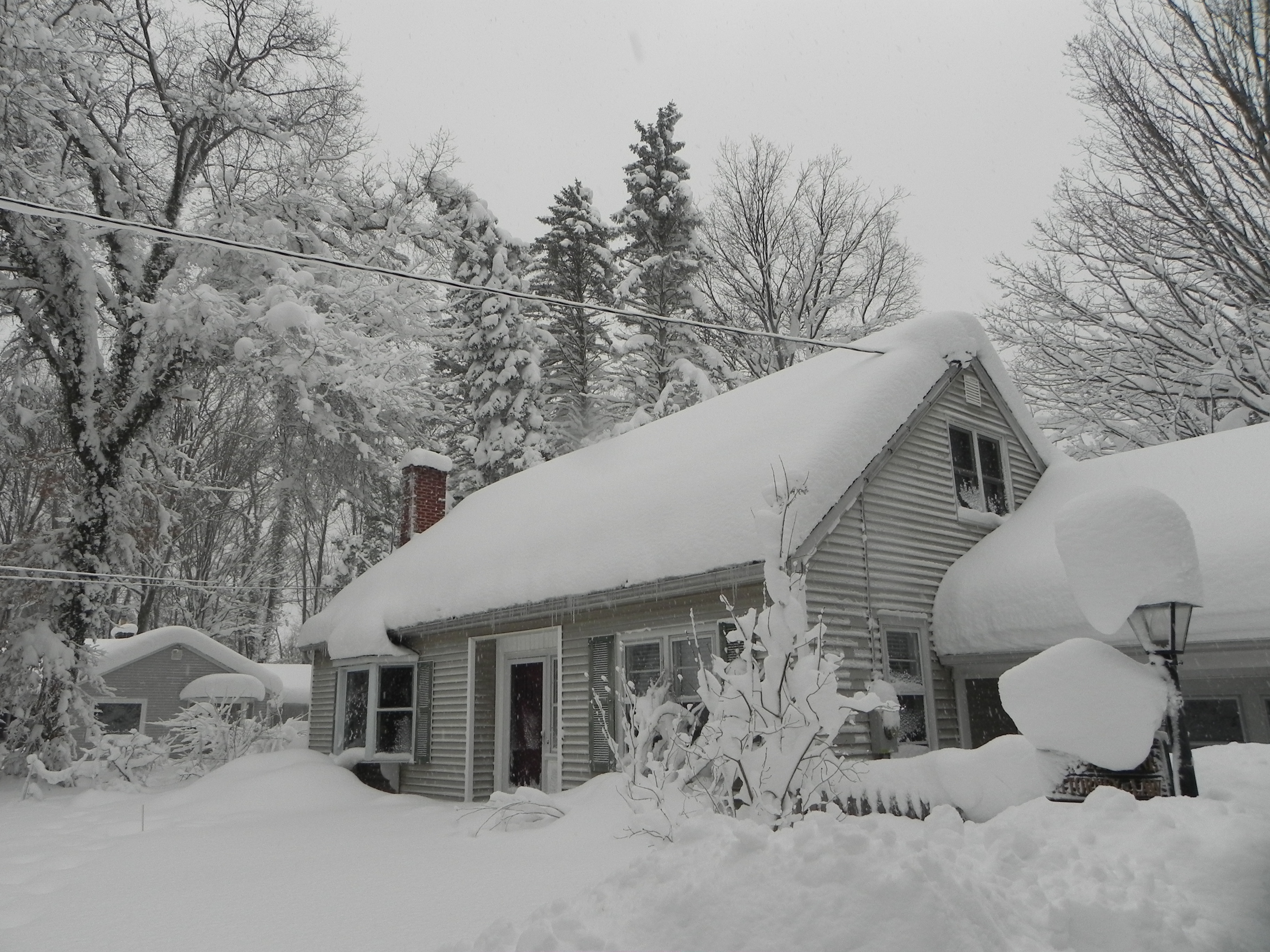
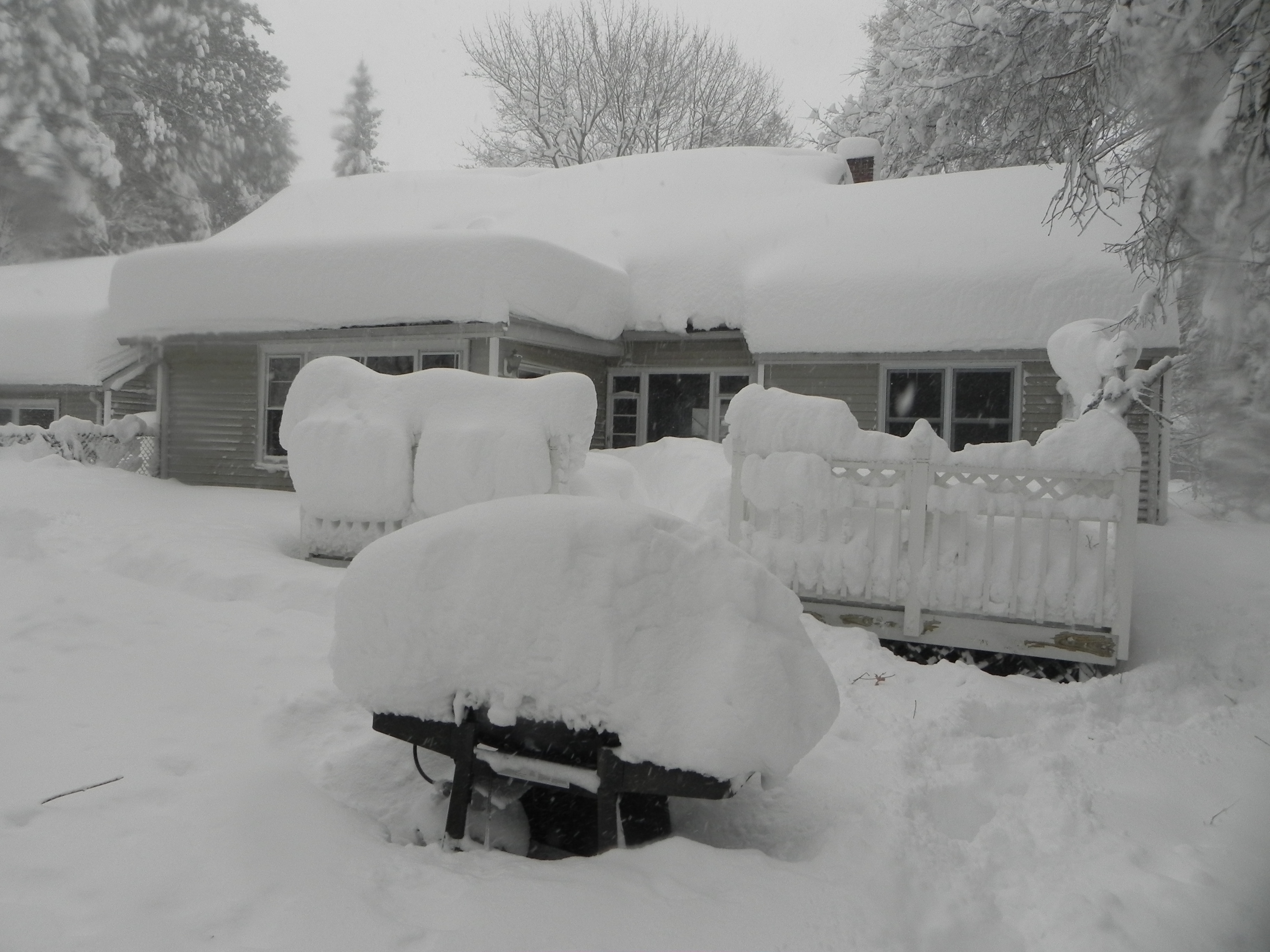
– The entire family appears to have survived three days of persistent snow and limited mobility, even finding time to enjoy what we all hope will prove to be the final chapter in this historic “lake effect” event.  Heeding my teenage daughter’s constructive critique of my Nov. 19th post, I will attempt to limit the use of captions in presenting today’s photos from in and around our East Aurora home. –

[Click an individual photo for a larger view.]

DSCN5435 DSCN5474

DSCN5429 DSCN5420

DSCN5430 DSCN5478

DSCN5453 DSCN5442

Here’s a comparison of the view from our front door on Day 1 – when we were hit hard overnight – and on Day 3:

DSCN5312 DSCN5477

And here is the tale of my disappearing law office shingle:

DSCN5397 DSCN5434

DSCN5485

It was a bit ironic, but a NYS plow sent from the Southern Tier to help WNY dig out managed to get stuck in a snow pile in front of our residence [we gave them a bag of cookies my daughter had baked on Day 2 to show our appreciation]:

DSCN5460

We lost another tree from the weight of this record-setting snow fall – a tall, elegant pine.  We witnessed what we optimistically hoped would be a reversible leaning toward a towering oak that straddles our property line.  Things didn’t quite work out that way, but at least it landed harmlessly in our side yard:

DSCN5423  DSCN5439

 DSCN5462 DSCN5492

DSCN5488 DSCN5490

DSCN5489

Then it was back to work with the end in sight:

DSCN5479  DSCN5483

Photo by Coral C. Clarke Nov. 20, 2014.

Photo by Coral C. Clarke Nov. 20, 2014.

It has been quite an experience – even for lifelong Western New Yorkers.  Time seemingly has stood still as we struggled to deal with nature’s fury.  I am more than ready to return to our everyday chores and activities (once those travel bans are lifted).

With All Due Respect,

Art Giacalone

P.S.  In case you’re curious, here’s what our driveway and primary entrance looked like on the morning of November 21, 2104:

DSCN5503 DSCN5504

Giving Western New York Snow Storms Their Due Respect

Posted by Arthur J. Giacalone on November 19, 2014
Posted in: Uncategorized. Leave a comment

– The view from my East Aurora home (20 miles southeast of Buffalo) –

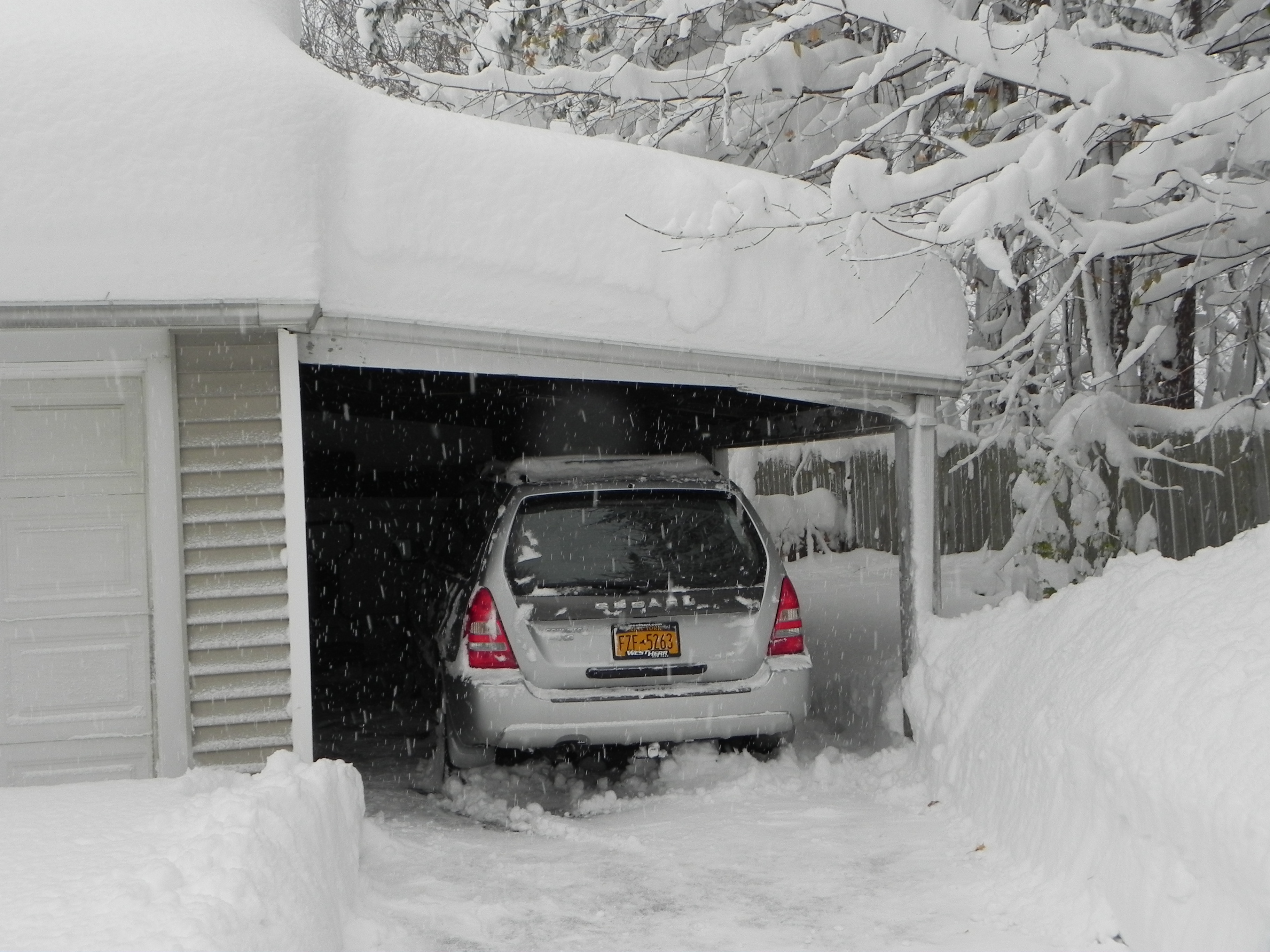
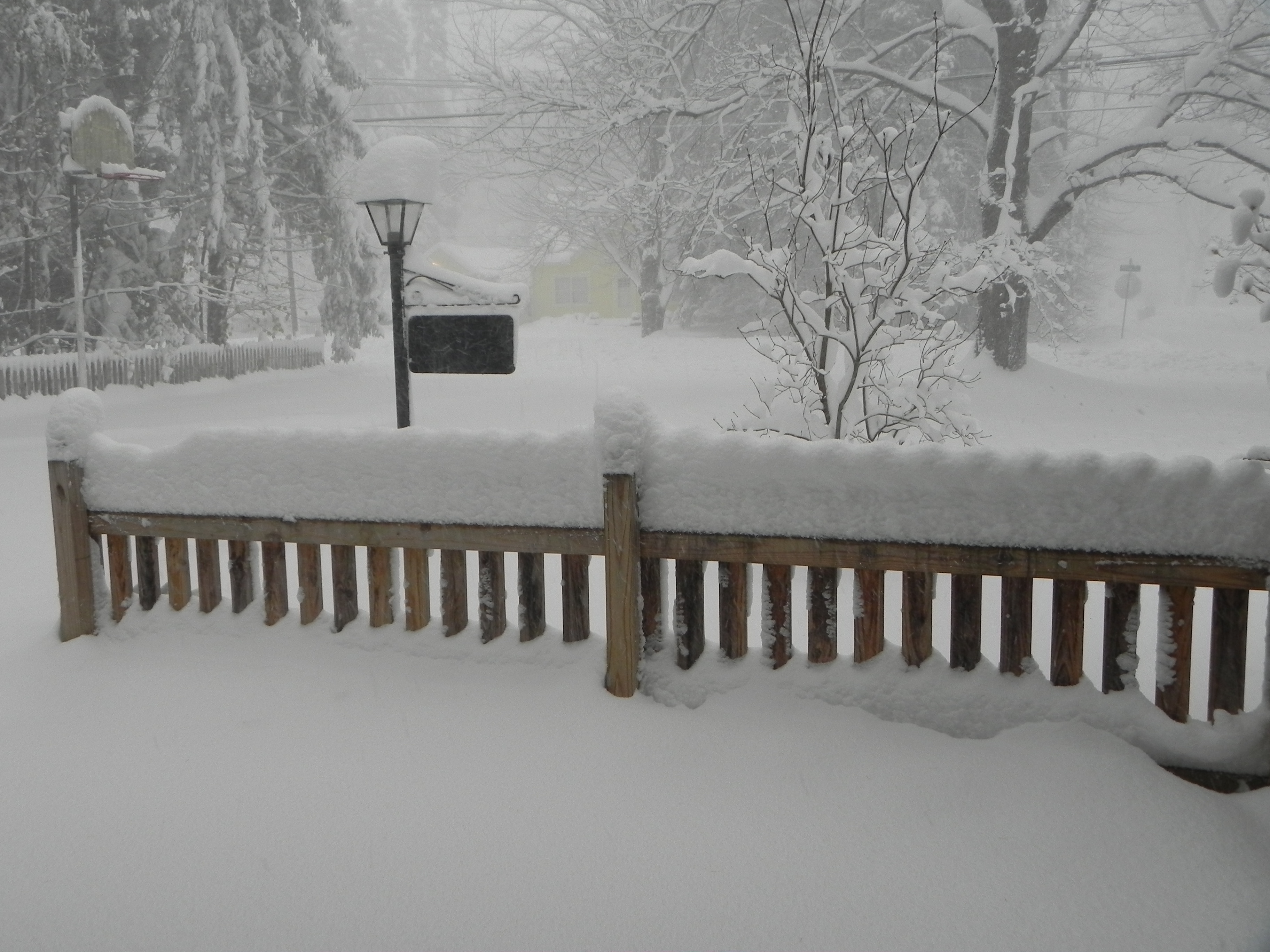
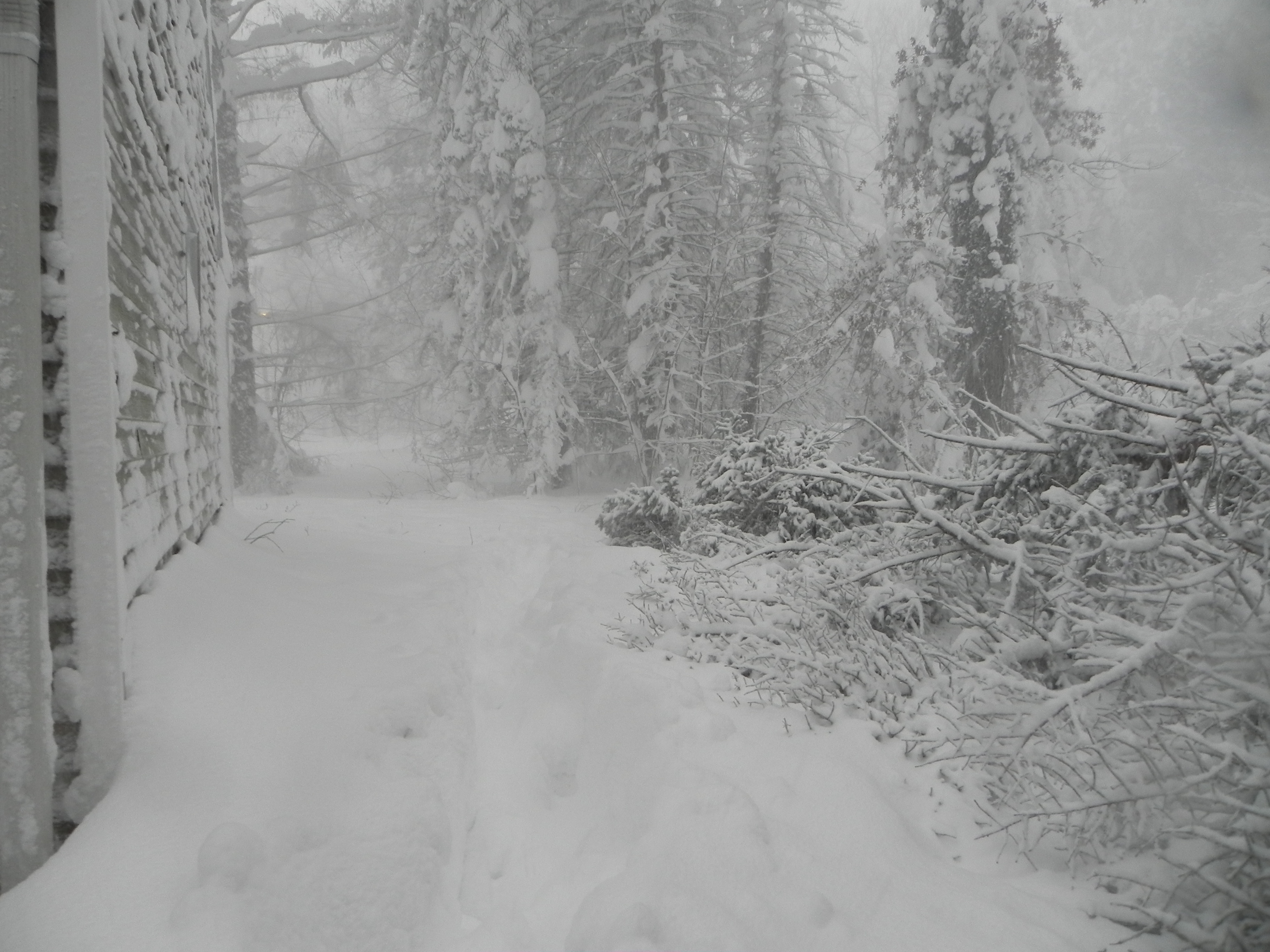
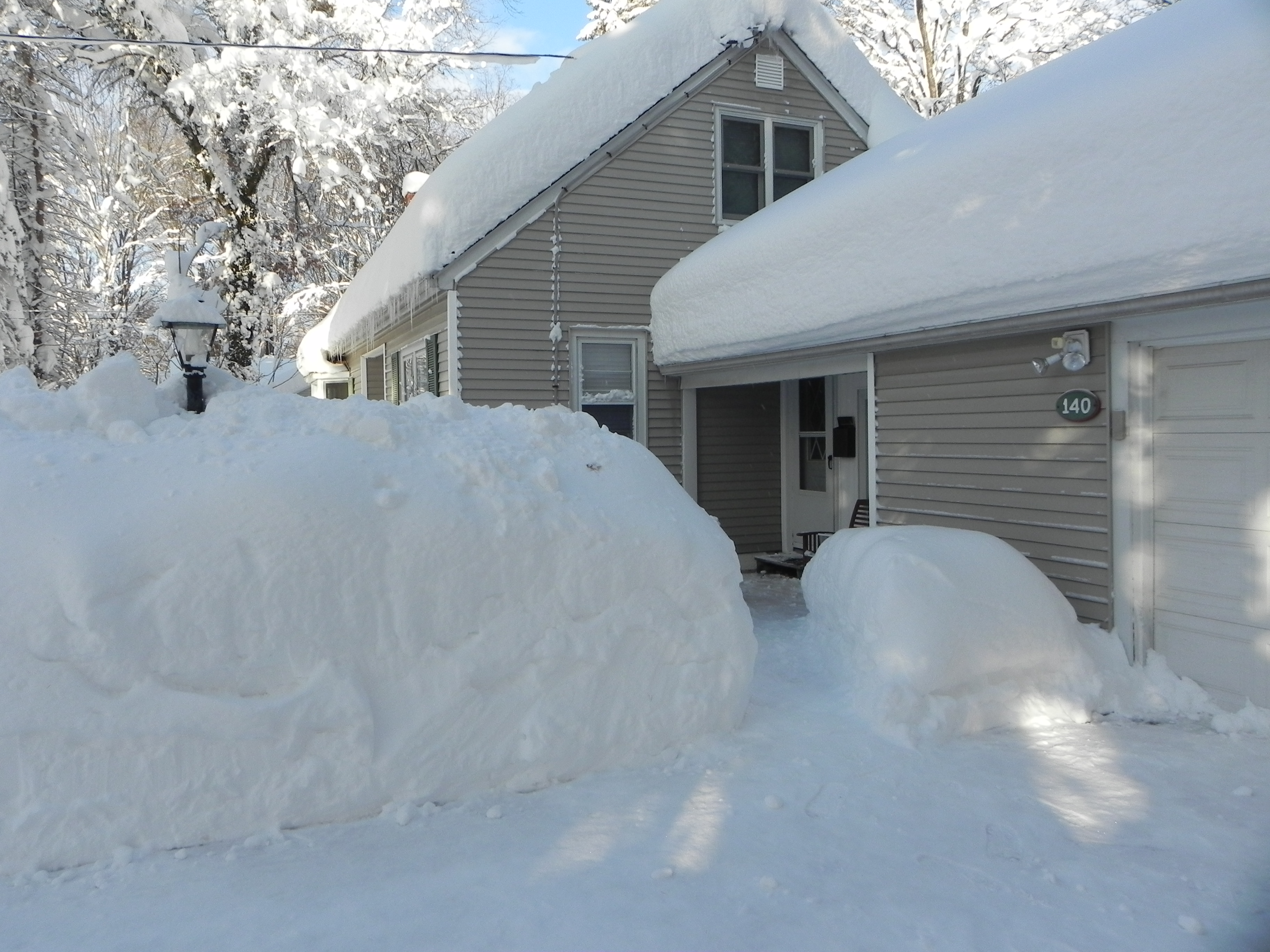
Travels bans and 40-plus inches of snow have drastically narrowed my world, both physically and mentally.  My body has not ventured beyond the end of our 70-foot long driveway for the past 39 hours.  My mind has been too preoccupied with weather reports and the minor aches and pains of snow shoveling to focus on legal matters or writing a new post.  So I thought I’d share photos that I’ve taken – from in an around our home – that capture some of the beauty and absurdity of a pre-winter “lake effect” snow storm that has humbled vast portions – but not all – of Western New York:

[Click an individual photo for a larger view.]

Our driveway after a day-and-a-half of shoveling 11-19-2014

Our driveway after a day-and-a-half of shoveling 11-19-2014

My favorite maple tree (and the yellow house across-the-street) 11-19-2014

My favorite maple tree (and the yellow house across-the-street) 11-19-2014

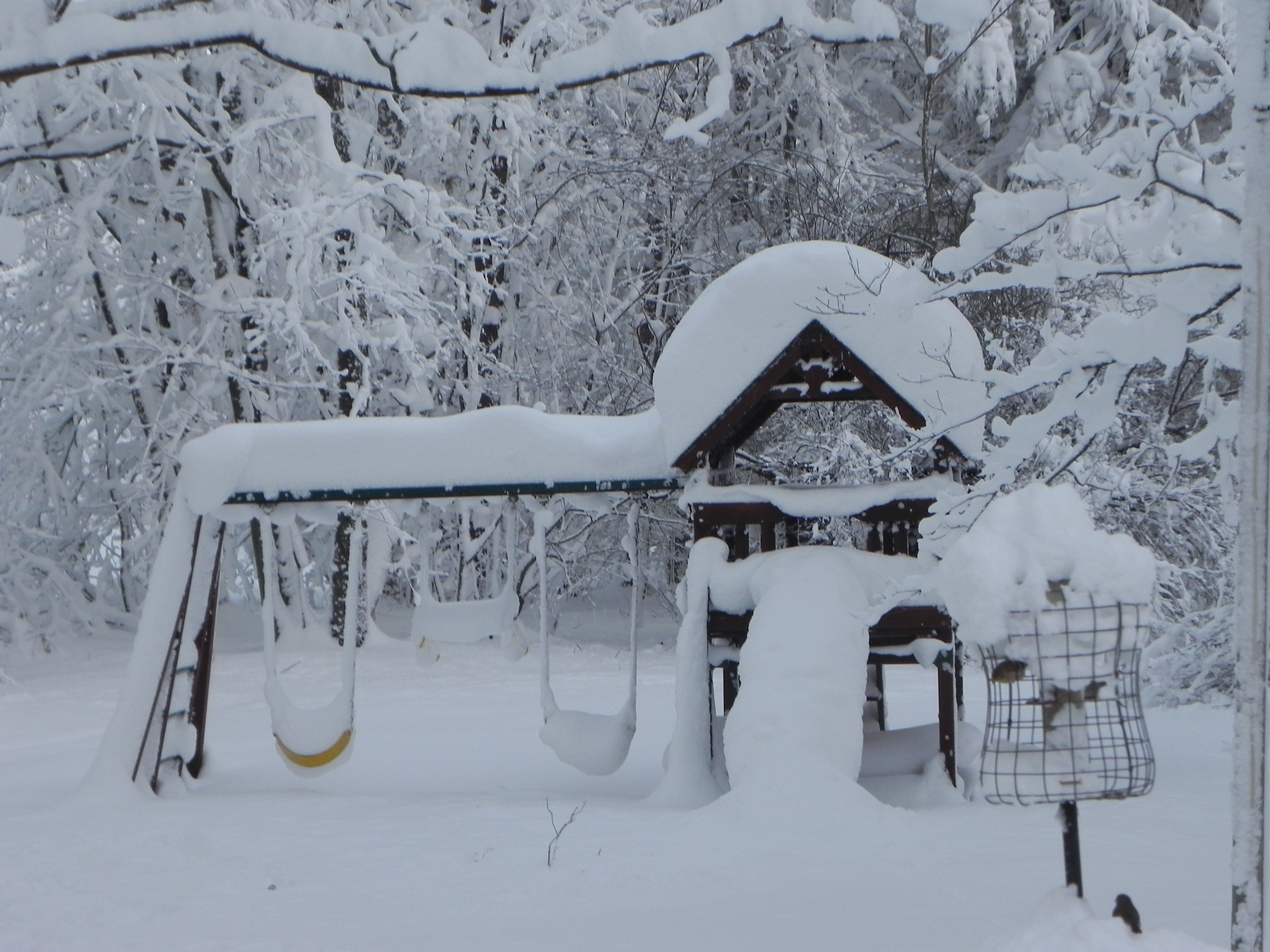
Yellow swing waiting for someone the adventurous type 11-19-2014

Swings waiting for the adventurous type 11-19-2014

Our apple tree - a deer-magnet - split in half from the weight of the snow 11-19-14

Our apple tree – a deer-magnet – split in half from the weight of the snow 11-19-14

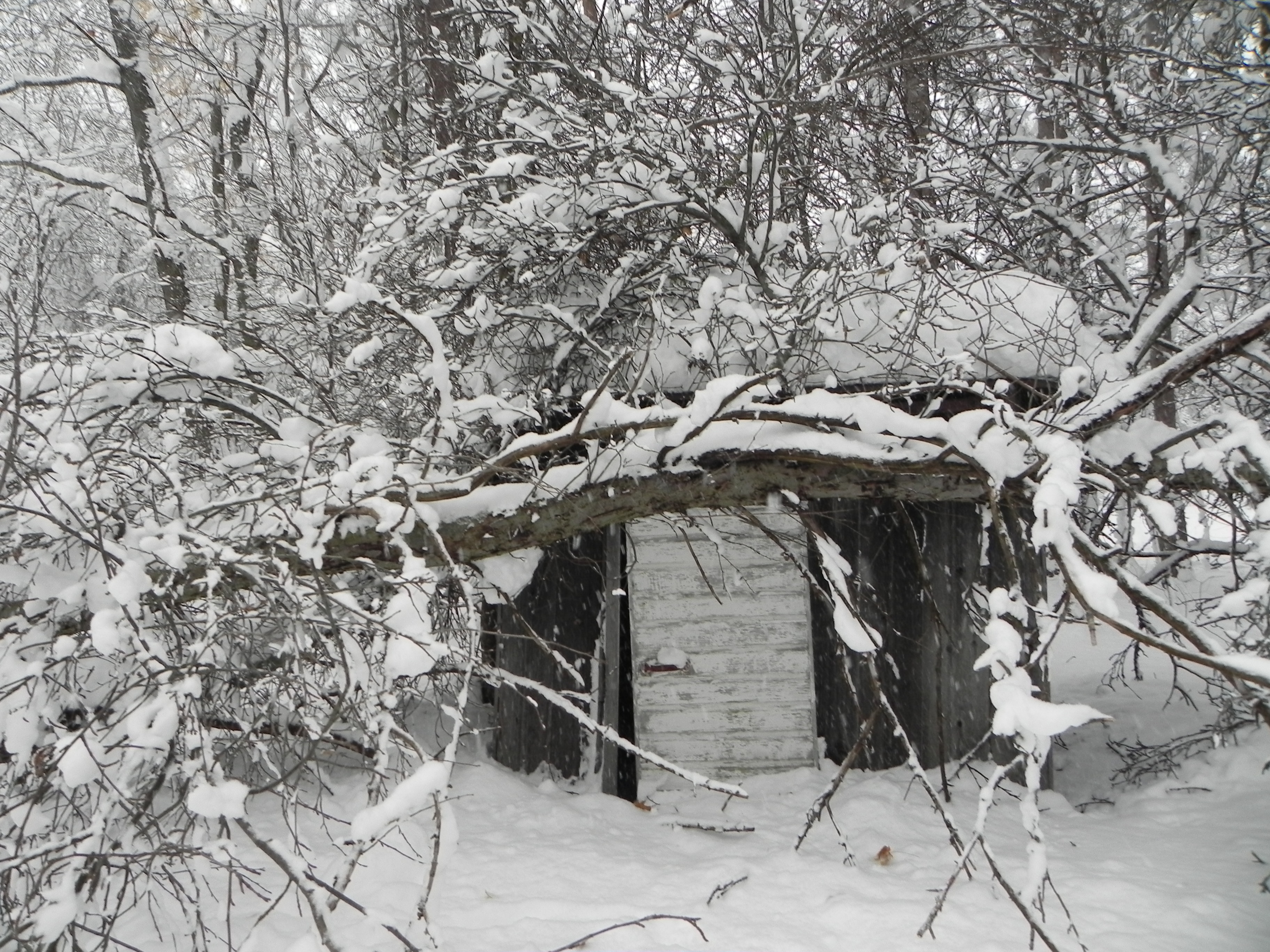
The other half of the apple tree landed on our shed 11-19-2014

The other half of the apple tree landed on our shed 11-19-2014

View from our front door on Day One 11-18-2014

View from our front door on Day One 11-18-2014

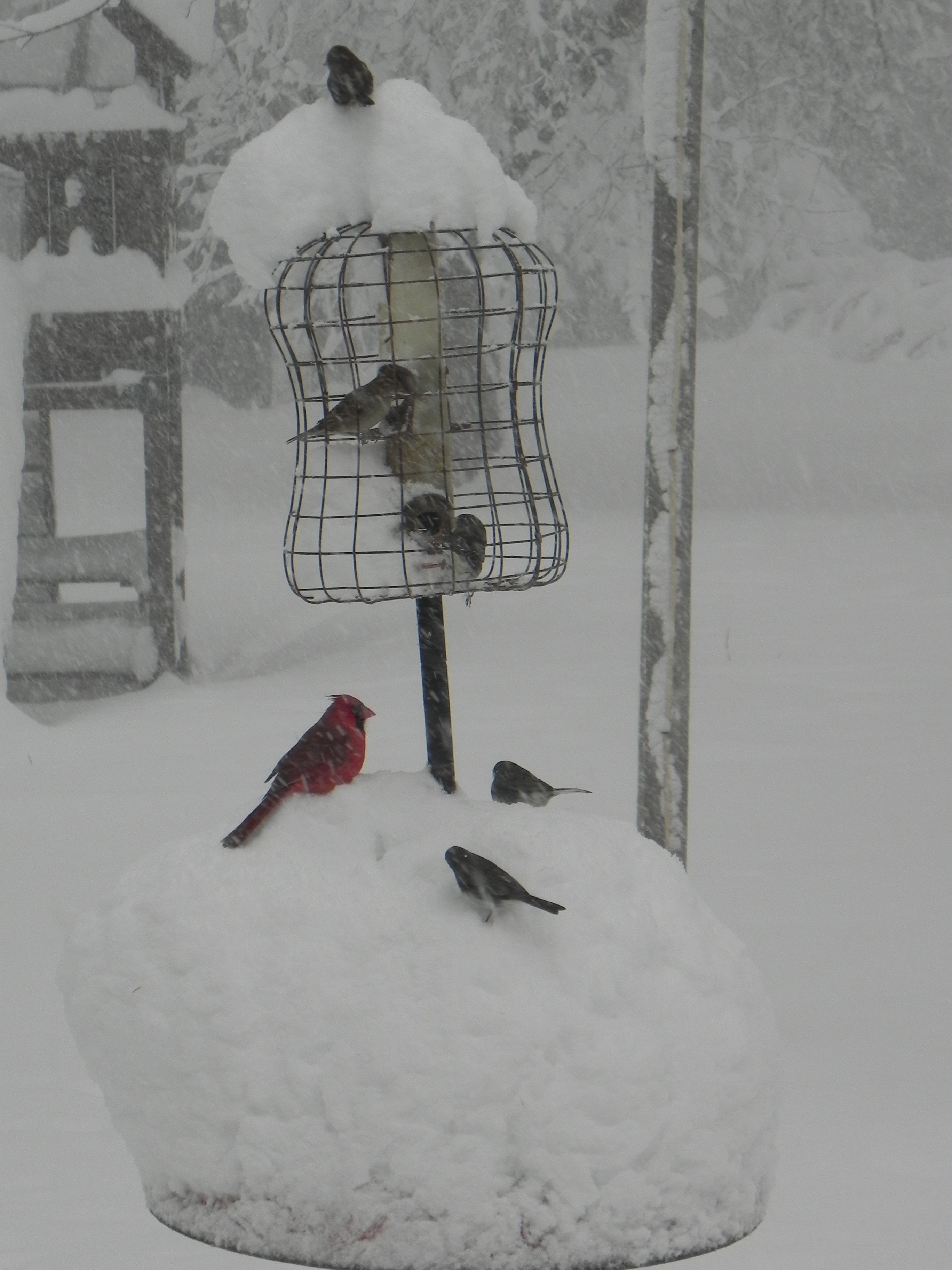
Eating to stay alive on Day One 11-18-2014

Eating to stay alive on Day One 11-18-2014

Waiting their turn Day One 11-18-2014

Waiting their turn Day One 11-18-2014

"Bird Lady" replenishing the food 11-18-2014

“Bird Lady” replenishing the supply 11-18-2014

Mother Nature's Wishbone?  11-18-2014

Mother Nature’s Wishbone? 11-18-2014

A view from our kitchen Day Two 11-19-2014

A view from our kitchen Day Two 11-19-2014

An apt symbol of my legal career 11-19-2014

An apt symbol of my legal career 11-19-2014

With All Due Respect,

Art Giacalone

Aggrieved by the Attorney Grievance Process

Posted by Arthur J. Giacalone on November 9, 2014
Posted in: Professional Ethics. Leave a comment

[A version of the post has been published as a letter-to-the-editor in the Feb. 2015 edition of the Erie County Bar Association’s BULLETIN, at http://www.eriebar.org/files/Bulletin_February_2015.forweb.pdf.]

– The refusal by the disciplinary officials to provide a copy of the accused attorneys’ response is unfair and reflects a system where certain lawyers are granted deferential treatment. –

The legal profession is described as “noble” and “largely self-governing” in the Preamble to the New York Rules of Professional Conduct – the standards of conduct that provide a framework for the ethical practice of law. According to the Preamble, adherence to the Rules depends upon voluntary compliance by lawyers, reinforcement by peer and public opinion, and, when necessary, enforcement through disciplinary proceedings. Additionally, unless every lawyer observes the Rules and “aid(s) in securing their observance by other lawyers,” the law will not continue to be a noble profession, and the public’s confidence in the rule of law and the justice system will not be furthered.

Until my recent efforts to comply with a lawyer’s ethical obligation under the Rules – to report to the local Attorney Grievance Committee conduct that raises substantial questions as to a lawyer’s honesty and trustworthiness – I wanted to believe that my chosen career was called “a noble profession” because society considered it a distinguished and admirable calling.  I am now left wondering whether the term “noble” describes a profession that perpetuates a two-class system where an aristocracy enjoys privileges not available to the commoners.

Confidentiality requirements prevent me from discussing the facts that motivated me – for the first time in my 38-year career – to file a complaint against an opposing counsel. [See NYS Judiciary Law, Section 90(10).] What I can say is that the conduct of my opposing counsel was unlike anything I had ever seen in a legal proceeding, behavior that – in my professional opinion – sunk so low as to easily meet the tough standard expressed in Rule 8.3(a) of the Rules of Professional Conduct [RPC]:

RULE 8.3. REPORTING PROFESSIONAL MISCONDUCT. (A) A lawyer who possesses knowledge or evidence that another lawyer has committed a violation of the Rules of Professional Conduct that raises a substantial question as to the lawyer’s honesty, trustworthiness or fitness as a lawyer shall report such knowledge to a tribunal or other authority empowered to investigate or act upon such violation. [Emphasis added.]

But the focus of this post is not the behavior that compelled me to report potential violations of the Rules of Professional Conduct to the local Attorney Grievance Committee [AGC].  What most concerns me is the process utilized by the AGC – or, at least, its staff and chief counsel – to investigate and dismiss my complaint. I do not know whether the grievance process – at least as it is administered where I practice – is heavily weighed against the complainant lawyer and in favor of the respondent lawyer, or if I am, in effect, a victim of a system where “the nobility” are treated with deference, and the commoners’ concerns are ignored.

Note: I consider myself one of the “commoners” – a sole practitioner and former legal services attorney who is not a member of a prestigious law firm, and who has never run for (much less held) statewide or federal office, or served as an officer or director of a state or local bar association. I lack the means to donate substantial sums of money to either charitable causes or political/judicial campaigns. I also have focused my practice on the representation of average citizens – the perennial underdogs – who possess the courage and foresight to challenge the actions of the financial and political elite.  

 * The process as described by the Attorney Grievance Committee *

The brochure distributed by the Attorney Grievance Committee, as well as the AGC’s “how-to-file-a-complaint” guidelines available on-line, provide the following description of the complaint process:        

 …  If review of your complaint by a staff member indicates that unethical conduct may be involved, the usual procedure is to send a copy of your complaint to the lawyer for his or her response. You will receive a copy of the lawyer’s response to your complaint. [Emphasis added.]

It was reassuring to me, as a potential complainant deciding whether to accuse another lawyer of having violated the Rules of Professional Conduct, to read the following statement:        

… The committee will act to resolve your complaint in a manner that is fair to both you and the attorney(s) named in the complaint. [Emphasis added.]

 * The process that I encountered *

Aware of the serious nature of the decision to report a claim of attorney misconduct, I drafted a detailed five-page complaint against opposing counsel – two lawyers affiliated with the same law firm. I also attached eleven supporting documents to the complaint letter, and mailed the papers to the AGC’s local office. Then I waited, expecting, not a quick determination, but the courtesy of a simple acknowledgement that my complaint had been received and would be reviewed. When several weeks crawled by without a word, I called the local AGC office and obtained confirmation over the phone that my packet had been received. Shortly thereafter, the grievance committee’s letter of acknowledgment arrived in the mail, signed by a staff investigator.

That correspondence contained the first troubling sign. To my dismay, contrary to the description of the complaint process found at the AGC’s web site and in its brochure, the first official correspondence from the Attorney Grievance Committee advised me that I would not receive a copy of respondents’ reply to my complaint.  Without explanation, the disciplinary office had decided that the two lawyers that I consider the most truth-challenged and the least trustworthy of any attorney with whom I have interacted in nearly four decades of practicing law, would not have to worry about me seeing their responses to my complaint.  In effect, they were given a license to say anything they wished – free from any concern that the complainant would be scrutinizing their assertions. This did NOT strike me as a process “fair to both” the complainant and respondents.

I promptly sent a letter to the AGC investigator and politely asked for clarification of two issues, including the apparent conflict between the process described in the brochure and the statement included in the AGC’s correspondence. The written reply that arrived the following week addressed the second point, but made no reference to my primary concern, the fact that I would not be receiving a copy of the response(s) to my complaint. Two weeks later, a letter arrived in my mailbox.  The opening paragraph advised me that further investigation with reference to the respondents was unwarranted at this time.  The concluding paragraph told me that the file would be closed.  The intervening paragraphs raised a number of vexatious issues, including the following:

* The two attorneys who were the subject of my complaint did not personally respond to my allegations.  Another attorney in the same firm – a lawyer who had also participated in the litigation in which the alleged misconduct had taken place, and who had demonstrated personal animus towards me throughout the lawsuit – submitted a response on their behalf denying my claims.  I was not told whether the grievance office had received a detailed response to the allegations in my lengthy complaint, or merely a general denial.  Given the significance of a lawyer’s motivations, mind-set, and intentions at the time an alleged violation of the Rules of Professional Conduct occurs, a response by a non-respondent appeared to me to be wholly inadequate and inappropriate.

* I was not provided an opportunity to respond to the conclusion that the issues raised in my complaint had been raised before the IAS court in oral argument, and that the court had apparently ruled on my claims.  In fact, while my allegations did stem from the circumstances relevant to a motion made by the two attorneys named in my complaint, the question of whether the “respondents” had violated their professional responsibilities had not been raised, and the Court never addressed or ruled on the factual and ethical issues raised subsequently in my grievance complaint.

* The Investigator’s assessment concluded with a statement (more appropriately uttered by an adversary than a grievance committee staff member) that while I may be dissatisfied with the lower court’s ruling, the Attorney Grievance Committee is not an alternate venue for appellate review of judicial decisions.  By expressing this sentiment, the grievance committee’s investigator chose to disregard – or had not been advised by respondents’ associate – that an appeal had in fact been taken from the court’s ruling, and that the appeal to the Appellate Division (on behalf of my clients) and the grievance complaint (filed solely by me as an officer of the court pursuant to RPC Rule 8.3[a]) involve discrete issues.

 * The absence of a mechanism to appeal or request reconsideration of the dismissal *

To my surprise, three of New York’s four Appellate Divisions – including the pertinent one here – do NOT provide a means for a complainant to challenge or request reconsideration of the dismissal of his or her complaint. That being the case, I sent a letter to the AGC’s Chief Counsel, requesting that the file containing my complaint be reopened, that I be allowed the opportunity to review and reply to the response submitted on behalf of the respondents, and that the grievance committee then reconsider its determination.

The Chief Counsel declined my request to reopen the matter.   Moreover, the conclusory assurances that were provided to me, that the entire file had been given thorough attention, and that the decision to dismiss the complaint was sound, failed to allay my concerns. In particular, the Chief Counsel made no effort to explain why – contrary to the grievance committee’s own procedures – I had been denied access to the response submitted on behalf of the two attorneys named in my complaint.  Instead, I was told that I appeared to be well aware of the respondents’ position since my complaint anticipated several challenges raised in the response.

Of equal importance, the Chief Counsel – presented by me with documentary evidence that the court had not ruled on the issues raised in my grievance committee complaint – stated the court’s rejection or denial of my concerns was “implicit” in the court’s rulings.  Apparently, at least in the mind of one chief counsel, an implicit (that is, unstated) ruling by a lower court is good enough reason for an Attorney Grievance Committee (or, at least, its staff) to disregard the well-documented concerns of a complainant.

 * The nobility of our profession, and confidence in the justice system, are imperiled *

As a result of the language used in the official correspondence sent to me by the grievance committee investigator and chief counsel, I do not know whether the volunteer group of lawyers and non-lawyers comprising the attorney grievance committee – established “to maintain the standards of the legal profession” and “to protect the public” – had any role in the dismissal of my complaint. It could be that my complaint was only seen by the AGC staff and counsel.  Regardless, it is difficult to reconcile the process that I experienced with the assurance in the Attorney Grievance Committee brochure that my complaint would be resolved “in a manner that is fair to both you and the attorney(s) named in the complaint.”   I also have no way of knowing whether other New York lawyers – who, like myself, may lack political connections, are not affiliated with a prestigious firm, lack the wherewithal to contribute generously to cultural institutions or political campaigns, or who have taken on unpopular causes on behalf of “the underdogs” – have filed grievance complaints against an attorney, and then experienced what I have:  a denial of access to that attorney’s response, and receipt of a condescending, if not insulting, admonishment that the Attorney Grievance Committee is not an alternate venue for appellate review of judicial decisions.

The bottom line: I feel as if I have been treated as a “second class” member of the legal profession by my local Attorney Grievance Committee, or, at least, by its staff and chief counsel.

It is unclear to me what would be worse for the legal profession and the rule of law:  a system where “the nobility” are treated with deference, and the concerns of “commoners” and the procedures meant to ensure fairness are disregarded; or, a grievance process where all complaints filed by one lawyer reporting misconduct of another lawyer are treated in the same fashion as mine. Either way, compliance with RPC Rule 8.3(a)’s mandate to report serious violations of the Rules of Professional Conduct to the appropriate authorities is being discouraged. Either way, the characteristics that – at least theoretically – make the legal profession a distinguished and admirable calling are imperiled, and the public’s trust in the justice system is diminished.

With All Due Respect,

Arthur J. Giacalone (NYS Attorney Registration # 1335082)

Bloomberg TV’s “With All Due Respect”

Posted by Arthur J. Giacalone on November 6, 2014
Posted in: Bloomberg's With All Due Respect. Leave a comment

– After one month on air, are Heilemann and Halperin maintaining the quality of the name we share? –

It was just about a year ago that I decided – in a rare enlightened moment – that “With All Due Respect” would make a great title for a blog where I could express my opinions about government decisions impacting land use and the environment.  By December 2013, I applied to the U.S. Patent and Trademark Office for a “service mark” to use that name while providing news analysis and commentary on topics of interest to me professionally and personally.  Thanks to Geoff Kelly at ArtVoice, I used the “With All Due Respect” mark in commerce for the first time on January 30, 2014 in a guest essay.

On September 23, 2014, the mark was officially registered in my name by the USPTO.  But, by then, I had entered into an agreement to assign my right and interest in the mark – my “baby” – to an unidentified party for use as the name for a political talk show.  Given the fact that, in return, I was being granted a license to continue using “With All Due Respect” in conjunction with this blog, related articles or commentary in newspapers and publications, books [fiction or non-fiction], and Continuing Legal Education classes or programs, I asked for and was given assurances that the phrase was not going to be diminished – at least, in my eyes – by association with some mindless, hate-filled, right-wing talk show.

On October 6, 2014, Bloomberg Television premiered “With All Due Respect”, co-hosted by Mark Halperin and John Heilemann. Promos for the show promised to provide “the high human drama of politics” and “fun” – in their words, “like a taco bar and a sushi bar, all in one.” [Okay, I’ll admit that I’m just a working-class Western New Yorker who is not exactly certain what that means.]  I have not watched the program – which airs weekdays at 5 PM ET.  Have you?  How are they doing?  Initial reviews were not exactly glowing.  Are they maintaining the quality that I have attempted to provide visitors to this site?  Should I feel comfortable with sharing a name – but otherwise not an affiliation – with the Bloomberg TV show?  PLEASE LET ME KNOW.

Bloomberg's W-A-D-R 11-06-14

With All Due Respect,

 Art Giacalone

P.S.  In case you’re wondering why Bloomberg TV chose the name, With All Due Respect, here’s what the co-hosts told David Carr in a New York Times interview: “Why is the show called “With All Due Respect”? Halperin: In Washington, 80 percent of the time, what they mean when they say that is, I’m about to kick you between the legs. Heilemann: “Due respect” could be a whole lot, or it could be virtually nothing.”  That sounds about right to me.

P.P.S.  I’m told that Bloomberg television is available in WNY through:  DIRECTV (Channels 353, 353 [HD]); DISH Network (203, 203 [HD]); Time Warner Cable (207).

NOT ALL LUNGS AND NEIGHBORHOODS ARE CREATED EQUAL

Posted by Arthur J. Giacalone on October 21, 2014
Posted in: Health impacts, Peace Bridge. Leave a comment

– A busy international truck crossing isn’t appropriate near a residential neighborhood –

Western New York’s most prominent newspaper and New York’s senior senator have raised their voices on behalf of citizens subjected to unhealthy conditions.

An October 20, 2014 Buffalo News editorial concluded that a “crematory simply isn’t appropriate in a densely populated neighborhood,” such as the one surrounding the Amigone funeral home in the Town of Tonawanda. Odors, smoke and soot that emanated from the building have depressed property values and affected the quality of life.

U.S. Senator Chuck Schumer recently visited Buffalo’s Seneca-Babcock neighborhood to express concerns over the negative impacts dust from a concrete crushing operations was having on nearby residents. According to the senator: “It’s quality of life we’re talking about. But it’s more. Residents of this neighborhood have been battling with health issues. People suffer from migraines, bloody noses and, in some of the worst cases, people have reported trouble from breathing and their kids with asthma.”

But the Buffalo News and Sen. Schumer have not used their substantial influence to protect the health and quality of life of the residents living near the Peace Bridge. They’ve chosen silence, although the lower West Side community is even more densely populated than the neighborhood surrounding Amigone’s crematory.

Aerial map - Vicinity of Peace Bridge

And the connection between diesel exhaust and severe health problems, especially childhood asthma, is irrefutable.

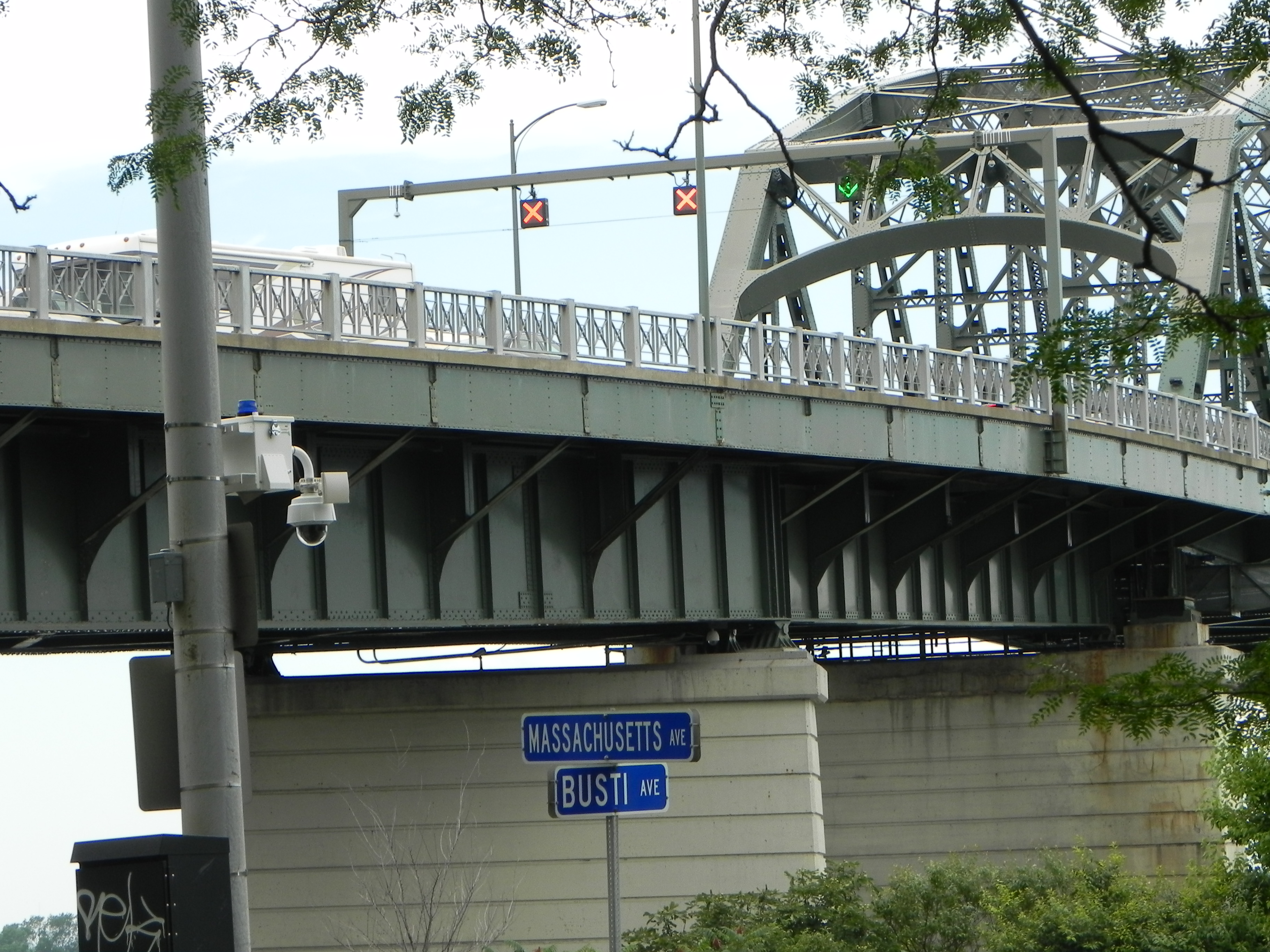
Corner of Busti & Massachusetts  DSCN5040

No one can rationally suggest that a busy international border crossing – that sees 1.24 million trucks annually – is appropriate in a densely populated residential neighborhood.

But money talks, and, apparently, not all lungs and neighborhoods are created equal.

FRont Park 11-12-08 034

With All Due Respect,

Art Giacalone

P.S.  A version of this post was published in the Nov. 6, 2014 weekly edition of ArtVoice, http://artvoice.com/issues/v13n45/letters_to_artvoice/lungs


Posts navigation

← Older Entries
Newer Entries →
  • CATEGORIES

  • March 2026
    M T W T F S S
     1
    2345678
    9101112131415
    16171819202122
    23242526272829
    3031  
    « Nov    
  • DISCLAIMER

    This blog is provided for general informational purposes only. It should not be construed as legal advice and is not intended to be a substitute for legal counsel. Persons requiring legal advice should retain a properly licensed lawyer. No attorney-client relationship will be formed based on use of this site and any comments or posts to this blog will not be privileged or confidential. *************** This blog's author, Arthur J. Giacalone, does not intend or consider the communications at this blog to be ATTORNEY ADVERTISING. The primary purpose of the communication is not for the retention of Mr. Giacalone's legal services. [See definition of "Advertisement" at Part 1200, Rules of Professional Conduct, Rule 1.0(a).] Nonetheless, in case the proper authorities choose to treat this web site as ATTORNEY ADVERTISING, the street address, phone number and email address of the law office of Arthur J. Giacalone are: 17 Oschawa Avenue, Buffalo, New York 14210; (716) 436-2646; AJGiacalone@twc.com.
Blog at WordPress.com.
With All Due Respect
Blog at WordPress.com.
  • Subscribe Subscribed
    • With All Due Respect
    • Join 62 other subscribers
    • Already have a WordPress.com account? Log in now.
    • With All Due Respect
    • Subscribe Subscribed
    • Sign up
    • Log in
    • Report this content
    • View site in Reader
    • Manage subscriptions
    • Collapse this bar
 

Loading Comments...