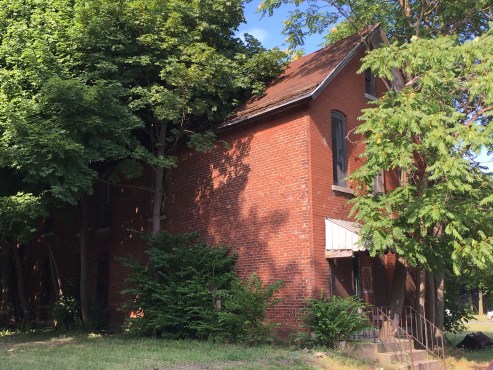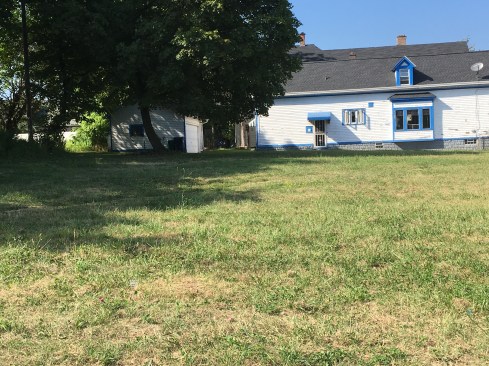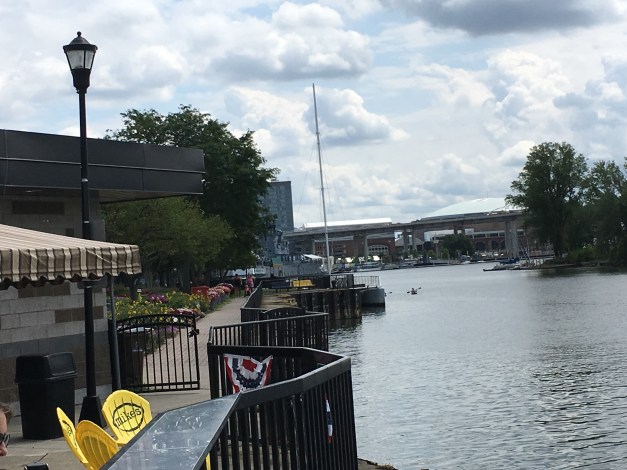
With All Due Respect

Photos and musings by Arthur J. Giacalone

  • About The Author
  • About This Blog
  • Pre-WADR Archives

Fruit Belt fiction and hypocrisy

Posted by Arthur J. Giacalone on November 11, 2019
Posted in: Buffalo News, City of Buffalo, Development, Fruit Belt, Gentrification, SEQRA. Leave a comment

[A shorter version of this posting was published on-line in the Buffalo News “Another Voice” column on November 10, 2019 under the headline, “Fruit Belt residents deserve moratorium, environmental review.” Here’s the link. Note: The print version on November 11, 2018 omits reference to “moratorium” in its headline.]

BNMC and Fruit Belt map

The November 5, 2019 print version of the Buffalo News contains an opinion by the newspaper’s editorial board under the headline, “Fruit Belt Friction – Residents’ fears of gentrification demand respect, without slowing revival.” [The on-line version, published November 4, 2019, uses the headline, “Editorial: Friction in the Fruit Belt.”]

The editorial board of Western New York’s major newspaper expresses the following perspective:

(1) “gentrification” occurs when high-tech development produces high-dollar jobs, demand for nearby land rises, and real estate prices in the surrounding neighborhoods are suddenly pushed higher;

(2) the fear of Fruit Belt residents, that economic forces beyond their control could upend their lives, is real;

(3) despite the impacts on Fruit Belt residents, gentrification should not be resisted because the “macro effects are overwhelmingly beneficial to the city”;

(4) “the job of government” is to limit the damage of higher tax bills on Fruit Belt residents who cannot afford them, but this task must be performed “without diminishing the possibilities” of rising prices for those who wish to sell their land;

(5) government should not and cannot view gentrification “as an irredeemably destructive force” because “it is, in the end, just another word for renewal,” part and parcel of reviving a neighborhood that has fallen on hard times; and

(6) although “anyone with a beating heart” should acknowledge that the fundamental fear of Fruit Belt residents that their lives could be upended is real, gentrification should not be slowed down.

With all due respect, I find the approach to gentrification reflected in the Buffalo News editorial – an approach embraced by the powers-that-be – to be fiction, rather than fact, and to reveal a thinly disguised hypocrisy towards the low-income residents of the Fruit Belt and other Buffalo neighborhoods.

The Fruit Belt “neighborhood” is not being revived by BNMC-spurred gentrification.

A neighborhood is much more than its physical location. It’s a section of a city defined by its residents, history and distinguishing characteristics. It’s a place where neighbors feel comfortable interacting in familiar surroundings.

It is fiction to suggest that the Fruit Belt neighborhood is being renewed or revitalized by the gentrification that has been occurring as the Buffalo Niagara Medical Campus (BNMC) has grown and expanded eastward.

A “neighborhood” is not renewed or revitalized if its existing residents are being displaced, either directly through significantly higher rents or an exorbitant rise in property taxes, or indirectly when long-time residents decide to move as the departure of family and friends leaves them feeling like strangers in a once familiar setting.

Real estate prices may be rising, and property assessments skyrocketing. New buildings out-of-scale with the existing homes, with residential units too expensive for existing neighbors, may be planned. But true Fruit Belt renewal and revitalization isn’t occurring if the neighborhood is no longer affordable for the residents who call it home, or if the character of the community is altered to the extent that it is no longer recognizable and comforting to the families who have lived there for decades.

DSCN5864

Government agencies have disregarded their obligation to protect Fruit Belt residents from displacement.

Contrary to the position taken in the Buffalo News editorial, the “job of government” goes well beyond limiting the damage of higher tax bills for the Fruit Belt homeowners who can’t afford them.

Each and every time a state or city agency was asked over the years to approve or help finance a development project for the medical campus, they were obligated, pursuant to the State Environmental Quality Review Act (SEQRA), to objectively and thoroughly assess the potential adverse impacts that might result from BNMC growth and expansion. Additionally, they were legally mandated to avoid or reduce the identified adverse impacts “to the maximum extent practicable” by incorporating mitigation measures as conditions to any approval or financing of a project.

It is important to note that SEQRA defines the term “environment” broadly to include, in addition to physical conditions, socio-economic factors such as “existing patterns of population concentration, distribution, or growth” and “existing community or neighborhood character.” As held by our state’s highest court, the “potential acceleration of the displacement of local residents and businesses” is one of the impacts on population patterns and neighborhood character that must be analyzed pursuant to SEQRA whenever a project is proposed. And, the impact must be assessed, not only for the actual parcel of land involved, but for the community in general.

In short, the environmental review mandated by SEQRA placed an obligation on city and state officials to protect Fruit Belt residents beforehand from the “upending of their lives” that might result from BNMC expansion and growth. Disturbingly, government officials have consistently failed to comply with their obligations under SEQRA. Fruit Belt residents have just reason to feel betrayed.

Although the BNMC Board of Directors acknowledged in 2010 that “the transition” between the medical campus and the Fruit Belt neighborhood must be carefully considered, dramatic expansion has occurred without concern for the Fruit Belt.

For a decade-and-a-half, Western New York powerbrokers have allowed virtually unfettered economic development in and around the medical campus to take priority over the quality of life of nearby residents. According to the BNMC, the clinical, research and support space on the medical campus doubled in size from 4.5 million square feet in 2002 – when the Buffalo Niagara Medical Campus, Inc. was formed – to 9.0 million square feet in 2017. During that same time period, the number of employees and students converging on the 120-acre campus grew from 7,000 to approximately 17,000.

IMG_4150 (3) From BNMC’s Report to the Community 2014.

Acknowledging that “the dramatic growth of the campus” far exceeded its initial expectations, the BNMC Board of Directors updated its original 2003 master plan in 2010. Expecting an accelerated eastward expansion of the medical campus, the BNMC board made the following statement in the update: “The transition between the medical campus and the Fruit Belt neighborhood must be carefully considered to take advantage of proximity while also mediating building scale, character and use.”

The 2010 Master Plan Update highlighted a list of “important and necessary initiatives,” which included the preparation of a “campus-wide” Generic Environmental Impact Statement [GEIS] to “establish conditions under which future actions [that is, proposed development projects] would be undertaken.” The GEIS was envisioned by the BNMC board as a neutral platform where information could be gathered and development options and impacts fully and publicly assessed. The City of Buffalo was considered the ideal entity to serve as the “lead agency” in guiding preparation of the GEIS.

Despite the BNMC’s lofty goals and ostensibly sincere concerns regarding the Fruit Belt, the campus-wide GEIS was never prepared. This failure to provide meaningful protections to residents of the Fruit Belt (and, other neighborhoods adjoining the medical campus) is particularly inexcusable given the identity of two members of the BNMC Board of Directors: the Mayor of the City of Buffalo, Mayor Byron Brown, and the City Common Council President, currently Darius Pridgen.

Preparation of the recommended GEIS would have provided an effective vehicle both to publicly and objectively assess the potential that BNMC expansion would result in accelerated displacement of Fruit Belt residents and businesses, and to establish and implement practical conditions to limit such adverse impacts. The need for a campus-wide environmental review is underscored by the dramatic growth of the medical campus in the years following the 2010 update. The new institutions that opened subsequent to 2010 include Kaleida/UB Global Vascular Institute, UB’s School of Medicine and Biomedical Sciences, John R. Oishei Children’s Hospital, Conventus, and the Innovation Center Annex.

Of special interest, due to its proximity to the Fruit Belt, is the opening in 2016 of Roswell Park’s Clinical Science Center at the northwest corner of Carlton Street and Michigan Avenue (a/k/a Harriet Tubman Way)

IMG_4076

.IMG_4077 (2)

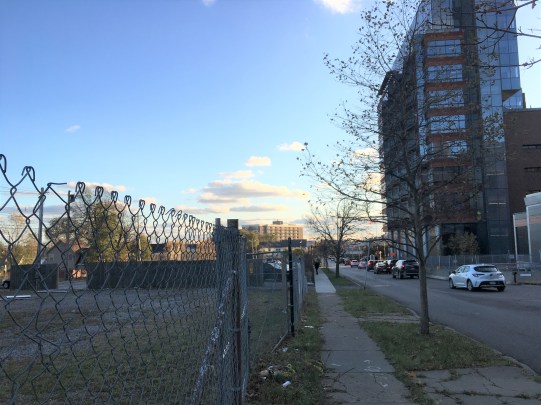
Rather than providing an appropriate “transition” at the interface of the medical campus with the Fruit Belt, government decisionmakers allowed Roswell to construct its tallest and most modernistic building at the critical Carlton Street/Michigan Avenue intersection. In doing so, the adjoining neighborhood has been subjected to a structure that contrasts starkly in scale, character and use to the Fruit Belt’s predominately one- and two-story residences.

IMG_4083 (2)

IMG_4096 (2)

IMG_4063

IMG_4050

IMG_4074

To compensate for the years of governmental and institutional neglect, and to prevent additional displacement of Fruit Belt homeowners and tenants, Buffalo’s Common Council should promptly enact a moratorium prohibiting any new construction along the portion of the Fruit Belt near the medical campus while it conducts a meaningful environmental study that identifies mitigation measures to protect residents from the adverse impacts of gentrification.

With All Due Respect,

Art Giacalone

Caz Park’s Classic Clouds

Posted by Arthur J. Giacalone on November 3, 2019
Posted in: Cazenovia Park, Olmsted Parks, South Buffalo, WNY Photos. Leave a comment

The winds were bitter, but the skies were impressive on my Sunday morning stroll through South Buffalo’s Cazenovia Park.  Hope you agree.

IMG_3937

IMG_3938

IMG_3940

IMG_3941


IMG_3944

IMG_3945

IMG_3936

IMG_3946

IMG_3948

IMG_3949

IMG_3951

IMG_3952

IMG_3954


IMG_3956

IMG_3957

IMG_3959

IMG_3960

IMG_3961

IMG_3965

IMG_3968

IMG_3970

IMG_3974

IMG_3976

With All Due Respect,

Art Giacalone


Hook & Ladder’s brewery plan should be promptly extinguished

Posted by Arthur J. Giacalone on October 31, 2019
Posted in: Cazenovia Park, City of Buffalo, Development, Green Code, Hook & Ladder, Olmsted Parks, South Buffalo, Zoning Law. Leave a comment

[Note: An abbreviated version of this posting was published as a letter-to-the-editor in the Buffalo News “Everybody’s Column” on October 31, 2019. You can read it here.]

Jonathan D. Epstein, the business reporter at the Buffalo News, must have experienced a really slow news day in mid-October.  Or, perhaps, Jonathan decided to do a favor and float a trial balloon for the three local firefighters – John Otto, Peter Scarcello, and Gino Gatti – who comprise the Hook & Ladder development company.

On October 15, Mr. Epstein and our region’s largest newspaper treated the following as newsworthy: (1) Hook & Ladder is “exploring the possibility of putting a brewery in the former St. John the Evangelist Roman Catholic Church” on Seneca Street. (2) An existing deed restriction mandated by the Catholic Diocese whenever it sells a former church building bars a brewery in a former house of worship. (3) A brewery would be possible only if the diocese “gives its blessing.”

IMG_3814           Former St. John’s church, 2317 Seneca St.

IMG_3834                        Detail from St. John’s Façade.

This story might have been worth the ink and paper used to produce the Buffalo News print version on October 16, 2019 had the Hook & Ladder boys already reached out to the diocese to discuss the concept of a brewery in the vacant church building.  But, according to the article, that critical step had not occurred: “Diocese spokeswoman Kathy Spangler said they have not been contacted yet by Hook & Ladder about future development of the church.”

Whether or not the article was a premature, I found it both surprising and disappointing that Hook & Ladder would be giving any thought to installing a brewery at the corner of Seneca Street and Saint John’s Parkside.

After all, when Epstein initially reported Hook & Ladder’s purchase of the St. John’s property in January 2017 for $175,000 – under the too-cute headline, “Firefighters answer call to revive Seneca Street” – the firefighting team made no mention of a brewery.  Rather, they expressed plans for 12 loft-style residential apartments on the second floor (which, I assume, is still part of the development company’s vision), and a deli, coffee shop or similar business in the front of the building, with office or other retail in back.

And, the company’s motto is: “We are committed to improving our community one property at a time.”  In my humble opinion as a South Buffalo homeowner and resident, a brewery is not the way to attain that worthy goal.

Here are the primary reasons that I urge the diocese – when and if they are approached by Hook & Ladder – to quickly douse any spark or flame that could intensify into a full-blown brewery in old St. John’s:

– The former church has three sensitive neighbors. On one side is Grace House, a non-profit healthcare hospitality house, which promises patients and their families “overnight stays and day respite in a secure and peaceful guest house.”

IMG_3818         Grace House, 2315 Seneca St.

IMG_3823                Side yard between St. John’s and Grace House.

To the church’s rear is Baker Victory Service’s St. John’s Parkside Early Childhood Program, which offers “child care in a nurturing environment” on a “safe and accessible campus.”

IMG_3805        Baker Victory Service’s Early Childhood facility, 51 St. Park’s Parkside.

IMG_3826              View down St. John’s Parkside from Seneca St.

Steps away from the former St. John’s is the entrance to the busy and family-centric Cazenovia Park.

IMG_3831 Entrance to Cazenovia Park at Seneca St./Warren Spahn Way with St. John’s in background.

– The zoning status of the property bars a brewery. The former house of worship is zoned “N-3R Residential” under Buffalo’s zoning and development ordinance, the “Green Code” (as are the neighboring hospitality house and early childhood program facilities). Neither a brewery, nor a restaurant, is permitted in a N-3R district.

While I don’t know whether Hook & Ladder’s principals took care to consider zoning constraints prior to purchasing the property, they may want to check out two potential uses for the former church under the Green Code: a cultural facility, or a bed-and-breakfast, would be allowed in the structure if a “special use permit” is approved by the City’s Common Council.

– There are plenty of places to get a drink on Seneca Street. The Seneca Street neighborhood doesn’t need another place to drink beer or other alcoholic beverages. Within four-tenths of a mile of the former church building there are six establishments where you can buy a drink, including the recently renovated Blackthorn Restaurant & Pub, the trendy Rocker Bottle Beer Reserve, and the old-time Daly’s Bar. There are also two liquor stores.

My suggestion: Let’s encourage Hook & Ladder to find a meaningful use for this historic structure, activities that will truly enhance the Seneca Street/Cazenovia Park neighborhood.

With All Due Respect,

Art Giacalone

Forget Letchworth – check out Caz Park’s autumn colors

Posted by Arthur J. Giacalone on October 25, 2019
Posted in: Olmsted Parks, South Buffalo, WNY Photos. Leave a comment

South Buffalo’s Olmsted-designed Cazenovia Park, October 25, 2019:

IMG_3746

IMG_3713

IMG_3718

IMG_3711

IMG_3723

IMG_3728

IMG_3730

IMG_3734

IMG_3736

IMG_3745

IMG_3747

IMG_3752

IMG_3755

IMG_3758

IMG_3761

IMG_3764

IMG_3766

IMG_3774

IMG_3776

IMG_3781

IMG_3787

IMG_3782

IMG_3801

With All Due Respect,

Art Giacalone


Whistleblower headlines stir up the past

Posted by Arthur J. Giacalone on October 22, 2019
Posted in: Donald J. Trump, Professional Ethics. Leave a comment

Preface:  The October 22, 2019 print version of the Buffalo News includes in its “My View” column a piece I wrote under the headline, “Former whistleblower reflects on his decision.”  [You can read the on-line version here.]  The newspaper’s editorial staff did a decent job “editing” what I had submitted, making it more streamlined and, one could say, more focused.  [If you’re curious about the changes, here’s a file tracking the alterations: My View whistleblower piece mark-up. ]  Posted below is the text of my submission to the Buffalo News:

I was a whistleblower 37 years ago while serving as a lawyer in a state office in Buffalo. No protections existed then for employees who sought to shed light on improper governmental action. I was fired.

That daunting episode perhaps explains my skepticism towards politicians, and my preference for a solo legal career. But, thankfully, I’ve managed to spend scant time the past few decades dwelling on the topic.

Recent events have changed that.

The media coverage of the whistleblower complaint, regarding a telephone conversation between President Donald Trump and Ukrainian President Volodymyr Zelensky, and the demeaning and threatening condemnation of the unidentified civil servant that followed, have affected me viscerally.

I recoil at the suggestion that a person who reports what he or she believes is improper governmental action must be a partisan or political hack. My party affiliation and progressive leanings were fully in line with those of my bosses.

I also know firsthand that personal animus towards an employer need not be a whistleblower’s motivation. I considered my local boss a mentor and friend. But I couldn’t remain silent once I concluded that his orders to me were potentially unethical and illegal.

There was also a human aspect to my actions. As the sole contact between our office and the powerless individuals who were relying on us, I was personally exposed to the pain caused by the politically motivated acts and omissions of my superiors.

Undoubtedly, the circumstances that I faced in 1982 pale in significance to those implicated by the anonymous whistleblower who has challenged the actions of President Trump. Nonetheless, the events that I found myself immersed in as a young attorney led me to place my ethical obligations as a lawyer, and the wellbeing of a hundred or so unemployed factory workers, above an unquestioned loyalty to the demands of my bosses.

The divergence between my opinion and that of my employer occurred in the summer of 1982. While the head of our statewide department was engaged in a re-election campaign, a federal agency sent him a stern letter questioning a decision my local boss had made concerning the case I was handling. The response was instantaneous: the public, including the unemployed workers, must not learn about “the letter” until after the November elections.

I found myself in an extremely uncomfortable position.

But I didn’t go running to an outside agency proclaiming my displeasure. I respectfully and discreetly asked my local boss for permission to prepare a confidential memorandum expressing my legal and ethical concerns. In response, my mentor and friend prohibited me from putting my research and conclusions in any written form, and ordered me not to raise my concerns with his superiors.

My discomfort, professionally and personally, escalated.

The November election came and went, but my local supervisor refused to lift the veil-of-secrecy or address the interests of the unemployed workers. I again tried to raise the issue privately with my Buffalo boss in December 1982. I was fired shortly thereafter, without any explanation, and told to immediately pack my belongings. An armed guard was placed at my office door.

About six weeks after my termination, my Buffalo supervisor announced his candidacy for an elected office. I finally understood the reason for his uncharacteristic behavior.

Given my experiences, I deeply admire the woman or man who had the courage and sense of duty to file the federal “whistleblower complaint.” And I know that if he or she possesses values similar to my own, the whistle had to be blown regardless of the consequences.

With All Due Respect,

Art Giacalone

P.S.  Attached is a lengthy “Statement of Facts,” written in 1987, which provides a  detailed chronology of my “whistleblower” episode:  1987 Statement of Facts.


Sunday morning solitude – Caz Park 10-13-2019

Posted by Arthur J. Giacalone on October 13, 2019
Posted in: Olmsted Parks, South Buffalo, WNY Photos. 1 Comment

IMG_3536

IMG_3537

IMG_3540

IMG_3542

IMG_3543

IMG_3544

IMG_3547

IMG_3552

IMG_3557

IMG_3560


IMG_3564

IMG_3568

IMG_3567

IMG_3577

IMG_3579

With All Due Respect (and, Appreciation),

Art G.

Brown-Feroleto “vape shop moratorium” exceeds mayor’s authority, accomplishes little

Posted by Arthur J. Giacalone on September 20, 2019
Posted in: Andrew Cuomo, Byron Brown, City of Buffalo, Green Code, Joel Feroleto, Zoning Law. Leave a comment

If vaping – the use of electronic cigarettes – is as unhealthy and addictive as many medical experts believe (especially for children, teens, and young adults, and women who are pregnant) – Buffalonians should thank New York State for taking aggressive action.

On September 17, 2019, Gov. Andrew M. Cuomo announced that New York is the first state in the U.S. to implement a ban on the sale of flavored electronic cigarettes and nicotine e-liquids. While the ban is effective immediately, the Department of Health will allow retailers a two-week grace period before beginning visits to enforce the flavoring ban.

That’s great. But what have Buffalo’s elected officials done in response to recent health advisories by federal and state agencies triggered by unexplained vaping-associated pulmonary illness? Predictably, not much.

On September 6, Mayor Byron Brown announced that he was “proud” to be issuing a six-month moratorium on the opening of new stores in Buffalo that sell electronic cigarettes and supplies to give the city time to learn more about the health impacts of “vaping” on residents. His Honor’s press release proclaims in all-caps, “MAYOR BROWN ANNOUNCES SUSPENSION OF NEW VAPE LICENSES FOR SIX MONTHS.” It also states, “The resolution, sponsored by Delaware District Common Council Member Joel Feroleto, was unanimously adopted by the Common Council on September 3, 2019.” [Here’s Mayor Brown’s VapeShopMoratorium-PressRelease 09-06-19.]

Joel Feroleto photo from prior bio Byron Brown photo

Mayor Brown’s statement provides the following explanation of the Brown/Feroleto moratorium:

“The City of Buffalo issues licenses and special use permits pursuant to Section 399-13.1 and Chapter 496 of the City of Buffalo Code for the sale of tobacco and electronically delivered nicotine, commonly referred to as ‘vapes’ or ‘electronic cigarettes.’ The [Common Council’s September 3, 2019] resolution requires a moratorium on the issuance of these special use permits while these studies and investigations are ongoing.”

[Note: I know of no provision in the city’s code that requires an individual or business to obtain a “license” to operate a vape shop within the boundaries of the City of Buffalo.]

I have many concerns regarding this feeble and, from what I can tell, unlawful action by Mayor Brown. Here are the primary ones:

First, the real danger to the health of Buffalonians are the numerous vaping establishments already in existence, not the theoretical new ones that might apply to the city to open a store in the next half-year. With or without the Mayor’s moratorium, vape shops continue to pedal their problematic products on Elmwood Avenue, Hertel Avenue, South Park Avenue, Seneca Street, Main Street, etc.

IMG_3251.JPG

Second, Mayor Brown’s pronouncement, and the Feroleto-sponsored resolution adopted by Buffalo’s legislative body, disregard (or, are ignorant of) an important fact: A “special use permit” approved by the Common Council is only needed to open a vape shop in the following four Buffalo zoning districts pursuant to Mayor Brown’s much-hyped “Green Code”: N-2C [Mixed-Use Center], N-2E [Mixed-Use Edge], N-3C [Mixed-Use Center], and N-3E [Mixed-Use Edge]. In contrast, “vaping establishments” are “permitted by right” in six zoning districts throughout the city. That is, under the “Green Code,” an individual or business can open a vape shop without the need to obtain a “special use permit” in the following districts: N-1D [Downtown/Regional Hub], N-1C [Mixed-Use Core], N-1S [Secondary Employment Center], D-S [Strip Retail], D-C [Flex Commercial], and D-IL [Light Industrial].

As a result of the provisions in the Green Code, a moratorium on the issuance of new special use permits for vaping establishments is an ineffective tool to stop all new vape shops. And it makes a joke out of the purported goal of the Feroleto resolution “to use every possible precaution to limit the potential negative effects of vaping while these studies and investigations are ongoing.” [Here’s the text of Feroleto’s 09-03-19 vape shop resolution.]

[Note: Just a reminder that the so-called “Green Code” – Buffalo’s zoning law – is known officially as the “Uniform Development Ordinance” (UDO) or Chapter 496 of the City of Buffalo Code.]

One can only wonder how our Common Council enacted, and Mayor Brown ceremoniously approved, a new zoning law in January 2017 that allows vaping establishments in many areas of the city “as of right” when the potential adverse health impacts of vaping were already well known at the time. [See, for example, Surgeon General’s 2016 report.]

Third, Mayor Brown does not appear to have the authority to issue this vapid moratorium. Suspending the special use permit process under the Green Code/Uniform Development Ordinance constitutes a temporary amendment of the zoning code. Amending the zoning code (or, any other provision of the City Code) is a “legislative” act which must be performed (following a public hearing) by our legislative body, the Common Council, not by the Mayor. The “Feroleto resolution” seemed to recognize that fact when it stated: “[T]he City of Buffalo Law Department is instructed to draft an ordinance amendment that suspends the issuance of new licenses for six months, to any person, entity, or company that plans to sell primarily tobacco or electronically delivered nicotine for the Common Council’s review.” Nonetheless, I have not heard any Councilmember publicly express dismay at either Mayor Brown’s usurpation of the legislative body’s authority, or the Mayor’s disregard for the separation of powers envisioned in the City Charter and Code (as well as our state and national constitutions).

Fourth, I could envision the Mayor’s staff arguing that Mayor Brown has broad power as the city’s executive to take emergency action when called for. There’s a major problem with such a claim. The only emergency powers a mayor is given in the City Charter and City Code that he or she can exercise unilaterally are the authority to order the emergency hiring of police officers (City Charter Section C-13-12), and to declare “the temporary closing of streets”(Section 413-34 of the City Code).

And, the only provision contained in either the City Charter or City Code pertaining to a mayor’s authority in response to a public health emergency does not appear to pertain to the current situation with e-cigarettes. Entitled “Proclamation to close public entertainment establishments,” Section 158-20 of the City Code:

(a) requires the Mayor to work in tandem with the Health Commissioner, and to issue orders as recommended, in writing by said commissioner;

(b) relates specifically to “the spread of any infectious or contagious disease”; and,

(c) limits the emergency measures to be taken to the “closing of all theaters and other similar places of public entertainment and all gatherings or assemblies of persons for any purpose.”  [See City Code, Section 158-20.]

From the various statements issued by federal and state health officials, we are not dealing here with an infectious or contagious disease. And, if we were, common sense would strongly suggest that an urgent health emergency would mandate the immediate suspension of the SALE of vaping products at EXISTING vape shops, not simply a moratorium on the opening of any new vaping establishments.

Fifth, Neither Mayor Brown’s September 6th press release, nor the Feroleto resolution, addresses the steps the City of Buffalo is willing to take if the six-month research effort called for in Mr. Feroleto’s resolution leads to a conclusion that electronically-delivered nicotine presents a severe health risk to city residents. [Note: I find it a bit odd that the resolution adopted by the Common Council instructs the City of Buffalo Law Department –rather than individuals with medical expertise – to perform the investigation.] If the results are dire, I hope that Buffalo’s elected officials (and, Department of Law) will conscientiously consider the following options:

(1) “Exclusionary zoning”. In my opinion, the Common Council has the authority to amend the Green Code/UDO to prohibit vaping establishments throughout the entire city, or to restrict such operations to very limited area of the city, if the scientific facts demonstrate that the existence of vape shops present a significant health risk to Buffalonians. Although an established legal theory – exclusionary zoning – prohibits a municipality from using zoning laws to keep lower and middle socioeconomic groups out [see Berenson v. Town of New Castle, 38 NY2d 102], a city may rationally exercise its police powers (of which zoning is one) to exclude certain commercial or industrial activities in order to protect the public’s health and well-being and promote the interests of the community as a whole. [See, for example, Gernatt Asphalt Products v. Town of Sardinia, 87 NY2d 668.]

(2). “Amortization period” to phase out existing vape shops. If the Common Council were to amend the Green Code to prohibit vape shops, the existing e-cigarette establishments would become “nonconforming uses,” that is, a use that was lawfully established prior to the zoning amendment, but no longer conforms to the zoning code. Our state’s highest court has repeatedly confirmed a municipality’s authority to phase out nonconforming uses through a mechanism called (somewhat misleadingly) an “amortization period.” Under this principle, the City of Buffalo could grant existing vape shops a reasonable period of time to phase out operations as each proprietor sees fit. It would, in effect, grant e-cigarette establishments a “grace period” and, theoretically, a fair opportunity to recoup their investment.

Note: The validity of an amortization period depends on its reasonableness, but the courts have not provided a fixed formula for determining what constitutes a reasonable period. Instead, they have held that an amortization period is presumed valid, and placed a heavy burden on the owner of the nonconforming use to overcome the presumption by demonstrating “that the loss suffered is so substantial that it outweighs the public benefit to be gained by the exercise of the police power.” [See, Village of Valatie v. Smith, 83 NY2d 396.]

IMG_3253.JPG IMG_3254

In other word, our Common Councilmembers and Mayor will have to give substantially more thought to their next actions regarding the future of vape shops in Buffalo than was apparent in the decision to issue a six-month moratorium on the approval of special use permits.

With all due respect,

Art Giacalone

Buffalo City Hall’s “No Standing Any Time” Policy to Court Challenges

Posted by Arthur J. Giacalone on August 30, 2019
Posted in: City of Buffalo. Leave a comment

I’ve been trying to muster the energy and focus to write a post equating the City of Buffalo’s approach to fighting Article 78 proceedings and other judicial challenges – to Common Council, Planning Board, and Zoning Board of Appeals determinations – with the parking-related sign in front of City Hall:

IMG_2773

Or, perhaps, pen something pithy about the city’s efforts to erect “an impenetrable barrier to judicial scrutiny”:

IMG_2779.JPG

But, blame it on an end-of-summer-malaise, I can’t quite sustain my effort.

Maybe I’ll feel the burn – in a positive or negative fashion – once Justice Mark A. Montour renders his decision in Sack v. City of Buffalo Common Council & TM Montante Development LLC, NYS Supreme Court, Erie County, Index No. I-2019-000073, where, of course, the city joins the developer in asserting the affirmative defense of lack of standing.

[Full disclosure: I represent Elmwood Village resident and activist Daniel Sack, pro bono, in State Supreme Court, asking the court to annul the Buffalo Common Council’s April 16, 2019 creation of the Linwood Lafayette Urban Development Action Area as an unlawful use of Article 16 of the State’s General Municipal Law in order to bail out TM Montante Development LLC.]

Enjoy the long weekend.

With All Due Respect,

Art Giacalone

Fruit Belt’s embattled Civil War-era home is ripe for Article 16 tax relief and incentives

Posted by Arthur J. Giacalone on August 6, 2019
Posted in: City of Buffalo, Fruit Belt. Leave a comment

Forty years ago, New York’s legislature enacted General Municipal Law Article 16 – the “urban development action area act” – with one goal in mind: to provide enhanced tax exemptions to private businesses to encourage redevelopment of blighted and deteriorated city-owned property. [Here’s the statute’s text: GML Article 16 Sections 690-698 .]

Article 16 offers private developers two generous incentives:

(i) a twenty-year exemption from paying city real property taxes, with 100% tax exemption for the first ten years, and negotiable terms for the second decade [see GML Section 696]; and,

(ii) loans that can be automatically reduced to zero payments for up to 30 years if multiple dwellings are rehabilitated or constructed, and the owner complies with the terms of a negotiated regulatory agreement [see GML Section 696-a].

To be eligible for this financial assistance, the follow requirements must be met: the city-owned property must be blighted or deteriorated, or becoming so, and must have been acquired by the city through condemnation, tax foreclosure, or a similar process; the present status of the property must tend to impair or arrest the sound growth and development of the city; and, the enhanced tax incentives available through Article 16 must be necessary to enable a restoration project to be undertaken.

As described in an August 1, 2019 Buffalo News article, “Civil War-era home in Fruit Belt gets one last chance to avoid demolition,” the long-vacant Italianate residence at 204 High Street – known by preservationists and neighborhood activists as the Meidenbauer House – appears to perfectly meet Article 16’s criteria.

IMG_2326.JPG [by AJG, 08/05/2019]

IMG_2331.JPG [by AJG, 08/05/2019]

DSCN7079.JPG [by AJG, 01-06-2016]

There is little time to waste. According to BN reporter Caitlin Dewey, “[This] battered, much-debated home in Buffalo’s Fruit Belt will fall to bulldozers this September unless city officials can find a buyer to salvage it.” The fate of this iconic Fruit Belt structure, it seems, depends on the will (whim?) of Common Council President – and Ellicott District Council Member – Darius Pridgen.

In April of this year, the Council President supported what I will charitably characterize as the “creative” use of Article 16 tax incentives to bail out financially-strapped TM Montante Development LLC at Gates Circle. [See my prior post.] During the Gates Circle proceedings, Mr. Pridgen expressly stated that he would like to see Article 16 financial assistance used in the Fruit Belt.

Well, here’s Council President Pridgen’s opportunity, if he has the will.

As reported in the August 1st newspaper article, a high-ranking (but, unidentified) city official told preservation groups that Pridgen “wants [204 High Street] demolished.” That sentiment might explain the tone of the Council President’s comment quoted in the recent Buffalo News article: “I am not shying away from the fact that if the building cannot be sold and cannot be rehabbed … then safety should trump preservation.”

Darius Pridgen is in a position – thanks to the many hats that he wears – to save the Meidenbauer House. To do so, he must place the importance of preserving this significant piece of Fruit Belt history above whatever political benefits he hopes to attain by removing this century-and-a-half old structure to make room for further advancement of the nearby medical campus.

Call on Mr. Pridgen to use his authority – as Council President, as the Councilmember in whose district 204 High Street is located, and as a director of the Buffalo Urban Renewal Agency – to begin the process (if it hasn’t already commenced) of designating an “urban development action area” eligible to obtain Article 16 incentives. The UDAA should include, at a minimum, the Meidenbauer House parcel, as well as the two vacant city-owned lots at 206 and 208 High Street immediately adjoining the east property line of 204 High Street.

IMG_2318.JPG

Please don’t wait. Darius Pridgen can, theoretically, be reached at: (716) 851-4980; dpridgen@city-buffalo.com.

[Full disclosure: I am currently representing Elmwood Village resident and activist Daniel Sack, pro bono, in State Supreme Court, asking the court to annul the Buffalo Common Council’s April 16, 2019 creation of the Linwood Lafayette Urban Development Action Area as an unlawful use of Article 16 of the State’s General Municipal Law to bail out TM Montante Development LLC.]

With All Due Respect,

Art Giacalone

Buffalo’s City Hall looks great from a distance…

Posted by Arthur J. Giacalone on July 31, 2019
Posted in: City of Buffalo, Corporate Welfare, Waterfront, WNY Photos. Leave a comment

I wish I could feel as good about City Hall – more specifically, the elected and appointed officials who set policy and directly impact the lives of Buffalo’ residents – as I do about the image of that grand structure from a distance.

Here are some recent photos I’ve taken while strolling the Erie Basin Marina.  Hope you enjoy them.

IMG_2247.JPG

IMG_2251.JPG

IMG_2262.JPG

IMG_2252.JPG

IMG_2264.JPG

IMG_2272.JPG

IMG_2270.JPG

IMG_2265

IMG_2273.JPG

IMG_2245.JPG

IMG_2246.JPG

IMG_2118.JPG

IMG_2121.JPG

IMG_2122.JPG

IMG_2072.JPG

IMG_2082.JPG

IMG_2106.JPG

IMG_2107.JPG

IMG_2075.JPG

IMG_2249.JPG

With all due respect,

Art Giacalone

Posts navigation

← Older Entries
Newer Entries →
  • CATEGORIES

  • February 2026
    M T W T F S S
     1
    2345678
    9101112131415
    16171819202122
    232425262728  
    « Nov    
  • DISCLAIMER

    This blog is provided for general informational purposes only. It should not be construed as legal advice and is not intended to be a substitute for legal counsel. Persons requiring legal advice should retain a properly licensed lawyer. No attorney-client relationship will be formed based on use of this site and any comments or posts to this blog will not be privileged or confidential. *************** This blog's author, Arthur J. Giacalone, does not intend or consider the communications at this blog to be ATTORNEY ADVERTISING. The primary purpose of the communication is not for the retention of Mr. Giacalone's legal services. [See definition of "Advertisement" at Part 1200, Rules of Professional Conduct, Rule 1.0(a).] Nonetheless, in case the proper authorities choose to treat this web site as ATTORNEY ADVERTISING, the street address, phone number and email address of the law office of Arthur J. Giacalone are: 17 Oschawa Avenue, Buffalo, New York 14210; (716) 436-2646; AJGiacalone@twc.com.
Blog at WordPress.com.
With All Due Respect
Blog at WordPress.com.
  • Subscribe Subscribed
    • With All Due Respect
    • Join 62 other subscribers
    • Already have a WordPress.com account? Log in now.
    • With All Due Respect
    • Subscribe Subscribed
    • Sign up
    • Log in
    • Report this content
    • View site in Reader
    • Manage subscriptions
    • Collapse this bar
 

Loading Comments...