With All Due Respect

Photos and musings by Arthur J. Giacalone

  • About The Author
  • About This Blog
  • Pre-WADR Archives

Seneca Nation’s New Cultural Center – Sustenance, Not a Quick Sugar High

Posted by Arthur J. Giacalone on August 8, 2018
Posted in: Native American, WNY Photos. Leave a comment

Western New York’s southern flank hosted two grand openings during the first four days of August.  Although separated geographically by a mere thirty-three miles, they were worlds apart in many other ways.

August 1, 2018  marked the opening ceremony for the National Comedy Center in Jamestown, New York, the small, economically-distressed city nestled in Chautauqua County about 70 miles and 85 minutes south of Buffalo.  A star-studded celebration – including comedians Amy Schumer, Lily Tomlin, Dan Aykroyd and Laraine Newman – continued for another four days.

Just three days later, the grand opening of the Seneca-Iroquois National Museum’s cultural center was celebrated in Salamanca, New York, a rural community in Cattaraugus County located within the Seneca Nation’s Allegany Reservation a similar distance from Buffalo.
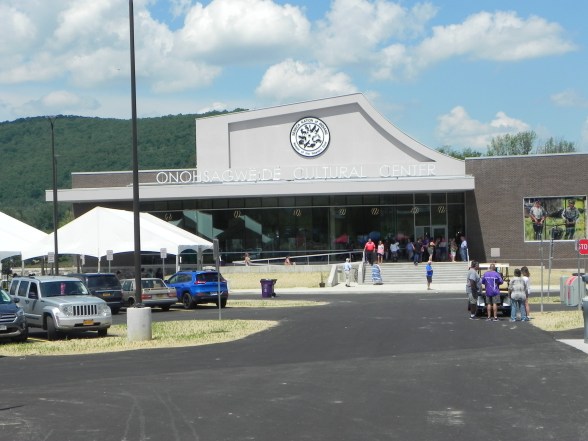
DSCN9950

The Comedy Center’s opening garnered widespread attention, not only from local reporters such as the Buffalo News’ Tim O’Shei and WBFO’s Jay Moran, but from publications as diverse as Forbes and USA Today, and even CBS news.   It also was the subject of an Andrew Cuomo press release, where our oft-hyperbolic governor proclaimed:  “The new National Comedy Center will serve as a tourist attraction and an economic game changer for Chautauqua County and the Western NY Region.”  According to Cuomo, the center will welcome more than 114,000 visitors annually, and generate in excess of $23 million each year in local economic activity.

Perhaps it was Tim O’Shei’s July 28th reference to the Comedy Center’s “techie, glitzy and celebrity-backed” five-day festival, his mentioning of “a farting bench – the equivalent of an electronic whoopee cushion,” or, the quote from the center’s executive director, Journey Gunderson, that “it’s just about making sure the reviews are good.”  But, I could not muster any interest in attending the Jamestown event.

In contrast, all it took was an early Saturday morning perusal of Anny Kim’s article, “Seneca Nation’s rich history finds a new home,” to motivate me to get my lazy backside moving – camera in tow – for the hour-and-a-quarter drive from South Buffalo to Salamanca.  I hadn’t seen or heard anything about the August 4, 2018 grand opening of the Seneca-Iroquois National Museum prior to that date.  While the cantankerous Andrew Cuomo might let NY’s disputes with the Seneca Nation over casino revenues and the legality of the portion of the Thruway/I-90 that runs through Seneca lands nix the issuance of a press release, I recognized the promise of an important cultural event when I saw one.

I wasn’t disappointed.

There was nothing glitzy about the grand opening ceremony for the Seneca Nation’s new cultural center.  The predominantly-Native American crowd in attendance didn’t need the lure of national celebrities to attract them to the white tent and folding chairs at 82 W. Hetzel Street, a site near the Nation’s Allegany administration building.  It was a family reunion – individuals of all ages knew and embraced each other and the speakers and officials who walked across the stage.

DSCN9864

The feeling of pride was palpable.  And, there was one beloved and revered individual and family at the center of it all:  the community’s late spiritual leader and bilingual specialist, Richard “Onohsagwe:de’” Johnny-John (1914 – 1992) – often called “Gwe:de’” – and the extended Johnny-John family.

It may be true that Jamestown’s Comedy Center was inspired by Lucille Ball – a Jamestown native who moved away and became a comedic legend.  But, the new Seneca-Iroquois facility appears, at least to this Italian-American outsider, to be the living, breathing embodiment of the life of Onohsagwe:de (which means “opening in the house”).  Johnny-John spent his entire life on the Allegany Territory, striving to preserve Seneca history and culture.  And, as expressed by the Seneca Nation’s Archives Director, Rebecca Bowen, there is hope that the center – which bears Onohsagwe:de’s name – will reflect the character of a man who gave so generously of his time, knowledge and energy .

DSCN9865

If I haven’t made it clear, I have not been to Jamestown to tour its newest attraction.  So, admittedly, my sense that its existence in the Chautauqua County city is more a contrivance than a natural occurrence is a preliminary assessment.  I’m open to having my mind changed.

But, the Seneca Nation’s cultural center feels genuine, a resource growing organically from the people and land around it.  It was financed by the Seneca Nation, and, unlike the National Comedy Center, did not require the cobbling together of funds and tax credits from the federal government, Department of Commerce, private foundations, and the State of New York.

Before sharing images that I took during the grand opening ceremony and while touring a small portion of the cultural center [note: I was told as I entered the facility, with camera hanging from my neck, that taking photographs would only be allowed on opening day], here are a few impressions that I came away with:

** The over-arching goal of the Seneca Nation is to have the Seneca-Iroquois National Museum be “a living, breathing entity,” not a static museum.

** While the Seneca Nation welcomes outsiders to come and learn about its culture and history, the most important function of the cultural center will be to ensure that Native Americans gain a fuller understanding of their language, culture, history and traditions.

** There is a strong desire to “redefine” the Seneca Nation’s history with the U.S.A. so that it can be described – not in the words of non-Native Americans – but from the perspective of the Seneca people.

** The Seneca people have a remarkable love and respect “for those who walked here long before.”  That reverence is manifested in many ways, including the moving “Thanksgiving Address” – known as the Gano:nok.  [My apologies that I don’t have ready access to the symbols needed to accurately portray the Seneca language.]

Note:  Out of respect for its spiritual nature, I did not take a photo of Hilton Johhny-John’s opening “thanksgiving address,” but here is a link to a video of the Ganö:nyök, and a booklet, from the Seneca Language Department.

SCENES FROM THE AUGUST 4, 2018 GRAND OPENING of the SENECA-IROQUOIS NATIONAL MUSEUM [SINM] in Salamanca, NY:

Master of Ceremony and SINM Bd. of Directors Chairman Rick Jemison:
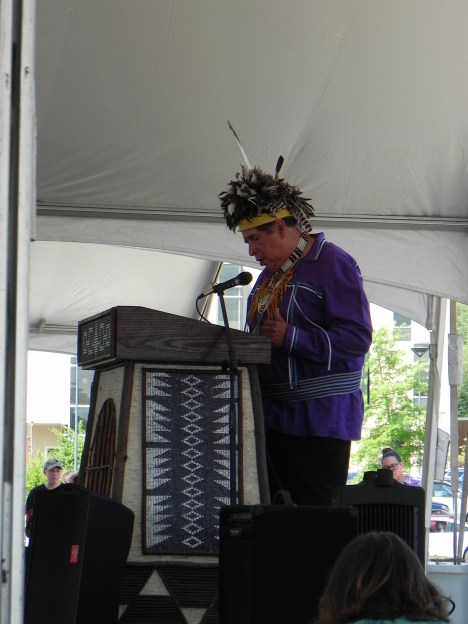
DSCN9863

Seneca Nation President Todd Gates:

DSCN9868

Seneca Nation Treasurer Maurice John, Sr. [who spoke warmly, eloquently, and frankly]:

DSCN9872

Member of Seneca Nation Tribal Council and Faithkeeper Steve Gordon (who spoke movingly and lovingly about Gwe:de’):
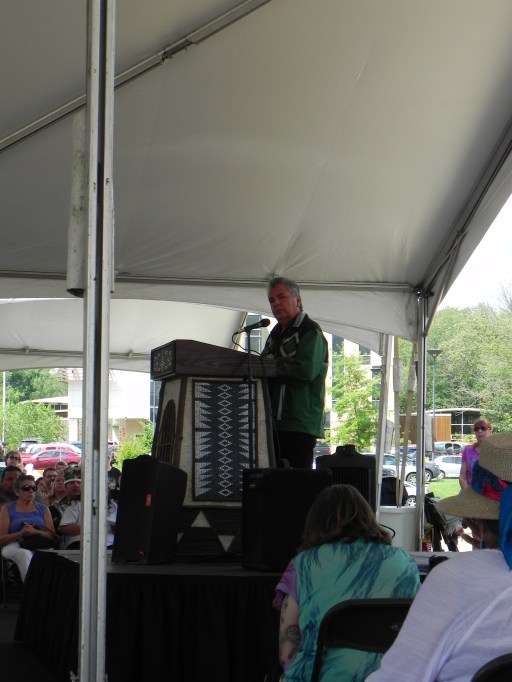
DSCN9874

Some of the Tribal Council Members in attendance:

DSCN9880

SINM Archives Director Rebecca Bowen:

DSCN9883

SINM Museum Director [and, the extremely exhausted] David George-Shongo:
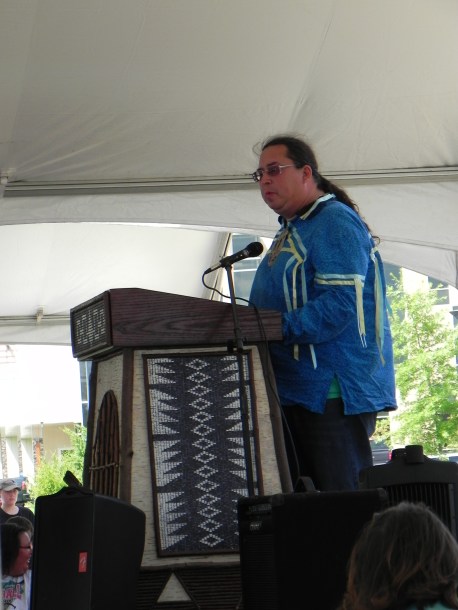
DSCN9885

Members of the Johnny-John family helped to close the ceremony when they took to the stage and expressed their gratitude to all who made the cultural center a reality, and bestowed such an honor on Gwe:de’.

DSCN9888

Ribbon Cutting (with members of the Johnny-John family front and center):

DSCN9906

Puffy clouds graciously shielding the crowd from a rather intense sun:

DSCN9908

A few scenes from inside the beautifully designed, informative, and inspirational SINM/Cultural Center:
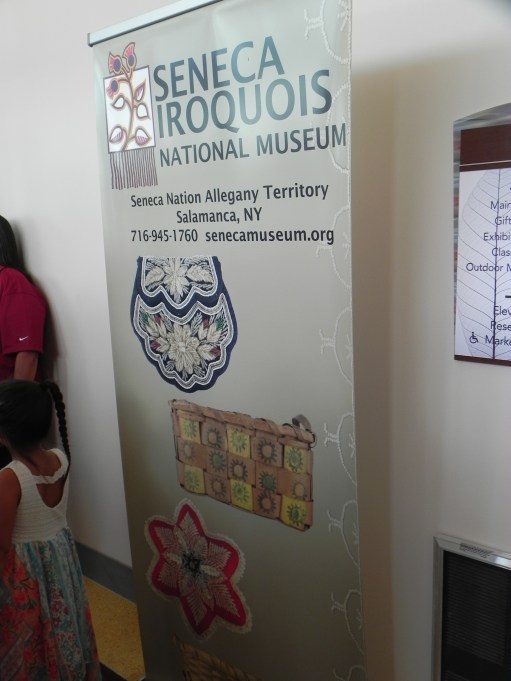
DSCN9910

Painting by Honored Artist Carson R. Waterman:

DSCN9917

Beaded Moccasins, Cornhusk Dolls by Artist Debbie Doxtator:

DSCN9919

“Thanksgiving Address”:

DSCN9938

Some of the things for which to be thankful [Illustrations by Bill Crouse]:

  • All of the birds

DSCN9927

  • All of the animals

DSCN9926

  • The Maple:

DSCN9925

  • The Wind

DSCN9929

  • Our Elder Brother DaytimeDSCN9931
  • Our Grandmother Nighttime

DSCN9932

  • Sky Dwellers

DSCN9936

“And so let it be that way in our minds.”

ONONDOWA’GA – People of the Great Hill/Keepers of the Western Door:

DSCN9947

With All Due Respect (and, Admiration),

 Art Giacalone
 

Buffalo Billion Verdict: Spell-checking, Hand-wringing, Bid-rigging and beyond

Posted by Arthur J. Giacalone on July 14, 2018
Posted in: Andrew Cuomo, Buffalo Billion, Political Corruption, SolarCity. 1 Comment

[A version of this post can be found in the July 18, 2018 print version of The Public,  and online under the title:  With All Due Respect: Reflections on the Buffalo Billion Verdict.  My thanks to the editor-in-chief of that fine publication, Geoff Kelly.]

As a citizen, I wish that the convictions handed down on July 12, 2018 in the Southern District of New York’s federal court shocked me.  They didn’t.  I’ve seen too much during the 29 years that I’ve been an observer of development-related government decision-making.

Zoning, land use and construction decisions are made at what I view as the intersection of politics and greed.  It’s an unattractive and discouraging place to be if you believe that citizens deserve both an open and fair process, and government officials who truly strive to function lawfully and in a manner intended to benefit society as a whole.

I feel saddened, not vindicated, by the convictions.  What is most troubling is a realization that the Lou Ciminelli’s of this world – and the compliant government officials with whom they interact – may truly believe that they’ve done nothing wrong.  After all, that’s how the system has always worked.

I have no profound recommendations.  There are no magic wands to wave.  We must intelligently exercise our right to vote, and select honest and courageous representatives.  But we human beings are flawed.  Self-interest – whether it’s the developers greed, or the politicians desire for power – will always be a motivating force when choices are being made.

One thing is certain.  The problem of corruption will not go away as long as publications such as the Buffalo News continue to express opinions like the one made in its July 14, 2018 editorial, “Corruption reigns”:  “But it is important to draw a distinction between valuable economic development and the corruption that may come to play.”

I beg to differ.  Whether we’re talking about decisions being made in Albany by the Cuomo administration, or in Buffalo under the auspices of Mayor Byron Brown and our very common Common Council, the ends do not justify the means.

The integrity of the decision-making process – the how and why decisions are being made – is of equal, if not greater, importance than the outcomes of those determinations.

Here’s a few other thoughts I have (some, admittedly, may be of greater significance than others) relating to the Buffalo Billion verdict.

A Prescient Spell-checker

The real world has finally caught up with my computer’s spell-checker.

I had noticed years ago that whenever I used the word “Ciminelli” in a document, the ubiquitous wavy-red line showed up under this well-known Buffalo family name.  To my amusement, the first spell-check suggestion was always “criminally.”

Now the proffered spelling option seems like more than just a quirky coincidence.  There actually is an official, tangible connection between Ciminelli and illegal, unlawful or illegitimate activity.

News of the conspiracy and wire fraud convictions has not only been splashed across the front page of the Buffalo News. Thanks to the elephant-in-the-room throughout the month-long trial – Andrew Cuomo (whose conduct has raised eyebrows long before the Buffalo Billion controversies, see, for example, this and that) interest in the story has far exceeded the boundaries of Mr. Ciminelli’s hometown.

Not surprisingly, the New York Times focused its headline on Alain E. Kaloyeros, the former president of SUNY Polytechnic Institute –  “Architect of Cuomo’s Buffalo Billion Project Is Convicted in Bid-Rigging Scheme.”  But its readers did not have to wade too far into the article to find reference to the conspiracy and wire fraud convictions of “Louis Ciminelli of LPCiminelli.”

So a good chunk of the world now knows what spell-check has been presciently alluding to for quite some time.

Hand-wringing & hypocrisy

It didn’t take long for a slew of rather predictable reactions to materialize on-line and in the media in response to the July 12th convictions.  Here’s a sampling of headlines:

** “Cuomo opponents, watchdog groups pounce on Buffalo Billion verdicts.”

** “Nixon wants probe of Cuomo admin after crony found guilty in Buffalo Billion.”

** “Buffalo Billion verdict warrants further action.”

** “Cuomo distances himself from disgraced pal after conviction.”

What caught my eye were the words of Paul Shechtman, Louis P. Ciminelli’s attorney.

While we may have crossed paths in Cambridge, Ma. in the mid-1970s while attending Harvard Law School, I don’t know Mr. Shechtman,   He certainly has had an impressive legal career.  And his political connections run deep, including appointments by former NY Governor Pataki as chair of New York State’s Ethics Commission and Commission on Lobbying.

So Paul Shechtman’s words in the July 13th Buffalo News, under a black banner and the words “BUFFALO BILLION:  THE VERDICT,” strike a chord:

“I have never been more deeply disappointed in my professional life. I don’t think there was any evidence against Lou Ciminelli.  The fact that 12 people saw it differently renders me speechless.”

Lou Ciminelli’s high-priced New York City attorney appears to be feeling the same way that I have felt all-too-often while representing common folk in Western New York who dare to question the wisdom of a proposed development project.  I have repeatedly experienced deep disappointment in my chosen career  Whether it was a city or town’s legislative body, a highly respected member of Congress, my own city councilmember, or a state Supreme Court judge.  I have found it difficult to fathom how government officials could honestly view things so differently than my clients and I.

Reporting on the Buffalo Billion verdict did provide one good laugh, thanks to the absurdity of the words attributed to Carl Paladino, Buffalo businessman and unsuccessful gubernatorial:

“A longtime critic of both Ciminelli and Cuomo praised the jury’s verdicts.

‘We’ve seen in Ciminelli’s case, greed took over in his life. You’d have to be a fool not to connect the dots back to Cuomo,’ said Buffalo businessman Carl Paladino, who unsuccessfully ran against Cuomo for governor in 2010. Paladino added that ‘there’s always going to be someone who wants to do a shortcut and develops a relationship with crooked politicians. This is just the tip of the iceberg for a guy like Cuomo.’

The hypocrisy – or self-deception – evident in dear Carl’s comment is mind-boggling.  As I posted more than four years ago – following a “New Urbanism” conference held in Buffalo – the relationship between Mr. Paladino and Mayor Brown is precisely why Buffalo’s residents should not expect any major change in the way local officials choose one project or neighborhood over another.

Beyond Bid-rigging

Benjamin Weiser and Jesse McKinley, New York Times reporters, did a nice job succinctly describing the crux of the Buffalo Billion scandal:

“… [A]t the trial, the prosecution presented evidence that Dr. Kaloyeros and Todd R. Howe, a former lobbyist with ties to Mr. Cuomo, conspired to defraud Fort Schuyler Management Corporation, a nonprofit real estate arm of SUNY Polytechnic, by steering lucrative contracts to two firms whose executives were significant donors to Mr. Cuomo’s campaign.

As part of the scheme, Dr. Kaloyeros and Mr. Howe tailored requests for proposals, or RFPs, to fit the specific qualifications possessed by the two companies — LPCiminelli, a Buffalo construction management firm, and COR Development, a Syracuse-area firm — and ensure that they be chosen by Fort Schuyler for the projects.

LPCiminelli, for example, received a contract to build what became a $750 million solar-panel plant on the banks of the Buffalo River, while COR received contracts worth more than $100 million for other projects. Both firms were clients of Mr. Howe’s.”

There are subtler ways than the Buffalo Billion bid-rigging scheme that political contributions and crony capitalism taint the decision-making process.

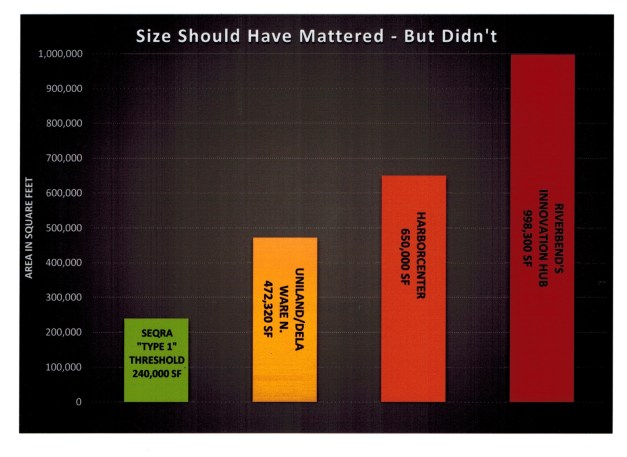
I’ve observed an unsettling correlation between major contributions to Andrew Cuomo, and receipt of an “environmental free pass” – that is, approval of major construction projects without the time and expense of an Environmental Impact Statement (which is the most effective tool the public has to influence development-related decisions).  The Jacobs family, the Pegulas, and Queen City Landing’s Gerry Buchheit, all appear to have benefited from this significant perq.

Size Matters bar graph

But the Solar City project is probably the most egregious example of this phenomenon.   LPCiminelli not only benefited from a rigged Request For Proposal process, the company was able to immediately put a shovel in the ground without first systematically analyzing and mitigating potential adverse environmental impacts.  The state agency granting the “free pass” was, no surprise here, Alain Kaloyeros’ SUNY Polytechnic Institute (known, at that time, as the College of Nanoscale Science).

And, by the way, Andrew Cuomo, in the midst of a re-election campaign, got to boast about a massive project actually underway in Western New York, rather than a mere development plan undergoing environmental review.

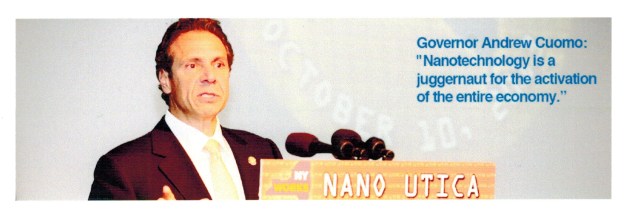
Andrew Cuomo - juggernaut

Lastly, there’s another example of what an objective observer might call “rigging” that occurs during the process of drafting zoning laws.  One need only look to the final stages of the City of Buffalo’s adoption of the “Green Code.”

In a bid to placate a number of environmental advocates concerned over future private development along Buffalo’s Outer Harbor, the Common Council created the “Outer Harbor Review Area.”  Residential structures are prohibited within the boundaries of  the review area, and any proposed use in the Outer Harbor review area has to receive a “special use permit” from the Common Council.

Sounds great, but there is one major problem.

dscn7962

Historically, the Outer Harbor has been described as the Lake Erie shoreline from the U.S. Coast Guard Station at the northern end, extending southerly beyond Times Beach Nature Preserve, the Seaway Pier, the Terminal “A” and “B” complex, the former Freezer Queen site (now, the proposed location of Queen City Landing’s controversial 23-story tower), the Small Boat Harbor, the Gallagher Beach facilities, down to the Tifft Nature Preserve.

But, the Green Code mysteriously ends the boundary of the Outer Harbor Review Area at the southern property line of the Terminal “A” and “B” parcel.  That means that the Queen City Landing parcel – adjacent to the terminal complex – is not burdened with the restrictions that apply to land included in the Outer Harbor Review Area.

Efforts to get South District Councilmember Christopher Scanlon to explain this discrepancy have not been successful.

With All Due Respect,

Art Giacalone

Councilmember Christopher Scanlon serves his political contributors, ignores concerns of South Buffalo residents

Posted by Arthur J. Giacalone on June 11, 2018
Posted in: Carl Paladino, Christopher Scanlon, City of Buffalo, Development, Native American, Political Contributions, South Buffalo. Leave a comment

[A version of this posting was published in The Public on June 12, 2018. My thanks to Geoff Kelly.]

Fact: On at least sixteen (16) occasions between August 2012 and February 2016, entities with the same address as the corporate headquarters of Carl P. Paladino’s Ellicott Development Company have made political contributions to “Friends of Christopher P. Scanlon.”  The donations – from contributors with names such as Turning Albany Upside Down P.A.C., Seneca Street Properties, Ellicott Development, and 2468 Group, Inc. – have ranged from $100 to $500 apiece.  William A. Paladino, the current CEO of the company founded by his father Carl, has also donated to Scanlon’s campaign.  [See  Scanlon contributions from Ellicott Development 2012-2016.]

Question:  Do these political contributions explain why Christopher P. Scanlon, the South District representative on the City of Buffalo’s Common Council, has failed to publicly acknowledge or address the legitimate concerns of residents in South Buffalo’s Buffum Street area concerning Western New York Maritime Charter School’s plans for their tranquil, historic neighborhood?  [Full disclosure:  I live less than 800 feet from the project site, and oppose the charter school’s proposal. See Giacalone Letter to Common Council re Special Use Permit 06-05-18 .]

Background:  More than a century ago, an elementary school (former Public School No. 70) was constructed three blocks east of Seneca Street on Buffum Street, a 20-foot wide residential road.  The masonry building stands two-stories high, and has approximately 43,000 square feet of gross floor area.

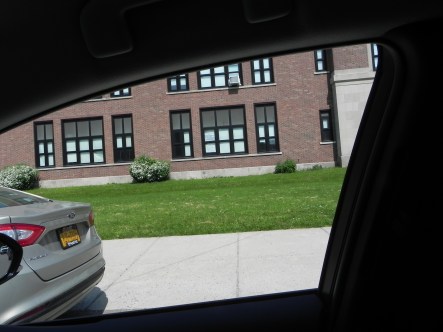
DSCN9653

The  elementary school site is encircled by residences – nearly all of which are one- and two-family homes.  The residences immediately east of the school pre-date the 1915 construction of former School No. 70.  The homes across the street from the project site on Buffum Street, and on Indian Orchard Place and Silverdale Place (one-block long dead-end streets) were built during or prior to the 1920s.  The scale of the two-story elementary school building is in harmony with the neighboring residences.

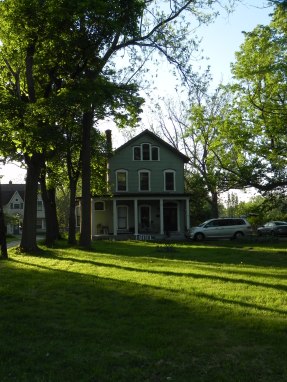
DSCN9592

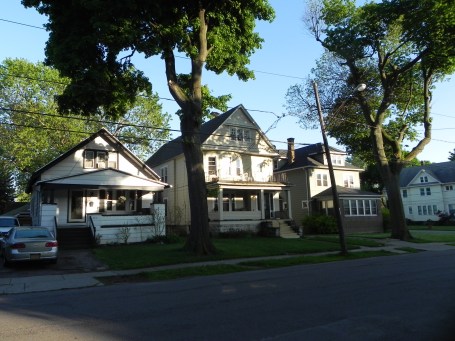
DSCN9642

In October 2016, Buffalo’s Common Council – including Mr. Scanlon – approved the sale of the then-vacant school building (along with vacant land to the rear of 102 Buffum Street) to an affiliate of Ellicott Development for $975,600.  According to City of Buffalo documents, it was the developer’s intentions to renovate the property for an estimated $390,000, lease it to an existing charter school, and construct a new 45,000 sq. ft. building which would include a gym.  No mention was made of a plan to construct a high school building at the site.

WNY Maritime Charter School began operating its “middle school” at 102 Buffum Street in September 2017.  The middle school has approximately 81 students and 24 faculty members.  Buffalo’s online property information website identifies the charter school as the current owner of the property, and also indicates that the facility is fully exempt from taxes as an education institution.

Current Proposal:   On May 1, 2018, William Paladino, as CEO of Ellicott Development Company, submitted a packet to the City of Buffalo on behalf of its “client” – WNY Maritime Charter School.  The October 2016 plan to construct “a new building including a gym (45,000 sq. ft.) and an athletic field” has transformed into a proposal “to construct a new 3-story classroom building” (64,913 sq. ft.) and “athletic facility addition” (24,050 sq. ft.) including “3 full size basketball courts.”  [See Charter school Special Use Permit packet 05-10-18.]

Neighborhood concerns:  Ellicott Development’s new proposal represents a significant increase in both the scale of development and the intensity of land use at the 102 Buffum Street site:

(a) The number of buildings would triple from 1 to 3.

(b) The gross floor area would triple in size from 43,000 sf to 132,000 sf.

(c) The maximum building height would increase from 2-stories to 3-stories.

(d) The current total of 105 students and faculty at the site would explode to 525 (450 students/75 faculty), five-times its current population.

(e) A beautiful grassy lawn on the east side of the existing school, graced by 8 to 10 mature trees, would be paved over to add an additional 57 parking spaces.

DSCN9600

DSCN9606

As expressed during a June 5, 2018 public hearing before the Common Council’s Legislation Committee (with Mr. Scanlon in attendance), the proposed Maritime charter school expansion threatens to adversely impact several aspects of the environment protected by the State Environmental Quality Review Act (SEQRA):

  1. Impact on Land. SEQRA’s  regulations expressly include “a substantial change in the intensity of use of land” as one of the “indicators of significant adverse impacts on the environment.”  The stark contrasts between existing conditions at the site and the proposed addition of a high school building, athletic facility, and parking area reflect – in quantifiable terms – a substantial increase in both the scale of development and the intensity of use of the site.
  2. Impact on Traffic. Although the City Planning Board casually spoke of road capacity “adequate to service any increase in traffic,” Buffum Street is not Seneca Street or a busy commercial thoroughfare.  To the contrary, 102 Buffum is located three blocks from Seneca, in the heart of a residential neighborhood, where the principal public street is only 20 feet wide, cars purposely park over the curb because of the narrowness of the  thoroughfare, and two of the adjacent streets (Indian Orchard and Silverdale) are one-block long dead ends.  Traveling on Buffum Street becomes more difficult, even treacherous, during the winter months.  School buses – with only 81 students currently attending the school – already have a difficult time maneuvering around each other as they approach and depart the school.  Note:  The developer’s unsupported premise that 90% of the high school students will be using public transportation to get to and from the school seems unrealistic and self-serving.  And, no consideration has been given to the capacity of either the on-site parking spaces, or adjacent residential streets, to safely handle added traffic when the Maritime high school functions as “home team” for its basketball and other varsity games.  DSCN9708  DSCN9696
  3. Impact of Existing Neighborhood/Community Character. The above-noted substantial increase in the scale of development and the intensity of use of the site will also have a significant adverse impact on the existing character of the surrounding neighborhood of modest one- and two-family residences.  [See 6 NYCRR 617.2(l), 617.7(c)(1)(v).]  Their scale and architectural features are in harmony with the two-story existing school building, and are incompatible with the size and sterile façade proposed for the 3-story new classroom building.  Additionally, the existing character of the surrounding residential neighborhood will be adversely impacted by the sheer number of students and faculty that would be coming to the site daily – estimated at a combined 525 individuals – starting at approximately 7:15 AM when the buses and autos begin to arrive.  DSCN9597
  4. Impact on historical, archeological, and aesthetic resources. The mature trees and green lawn east of the existing school building are a significant aesthetic resource to this neighborhood, enjoyed by the residents who live across the street from the school property, passers-by, and, presumably, the staff and students at the Maritime middle school.  This important aesthetic resource – which took generations to reach its current state – would be eliminated in-a-blink-of-an-eye if the proposed project is approved, replaced by a large, noise-producing, exhaust-creating parking lot.  Note:  Although the Planning Board meekly attached as a condition to its site plan approval the following, “All mature trees must be saved where possible,” it is inconceivable that the developer would not claim that the vast majority of the majestic trees (with their extensive root systems) must be removed to ensure a safe, efficient movement of vehicles into and out of the new parking lot.   The project site is located within a couple hundred feet of the Seneca Indian Park, a site deemed sacred and part of a much larger area used historically as a burial ground by the Seneca Nation and others.  Historians believe that in 1819 the first Seneca Mission house was built by Christian missionaries at the site of the former School No. 70 – that is, the subject parcel.  While the developer and the Planning Board acknowledge that the proposed action is in an “archeologically sensitive area,” a “Phase 1” archeological survey has not been conducted.    DSCN9588  DSCN9587
  5. Construction-related adverse impacts. Construction-related traffic, noise, dust, etc., would have a profound impact on the quality of life of the surrounding residents for many, many months.

Scanlon’s response:  The South District’s Common Council member sat passively throughout the comments made by the public on June 5, showing neither interest, nor concern.  But Mr. Scanlon made certain that he expressed support, on the record, for Ellicott Development’s proposed project at the close of the hearing.  As reported by WBFO:

“… South Buffalo Common Councilmember Chris Scanlon says the project would be a good addition, especially saving the long-closed School 70.  ‘If it continued that way, it would eventually have fallen into a state of disrepair,’ says Scanlon. ‘Here we have a[n] entity, a school, which has a wonderful reputation, which is bringing life back to that building and which will inject the South Buffalo community with a couple hundred bodies each and every day, and they’re further investing between $10-$15 million in that location, which will further revitalize the Seneca Street Corridor.’”

Scanlon’s comments ignore several relevant facts.  The presence of the middle school students and faculty has already brought “life back to that building” – life commensurate with the scale of both the century-old building and surrounding residential neighborhood.  The building was not in significant disrepair when purchased by the Maritime school, and would almost certainly have been an attractive target for conversion into apartments or condominiums given the current momentum by developers to breathe life into Seneca Street.  Also, whatever purported benefit “a couple hundred bodies each and every day” would have on the broader South Buffalo community, it is disingenuous, at best, to imply that attracting over 500 individuals a day, every day, would improve the quality of life for the human beings – homeowners and renters – who call the adjacent streets “home.”

One last point needs to be made.  Scanlon not only ignored the concerns of his constituents who will bear the burden of placing a high school in their midst, he disregarded the questionable process used by his political contributors – I mean – Ellicott Development, and its client, WNY Maritime Charter School:

(1) Ellicott Development and the Maritime charter school engaged in a bait-and-switch transaction when the sale of the property was before the Common Council in October 2016, expressing a desire to construct one 45,000 sq. ft. building to house a gymnasium, and then replacing that scenario with a plan to add a 65,000 sq. ft. high school building (three-stories in height), a 24,000 sq. ft. athletic facility, and nearly 5 dozen additional parking spaces.

(2) The filing of site plan documents that omitted important and necessary information concerning existing conditions on- and off-site:  the location and scale of the nearby residences; the location of driveways on Buffum Street; and, the number and location of the “established trees” on site.

(3) Despite a grassy front lawn approximately 48’ deep, the developer violated the Green Code’s “posted notice” requirement by ignoring the mandate to post a sign “clearly visible from” and “within 10 feet” of Buffum Street.  Instead, the public notice was hidden in a classroom window more than 50’ from Buffum Street, obscured by the glare and light reflecting off the school window.

DSCN9686

DSCN9679

It appears to me that Councilmember Scanlon is more interested in protecting the interests of the developer (who also happens to be an early and faithful campaign contributor), than preserving the quality of life and existing character and historical significance of the surrounding residential neighborhood.

With All Due Respect,

Art Giacalone

The vacant Park District BOE seat – a day late ain’t great

Posted by Arthur J. Giacalone on June 3, 2018
Posted in: Carl Paladino, City of Buffalo. Leave a comment

I moved from East Aurora to South Buffalo in June 2015 – June 17, to be exact.  [You’ll understand the reason for such specificity as you read this posting.]

I half-jokingly told my friends at the time that the primary motivation for my landing in South Buffalo was so that I could run against Carl P. Paladino for the Park District seat on the City of Buffalo’s Board of Education.  I was sick and tired of his bullying, vitriol, and conflicts-of-interest.  In reality, it was the prices of homes in the Queen City’s trendier neighborhoods, and a desire to live as close as possible to my teenage son in East Aurora, that led me to my humble-but-charming century-old home several blocks from Cazenovia Park.

DSCN6380

But my belief that the residents – and, most especially, the children – of South Buffalo were not being well-served by Paladino’s act pre-dates my daily walks down Indian Church Road, across Seneca Street, and around Caz park.  In fact, in March 2015, after reading yet another example of what I viewed as an endless stream of ill-conceived and unnecessary confrontations by The Carl, I posted a piece at this blog titled, “Dear Park District Voters, Please Don’t Re-elect Carl Paladino in 2016.”

To my chagrin, I discovered – not long after settling into my new home, neighborhood, and community – that I would not be eligible to run for the Park District seat in May 2016.  Although I was a U.S. citizen, had never been convicted of a felony, and was a qualified voter of the Buffalo City School District (and, had been a resident of the City of Buffalo for approximately nineteen years prior to moving to East Aurora in 1996), I couldn’t meet two qualifications:  “a resident of the city school district for three years and a resident of the [Park District] for a period of one year preceding the date of the election.”  [See NYS Education Law, Section 2553(1).]

Mr. Paladino won an unexpectedly competitive race in March 2016.  The most that I could do at the time was vote for his youthful opponent.  The thought of three-more-years of Carl was distressing.  And waiting until May 2019 for the next opportunity to seek the Park District seat – when I would unequivocally meet all of the requirements –  seemed interminable.

So I decided to look for ways to personally assist and get to know the challenges facing the students in Buffalo’s public schools.  During the summer of 2016, I responded to a call for volunteers from Read To Succeed Buffalo.  The organization did not have arrangements at that time (they will this coming year) to place reading tutors/mentors in any of South Buffalo’s schools.  But I’ve had the good fortune of spending two extremely rewarding and informative years volunteering twice a week at the Waterfront Elementary School, where I get to interact with a diverse group of bright, energetic second-graders.

As most of you are aware, Carl Paladino was removed from the Buffalo BOE in August 2017 by the State Education Commissioner, MaryEllen Elia.  As succinctly described by Buffalo News reporter Jay Rey, the disciplinary action was taken against Paladino “for publicly disclosing private information from a School Board executive session – which happened in the wake of his inflammatory comments about former President Barack Obama and his wife, Michelle.”

When the Board of Education solicited applicants to fill the vacant Park District seat in August 2017, I was unable to apply, shackled by the three-year City of Buffalo residency requirement.  But I was pleased by the BOE’s unanimous choice of pediatric psychologist Catherine Flanagan-Priore to fill Carl’s place on the board.  She brought a fresh perspective, and I looked forward to a new, more-placid, and productive era for the Buffalo school district, one devoid of the drama and discord associated with Mr. Paladino’s tenure.

Meanwhile, I have continued my own efforts to become more familiar with the day-to-day workings of Buffalo’s public schools.  For the past year, I have worked as a Substitute Teacher in more than a dozen elementary schools throughout the city, spending a majority of my time in South Buffalo schools.  The experience has been eye-opening in many ways, and on many levels.

But back to Buffalo’s BOE.  Good times don’t seem to last all that long on the eighth floor of Buffalo City Hall.  Last month – on May 16, 2018, to be exact – the Park District once again found itself without a member on the Buffalo Board of Education.  Catherine Flanagan-Priore abruptly resigned her seat.  As reported by local media, the Park District board member resigned on May 16 to protest the manner in which the BOE handled a new nursing contract (a board decision adversely impacting Flanagan-Priore’s employer, Kaleida Health).

The remaining members of the Buffalo’s BOE have 30 days from the date when the vacancy occurred to fill the open seat with a qualified person (or the Mayor, subject to confirmation by the Common Council, makes the appointment).  That means that a majority of the board must select Ms. Flanagan-Prior’s replacement by June 16, 2018.  [See Education Law Section 2553(10(n).]

My current residency in the City of Buffalo will not reach three successive years until June 17, 2018, the day after the BOE’s deadline for appointing the new Park District member.

Not surprisingly, the Board of Education has officially informed me that I do not meet the three-year City of Buffalo residency requirement.  [Click here to see Arthur Giacalone’s Letter of Notification with Resume, and here to see BOE Letter to Arthur Giacalone.]

Being the proverbial “day late” is a bummer.  While I would have preferred that the respected  child psychologist not have resigned at all, I can’t help but wish that she would have made the decision a bit less impulsively, or, at a minimum, had given her fellow board members some notice and made the resignation effective later in the month of May.  Had either option occurred, the three-year residency deadline would have been pushed beyond June 17, 2018.

I am not in any way suggesting that I would have been the best qualified of the prospective applicants for this unexpected opening, or that a majority of the remaining eight board members would have chosen me as the new Park District member.  But I certainly would have appreciated an opportunity to be interviewed by the BOE.  And, had I been appointed, I would have been honored – and, humbled – to join the BOE members and undertake the challenge, on behalf of South Buffalo’s residents, to improve the City of Buffalo’s public school system.

While it may not be in any official capacity, I am ready, willing, and able to assist the current BOE members, and whomever is appointed to the vacant Park District seat, to further the interests of Buffalo’s students.

With All Due Respect,

Art Giacalone

Lilacs, Magnolias and Frederick Douglass – Rochester’s Olmsted Jewel

Posted by Arthur J. Giacalone on May 18, 2018
Posted in: Frederick Douglass, Highland Park/Lilac Festival, Olmsted Parks, Rochester NY, WNY Photos. Leave a comment

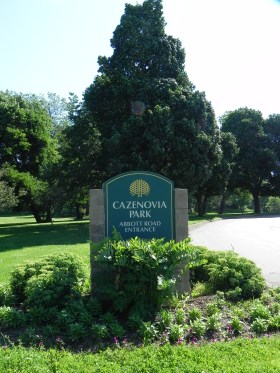
We Buffalonians exude pride and gratitude for our historic connection to Frederick Law Olmsted and our legacy of Olmsted designed and inspired parks and parkways.  My days are certainly more energetic and promising when they start with a walk through my neighborhood’s gem, Cazenovia Park (even during the winter months).  And I recall fondly my young adult years when I would daringly cross Parkside Avenue during the PM rush hour to jog along Delaware Park’s ring road, enjoying the expanse of green grass, shade of the trees, and glimpses of the inhabitants of the Buffalo zoo.  Generations of Queen City residents have similar positive feelings and memories for their nearby Olmsted parkland, whether it’s Front Park, MLJ, Jr. Park, Riverside Park, or South Park (and its glorious botanical gardens).

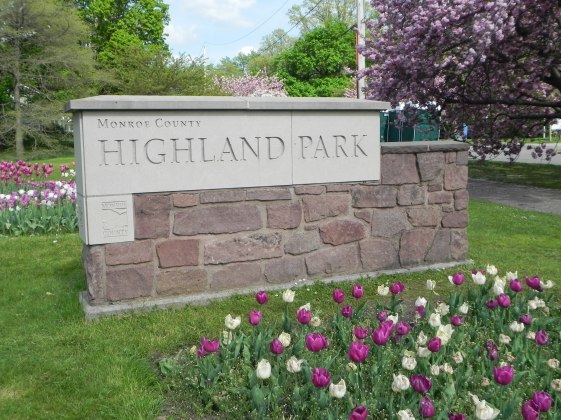
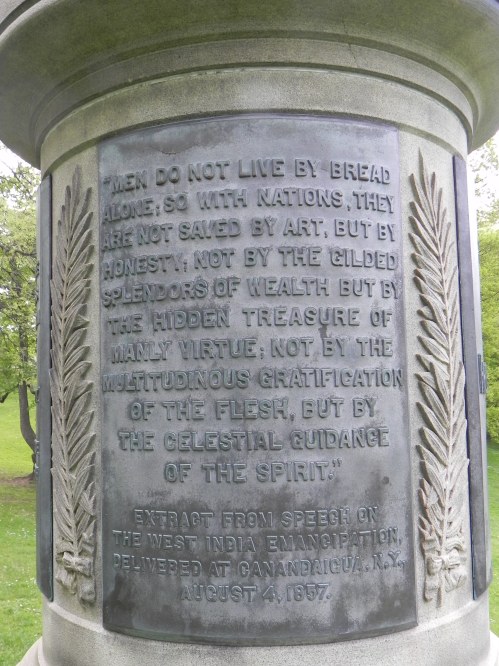
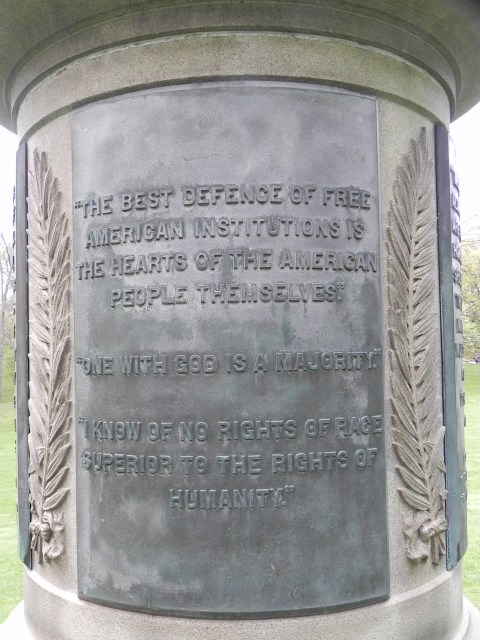
But I’m also a native of Rochester, New York, and I find it near-impossible this time of year not to be lured 75-miles eastward down the I-90 to re-visit my first Olmsted Park – Highland Park – nestled in a stunningly beautiful and hilly area of the “Flower City” [f/k/a “Flour City”].  While Highland touts its 1,200 lilac shrubs, and is in the midst of the 120th annual Lilac Festival  (being held this year from May 11th through May 20th), the park’s magnolia trees made the deepest impression on me during my May 16, 2018 sojourn.  And my quick trip to the city of my birth also reminded me that 2018 is the 200th anniversary of the birth of legendary social reformer Frederick Douglass – who called Rochester home for a quarter of a century.

DSCN9532

DSCN9480

DSCN9566

Here are other images from my visit to Rochester’s Olmsted park:

DSCN9558

DSCN9448

DSCN9474


CHERRY BLOSSOMS:

DSCN9452

DSCN9453

DSCN9439

MAGNOLIAS:

DSCN9486

DSCN9484

DSCN9489


DSCN9503

DSCN9499

DSCN9508

DSCN9511

DSCN9516

DSCN9518

LILACS:

DSCN9533

DSCN9528


DSCN9536

DSCN9547

DSCN9545

DSCN9548

DSCN9551

DSCN9555

TULIPS:

DSCN9462

DSCN9465

DSCN9468

DSCN9456

FREDERICK DOUGLASS/HIGHLAND BOWL:

DSCN9576

DSCN9575

DSCN9562

DSCN9573

DSCN9570

DSCN9569

DSCN9567

DSCN9540

With All Due Respect,

Art Giacalone

P.S.  The City of Rochester has events to commemorate the bicentennial of Frederick Douglass’ birth throughout 2018.  For additional information, click here.

DEC – enlightened by public comment – partially scales back SEQRA “streamlining”

Posted by Arthur J. Giacalone on May 4, 2018
Posted in: SEQRA, Uncategorized. Leave a comment

There’s some encouraging news to share with anyone who cares about the environment and believes that government decision-making should be well-informed and objective.  But there’s also no time for complacency, with a rapidly approaching May 11, 2018 deadline for submitting comments to New York’s Department of Environmental Conservation [DEC] – via email to seqr617@dec.ny.gov – to ensure continued forward progress.

The Good News

As I expressed in a Buffalo Law Journal article a year ago, the DEC – under the pretext of “streamlining” and “updating” regulations implementing SEQRA (State Environmental Quality Review Act) – was about to significantly weaken environmental protections and lessen the public’s role in zoning and land use decision-making.

The proposed regulatory changes issued by the DEC in February 2017 recommended a substantial increase in the categories of so-called Type II actions – the proposed projects and policy changes that do not have to undergo any SEQRA review – from the current 37 to 54.  By expanding the list of projects completely insulated from SEQRA review, the DEC’s proposed regulations would likely result in the following impacts:

  • Decrease the information available to the public, as well as to the government decision-makers, to intelligently assess a proposed project’s potential impacts on the environment;
  • Reduce the ability of a municipality or a concerned public to objectively consider a proposed project’s specific natural and manmade surroundings, or the existing neighborhood or community character, when determining whether a proposed project may have a negative environmental effect;
  • Eliminate the obligation of a project sponsor or government agency to systematically consider alternatives and mitigation measures.

But something quite unusual happened in Albany.  The DEC allowed itself to be enlightened by the written and oral public comments it received last spring.  On April 4, 2018, the revised proposal for amending the SEQRA regulations was revealed.  Significantly, the latest iteration of proposed changes reduces the number of new “Type II” categories from 17 to 9.  Unless the inevitable push-back by developers and municipal “stakeholders” causes a reversal, the following types of proposed actions will not be treated as “Type II actions” and will still need to undergo environmental review under SEQRA:

– area variance applications to a city, town or village zoning board of appeals [other than the previously-excluded individual setback and lot-line modifications and area variances for one-, two- and three-family residences];

– brownfield clean-up agreements;

– acquisitions of less than 100 acres of land for parkland [although, as revised, an agency’s acquisition and dedication of 25 acres or less of land for parkland, or acquisition of a conservation easement, would be treated as a Type II action and not undergo SEQRA review];

– minor subdivisions;

– installation of cellular antennas or repeaters; and, perhaps most importantly,

– so-called “sustainable development” projects on a “previously disturbed site in the municipal center of a city, town or village”.

SEQRA’s “Cooperative Venture”

The DEC’s revised draft EIS for the proposed amendments to the SEQRA regulations is an excellent example of how the SEQRA environmental review process is intended to function.

More than three decades ago, New York’s highest court, the Court of Appeals, explained that “SEQRA makes environmental protection a concern of every agency [and] insures that agency decision-makers – enlightened by public comment where appropriate – will identify and focus attention on any environmental impact of a proposed action.”  [See Jackson v. NYS Urban Dev. Corp., 67 NY2d 400 (1986).]  That court accurately characterized the Environmental Impact Statement [EIS] process as “the heart of SEQRA … designed as a cooperative venture, the intent being that an agency have the benefit of public comment” before approving a proposed action.  As recognized by our state’s top jurists, “a primary purpose of a [draft] EIS is to inform the public and the public agencies … and to solicit comments which will assist the agency in the decision-making process.”

The public spoke – in the form of hundreds of written and oral comments – and the DEC was enlightened and pulled back on many of its most troubling proposals.

The fact that the SEQRA review process for the proposed regulatory changes worked precisely as envisioned by NY’s legislators when the statute was enacted is more than a bit ironic.  The DEC’s February 2017 proposal for “streamlining” and “updating” the SEQRA regulations (which are found at 6 NYCRR Part 617) by significantly adding to the “Type II” list of actions not subject to review under SEQRA was – from my perspective – little more than a capitulation by the DEC and Cuomo administration to pressures from the business community and government officials.  These “stakeholders” wished to eliminate what they perceive as two obstacles in the way of proposed development projects: public comment, and the objective information obtained when the SEQRA review process works as intended.

The SEQRA review process has – so far – reduced the number of new “Type II actions,” and, by doing so, has preserved the opportunities for the public to impact future development decisions by exerting the power that accompanies knowledge.

The Need for Immediate Action

With the May 11, 2018 deadline for submitting comments on the Revised Draft Generic Environmental Impact Statement looming near, here are a number of points that I recommend sending to the DEC – via email to seqra617@dec.ny.gov – to ensure protection of NY’s natural and man-made resources and preservation of the public’s ability to enlighten our government decision-makers:

  1. The DEC’s removal of several categories of new Type II actions from the proposed changes to the SEQRA regulations is laudable. The DEC should resist any pressure to reinstate the eliminated categories.
  2. The DEC has made the correct decision to require all future Environmental Impact Statements [EISs] (other than Supplemental EISs) to undergo the “Scoping” process. This proposal will help make certain that future EISs focus on potentially significant adverse impacts, and not irrelevant or non-significant impacts.
  3. The proposed changes to the SEQRA regulations fail to take any steps to reverse the regrettable trend of agencies failing to meet the low threshold for requiring an EIS, the “heart of SEQRA.” As noted in the Revised DGEIS, there are only about 200 EISs being prepared annually statewide – despite the thousands of proposed actions under consideration by the state’s 1,500 local municipalities and the myriad of NYS departments, agencies and authorities obligated to comply with SEQRA.  Most troubling for Western New Yorkers, there were ZERO EISs required in 2017 throughout all of Erie County (including the City of Buffalo) and Niagara County, and only two EISs required in 2016 throughout the DEC’s entire six-county Region 9 (including Erie and Niagara counties).  The DEC must take effective steps to reverse this trend, and firmly instruct local and state agencies that it is their obligation to “insure that agencies will err on the side of meticulous care in their environmental review,” and not “cut corners and then cure defects only after protracted litigation, all at the ultimate expense of the environment.” [ See New York’s highest court’s decision in King v. Saratoga County Bd. of Supervisors, 89 NY2d 341 (NYCA 1996).]  At a minimum, the SEQRA regulations must be amended – perhaps as an introductory paragraph at Section 617.7 (Determining Significance) – to include the language contained in the SEQRA statute at ECL Section 8-0109(2):  “All agencies (or applicant as hereinafter provided) shall prepare, or cause to be prepared by contract or otherwise an environmental impact statement on any action they propose or approve which may have a significant effect on the environment.”  [Emphasis added.]
  4. To ensure that any proposed action that may have a significant adverse impact on any one or more aspects of the environment undergoes the SEQRA review process, the DEC should follow the “no action” alternative and eliminate the remaining proposed additions to the Type II actions list.

With All Due Respect,

Art Giacalone

Frank B. Mesiah and Luke Easter: Two men who graced the City of Buffalo

Posted by Arthur J. Giacalone on April 29, 2018
Posted in: City of Buffalo, Political Contributions. Leave a comment

It was my plan to write yet another piece on the “pay-to-play” environment that appears to have tainted so much of the development landscape in Buffalo and the State of New York.  The post would start by mentioning an April 27, 2018 headline at the Buffalo News website – “Prosecutors seek use of donations to Cuomo campaign as evidence in Buffalo Billion trial” – and proceed to reference postings which, in my opinion, reflect (at a minimum) the appearance of “pay to play” politics in Western New York.  Examples would include U.S. Representative Brian Higgins and Gerry Buchheit’s Queen City Landing project, Buffalo City Council Member Joel Feroleto and Chason Affinity‘s Elmwood and Forest avenue travesty, the Jacobs and Pegula’s contributions to Gov. Andrew Cuomo, etc., etc.]

But my visit to http://BuffaloNews.com in search of the article regarding the Ciminelli donations to Cuomo altered those plans.  Before I could locate the “pay-to-play” article, two very different headlines caught my eye and changed my attitude from disdain to gratitude.  Rather than address actions fueled by self-interest, greed, and a sense of entitlement, I would use my blog to honor two men who made Buffalo, New York a better place.

The first headline sadly announced the death on April 27, 2018 of Frank B. Mesiah, a Buffalo native who spent decades fighting for racial justice in his hometown and beyond:  “Frank B. Mesiah, longtime civil rights leader and former NAACP president, dies at 89.”

I barely knew Mr. Mesiah, but I deeply respected his tireless effort to confront racial discrimination and injustice.  His dedication and countless accomplishments – as outlined in the above article – are  remarkable.  Our community has lost a true leader.

The second headline that altered my plan belonged to Sean Kirst’s column:  “A year from now, in Buffalo, how about Luke Easter Park?  In contrast to Frank Mesiah’s lifetime of advocacy in the Queen City, the Mississippi-born Easter – who died tragically in 1979 – spent a mere three years hitting home runs as a Buffalo Bison.  But, after reading Kirst’s column, it is difficult not embrace his characterization of Luke Easter as “a lasting symbol of community.”

As a kid growing up in Rochester, where Easter played after he was let go by the Bisons, I can attest to the way that this beloved ballplayer could – in the words of Sean Kirst – “galvanize a community, an entire community.”  Despite the passage of nearly six decades, I can still recall the respect and affection Easter engendered throughout my hometown.  And I can still hear the “knot hole club” screaming L-U-U-U-U-KE whenever our hero came to the plate.

It would be wonderful if Buffalo’s downtown ballpark could be named “Luke Easter Park.”  And then, perhaps, our city could find a fitting way to remember Frank Mesiah.

With All Due Respect,

Art Giacalone


“

Battle to Stop Queen City Landing project continues – without me

Posted by Arthur J. Giacalone on April 13, 2018
Posted in: Development, Gerald A. Buchheit Jr., Waterfront. Leave a comment

I have immense admiration for Buffalo environmentalists and Outer Harbor advocates Margaret Wooster, Jay Burney and James E. Carr. They have decided to continue their effort to utilize the zoning and judicial processes to stop Queen City Landing, LLC’s plan to construct a 23-story tower complex at the former Freezer Queen site.

Bird's Eye View from Fuhrmann Blvd.

But I will no longer be their legal representative. After decades of public hearings and court proceedings – where I have attempted, with mixed results, to convince public officials to faithfully comply with the letter and spirit of New York’s development and environmental laws – I have decided to take a break from the solo practice of law. [Please note, I am not ready to call it retirement.]

On April 12, a “notice of appeal” was filed on behalf of Margaret, Jay and Jim in the Erie County Clerk’s office.  It expresses their intention to appeal the March 12, 2018 dismissal of their lawsuit – by the Hon. Catherine Nugent Panepinto – to the Appellate Division, Fourth Department, the state’s intermediate appellate court in Rochester.

Notice of Appeal p1

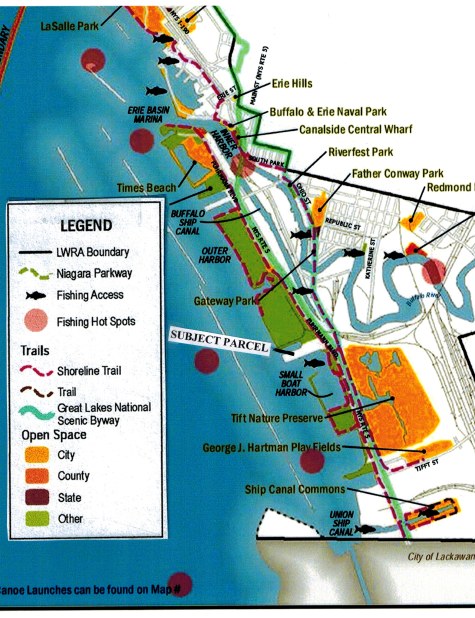
As addressed in detail in prior posts here [for example], the mixed-use development proposed by Queen City Landing (QCL) is located in the heart of Buffalos Outer Harbor, adjacent or within walking distance to marinas and significant wildlife habitats (including the Small Boat Harbor, Times Beach and Tifft Nature Preserves), popular fishing spots, and public parks and walkways, such as the Greenway Nature Trail, Gallagher Beach and Wilkeson Pointe. The site (referred to as “Subject Parcel” in the image below) lies in a 100-year floodplain along Lake Erie’s ecologically fragile coastline.

LWRP map detail rec areas - LEGEND

I join in the belief held by my “former clients” that the setting chosen by developer Gerald Buchheit and his partners at R & P Oak Hill for a 23-story, glass-and-steel tower is unique, environmentally vulnerable, and utterly inappropriate for a massive residential/mixed-use development. Not only does the site lie in a floodplain and along a globally significant migratory bird flyway, there are hidden concerns. QCL’s geotechnical engineers have determined that the project’s “heavy foundation loads” – a 305-foot tower and large parking ramp – would be perched on “soft to very soft clays” with “very marginal (weight) bearing capacity” that extend to bedrock 70 to 75 feet below the existing ground level.  [Note:  QCL chose not to make public its consultant’s May 2016 “Geotechnical Evaluation Report” until after the project had received its approvals – without preparation of an Environmental Impact Statement – from the city Planning Board and Common Council.]

And the nature of the subsurface soils is not the only source of potential environmental and “constructability” issues at the former Freezer Queen site.  QCL’s engineering consultants proved prescient when making the following observation in their geotechnical evaluation report: “Lake Erie is also prone to a seiche effect from a strong sustained wind event out of the southwest. During these events the water levels in the northeastern end of the lake can rise several feet.” As aptly described and caught on videotape by Jay Burney on April 4, 2018, a historically-moderate seiche occurred along the Outer Harbor, elevating water levels an estimated 5 to 8 feet, and inundating a substantial portion of the proposed tower site.

Version 2

[Above photo, showing seiche’s impact on QCL site on April 4, 2018, courtesy of Jay Burney.]

I’d be curious to see an objective market-feasibility study for QCL’s proposed 200-unit residential tower. No matter what Mr. Buchheit and his agents suggest at public hearings, I find it hard to imagine a strong interest in luxury apartments at a site that, for much of the year, is frozen, wind-slept, threatened by floods, and far from most urban amenities. Those desiring a residence that is simultaneously close to the Lake Erie shore and high above the mere mortals below might be better off patiently waiting for a condominium or apartment located downtown in Buffalo’s tallest building, One Seneca Tower.

With All Due Respect,

Art Giacalone

P.S. Inquiries concerning the appeal should be addressed to Margaret Wooster at (716) 833-5892 or by email at miwooster@gmail.com.

For What It’s Worth – Young people, once again, speaking their minds

Posted by Arthur J. Giacalone on March 30, 2018
Posted in: Uncategorized. Leave a comment

Listening to the passionate and articulate voices of WNY’s youthful speakers at the March 24, 2018 “March for Our Lives” rally at Buffalo City Hall was inspiring. Realizing that similar gatherings were occurring across our nation and around the world filled me with a sense of optimism in the future of our divided country, and a feeling of confidence that the generation that is currently coming of age will indeed compel the changes that their parents and grandparents have been unable – or unwilling – to make.

Something else occurred at the downtown Buffalo rally. I found myself singing along with – and proudly remembering the words to – a song embraced by the youthful opponents to the Viet Nam war during the late 1960s: Buffalo Springfield’s “For What It’s Worth.”  Stephen Stills’ lyrics, written more than a half-century ago, still resonated in my heart and mind. And they embodied, for me, a tangible connection between the protestors of that earlier era, and the energy and fierce resolve of today’s students who are demanding “timely passage of legislation to effectively address the gun violence issues that are rampant in our country.”

I was 17-years-old and a high school senior in February 1967 when the Canadian-American folk rock group (which, in addition to Stills, included Neil Young and Richie Furay) released “For What It’s Worth.” The USA was experiencing social upheaval on a variety of fronts with demonstrators taking to the streets and college campuses to express outrage over civil rights injustices and the Viet Nam war. I was still living in the protective cocoon of my parents’ working-class home, not quite ready to march in solidarity with those enraged by what they saw.

In contrast to the high school and middle-school activists who organized and participated in the March For Our Lives event on March 24th, my overt expression of outrage did not occur until my college days. The best that I could do in early 1967 was immerse myself in the raw emotions reflected in the music and lyrics to Stephen Stills’ protest song:

For What It’s Worth

by Stephen Stills

There’s something happening here.  What it is ain’t exactly clear.  There’s a man with a gun over there.  Telling me I got to beware.  I think it’s time we stop, children, what’s that sound Everybody look what’s going down

There’s battle lines being drawn. Nobody’s right if everybody’s wrong. Young people speaking their minds. Getting so much resistance from behind. It’s time we stop, hey, what’s that sound Everybody look what’s going down

What a field-day for the heat. A thousand people in the street. Singing songs and carrying signs. Mostly say, hooray for our side. It’s s time we stop, hey, what’s that sound Everybody look what’s going down’ 

Paranoia strikes deep. Into your life it will creep. It starts when you’re always afraid .You step out of line, the man come and take you away. We better stop, hey, what’s that sound Everybody look what’s going down.

Stop, hey, what’s that sound .Everybody look what’s going down. Stop, now, what’s that sound. Everybody look what’s going down. Stop, children, what’s that sound. Everybody look what’s going down.

 © Warner/Chappell Music, Inc. For non-commercial use only.

[As an aside, Rolling Stone magazine places Buffalo Springfield’s “For What It’s Worth” No. 63 on its “definitive list of the 500 greatest songs of all time,” right behind the Beatles’ “She Loves You,” and one ahead of Bo Diddley’s eponymous single “Bo Diddley.”]

The hopeful images of “young people speaking their minds,” and “a thousand people in the streets, singing songs and carrying signs,” are tempered by the knowledge that “paranoia runs deep” in our society, and, indeed, “there is a man over there telling me (and, you) we’ve got to beware.”

DSCN9413 40 Indian Church Rd., Buffalo, New York

But, I am optimistic that the generation coming of age – including my son, a 17-year-old high school senior, and daughter, a 20-year-old college student – will succeed in the battle to end gun violence and heal our divided nation.

With All Due Respect (and, admiration),

Art Giacalone
P.S.  Here is the March For Our Lives “Mission Statement.”

Dear Mr. Poloncarz, Set the ethics bar higher!

Posted by Arthur J. Giacalone on March 14, 2018

Posted in: Erie County, Mark C. Poloncarz, Political Contributions. Leave a comment

[I apologize for this late notice.  Erie County Executive Mark C. Poloncarz will hold a public hearing on the proposed new code of ethics at 2 PM this afternoon, Wednesday, March 14, 2018, in the 14th Floor Conference Room at 95 Franklin Street, Buffalo, NY.  Here are the comments I plan to express at the hearing.]

Dear County Executive Poloncarz:

I have no axe to grind. I sincerely wish that I could be praising Erie County for drafting a strong, exemplary code of ethics. But, I can’t. And, I am unable to figure out a legitimate reason why this proposed local law was approved unanimously by Erie County legislators on March 1st, and why you announced that you would sign the new code of ethics into law even before conducting today’s public hearing.

It is – with all due respect – a mediocrity. The proposed code of ethics is neither strong, nor easy to understand. It adds little of substance to the pre-existing ethics code, fails to comply with the State mandates for municipal codes of ethics, further politicizes the County’s Board of Ethics by adding three non-voting, politically-appointed members, and is riddled with ambiguities, typographical errors, and incongruities.

As County Executive, you can do so much better for the residents and taxpayers of Erie County.

I. NON-COMPLIANCE WITH STATE LAW

What troubles me most about the proposed code of ethics is its failure to comply with the requirements set forth in Article 18 of the State’s General Municipal Law. Although the provisions found in the State’s Conflict of Interest law do not “pre-empt the field,” the State’s Legislature placed an important limitation on a county’s powers to enact its own code of ethics: A county’s code “MAY NOT AUTHORIZE CONDUCT OTHERWISE PROHIBITED” by GML Article 18.

Astonishingly, the proposed code of ethics does not prohibit “conflicts of interest” as required by GML 801, and fails to adopt GML 804’s provision voiding contracts willfully entered into despite a prohibited conflict of interest. These mandates are at the very core of Article 18’s ethics standards.

For Erie County officials to claim – as reported in the Buffalo News – that “these provisions are covered under state law and implied in the language of the local law,” makes a mockery of both the intent of a municipal ethics code, and your expressed goal of a code of ethics that is “easier to understand” and provides “definitive answers to officials.” It would be highly unrealistic to expect county officials and employees to be fully versed in the mandates of NY’s General Municipal Law (when county legislators and the county attorney’s office appear to have been unaware of the significance of the provisions). And, it would be markedly unfair to punish a county worker for violating a prohibition that is merely “implied” in the county’s official code of ethics.

Furthermore, one cannot persuasively argue that the proposed new code of ethics impliedly incorporates Article 18’s prohibition against an official’s conflict-of-interest when it expressly allows an Erie County legislator to voluntarily decide whether or not to divest himself[1] or herself of the “substantial personal economic interest” creating the conflict situation. The legislative process is tainted by the existence of the conflict-of-interest, whether or not the conflicted elected official “abstains from participation” in a particular action. [See proposed Code of Ethics, Section 5(b).]

Additionally, the proposed code of ethics contradicts Article 18’s definition of “employee” – which expressly includes individuals “whether paid or unpaid” – by restricting the definition of “employee” to a person “who receives a salary or wage.”   In doing so, it authorizes conduct prohibited by GML Article 18’s provisions by excluding unpaid officers and employees from the standards of conduct and disclosure mandated by State law.

II. UNDERWHELMING “IMPROVEMENTS” TO THE EXISTING CODE OF ETHICS

I could understand a desire to immediately approve a new-and-improved code of ethics if truly significant changes to the current set of standards were being enacted. But, it is difficult to see how the public would be materially harmed if enactment of a new code of ethics was delayed while the proposed local law was strengthened and brought into compliance with State mandates. Here, as a reminder, are the primary changes from the existing ethics code:

** Section 3(j) adds a definition for the term “services,” excluding “work on a pro bono or volunteer basis where no remuneration is received for the work performed.”

** Section 4 gives elected officials, employees, and political party officials an extra month – from April 15th to May 15th – to file their annual financial disclosure statement.

** Section 5(c) requires elected officials to file a list of all family members employed by any government organization “in any capacity.”

** Section 6(a) changes the maximum value of a gift that a county official may solicit or accept from $75 to “ a nominal value,” but fails to define “nominal value” and greatly benefits elected officials, county officers and employees by adding a page-and-a-half of items that will not be considered “gifts.”

** Section 6(h) requires elected officials and candidates for elected office, who are hired by a third party to provide any services, to disclose the identity of such clients within five days of being hired if the third party is seeking any action [or lack of action] from a county agency or board.

Beyond these additions, the proposed ethics code – without explanation (and, frankly, an explanation is called for when the legislature chairman, minority leader, and county executive are all licensed attorneys) – deletes a provision in the current financial disclosure form which requires a reporting individual who practices law to give “a general description of the principal subject areas of matters undertaken” by the individual, and, if applicable, the firm or corporation with whom he or she practices. Surely, the public interest will not be harmed if the elimination of this disclosure requirement is delayed.

III. AMBIGUITY AND INCREASED “GIFTING” UNDER NEW ETHICS CODE

Mr. Poloncarz, as you know, the proposed new code passed on March 1st by the Erie County Legislature ostensibly prohibits county officials and employees from soliciting or accepting any gift having more than a “nominal value.” I assume county lawmakers were attempting to show how tough they can be when establishing a set of standards. Frankly, I’m not impressed.

The county legislators have failed to define the term “nominal value” – a truly subjective concept. And, even more troubling – if a goal of a new ethics code is to reinforce public faith in government – they have made it safe for county officials and employees to accept (and, apparently, solicit) a host of items that would no longer be considered a “gift.”

I can’t see how the Board of Ethics – much less an individual county official or employee – will be able to determine what is or is not a permissible gift without a clear definition for “nominal value.” The difficulties, at least from my perspective as a lawyer and resident, are compounded by the page-and-a-half list of “non-gifts.” Here are just a few examples:

?? If “food or beverages valued at fifteen dollars or less” is not a “gift,” would it be proper for a county legislator to be treated to a $14.99 lunch by the same person once a week for a year? Does the $15.00 maximum include tax and tip? Could a county official treat a $15.45 lunch at the Town Restaurant, consisting of a club sandwich ($10.95) and small Greek salad ($4.50), as a gift having less than a nominal value? Would it depend on how hungry the official was at the time?

?? If the “complimentary attendance at a widely attended event” exclusion “is not intended to include professional sporting events,” could one of your department heads accept an invitation to a sold-out, high-demand collegiate sporting event where tickets were being scalped for $40? $60? $75? $100? [Note: Tickets for the Men’s Mid-American Conference Basketball Championship semi-final and final games last week were priced at $34.00 each.]

?? If “honorary jerseys or other sports-related clothing” publicly presented in recognition of public service and “otherwise reasonable under the circumstances” are not a “gift” for purposes of the code of ethics, would it be a violation of the no-gift-exceeding-a-nominal-value provision for a county official to privately accept a Bills T-shirt ($25)? Bills long-sleeve T-shirt ($40)? New Era Cap ($25 to $40)? Bill’s Women’s Hoodie ($70)? A personalized UB Bulls long-sleeve T-shirt ($42.99)?

Although one might question whether the maximum $75 value limitation in the current ethics code should be higher (e.g., the City of Buffalo’s limit is $100) or lower (e.g., East Aurora’s limit is $25), at least the current code draws a tangible line-in-the-sand for county officials and employees (and, Ethics Board members) to apply. As drafted, the proposed code of ethics contradicts your expressed wish for “a Code of Ethics that was easier to understand and would give more definitive answers to officials.”

IV. TYPOS AND INCONGRUITIES

I admit, increasingly, as my eyes and mind weaken with the passage of time, my writings contain more typographical errors. That fact annoys and, on occasion, embarrasses me. But, I’m just one person, I often have significant time constraints, and my blog posts and court papers are not official enactments adopted by elected officials intended to bind thousands of county employees, officers, and elected officials.

In contrast, the proposed code of ethics has been under consideration in various drafts since September 2016, has (theoretically) been reviewed and re-read by the eleven legislators and their individual staffs in at least three iterations, has obtained the blessing of County Attorney Siragusa, constitutes binding legislation setting standards of conduct for the county’s workforce and board members, and faced no imminent deadline. Despite these circumstances, this dreary-eyed and uncompensated senior citizen has – so far – discovered a host of typographical errors and incongruities in the proposed local law, including, for example, the following:

        A.  Eliminating necessary authority. The latest version of the ethics code retains the following provision from the original county ethics law: “It is the intent of the legislature to exercise all authority granted under subdivision three of section eight hundred twelve of the General Municipal Law.” GML Section 812(3) provides a county with the authority to “elect to remove itself from the ambit of all (but not some) provisions” of Section 812. It is unclear to this lawyer whether my county lawmakers truly intended to exercise that option.

GML 812 is the only provision in the State law that empowers municipalities to enact an ethics code which includes a requirement that candidates for elected offices submit financial disclosure statements. GML 811 does not contain that power. By exercising the authority granted in GML 812(3), Erie County has eliminated the legal basis to demand financial disclosure from candidates. Nonetheless, the proposed ethics code mandates financial disclosure from candidates for elected offices.

        B.  Allowing the indefensible. As approved on March 1, 2018, the new code of ethics would literally allow county officials who are also lawyers to represent clients in what is clearly a conflict-of-interest situation:

Section 7. Non prohibited activities.

Nothing contained in this section shall be construed as prohibiting an elected official, officer or employee from:

                                                            …

        d. representing or filing any action against an agency of the county, or officer or employee thereof, in which the subject matter involves the normal functions or is within the scope of duties of his office or position.

Despite any conscious or unconscious desire to make life easier for members of the bar, I doubt that the county’s legislators intended to approve the above-quoted provision. (But, apparently, no one at County Hall read the proposal closely enough to detect this obvious error.)

C.  Referencing incorrect sections. A code of ethics that provides county employees and officials with incorrect citations to other sections within the code can hardly be called “easier to understand.” One example: Section 4 of the proposed local law deals with financial disclosure obligations, and refers elected officials, employees and political party officers to financial disclosure forms found at “section seven of this local law.” However, section 7 is entitled “Non prohibited activities”, and has nothing to do with disclosure. Similarly, Section 6(i) refers county officials to the definition of “relative” as defined in “section 3 sub h of this local law. When the reader flips back to section 3(h) they will find the extensive definition for “political party official,” with nary a mention of “relative.”

In conclusion, I sincerely believe that you, as County Executive, can agree that Erie County residents and taxpayers deserve a county code of ethics that complies with the mandates of state law while clearly and unambiguously establishing the highest standards for the conduct of county elected officials, officers and employees. I respectfully ask that you give careful consideration to my comments, and refrain from giving your approval to a new code of ethics until this attainable goal is met.

With All Due Respect,

 Arthur J. Giacalone

[1] How can Erie County, in the year 2018, adopt an official code of ethics that only refers to elected officials, officers and employees using the masculine pronouns he, him, and his? Incredibly disappointing.

Posts navigation

← Older Entries
Newer Entries →
  • CATEGORIES

  • February 2026
    M T W T F S S
     1
    2345678
    9101112131415
    16171819202122
    232425262728  
    « Nov    
  • DISCLAIMER

    This blog is provided for general informational purposes only. It should not be construed as legal advice and is not intended to be a substitute for legal counsel. Persons requiring legal advice should retain a properly licensed lawyer. No attorney-client relationship will be formed based on use of this site and any comments or posts to this blog will not be privileged or confidential. *************** This blog's author, Arthur J. Giacalone, does not intend or consider the communications at this blog to be ATTORNEY ADVERTISING. The primary purpose of the communication is not for the retention of Mr. Giacalone's legal services. [See definition of "Advertisement" at Part 1200, Rules of Professional Conduct, Rule 1.0(a).] Nonetheless, in case the proper authorities choose to treat this web site as ATTORNEY ADVERTISING, the street address, phone number and email address of the law office of Arthur J. Giacalone are: 17 Oschawa Avenue, Buffalo, New York 14210; (716) 436-2646; AJGiacalone@twc.com.
Blog at WordPress.com.
With All Due Respect
Blog at WordPress.com.
  • Subscribe Subscribed
    • With All Due Respect
    • Join 62 other subscribers
    • Already have a WordPress.com account? Log in now.
    • With All Due Respect
    • Subscribe Subscribed
    • Sign up
    • Log in
    • Report this content
    • View site in Reader
    • Manage subscriptions
    • Collapse this bar
 

Loading Comments...