With All Due Respect

Photos and musings by Arthur J. Giacalone

  • About The Author
  • About This Blog
  • Pre-WADR Archives

Read The Public Staff’s Editorial: “Seriously, Don’t Vote for Anyone the Buffalo News Endorses.”

Posted by Arthur J. Giacalone on May 3, 2016
Posted in: Buffalo's Schools, Uncategorized. Leave a comment

My plan was to write a post addressing how Buffalo’s most influential newspaper has been waging an unprecedented, one-sided campaign in support of the so-called “reformers” on the Buffalo School Board, and against anyone who dares to have the support of a teachers’ union.  But, frankly, I don’t need to.  Everything that needed to be said was expressed this morning by the staff of “The Public” – here’s their editorial, “Seriously, Don’t Vote for Anyone the Buffalo News Endorses.”

Thank you, Geoff Kelly and the rest of The Public crew.

With All Due Respect,

Art Giacalone


Fellow “Park District” Voters, Please Don’t Re-elect Carl Paladino

Posted by Arthur J. Giacalone on May 3, 2016
Posted in: Buffalo's Schools, Carl Paladino. Leave a comment

Today being Buffalo School Board election day, I am doing something that I have not done before – re-publishing an earlier post.

In March 2015, exasperated by Carl Paladino’s tiresome antics, I looked ahead and asked the voters in South Buffalo not to re-elect Carl in May 2016.  Well, the day to vote for School Board members is here, and my opinion of Mr. Paladino’s worthiness to serve on the Buffalo school district’s board has not changed.  One thing that has changed, however, is my place of residence.  I now live in the “Park District,” and I was able to walk to my polling place on Seneca Street and cast a vote on behalf of Carl’s challenger, eighteen-year-old Austin Harig.

Anyway, here’s my piece from March 2015.

Dear “Park District” Voters, Please Don’t Re-elect Carl Paladino in 2016.

* Paladino’s Bullying & Vitriol Poison the Public Arena and Make Progress Impossible * 

Just in case Carl Paladino is deluding himself and thinks that it’s only African American clergypersons who wish that he would resign from Buffalo’s board of education, I have news for him. THIS ITALIAN-AMERICAN LAWYER FEELS THE SAME WAY.

The good people of the “Park District” gave the erratic developer nearly 80% of the vote in March 2013 and elected him to the City of Buffalo’s School Board. What were they thinking? The responsibilities of a board of education member is serious business, not “reality TV.”

Mr. Paladino’s antics three years earlier – during his unsuccessful bid for New York State governor – were embarrassing and disheartening to anyone who values civil discourse and rational behavior from its public servants. The last thing that Buffalo’s public school students needed was the hostility and dictatorial personality that Carl would bring to the already-charged board of education table.

Carl’s latest demand – that interim Superintendent Donald A. Ogilvie be fired immediately – is merely the latest example in an endless stream of ill-conceived and unnecessary confrontations by the board of education’s Park District representative. Whether he is threatening a civil rights expert to “get out of the way,” or berating school board members or employees who disagree with his proposals, Mr. Paladino appears to lack an internal thermostat to regulate his words and actions. While he might “thrive on confrontation,” a board of education does not.

Of course, no one should be surprised by Carl Paladino’s ill-tempered, immature, and inappropriate behavior. Who can forget Paladino’s scuffle with a New York Post reporter, Fredric U. Dicker, during his 2010 gubernatorial campaign, and the accompanying threat, “I’ll take you out”? Or the fact that “impulsive” Carl gave the same columnist “the finger” while passing him in the State Capitol building a couple years later? And, of course, there’s Mr. Paladino’s admission back in 2010 that he had forwarded to a group of friends emails described as “pornographic and racially degrading.”

This is not the type of behavior that elected school board members owe to their constituents, especially the school district’s children.

The Gates - Central Park 02-2005 072

Unless the inconceivable happens and Carl Paladino resigns his seat, we can only hope that Buffalo’s school board will overcome Mr. Paladino’s presence the next 15 months [his current term ends on June 30, 2016], and that the voters in the “Park District” will recognize that the City of Buffalo’s children will be best served if Carl Paladino were not a member of the Buffalo board of education.

With All Due Respect,

Art Giacalone

Buchheit’s Consultants Need to Do Their Homework!

Posted by Arthur J. Giacalone on April 18, 2016
Posted in: City of Buffalo, SEQRA, South Buffalo, Waterfront. 1 Comment

Whether it is the result of arrogance, carelessness, or lack of skill, the information submitted on behalf of developer Gerry Buchheit’s Queen City Landing project – at the former Freezer Queen site on Buffalo’s Outer Harbor – continues to be plagued with unanswered questions, inaccuracies, and omissions.  And, despite this “information void,” Mayor Brown’s planning staff is still pushing the approval process along at a rapid pace, to the detriment of the public, conscientious members of the city’s various boards, and our environment.

975 Fuhrmann Blvd.

I revisited Buffalo’s Planning Department office on April 15, eleven days after the City Planning Board prematurely held a public hearing for the proposed 23-story complex at 975-1005 Fuhrmann Blvd. [https://withallduerespectblog.com/2016/03/28/cancel-april-4-2016-planning-bd-hearing-on-23-story-tower-project/ ], and three days prior to the Planning Board’s April 18, 2016 meeting where two important matters relating to Mr. Buchheit’s project are on the agenda: completion of the public hearing begun on April 4 regarding the developer’s plans to demolish the existing building, construct a 23-story mixed-use tower and three-level parking ramp, and subdivide the 20-acre parcel; and, approval of a SEQRA resolution that will decide whether the project sponsor must prepare a Draft Environmental Impact Statement [DEIS].

The ONLY “new” material made available by the city planning office for public review was a glossy, three-ring binder, dated April 4, 2016, the date of the original public hearing. Unavailable for review – either because it wasn’t in existence, or was being kept from the public – was a response to the legal and environmental issues raised during the April 4th proceedings, documentation addressing the claims asserted in my April 7, 2016 letter to the City’s Corporation Counsel, Timothy Ball, or staff correspondence addressing any of these concerns.

The public (and, media) will never know whether Gerry Buchheit, or his legal and engineering consultants, have been told by the City planning officials “not to worry” about the legal and environmental concerns being raised by – in Mr. Buchheit’s words – “an obstructionist … [who] objects to everything.” [See BuffNews 04-08-16 article.]  The Buchheit team is certainly acting as if it has no obligation to accurately and fully support its assertions. To the contrary, it all-too-often makes conclusory, incomplete statements, and appears to have faith that Buffalo’s decision-makers will simply acquiesce and comply with its requests. Here are several examples:

A.  Still no proof that the property was rezoned in 2008.

The City Clerk, Gerald Chwalinski, signed a document on March 17, 2016 indicating that the Common Council adopted a resolution on June 24, 2008 that rezoned the property – 975 and 1005 Fuhrmann Blvd. – from “M3” (Heavy Industrial) to “CM” (“General Commercial”).  Most significantly, however, the resolution expressly states that the rezoning would NOT take effect unless and until two conditions were met:

– “a certified copy [of the resolution] is filed by the petitioner in the office of the Erie County Clerk’s Office and proof of such filing is submitted to the City Clerk’s Office” AND

                – “such conditions as set by the City Planning Board are met.” 

The City Clerk’s 03/17/2016 statement does not address the crucial question: Were the conditions met? And there are two very good reasons to believe that they weren’t. First, had they been met (with proof of filing in the County Clerk’s office submitted to the then-City Clerk, the same Gerald Chwalinski) the City’s official zoning map would have – in the ordinary course – reflected that change, as required by the City Code. But the City’s records still show the property as zoned “M3” – a zoning district that does NOT allow residential units.

Note: The “Existing Zoning” map in the Green Code DGEIS documents, accepted by the Common Council in mid-February 2016, showed the entire area in and around the former Freezer Queen site as zoned “M3.”  Likewise, the Brownfield Opportunity Area documents made public in October 2015 state, “All of the land in the Outer Harbor has been designated as M1-Light Industrial, M2-General Industrial or M3 Heavy Industrial.”

DGEIS Figure 5 - Existing Zoning

A second reason to believe that the rezoning resolution never went into effect stems from the fact that Mr. Buchheit’s Queen City Landing, LLC, was the owner of the property when the June 2008 resolution was adopted. Had the conditions been met, Mr. Buchheit would be the party most likely to have in his possession proof of the steps that had been taken to effectuate the rezoning. To date, the Buchheit team has not submitted proof to the Planning office or Planning Board. Most telling is the following statement found in the developer’s March 14, 2016 cover letter submitted nearly 5 weeks ago to the City Planning Board:

“ZONING

Through zoning analysis, we previously concluded that we should seek to have the entire Site rezoned to the CM District because of its favorable use and bulk standards for mixed-use development. This process was commenced in the fall of 2015, but not completed due to changes in the Project. Further, while preparing the Brownfield Cleanup Application, we discovered that the Site may have been rezoned previously and we are still trying to verify if it was completed. In the interim, we will assume that the Site is or will be zoned CM.”

Having spent five weeks “trying to verify if [the rezoning] was completed,” it is time for the Buchheit Team to stop playing games and admit to the City Planning Board if, in fact, the crucial conditions set forth in the June 2008 resolution, were never met.

 B.  Continued failure to concede the important role the Common Council must play for the current proposal to proceed.

The April 4, 2016 documents belatedly handed to the City Planning Board make the assertion that the City’s Common Council has no approvals to grant in furtherance of the proposed 23-story project. [See FEAF, p. 2 of 13.] This assertion is simply incorrect if, as it appears, either a rezoning is required for the proposed project, and/or, as a plain reading of section 511-67(A)(1) of the City of Buffalo Code seemingly indicates, 975-1005 Fuhrmann Blvd. lies in the Buffalo Coastal Special Review District [BCSRD]. If the subject site is located in the BCSRD, the project may not proceed without the project sponsor obtaining a Restricted Use Permit from the Common Council, and without Buffalo’s legislative body having the final say as to the Queen City Landing facility.

The Common Council’s involvement in the approval process for the proposed 23-story project has a major impact on the City’s environmental review process. The City of Buffalo’s Code, at section 168-7(A)(2), mandates that the SEQRA “lead agency shall automatically be” the Common Council for “actions undertaken wholly or partially within, or contiguous to, Coastal Special Review Districts” and for “amendment or change in land use and development ordinances and regulations.” Given this legal requirement, the City Planning Board lacks the authority to make the most crucial SEQRA decision, whether or not to require the project sponsor to prepare a Draft Environmental Impact Statement [DEIS] for the proposed project.

C.  Submission of a Full Environmental Assessment Form [FEAF] containing incomplete, inaccurate and unsupported assertions.

The FEAF belated provided to the City Planning Board, dated March 30, 2016 and filed April 4, 2016, has far too many inaccuracies, incomplete assertions and omissions to address here, but here are representative samples:

** The FEAF references proposed land use plans when it thinks the non-adopted plan might be helpful, but ignores the pending plans when the expressed vision for the Outer Harbor area is contrary to Mr. Buchheit’s current whim. For example:

      The FEAF fails to mention that the proposed LWRP (approved by the Common Council, but awaiting review by the State Department of State), contains a pictorial recommendation for the Freezer Queen site that has a remarkable resemblance to Mr. Buchheit’s 2015 proposal for 975 Fuhrmann Blvd. See for yourself:
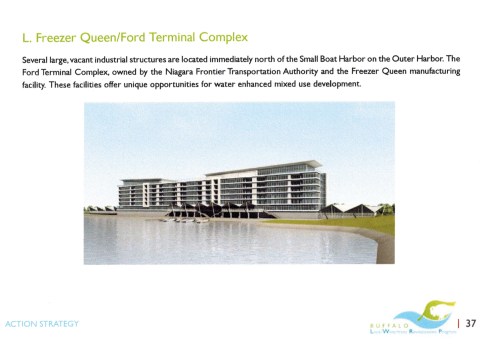
LWRP - Freezer Queen site

Rendering of Buchheit's 2015 project

       The FEAF also ignores the Green Code’s proposal for the 20-acre site: N-1-S (Secondary Employment Center) zoning status, where “heritage structures” are reused for a mix of industrial, commercial, and residential uses “with building heights of up to six stories.”

** In addition to its disregard of the Common Council’s role in the approval process, the FEAF fails to acknowledge the County’s authority to review and recommend for and against the proposed project pursuant to Section 239-m of the State’s General Municipal Law.

** When asked to identify the parks that serve the project site, the FEAF merely states, “Tifft Nature Preserve, South Park.” Oddly, no mention is made of the nearby Outer Harbor State Park, or Gallagher Beach, or Wilkeson Pointe, or Times Beach Nature Preserve.

BOA - Inventory - Parks and Open Space

** The FEAF states that the project sponsor wishes to subdivide its 20.25-acre parcel into two lots, one 7.22-acre lot, and one 7.66-acre lot. Somehow, 4.87 acres are not accounted for.

** The FEAF answers affirmatively when asked whether the proposed action would involve excavation or dredging of contaminated soils, but does not attempt to estimate the volume of polycyclic aromatic hydrocarbons (PAHs) and metals that will be excavated, or the depth of the excavation.

** The FEAF indicates that the project involves the addition of 300 feet of new boat slips, and that construction of the new slips will affect Lake Erie by disturbing bottom sediments, but proposes no reclamation or mitigation following the disturbance.

** The FEAF estimates that the project will generate 31,200 gallons per day of liquid waste generation, and claims that the existing treatment plants have the capacity to serve the project. No reference is made to the following statement in the recently released BUFFALO HARBOR Brownfield Opportunity Area [BOA] document:

      “… [A] separate 10-inch sanitary sewer service terminates at the Small Boat Harbor. The [Buffalo Sewer Authority] does not have any sewers south of this location… To support future development on the waterfront an extension of this service may be feasible. However, the present sewers ranging from eight to 12 inches in diameter may not be sufficient to support significant additional growth beyond that anticipated at Lakeside Commerce Park.”

** The FEAF admits that the proposed action will “result in a substantial increase in traffic above present levels,” and that they anticipate both morning and evening peak traffic hours. But the project sponsor has chosen not to provide any trip generation estimates to assist the lead agency in determining the extent of adverse impacts.

** The FEAF recognizes that the proposed action will “produce noise that will exceed existing ambient noise levels,” both during the estimate 120-day construction period, and during operation. It also states that an existing natural noise barrier or screen, “a line of trees and shrubs between site and 901 Fuhrmann will likely be removed. Nonetheless, the project sponsor has provided no analysis of the existing ambient noise levels, or the impact of the mechanical systems and vehicular traffic that will be generated by the proposed project. Instead we are simply told: “[A]ny noise in the area is overwhelmed by Route 5 nearby.”

** The FEAF’s claim that no historic site or resources have been identified on site is belied by the inventory in the “BUFFALO HARBOR Brownfield Opportunity Area” Nomination Document, which specifically identifies the existing Freezer Queen facility as eligible for the State and National Registers of Historic Places.  [See BOA – Register Eligible excerpt.]

** The FEAF claims that there is only one “officially designated and publicly accessible federal, state, or local scenic or aesthetic resource within five miles of the project site: Great Lakes Seaway Trail Scenic Byway.

Lastly, and utterly representative of the effort taken to date on behalf of the project sponsor, the Buchheit development team has provided no “additional information” needed to clarify the project, or to describe any adverse impacts which could be associated with the proposal or measures proposed to avoid or minimize such impacts.

D.  Failure to provide the City’s Preservation Board with the information needed to rule on its application for a demolition permit.

On April 8th, the Buchheit Team appeared before the City’s Preservation Board. Consistent with its approach to the first hearing before the City Planning Board, the critical document filed with the Preservation Board – the “Expanded Application for Demolition” form – provided no response to three important questions: When was the building constructed? What is the building’s architectural style? Who was the architect or designer of the building?

Without access to this information, the Preservation Board was compelled to call Buchheit’s “Application Incomplete,” and to ask the developer to provide the missing information.

Note: As mentioned above, according to the “BUFFALO HARBOR Brownfield Opportunity Area” Nomination Document, recently made public as part of the proposed Green Code DGEIS, the “Freezer Queen Foods” property is eligible for listing in the State and National Registers of Historic Places.  

Gerry Buchheit and his team of consultants apparently believe that it is just fine to waste other people’s time.  Rather than doing their homework and conscientiously providing information and supporting documentation to the governmental officials from whom they need approvals, they rush to submit material inadequate for the intended task. After all, Mr. Buchheit wants to break ground this June!

For the sake of the public, the integrity of the zoning and development process, and the environmental wellbeing of the Outer Harbor, I hope Mr. Buchheit will do what he threatened (promised) to do during a recent television news report when confronted with the zoning issues raised concerning his 23-story tower project:

“WE’RE SPENDING A LOT OF MONEY, AND IF THEY DON’T WANT IT, YOU KNOW WHAT, WE’LL GO SOMEWHERE ELSE.”

Please do.

With all due respect,

Art Giacalone
Cancel the April 4th Planning Bd. Hearing on the 23-Story Outer Harbor Tower

Posted by Arthur J. Giacalone on March 28, 2016
Posted in: City of Buffalo, Development, SEQRA, South Buffalo, Waterfront. Leave a comment

Incomplete, inaccurate, and inadequate information submitted on behalf of the developer – Gerry Buchheit’s Queen City Landing, LLC – regarding the latest proposal for the former Freezer Queen site on Buffalo’s Outer Harbor renders the public hearing scheduled for April 4, 2016 a waste of the public’s and Planning Board’s time.

Bird's Eye View from Fuhrmann Blvd..jpg

Somebody in the City of Buffalo’s Planning Office decided to schedule an April 4, 2016 public hearing before the City Planning Board regarding the design and site plan application for “The Apartments at Queen City Landing.”  The project is proposed for a prime Outer Harbor parcel at 975 Fuhrmann Blvd., just north of the Buffalo Harbor State Park.  Had the Planning Office staff objectively reviewed the developer’s application – which was filed on March 15, 2016, the deadline for anyone wishing to get on the April 4th calendar – she or he would have realized just how inadequate the developer’s submissions are.

To prevent a substantial waste of time and resources – by the public, the Planning Board, and other interested parties – the Planning Office or Chairman of the City Planning Board should immediately announce that the public hearing will not be conducted on April 4, 2016, and will not be rescheduled until, at a minimum, the following deficiencies are corrected:

I.  The parcel’s zoning status is verified.

The Planning Board cannot determine whether the proposed site plan complies with the City of Buffalo’s zoning laws, and a determination cannot be properly made as to the appropriate “lead agency” for environmental review purposes under SEQRA (State Environmental Quality Review Act), without first knowing the 20-acre parcel’s zoning status.  GIS mapping system, and the recently accepted Green Code Draft Generic Impact Statement, identify the former Freezer Queen site at 975 Fuhrmann Blvd. as “M3” – Heavy Industrial. [See “Figure 5” Existing Zoning in DGEIS Figures.]

But the developer has discovered that “CM” – General Commercial District – provides, in its words, “favorable use and bulk standards for mixed-use development.”  [In other words, CM zoning status may allow them to get away with a 23-story tower on the Outer Harbor.]  Rather than focusing on the M3 requirements for the parcel, or taking the time to verify whether or not the property was rezoned a number of years ago to CM, Quaker City Landing’s cover letter to the City Planning Board fudges on the site’s zoning status, stating:  “[W]e will assume that the Site is or will be zoned CM.”  [Click here to see the Queen City Landing Cover Ltr 03-14-16.]  That simply is neither adequate, nor appropriate.

II.  A “Full Environmental Assessment Form” is filed under SEQRA.

The applicant has submitted what is called a “Short Environmental Assessment Form” [SEAF] to purportedly assist the “lead agency” in assessing the potential adverse environmental impacts likely to occur if the proposed project were to be approved.  [Click here to see the Queen City Landing SEAF 03-14-16.]  The SEAF – a two-and-a-half page form – is palpably inadequate for analyzing 23-story, 370,000-square-foot mixed-use facility located along Lake Erie on land historically used for industrial purposes.  It provides the Planning Board and the public with only the most perfunctory information (even if we presumed the questions were faithfully answered).

SEQRA prohibits use of an SEAF for a “Type I action,” which are projects of sufficient scale and/or sensitivity that a thorough environmental review pursuant a Draft Environmental Impact Statement (DEIS) is presumed to be needed. For a “Type I action,” a project sponsor or applicant must provide the lead agency a “Full Environmental Assessment Form” [FEAF] to be used to determine whether or not the proposed project [“action”] will have a significant adverse impact on any one aspect of the environment.  Given the fact that the proposed project is not simply a “residential” development, but, as characterized in the applicant’s cover letter, is a “mixed-use facility,” it meets the SEQRA regulation’s thresholds for a “Type I action.”  More specifically, under SEQRA, construction of a project other than a “residential” facility is a “Type I action” if it involves: “the physical alteration of 10 acres” [the SEAF states that 11.00 acres will be physically altered]; or, in a city the size of Buffalo, construction of “more than 240,000 square feet of gross floor area” [the SEAF indicates that the tower alone “totals approximately 274,000 gross square feet”]; or, the action consists of activity or construction occurring “substantially contiguous to any publicly owned or operated parkland, recreation area or designated open space” [the applicant’s site plan shows that the parcel fronts on the public bike path].

Quaker City Planning Site Plan - east.jpg

Importantly, whether or not the proposed project is determined to be a “Type I action” under SEQRA, an agency – such as the City Planning Board – is authorized to require the applicant to provide an FEAF if “the short EAF would not provide the lead agency with sufficient information on which to base its determination of significance” [that is, the lead agency’s decision whether or not “that action may include the potential for at least one significant adverse environmental impact”].  The Queen City Landing project is undoubtedly such an action.

III.  “True and Accurate” information is provided.

The individual who submits an SEAF or FEAF to a government agency must affirm at the end of the form that “the information provided above is true and accurate to the best of my knowledge.”  The SEAF was affirmed, despite the following responses:

(a) The SEAF only refers to the gross square feet of the tower – approximately 274,000 gsf – and fails to provide information on the square footage of the other proposed structures.  According to the March 24, 2016 article in Buffalo Business First, “The entire Queen City Landing complex will encompass more than 370,000 square feet.”

(b) The SEAF makes no mention of the Site Plan’s reference to “Future 10-Story Building With Structured Parking” at the west end of the 20-acre parcel.

Quaker City Planning Site Plan - west

(c) The SEAF answers “Yes” to the inquiry, “Is the proposed action consistent with the predominant character of the existing built or natural landscape?”  This answer is in the affirmative despite the total absence of any towers at the Outer Harbor, the presence of the small boat harbor nearby, as well as the other parkland, recreation areas, open space, nature preserves, etc.  The packet submitted by the applicant’s engineers/architects includes elevations showing that the 23-story tower will be 324 feet in total height:

Quaker City Landing South Elevation

(d) The SEAF answers “No” to the question, “Will the proposed action result in a substantial increase in traffic above present levels?”  So, according to the SEAF, this 23-story facility, with at least 158 apartments, two restaurants, a night club, a fitness center, and off-street parking for a minimum of 255 vehicles, would not generate many more vehicle trips than the currently abandoned Freezer Queen facility.

Please cancel the April 4th public hearing.

With all due respect,

Art Giacalone


Councilmember Chris Scanlon’s call for slow, careful Outer Harbor development should be heeded

Posted by Arthur J. Giacalone on March 25, 2016
Posted in: Christopher Scanlon, City of Buffalo, SEQRA, South Buffalo, Waterfront. Leave a comment

UPDATE: Following the 3/25/16 publishing of this post, I found a March 24th “Notice of PUBLIC HEARING” in the Buffalo News which indicates that the Buffalo Planning Board will conduct a hearing in Room 901 City Hall on Monday, April 4, 2016, at 4:00 PM “to consider the design and site plans for: … demolition of existing building, 23-story apartment building and 3-level parking ramp at 975 Fuhrmann Blvd.” It also states: “Plans may be examined in Room 901 City Hall weekdays between 8:30 AM and 4:00 PM and at the hearing.”  

The sudden rush by developer Gerald A. Buchheit to gain approval by June for his latest proposal for the former Freezer Queen site – a 23-story, 370,000-square foot mixed-use facility – shows a stunning disregard or ignorance of the environmental review process and City of Buffalo zoning laws.

Businessman Gerald A. (“Gerry”) Buchheit has yet another plan for the 20-acre former Freezer Queen warehouse site just north of the Outer Harbor’s Buffalo Harbor State Park (f/k/a the Small Boat Harbor).  As announced by Buffalo Business First, Buchheit now envisions a 23-story apartment tower as the center piece of a 370,000 square-foot complex that would as many as 200 apartments, a night club, two restaurants, a three-floor underground parking garage, etc., etc.

Freezer Queen site tower

Buchheit’s latest proposal requires demolition of the existing 6-story warehouse and frozen food storage facility, built circa 1927.  Plans to raze the complex contrasts sharply with the proposal the developer announced just this past October.  That plan, as described by the Buffalo News, would reuse the building’s superstructure, remove and replace the façade, add two floors to the existing six-story building and expand the first-floor footprint to include indoor parking covered by a tension-membrane roof structure made by Birdair.

DSCN6862

Although, according to Business First, final development plans “are still coming together,” that publication also reports that, “The Buffalo Planning Board is expected to hold a public hearing on the proposed project when it meets on April 4.”  The Good Friday holiday prevents me from confirming the Planning Board’s calendar and intent.  [Note: See “Update” above.]

But what is more disconcerting than a premature public hearing is Mr. Buchheit’s unrealistic timetable for starting the newly announced project. Business First attributes the following quote to Buchheit: “I hope we can start this by June. Every day I am getting more and more excited about the project.”   A similar aspiration was echoed by WGRZ-TV reporter Andrea Marvin, who concluded her March 24, 2016 piece on the 23-story tower project with the following words: “And if all goes well, the developer hopes to break ground by June.”

A June 2016 groundbreaking could only occur if the City of Buffalo recklessly disregards its obligations under SEQRA, the State Environmental Quality Review Act.  This project clearly requires the objective and thorough scrutiny called for in a Draft Environmental Impact Statement (“DEIS”), including a hard look at potential adverse environmental impacts, an examination of alternative uses of the prime 20-acre waterfront property, and thorough consideration of mitigation measures. Of equal importance, the DEIS process – if done properly – provides for meaningful involvement by the public and other state and local agencies in the decision-making process.

The call for a shovel in the ground by June also reflects a misunderstanding of the zoning and planning decisions that must be made prior to the proposed project going forward. The former Freezer Queen site is currently zoned “M3” (Heavy Industrial District). New residential units are not permitted in an M3 zoning district. Given that fact, Buchheit’s project needs either:

(a) A rezoning by the City of Buffalo’s Common Council – a process that requires a recommendation by the Planning Board, a public hearing before the Common Council, and, importantly, full compliance prior to a vote with the requirements of SEQRA. Or,

(B ) A use variance” from the City’s Zoning Board of Appeals (“ZBA”). However, according to decades of court rulings by New York’s appellate courts, the entity that owns the 20-acre parcel, Queen City Landing, LLC, is not eligible for a use variance. The prohibition against constructing residential dwellings in an M3 zone predates the 2007 acquisition of the property by Buchheit and his group of investors. Under such circumstances, the need for a use variance is treated as a “self-created hardship,” barring the ZBA from granting such relief.

Fortunately, one City of Buffalo official appears to recognize the importance of a thoughtful and comprehensive examination of the latest Buchheit proposal. South District Councilmember Christopher P. Scanlon – whose district includes the Outer Harbor – expressed the need for a cautious approach to WGRZ-TV’s Andrea Marvin:

     “It is a large footprint, so I think we have to just be really careful moving forward.”

     “We have been waiting to develop the outer harbor for more than fifty years now and we’re only going to get one shot to do it right, so we should take a slow first step, and be very careful about it.”  

Chris Scanlon’s words and cautious approach need to be heeded by all of the City’s officials and boards. Not only that, the moratorium that I recently proposed for the Elmwood Village – while the Common Council deliberates the proposed Green Code/Unified Development Ordinance – appears to be needed throughout the Queen City.

With All Due Respect,

Art Giacalone

Can’t we have an intelligent dialog regarding the “Green Code”?

Posted by Arthur J. Giacalone on March 19, 2016
Posted in: Green Code, Uncategorized. Leave a comment

My St. Patrick’s Day post, https://withallduerespectblog.com/2016/03/17/are-you-sure-buffalos-green-code-is-95-g-r-r-reat/, sought to elicit a thoughtful discussion regarding the pros and cons of Mayor Brown’s complex and increasingly controversial proposal for reinventing the City of Buffalo’s zoning and development ordinance. While I certainly did not expect anyone to agree 100% with my perspective – born of a quarter century of representing city residents in zoning and development matters, and years of living in the Elmwood Village, Parkside neighborhood, and, currently, South Buffalo – I was hoping for a bit more than name-calling and unsupported “glibness.”

But here is what has transpired during an ongoing Facebook “discussion” the past day-and-a-half:

Andrew Kulyk, a Cheektowaga resident who operates an exterminating company in the Buffalo area, had the following to say about me:

Giacalone has cut his teeth and made his life’s profit as Obstructionist in Chief. The worst of the bottom feeders. His entire playbook is the same… show up to oppose project X, find some obscure verbiage in environmental regulations, and file art 78 [Article 78] proceeding to slow things down and add to cost and timetables. He’s ruthlessly efficient… and despicable.

… I chaired the ZBA in Cheektowaga for 19 years and heard this guy present arguments before our board that were outrageous…

… The man is evil.

So much for addressing the issues raised in my recent blog post.

Thankfully, Mr. Kulyk’s opinion of my professionalism and character is not shared by two sets of Cheektowaga Town Board members and Town Attorneys. In 1997, and again in 2011, at the recommendation of the Town Attorney, the Town Board hired me as special counsel to assist the town in addressing complex and sensitive zoning and environmental issues. My judgment was valued enough that I was asked in 2011 to not only advise the Town Board on whether or not Cheektowaga should incur the expense and other consequences of appealing a controversial lower court decision to the appellate court in Rochester, but also to assist the town in drafting a local law to enact a zoning-related moratorium.

Chuck Banas, a self-described community activist and Green Code proponent, is capable of putting together a 22-minute talk and slide show on the deficiencies in Buffalo’s current zoning code, and the merits of the Green Code. His October 2011 YouTube presentation concludes with Chuck praising the Green Code’s “collaborative, inclusive” process, urging “good public participation,” and stressing the importance of “consensus.” [See Banas video here.]

But Mr. Banas appears to have set aside these lofty principles now that residents are showing up at meetings displeased with various aspects of the proposed Green Code. At the Common Council’s March 15th public hearing, Chuck characterized the speakers who expressed detailed, substantive concerns about the proposed development ordinance as “alarmists” and “misinformed.” And here is what he had to say in response to my March 17th blog:

Not to go glib, but to be glib: This post is fundamentally wrong on most of its assumptions and most of its points. It reeks of NIMBY fearmongering.

For Chuck Banas, the only “good public participation” is commentary that fits his vision for Buffalo. And while the Green Code’s “No. 1 Cheerleader” talks of a form-based zoning code that allows “the local DNA” to be downloaded into it, he turns a deaf ear to those in the best position to identify the characteristics that have made their neighborhoods strong and attractive: longtime residents and homeowners.

I’m not gifted with Mr. Banas’ smooth and easy way of talking to a crowd. But I would gladly have a detailed public discussion with Chuck concerning the pros and cons of the Green Code.

With All Due Respect,

Art Giacalone

Are You Sure Buffalo’s Green Code is 95% GREAT?

Posted by Arthur J. Giacalone on March 17, 2016
Posted in: Green Code, Uncategorized. 1 Comment

Whether it’s motivated by a fondness for the young urban planners who have spent the majority of their professional lives working on the City’s Unified Development Ordinance, or political correctness, or a laser-like focus on only the issues they care most about, some of the Buffalonians I hold in the highest esteem preface any criticism of the proposed Green Code with the phrase, “The Green Code is 95% great, but…”  I can’t help wondering: Really?

Please understand, I appreciate that there are general concepts in the Mayor’s proposed Unified Development Ordinance [UDO] that are attractive to most thinking Buffalonians – a walkable city, traffic calming measures, bicycle access and facilities, tree conservation, etc. To a great extent, these broader concepts focus on the public domain, providing guidance to city officials when they consider significant changes to Buffalo’s streetscapes and public property.

But these attractive principles are merely the frosting on an otherwise indigestible cake. The heart and soul of land use and zoning regulations – the issues that impact residents in their day-to-day lives – are the provisions addressing how private actors utilize private property, and how those uses impact the surrounding neighborhoods and community. As a resident and taxpayer, I believe that the function of a city is to preserve and enhance the quality of life of its residents, and that the role of commercial activities is to service the needs of residents (and, not vice versa). Zoning and land use law should empower residents to protect the peaceful enjoyment of their homes and neighborhoods, either directly through the public hearing process, or indirectly through their elected officials.

Unfortunately, the primary purpose of the proposed Green Code is not – and never has been – to enhance the ability of residents to control the character of their neighborhoods. To the contrary, the major function of the Green Code has been, from its inception, to make it easier for developers and commercial interests to do precisely what they want to do without any meaningful interference from either nearby residents and property owners, or from Common Council members wishing to serve their constituents. As Council President Pridgen enthusiastically proclaimed at the unveiling of the latest version of the Green Code last October: The green in Green Code stands for a “green light” for developers! You bet.

If not substantially amended by the Common Council, the proposed UDO (prepared by Mayor Byron Brown’s Office of Strategic Planning) will accomplish the pro-development goal of its authors, at the expense of the City’s residents and, ironically, the power of the Common Council members. As stated at page 39 of the Draft Generic Environmental Impact Statement [DGEIS]: “…[T]he UDO would significantly increase the amount of land available for as-of-right development.” In other words, under the Green Code as proposed, developers will be in a much stronger position to build what they want to build, where they want to build it, without the ability of residents – or the Common Council – to stop them.

The proposed UDO allows developers and commercial interests – not City residents and their elected Common Council members – to decide where new construction will occur by increasing not only the amount of land “available for as-of-right development,” but by greatly increasing the density of the projects permitted as-of-right. And here’s how: Although the UDO describes “a projected goal of approximately 30,000 new residents over a 20-year period,” [see DGEIS, p. 116], a “full build-out” of as-of-right projects under the UDO would create 156,979 additional residential units – which translates to over 300,000 new residents, ten times the targeted increase of 30,000 new Buffalonians. [See DGEIS page 39-40]

Given the fact that even the target population figure is unlikely (given the Queen City’s historical trend), developers will be able to cherry-pick the parcels and neighborhoods they consider most profitable (for example, Elmwood Village and adjacent to the Buffalo Niagara Medical Campus) and build over-sized structures out-of-character with the adjoining community, while the vast majority of the city’s neighborhoods see little, if any, new development.

So, I humbly ask anyone who thinks or is tempted to say that the proposed Green Code is “95% great” – especially my friends and allies – to reflect on the accuracy of such a claim. And, additionally, to ponder these questions and comments, presented in no particular order:

Number One. Have the authors of the Green Code ever explained why the UDO places emphasis on “building types” or “forms” as opposed to zoning’s traditional emphasis on “uses”? What are the benefits – to the existing residents of the City of Buffalo – of placing form over function, especially when, all too often, the allowed forms are much larger and denser than what currently exists in the surrounding neighborhood?

Number Two. Do the current residents of the City of Buffalo (not some hypothetical new wave of individuals rushing to embrace what our community has to offer) believe that their quality of life would be enhanced by the introduction of higher density, vertical development in their neighborhoods?

Number Three. Can we honestly say that the proposed Green Code reflects “public consensus” when the vast majority of information meetings and workshops conducted by the Mayor’s Office of Strategic Planning did not provide City residents (or, individual Common Council members) with detailed information on how the proposed new development ordinance would impact their own neighborhood, much less the block where they live?

Number Four. Isn’t it troubling that, after years of study and analysis, the Office of Strategic Planning has provided the Common Council and public with a DGEIS that fails to provide the assessment and information needed to determine which neighborhoods would experience a substantial change in character under the proposed UDO, or to measure the adverse impacts of such change? Are they hiding something from us? Are we really supposed to be satisfied with the statement, as expressed at page 74 of the DGEIS, “The land use maps and zoning analysis discussed … above, demonstrate that the BCDF will not radically change the community character in most areas of the City”?

Number Five. Is there a reason that Outer Harbor advocates, shocked by a proposed UDO and LWRP that place a “N-3E (Mixed-Use Edge)” district within a few hundred feet of Times Beach, or a land use plan that allows supposed “green space” to be covered by as much as 25% impervious surfaces (buildings and pavement), shouldn’t be suspicious of what lurks in the details of other parts of the proposed Green Code? Here’s but one example: Is it “great” for Buffalo’s residents that as currently proposed, a “Residential Campus” district (such as the low-income McCarley Gardens development adjacent to the Buffalo Niagara Medical Campus and UB’s education campus) allows “by right” government offices, cultural facilities, and dormitories, and, by special use permit, professional offices, taverns, and restaurants? Do we want a zoning code that helps protect less affluent residents, or provides an incentive for private developers or powerful public institutions to displace the residents of a well-functioning residential campus?

Number Six. Is there a reason that historic preservation advocates, rightfully concerned that the proposed Green Code fails to protect the City’s most significant historic resources (despite claiming to be based on the existing historic fabric of Buffalo’s neighborhoods), shouldn’t also wonder what the impact of “neighborhood shops” will be on the residents of this City’s aging-but-cherished neighborhoods? Does it truly enhance a city’s walkability and quality of life to allow a tavern, resident, or retail shop in the middle of a residential block for the sole reason that the structure was built prior to 1953 and once had a non-residential occupant on its first floor?

Thank you for your consideration of these comments.

With All Due Respect,

Art Giacalone

SEQRA and Buffalo’s History of (Non)Compliance

Posted by Arthur J. Giacalone on March 4, 2016
Posted in: Byron Brown, City of Buffalo, Green Code. Leave a comment

I recently urged Buffalo residents to roll up their sleeves, and provide “substantive comments” to our Common Council members regarding the Green Code’s Draft Generic Environmental Impact Statement [DGEIS]. [See https://withallduerespectblog.com/2016/02/20/how-green-is-the-buffalo-green-code/.] But I realize how daunting a task that might be for anyone not fully familiar with SEQRA, its intended role, and the alphabet soup of phrases and legal terminology that surrounds the environmental review process. So this post will offer the public and our public officials some background information concerning SEQRA, as well as my perspective on the City of Buffalo’s history of (non)compliance with this important law.

DSCN5144

I.  State Environmental Review Act (SEQRA).

The Draft Generic Environmental Impact Statement [DGEIS] that was accepted by Buffalo’s Common Council in mid-February is an attempt by city officials to demonstrate compliance with the requirements of a state law enacted four decades ago, the State Environmental Quality Review Act, known commonly as SEQRA. [See ECL Article 8 SEQRA.] Hugh Carey, New York’s governor at that time, explained in his acceptance memorandum why the legislation was sorely needed:

… In recent years, it has become abundantly clear that state and local agencies have not given sufficient consideration to environmental factors when undertaking or approving various projects or activities… [Emphasis added.]

Gov. Carey also identified the goal of SEQRA: to create a mechanism to provide state and local agencies with objective information so they could “intelligently assess and weigh environmental factors” when deciding whether or not to approve new policies, laws and projects. SEQRA’s role was also described by our state’s highest court in a landmark 1986 court decision known as Jackson v. NYS Urban Dev. Corp.:

“… SEQRA makes environmental protection a concern of every agency. In proposing action, an agency must give consideration not only to social and economic factors, but also to protection and enhancement of the environment. SEQRA insures that agency decision-makers–enlightened by public comment where appropriate–will identify and focus attention on any environmental impact of proposed action, that they will balance those consequences against other relevant social and economic considerations, minimize adverse environmental effects to the maximum extent practicable, and then articulate the bases for their choices… factors when undertaking or approving various projects or activities…”  [Emphasis added.]

To assure protection and enhancement of the environment, SEQRA defines “environment” broadly to include not only the “physical conditions” that will be affected by a proposed action, such as land, air, water, minerals, flora, fauna, and agricultural and archeological resources, but also elements that are less tangible and may be considered socio-economic in nature, such as historic and aesthetic resources, existing patterns of population concentration, distribution or growth, existing community or neighborhood character, and human health. [See 6 NYCRR 617.22(l).] Notably, our state’s highest court held thirty years ago that an action’s potential impact on these socio-economic factors (which include the displacement of low-income residents through the process euphemistically known as “gentrification”) must be a matter of concern “with or without a separate impact on the physical environment.”   [See Chinese Staff and Workers Association v. City of New York, 68 NY2d 359, 365-366 (1986).]

DSCN4775

The “heart” of SEQRA is the “environmental impact statement” or “EIS.” It is a document – when properly prepared – that provides government agencies, project sponsors, and the public a means to systematically gather and consider significant adverse impacts on the environment, alternatives to the proposal under consideration, and mitigation measures to eliminate or substantially reduce unavoidable adverse impacts. As expressed by our state’s highest court in the Jackson decision, the EIS process is designed as “a cooperative venture” whereby both the public and public agencies are informed, and an agency has “the benefit of public comment” prior to approving an action.

To comply with SEQRA’s purpose, consideration of environmental factors must be incorporated into the planning, review, and decision-making processes of government agencies “at the earliest possible time.” [See 6 NYCRR 617.1(c).] Although SEQRA does not state the precise time a DEIS must be prepared, the document is to be presented to the public “at a point ‘where genuine flexibility remains before bureaucratic momentum strips [it] of any real influence on decision-making.’” [See Sun Beach Real Estate Development Corp. v. Anderson, 98 AD2d 367 (2d Dept. 1983).

DSCN6742

II.  City of Buffalo and SEQRA (Non)Compliance.

I have closely observed the City of Buffalo’s efforts to comply with the requirements and intent of SEQRA for a quarter century, as a citizen, as a lawyer representing informal groups of residents, and, in the mid-1990s, as a member of the City of Buffalo’s Environmental Management Commission (BEMC). I will be gracious and refer to the city’s approach to its obligations under SEQRA as less-than-diligent. But one need not rely solely on my assessment.

In 1994, James A. Smith, as Executive Director of the City’s Office for the Environment, served as the liaison between the Department of Community Development and the BEMC. In that capacity, Mr. Smith prepared a document entitled 1994 State of the Environment Report for the City of Buffalo. Although known for his diplomatic choice of words and non-confrontational demeanor, Jim Smith’s 1994 report concludes that, “there are serious problems with the City’s compliance with SEQR,” and states:

“… Due to a lack of procedural guidelines, and in some cases lack of commitment, the City of Buffalo does not fully obey New York state law regarding mandated environmental review procedures…”

The Common Council did adopt environmental review procedures in 1997. But serious problems remain with Buffalo’s compliance with SEQRA. In my opinion, there continues to be a lack of commitment to the statute’s goal of assuring the timely and informed assessment and consideration of environmental factors. This indifference to SEQRA’s mandates has manifested itself in a variety of ways, including:

A.  The failure of the City to require a Draft EIS for politically popular and fast-tracked projects, despite the fact that the proposed actions far exceed SEQRA’s thresholds for preparing an environmental impact statement. (See, for example, ENB 10-30-13 re Uniland’s 250 Delaware Ave. and ENB 02-24-16 re NorthlandCorridor.)

250 Delware Ave rendering

B.  An agency with the principal authority to approve or deny a proposed action (most often, Buffalo’s Common Council) deferring to other city agencies to oversee the DEIS process, and, in doing so, insulating itself from directly assessing potential environmental problems. (See, for example, Price v. Common Council 01-22-04.)

C. Delay in issuing a Draft EIS until a time when genuine flexibility no longer exists.

From my perspective, the City’s disinterest in adhering to SEQRA’s letter and spirit has emanated from the Mayor’s office, spreading throughout City Hall. SEQRA appears to be viewed by the current Mayor – as well as his predecessors – as an obstacle to be circumvented, an impediment to developers doing precisely what they want when they want to do it, and an unwanted constraint on the unfettered discretion of government agencies and officials. Without commitment from the head of the executive branch, and a steadfast effort by the City’s law department to educate and train city decision-makers on their duties and powers under SEQRA, it is not surprising that members of the Common Council, City Planning Board, Zoning Board of Appeals, etc., often fail to fully comprehend their role and obligations under SEQRA. .

III. Green Code’s Draft Generic Environmental Impact Statement (DGEIS).

Buffalo’s Common Council – the city’s elected legislative body – has been designated “lead agency” for the proposed Green Code. It correctly holds that status because, as Buffalo’s legislative body, it alone has the authority to decide whether or not the new zoning and development ordinance will be enacted and become law. [See 6 NYCRR 617.2(u).] Under SEQRA, the “lead agency” is responsible for determining whether an Environmental Impact Statement (EIS) is required, and for preparing and filing the EIS.

Despite the fact that the Common Council holds the title of “lead agency” for the proposed Green Code, the Green Code is Mayor Byron Brown’s baby, and the actual task of writing this massive piece of legislation has been assumed by the Mayor’s Office of Strategic Planning (OSP). Given that fact, it was more important than ever to adhere to SEQRA’s mandate to prepare a Draft EIS “at the earliest possible time” and “at a point where genuine flexibility remains before bureaucratic momentum strips [it] of any real influence on decision-making.” Unfortunately, the exact opposite has occurred.

Nearly five-and-a-half years elapsed between the time the Green Code planning process officially began in September 2010, and the public’s first access in February 2016 to the DGEIS, the heart of SEQRA. Here’s a brief chronology of major Green Code and SEQRA-related events:

– September 2010: “Kick off” of the Land Use Plan project occurs.

– November 2010 – Summer 2011: Mayor’s OSP holds community meetings, workshops.

– October 2011: Mayor’s OSP releases the First Draft of Buffalo Green Code.

– April 2012: Mayor’s OSP releases “A New Zoning Direction for Buffalo – Technical Report,” and Mayor hosts a major forum entitled “Buffalo Green Code – A Form Based Unified Development Ordinance.”

– May 2012 – Mayor’s OSP takes first step to comply with SEQRA, filling out an informational form known as a Full Environmental Assessment Form (FEAF), and submitting it to the Common Council.

– July 2012: Common Council determines that the proposed Green Code may have a significant adverse impact on the environment and issues a “Positive Declaration” under SEQRA calling for a Draft Generic Environmental Impact Statement (DSGEIS); Mayor’s OSP prepares and releases a “Draft Scoping Document” to identify potentially adverse impacts that should be evaluated in the DGEIS.

– May 2014: Mayor’s OSP releases the second draft of the proposed Green Code for public review.

– October 2015: Mayor’s OSP releases the third draft of the proposed Green Code for public review.

– February 2016: On February 16, 2016, Common Council accepts as complete the Green Code DGEIS prepared by the Mayor’s OSP, and begins the public comment period (which ends April 22, 2016).  [Click here for the Green Code’s DGEIS.]

IV.  Flaws in the City’s Approach to the Green Code.

There are four basic flaws in the approach taken by the Mayor’s Office of Strategic Planning in enacting, in Mayor Brown’s words, “a historic revision of Buffalo’s land use and zoning policies”:

First, the decision to conduct the environmental review of four diverse projects, that is, Buffalo’s Land Use Plan and Unified Development Ordinance (“Green Code”), Local Waterfront Revitalization Program, Revised Urban Renewal Plans, and Brownfield Opportunity Areas, “as one package” greatly reduces the likelihood that any of the four sets of laws, policies and plans will be afforded the “hard look” mandated by SEQRA. The Mayor’s OSP further “softens” the assessment process by choosing to evaluate potential environmental problems through the gauzy lens of a generic draft environmental impact statement (GDEIS), rather than looking at site-specific impacts.

Second, contrary to SEQRA’s mandate that the environmental review process occur “at the earliest possible time” in the planning process, the City and its consultants have spent years developing their comprehensive proposals without the benefit of the DGEIS. In doing so, the City has made it much more unlikely that any of the proposals constituting Buffalo’s new land use and zoning policies will be significantly modified in response to any environmental problems discovered through the EIS process. Bureaucratic momentum in favor of the “preferred” proposals, as well as the non-environmental [that is, political] considerations that have contributed to the shape of the various projects, will almost certainly eliminate any genuine flexibility in the decision-making process. In other words, by delaying its SEQRA review, the City has stripped the environmental impact statement of any real influence on the decision-making process.

Third, the much-touted “public outreach” the City has engaged in concerning its proposed land use and zoning plans occurred pre-SEQRA when residents were not armed with the information needed to insure fully informed commentary. Although it has taken “the experts” five-and-a-half years to amass the numerous and lengthy documents comprising the DGEIS and its nine appendices, Buffalonians have until only April 22, 2016 to assess and comprehend this mountain of information – and figure out what important information and evaluation is missing from the DGEIS.

Fourth, following the DGEIS public comment period, it will be the Mayor’s OSP and consultants, not the Common Council, responding to the public’s comments, and making revisions, if any, to the Green Code documents. As stated at the Green Code’s website, “Once the revisions are complete, the Green Code documents and the Final GEIS will be presented to the Common Council for adoption.” This approach further insulates the Common Council from the planning and review process, jeopardizing compliance with the letter and spirit of SEQRA. According to SEQRA, the Green Code’s Final GEIS must include “the lead agency’s responses to all substantive comments,” and it is the lead agency that is “responsible for the adequacy and accuracy of the final EIS, regardless of who prepares it.” [See 6 NYCRR 617.9(b)(8).]

I guess we really do have to roll up our sleeves!

With All Due Respect,

Art Giacalone

Note:  My thanks to Jay Burney for arranging to have this posting re-published at The Public‘s inestimable GreenWatch column at http://www.dailypublic.com/articles/03062016/greenwatch-buffalo-greencode.


Moratorium needed to save Elmwood Village

Posted by Arthur J. Giacalone on February 25, 2016
Posted in: Byron Brown, City of Buffalo, Development, Elmwood Village, Green Code. 11 Comments

Buffalo’s Common Council must move quickly to temporarily halt development in and around Elmwood Avenue to preserve the historic fabric of this unique and livable neighborhood.

The Elmwood Village is under assault on two major fronts.

Mayor Byron W. Brown’s Office of Strategic Planning has authored a new zoning and land use ordinance – the “Green Code” – that proposes elimination of many of the zoning provisions that helped the Elmwood Village earn its 2007 designation as one of the American Planning Association’s “10 Great Neighborhoods.” [See APA – Elmwood Village award 2007.]

[Click here for a quick summary, Green Code Threats to Elmwood Village 02-24-16.]

And a bevy of Western New York developers – including, among others, Carl Paladino’s Ellicott Development Company, Chason Affinity, the Frizlen Group, and Ciminelli Real Estate Corp. – has rushed into the Elmwood Village with proposals that fail to capture the scale, aesthetics, history, and architecture of Buffalo’s nationally recognized asset. The historic fabric and extraordinary character of Elmwood Avenue will be irreparably compromised if this unique neighborhood continues to be tarnished by projects such as these:

905 Elmwood Avenue:

Elmwood and WDelevan graphic

Southeast Corner of Elmwood and Forest Avenue:

Affinity schematic 10-16-2010

766 Elmwood Avenue:

DSCN6986

It is time for Buffalo’s Common Council to demonstrate its leadership. The city’s legislative body has the power to enact a moratorium that would preserve the status quo within the boundaries of the Elmwood Village while the process of reviewing and, hopefully, modifying the proposed Green Code moves forward.

There will almost certainly be reluctance among Common Council members to take what some will view as a dramatic – if not drastic – move. And our legislators are unlikely to receive constructive assistance from the Corporation Counsel’s office – the city’s law department – where attorneys hold their jobs at Mayor Brown’s pleasure. So I will share with the Common Council – and, in particular, Messrs. Pridgen, Rivera and Feroleto – the following principles [additionally, here is a memorandum addressing FAQ re Moratoriums]:

First, New York’s courts have repeatedly upheld moratorium resolutions as “valid stopgap or interim zoning measures” when they temporarily halt development while a municipality considers comprehensive zoning changes (such as the proposed Green Code) or a new comprehensive plan.

[See, for example, Laurel Realty v. Planning Bd. of Town of Kent, 40 AD3d 85 (2nd Dept. 2007); 119 Development Associates v. Village of Irvington, 171 AD2d 656 (2nd Dept. 1991); McDonald’s Corp. v. Village of Elmsford, 156 AD2d 687 (2nd Dept. 1989); Matter of Charles v. Diamond, 41 NY2d 318 (1977).]

Second, the fact that one or more developer may have applied for approval of a project prior to enactment of the moratorium neither invalidates the moratorium, nor makes the moratorium inapplicable to the pre-filed application, so long as the city does not act in “bad faith” and unduly delay acting on the application.

[Note: The courts have repeatedly upheld moratoriums enacted after a municipality has received an application. For example, McDonald’s Corp. v. Village of Elmsford, 156 AD2d 687 (2nd Dept. 1989); West Lane Properties v. Lombardi, 139 AD2d 748 (2nd Dept. 1988); Dune Associates v. Anderson, 119 AD2d 574 (2nd Dept. 1986).]

Third, under New York law, a developer does not have a “vested right” to complete a project under the existing zoning law unless and until there has been construction or other change to the land itself in furtherance of the project to such an extent that enforcement of a subsequently enacted zoning law would inequitably cause a serious hardship or loss.

[See, for example, Pete Drown Inc. v. Town Board of Town of Ellenburg, 229 AD2d 877 (3rd Dept. 1996); Masi Management, Inc. v. Town of Ogden, 273 AD2d 837 (4th Dept. 2000); Alaimo v. Town of Greece, 68 AD2d 743 (4th Dept. 1979).]

Fourth, moratoriums, to be valid, must be “reasonable” in length. Courts consider a six-month moratorium, and, if circumstances warrant, an extension if additional study is needed, to be a reasonable length.

[See, for example, Lakeview Apartments of Hunns Lake v. Town of Stanford, 108 AD2d 914 (2nd Dept. 1985; McDonald’s Corp. v. Village of Elmsford, 156 AD2d 687 (2nd Dept. Noghrey v. Acampora, 152 AD2d 498 (2d Dept. 1988).]

And fifth, a resolution to enact a moratorium must follow the same procedures as a request to amend a zoning ordinance. But, note, adoption of a moratorium on land development or construction is a “Type II action” under SEQRA, and, therefore, no SEQRA reviewed is required.

[Here is a sample resolution enacting a moratorium; and, a document, Land Use Moratoria – NYS Dept. of State 1999,” which provides a thoughtful discussion of the topic.]

If asked, I will gladly provide the Common Council pro bono advice and assistance in preparing the required documents and navigating the procedurals steps needed to enact an effective moratorium to maintain the status quo until the proposed Green Code is carefully assessed and modified to assure preservation of the Elmwood Village’s historic fabric.

With all due respect,

Art Giacalone

POST-SCRIPT:

The post, https://withallduerespectblog.com/category/elmwood-village/, appears to have touched a nerve. More than 1,600 visitors have been to my oft-quiet website in a little over 48 hours. I can only hope that Buffalo residents who are troubled by the current assault on the Elmwood Village will take the time to express their concerns to their respective Common Council Members and Council President: dpridgen@city-buffalo.com; darivera@city-buffalo.com; jferoleto@ch.ci.buffalo.ny.us.

I would like to respond with some detail to a comment I have received.  But, first, let me clarify a point. No one is compensating me in any way for my efforts to shed light on the Green Code process. As a former resident of the Elmwood Village (having lived as a young adult on both Auburn and Ashland avenues),  I greatly appreciate its attractiveness and uniqueness as a place to live.  As a lawyer who has represented residents in and around the Elmwood Village area for a quarter century, I know all too well how vulnerable this historic neighborhood is to the whims of developers and, all too often, compliant city officials.

COMMENT: What is the Elmwood Village Association doing about this? Do they have any interest in preserving the most beautiful area of Buffalo?

RESPONSE: I have no doubt that there are members on the EVA board of directors who care deeply about preserving and protecting the historic fabric of the Elmwood Village. But I have seen professionally – most recently, as the lawyer for a group of Granger Place and Forest Avenue residents and property owners fighting to prevent the demolition of ten century-old dwellings on the southeast corner of Elmwood and Forest – how the EVA has functioned more as the “Elmwood Village Chamber of Commerce” than as an organization determined to enhance the qualities that have made this portion of Buffalo the gem that it is.

It is understandable that there are mixed feelings about the current condition of the properties on the east side of Elmwood Avenue south of Forest Avenue – owned since 2009 by an affiliate of the Chason Affinity companies. However, for many years, neither the EVA (which was founded in 1994), nor the City of Buffalo, took effective steps to compel the former owner of the parcels, Hans Mobius, to properly maintain and preserve these properties. With the appropriate attention, these structures – built as two- and three-family residences between 1900 and 1920 – would proudly reflect “the unique and historic nature of Elmwood Avenue” the EVA claims it was formed to preserve and protect.

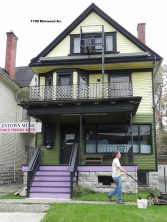
Exh 5 - 1115 Elmwood Ave. 11-06-13 Exh 8 - 1109 Elmwood Ave. 11-06-13

Exh 9 - 1105 Elmwood 11-06-13 1101 ELMWOOD AVE

Rather than attempting to save ten dwellings (eight on Elmwood and two around the corner on Forest) from the wrecking ball, EVA Executive Directors – one former, Justin Azzarella, and the current, Carly Battin – have functioned as cheerleaders for a developer who wishes to demolish them all, eliminate their welcoming front lawns, and construct a six-story (five stories and a penthouse), approximately 200,000 square-foot mixed-development project which would be completely out-of-character with Elmwood’s fabric and history.

Elmwood-Forest DNA v Mutant 2

More specifically, Mr. Azzarella provided Chason Affinity with an undated letter (sometime after December 6, 2010) expressing, on behalf of the board of directors of the Elmwood Village Association, “support of your mixed-use development at the corner of Elmwood and Forest Avenue,” applauding the developer’s “commitment to developing an appropriately scaled, mixed-use building in keeping with the City of Buffalo’s Elmwood Village Design Standards” [EVDS]. [Click here for EVA support letter.]

Curiously, despite the fact that every single building on Elmwood between Bird and Forest avenues is less than three stories in height, Mr. Azzarella fails to explain how a five- or six-story structure could be compatible with the EVDS requirement that “new buildings shall respect the predominant height of buildings within the area”:

EVDS re scale

More recently, Ms. Battin not only testified in a civil proceeding on behalf of Chason Affinity’s efforts to extinguish deed restrictions protecting the adjacent owners since 1892, she provided a sworn affidavit expressing EVA’s “full support” for the proposed planned hotel-condominium-retail, proclaiming that it would be “overwhelmingly beneficial for the commercial strip of Elmwood Avenue.”  [Click here for Carly Battin’s affidavit.]

Notably, not a word was expressed by EVA’s former or current Executive Director regarding potential adverse impacts a 200,000-square-foot development would have on the residents living near the proposed project on Elmwood, Forest and Granger. And nothing was stated concerning the goal of protecting and preserving Elmwood Avenue’s unique and historic nature.

With All Due Respect,

Art Giacalone

How “Green” is the Buffalo Green Code?

Posted by Arthur J. Giacalone on February 20, 2016
Posted in: City of Buffalo, Development, Green Code, SEQRA. 2 Comments

Dear Fellow Buffalonians,

It is time for some hard work. The Buffalo Common Council has scheduled a public hearing for MARCH 15, 2016 at 5:30 pm to receive comments on the Draft Generic Environmental Impact Statement [DGEIS] for the Buffalo Green Code. The DGEIS public hearing and written comment period are the most significant opportunity for the public to have a voice in the environmental review process mandated by SEQRA – the State Environmental Quality Review Act.

The announcement and specifics can be found at the Buffalo Green Code home page, http://www.buffalogreencode.com/:

“The Buffalo Green Code has been updated: The Draft Environmental Impact Statement (DGEIS) was accepted by Common Council on Februrary [sic] 16, 2016 and is now available.   A public hearing on the DGEIS is scheduled for March 15, 2016 at 5:30 p.m. at the City of Buffalo Common Council Chambers, 13th floor City Hall, 65 Niagara Square, Buffalo, NY 14202.  A second public hearing is scheduled for the April 2, 2016 at 10:00 a.m., the location has not been determined for this hearing at this time.  The public comment period will end on April 22, 2016.” 

I urge anyone who cares about the City of Buffalo’s quality of life and future to prepare for the upcoming public hearings – and the related “written comment period” – by carefully reading and analyzing the DGEIS.  It will not be helpful to the Common Council members, Office of Strategic Planning, or the public, to stand up at a public hearing [or, sit down at your computer to prepare written comments] and merely provide general, non-specific comments about the DGEIS or proposed Green Code.  To make a difference, you must first educate yourself and then provide “substantive comments.”  Specific references to the DGEIS and proposed Green Code, with examples of what you believe has been omitted or not thoroughly and objectively considered in the DGEIS, will be the most effective approach.

There are practical and legal reasons to “do your homework” and then provide comments to City of Buffalo officials.   On the practical level, the DGEIS and proposed Buffalo Green Code are large, multi-faceted documents.  Common Council members are much more likely to consider and react to your specific concerns, examples, and recommendations, than to generalities.  Legally, the FGEIS – Final Generic Environmental Impact Statement – must include “the lead agency’s responses to all substantive comments” on the Draft GEIS.

To make certain that City officials actually think about and respond to the issues of concern to you,  provide “substantive comments” – that is, provide Common Council members substance, not just generalities.

For your convenience, here are links to the DGEIS:

DGEIS Text: http://buffalogreencode.com/Draft%20Generic%20Environmental%0Impact%20Statement%20-%20Green%20Code_accepted.pdf

DGEIS Figures: http://buffalogreencode.com/DGEIS%20Figures.pdf

And here are the DGEIS “Appendices,” including the multiple parts making up the “Unified Development Ordinance” (UDO), commonly referred to as the Buffalo Green Code:

Appendix A – Land Use Plan

Appendix B – Draft Local Waterfront Revitalization Plan

Appendix C – Homestead Plan

Appendix D – Brownfield Opportunity Area Plans and Nomination Documents

Appendix E – Unified Development Ordinance

Appendix F – Urban Renewal Plans Review Document

Appendix G – Communty Outreach

Appendix H – Build Out Analysis

Appendix I -Transportation Analysis

It is time to roll up our sleeves, delve into the DGEIS and proposed Green Code, and determine whether the City of Buffalo’s proposed new zoning and development code deserves to be called “Green.”

With All Due Respect,

Art Giacalone

Posts navigation

← Older Entries
Newer Entries →
  • CATEGORIES

  • February 2026
    M T W T F S S
     1
    2345678
    9101112131415
    16171819202122
    232425262728  
    « Nov    
  • DISCLAIMER

    This blog is provided for general informational purposes only. It should not be construed as legal advice and is not intended to be a substitute for legal counsel. Persons requiring legal advice should retain a properly licensed lawyer. No attorney-client relationship will be formed based on use of this site and any comments or posts to this blog will not be privileged or confidential. *************** This blog's author, Arthur J. Giacalone, does not intend or consider the communications at this blog to be ATTORNEY ADVERTISING. The primary purpose of the communication is not for the retention of Mr. Giacalone's legal services. [See definition of "Advertisement" at Part 1200, Rules of Professional Conduct, Rule 1.0(a).] Nonetheless, in case the proper authorities choose to treat this web site as ATTORNEY ADVERTISING, the street address, phone number and email address of the law office of Arthur J. Giacalone are: 17 Oschawa Avenue, Buffalo, New York 14210; (716) 436-2646; AJGiacalone@twc.com.
Blog at WordPress.com.
With All Due Respect
Blog at WordPress.com.
  • Subscribe Subscribed
    • With All Due Respect
    • Join 62 other subscribers
    • Already have a WordPress.com account? Log in now.
    • With All Due Respect
    • Subscribe Subscribed
    • Sign up
    • Log in
    • Report this content
    • View site in Reader
    • Manage subscriptions
    • Collapse this bar
 

Loading Comments...