With All Due Respect

Photos and musings by Arthur J. Giacalone

  • About The Author
  • About This Blog
  • Pre-WADR Archives

Plea to Buffalo Outer Harbor Activists: Refocus, Don’t Appeal!

Posted by Arthur J. Giacalone on December 30, 2021
Posted in: City of Buffalo, Development, SEQRA, South Buffalo, Waterfront. Leave a comment

I agree wholeheartedly with one point raised in the December 29th email from my longtime friend and former client, Margaret Wooster.  It is time for citizens concerned about the Outer Harbor’s future to “strengthen our resolve and focus for the new year.”  But I am absolutely convinced – after 32 years of representing residents in development and SEQRA cases – that the least effective step that could be taken at this juncture is to expend precious time, energy and money appealing the unfavorable decision rendered on December 9, 2021 by Supreme Court Justice Donna Siwek (see LWVBN v ECHDC – Siwek’s 12-09-21 Decision).

I greatly admire the grit shown by the Petitioners, League of Women Voters of Buffalo/Niagara, Inc., The 21st Century Park In The Outer Harbor, Inc., and The Western New York Environmental Alliance, Inc., in bringing the “Article 78 proceeding.”  But here’s the reality:  Their lawyers took a case that was going to be extremely difficult, at best, to win, and, in my professional opinion, gravely undermined any chance at success by their actions and omissions.   Here are some examples:

First, complying with the four-month statute of limitations for challenging the determinations made by Erie Canal Harbor Development Corporation (ECHDC) isn’t just a “technicality.”  It is a prerequisite for succeeding in a lawsuit.  Commencing the lawsuit on June 24, 2021 was not only well beyond four months from the November 8, 2020 ECHDC approval of the contested plan and SEQRA “Negative Declaration,” it was more than four months from February 8, 2021, the date the ECHDC reaffirmed their original resolution.  If Petitioners’ team of attorneys had hoped to prevail by making a “creative” legal argument, or by making new law on when the statute of limitations begins to run, they were obligated to fully inform their clients of the riskiness of their approach.

Second, a court challenge to a decision made by the City Planning Board – such as site plan approval, or LWRP consistency determination – must be brought within 30 days of the Planning Board’s action.  The City Planning Board made its determinations relating to the ECHDC’s amphitheater plans on May 17, 2021, more than 30 days prior to the commencement of Petitioners’ lawsuit.  [Note:  On September 13, 2021, the City Planning Board revisited ECHDC’s site plan application, and reapproved it with conditions.  The September 13th determination could have been challenged in court within 30 days of that approval by either filing a motion seeking to supplement the original Petition by adding the new claim(s), or by filing a second Article 78 petition.  It appears that no such steps were taken.]

Third, as New York’s appellate courts have made clear, administrative boards – such as a municipality’s Planning Board or Zoning Board of Appeals – are separate and independent entities from the municipality itself.  For that reason, when you challenge determinations made by the City of Buffalo Planning Board, the Planning Board is a “necessary party,” and must be expressly named as a Respondent in an Article 78 proceeding.  By only naming the City of Buffalo as a Respondent, and failing to name the City Planning Board as a separate Respondent, Petitioners’ lawyers doomed any claims raised in the lawsuit based on City Planning Board actions or omissions.

Fourth, if a lawyer wishes to prevent construction-related activities – including vegetation removal and grading – during the pendency of a lawsuit, he or she must seek a restraining order or “preliminary relief” in a timely manner  New York’s appellate courts have frequently held that, when no timely and meaningful attempt has been made to preserve the clients’ rights by requesting such relief, and significant construction-related activities occur, an appeal from an unfavorable ruling may be rendered “moot,” and the appeal dismissed.  Here, for whatever reason, Petitioners’ lawyers did not seek a restraining order or preliminary relief in June 2021 when the lawsuit was commenced, despite the fact that the City Planning Board and Common Council had already given their approvals to the project.  Nor did they file a motion seeking preliminary relief – despite four months of adjournments – at the time oral argument was heard in November 2021.  [Note:  Even if the request for preliminary relief had failed, under well-established legal precedent, the ECHDC would have been put on notice that it proceeded with any construction “at its own risk.”]  Not even Justice Siwek’s unfavorable decision on December 9, or the subsequent sight of construction equipment at the site of the proposed amphitheater shortly thereafter, resulted in a prompt filing of papers requesting preliminary injunctive relief.

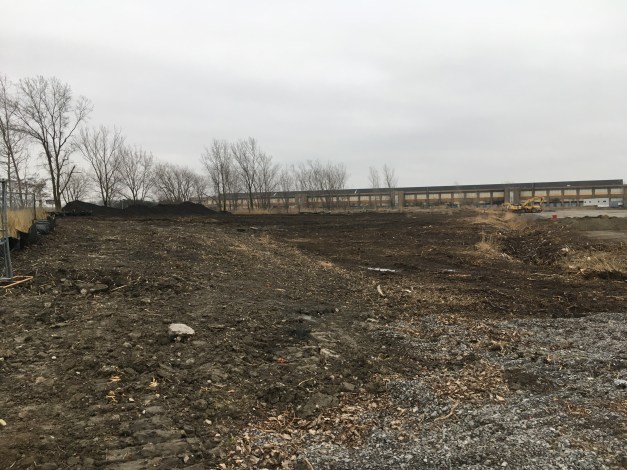
Because Petitioners’ lawyers have not, in my opinion, done “all they could do to timely safeguard their interests,” an injunction or “stay” at this point to prevent further destruction of our recovering Lake Erie coast is highly unlikely, and would have to be secured by a bond or other sizeable undertaking. [Note:  If the appeal proceeded and was unsuccessful, Petitioners would be held liable for damages to ECHDC resulting from the delays.]  Also, it appears, such injunctive relief at this stage – given the removal of over 100 trees and other vegetation, and the bulldozing and scraping off of soil on 5+ acres of the amphitheater’s “great lawn” – would be, at best, too little, too late.

IMG_9908

IMG_9907

IMG_9904

IMG_9900

I’m not happy to have to write this blog post.  And, I won’t claim to have any great ideas on what steps need to be taken.  But I urge Buffalo Outer Harbor Concerned Citizens to find a new focus for 2022.

With All Due Respect,

Art Giacalone

Autumn hangs on despite winter’s intrusion

Posted by Arthur J. Giacalone on November 14, 2021
Posted in: Cazenovia Park, Olmsted Parks, South Buffalo, WNY Photos. 1 Comment

[Note: Photos from November 15, 2021 have been added to the original posting.]

Buffalo received its first measurable snow fall yesterday, November 13, a few weeks later than the typical year.  The heavy layer of white on leaf-clad branches was a burden some limbs were unable to bear.

IMG_9633

Nonetheless, autumnal hues could still be seen and admired in South Buffalo’s Cazenovia Park this morning, November 14.

IMG_9641

IMG_9645

IMG_9637

IMG_9639

IMG_9646

The following Caz Park photos were taken November 15th.

IMG_9662

IMG_9680

IMG_9675

IMG_9677

IMG_9689

IMG_9685

IMG_9684

IMG_9682

And, this golden-hued beauty greeted me on Indian Church Road as I headed home for Sunday morning breakfast.

IMG_9647

With All Due Respect,

Art Giacalone

The “Face of Democracy” Isn’t Always Pretty

Posted by Arthur J. Giacalone on November 11, 2021
Posted in: Uncategorized. Leave a comment

[Update:  The Buffalo News published this piece on November 15, 2021 in its “My View” column at: https://buffalonews.com/opinion/my-view-face-of-democracy-isn-t-always-pretty/article_8fb313f6-459d-11ec-97c4-e30c30eb3ceb.html. A print version was included in the following day’s newspaper.]

This election day was unlike any in my past.

On November 2, I worked as an “Election Inspector.”  Preparation included a three-hour training session, and absorbing the contents of the Board of Elections’ 50-page instructions manual.  One point was stressed:  On election day, poll workers are “The Face of Democracy.”

Little did I know that awakening at 4 A.M., and arriving at my assigned polling location by 5:30, would be the easiest task.

Our polling place hosted eight polling districts, each with its own two-digit number.  The room was a bit too small for its intended purpose, and the eight districts were only provided six tables.  Given the physical limitations, cooperation amongst the districts and workers would be essential if the anticipated stream of heavy voting was to flow smoothly. That’s not exactly what happened.

Don’t get me wrong.  Most of the poll workers were welcoming, cooperative, and professional.  But it was immediately apparent that a few of the “Faces of Democracy” were not in a mood to make decisions in a democratic fashion.  Nor were they willing to follow the directions in the BOE manual to “treat your fellow inspectors with respect at all times.”

Here’s one example.  Common sense would dictate that the districts and tables be set up in numerical order, from lowest to highest, to assist the voters in locating their districts. When the doors were unlocked, however, an election inspector from the lowest-numbered district grabbed a table a distance from the entrance door, and adamantly refused to relocate to the front table.  That stubbornness resulted in randomly-located sign-in tables, and numerous puzzled expressions on the faces of the voters as they searched for their polling district.

Perhaps this situation could have been avoided if the BOE had assigned one person the role of making logistical decisions, and resolving disagreements amongst the eight districts.  Without a specific person in charge, eight self-appointed “chairpersons” were left to their own devices.

Thankfully, most – but not all – decisions were made cooperatively. At mid-day, one poll worker suddenly decided to re-position the tables that were being used by voters to privately mark their ballots.  That move led to a visible and public argument between two district “chairs.”  Certainly not an attractive face to show the voters.

Similar tensions and inconveniences occurred occasionally among the four individuals assigned to a specific district.

The BOE manual directs each district chairperson to delegate, and then periodically rotate, the primary responsibilities amongst the four-person team:  operating the poll book, issuing ballots, supervising the privacy area and scanner, and greeting the voters at the door.  This sensible approach was disrupted when an election inspector sat down at the assigned table – with novel, thermos, and other personal items in hand – and announced an unwillingness to change seats during the course of the day.  The chairperson, not wishing to create a scene, was forced to move the election documents – not poll workers – each time tasks were rotated.  The tension was palpable.

I have no doubt that I did or said something to annoy my fellow poll workers during the challenging 16-hour day.  But I consciously tried to work as a member of a team.  While there is a good chance I won’t return as a poll worker next year, I’m glad to have learned what democracy looks like.  It resembles each of us, foibles and all, and relies on cooperation and compromise to function effectively.

With All Due Respect,

Art Giacalone

Byron Brown’s “Buffalo renaissance” is a mirage

Posted by Arthur J. Giacalone on October 20, 2021
Posted in: Byron Brown, City of Buffalo, Corporate Welfare, Development, India Walton. Leave a comment

[The following letter was published in the Buffalo News, on-line on 10/25/2021, and in hard copy the following day, under the heading, “Brown’s renaissance claim is simply another sham.”]

Dear Editor,

You know that Mayor Byron Brown’s claims of  a “Buffalo renaissance” is political hype, and not a reality for most of this city’s residents, when:

– Major developers insist that they cannot make projects financially viable in Buffalo without the larger real property tax breaks made possible through programs such as the controversial “485-a” incentives.

– Neither Mayor Brown, nor Buffalo’s Common Council, has had the courage to do what other New York State cities have done, mandate that a specified percentage of every residential project be set aside for affordable housing to assist the 40% of city residents who live below the poverty level.

– Mayor Brown’s Administration was willing to label the Gates Circle area “blighted” in order to provide tens of millions of dollars of additional tax relief to bail out a distressed private developer, a misguided effort that a State Supreme Justice has twice declared “contrary to law, arbitrary and capricious.”

– Most revealing, Buffalo has the second highest percentage of children living in poverty of all of our nation’s larger cities.

After sixteen years of Byron Brown’s approach to running our city, it certainly is time for a change.

With All Due Respect,

Art Giacalone

Sunday Stroll Interrupted (often)

Posted by Arthur J. Giacalone on October 17, 2021
Posted in: Cazenovia Park, Olmsted Parks, South Buffalo, WNY Photos. Leave a comment

My 35 minute walk this morning took me an hour and a quarter.  My septuagenarian legs were working fine, but no matter how hard I resisted the urge, my eye kept finding something interesting, unusual, or just plain beautiful.  So I would stop, slip my smartphone out of my pocket, and snap a picture.

Here are the results (with a bit of a narrative):

My stroll began in its usual direction, heading a block away from my home to the Seneca Indian Park on Buffum Street.  This hundreds-of-years-old black walnut tree is a favorite of mine:

IMG_9233

Directly across from the ancient Indigenous burial ground, set back a distance from Buffum, is the home of a friend of mine, always a welcoming sight.  And, today her front yard was graced by five or six deer (I think one member of this four-legged clan scampered out before I could take the photo):

IMG_9235

As I headed down Buffum towards Seneca Street, I couldn’t help notice the cloud formations beyond the roof lines::

IMG_9239

IMG_9236

IMG_9241

But houses aren’t required for me to appreciate the clouds enveloping Cazenovia Park:

IMG_9246

As I headed towards the far (south) side of Caz Park, I crossed the Cazenovia Street bridge, and saw a lone fisherman in the distance:

IMG_9253

But my head was soon back in the clouds (including a seemingly angry “mass of particles of condensed vapor”):

IMG_9250

IMG_9266

Although autumn colors are taking their time arriving in my neck-of-the-woods, I noticed some hints of fall:

IMG_9256

IMG_9271

But here’s my favorite scene from today’s longer-than-expected walk:

IMG_9268

Tomorrow I’ll do my best to walk at a steady pace and, perhaps, work up a sweat.

With All Due Respect,

Art Giacalone

Truth, Reconciliation, and an “Every Child Matters” Remembrance Walk

Posted by Arthur J. Giacalone on October 1, 2021
Posted in: Native American. 2 Comments

September 30, 2021 was “National Day for Truth and Reconciliation” in Canada.  The day has been observed for several years by our northern neighbor’s Indigenous peoples.  This year, however, marked the first “official” recognition of the day by the Canadian government, a collective response to the shocking news earlier in 2021 that thousands of children forcibly removed from their families died at “residential schools” and were buried in unmarked graves. 

The disgraceful practice of removing Native American children from their families and homes and compelling them to attend boarding schools – in order to strip them of their language, culture, and sense of pride – began, not in Canada, but in the United States, and is part of the colonial legacy in both Canada and the USA.  This inhumane treatment of Indigenous children (and, thus, their families, clans, and nations) has resulted in intergenerational trauma, as explained by Paul Smith, a freelance writer and citizen of the Métis Nation, in an op-ed piece recently published in the Guelph Mercury Tribune:

Poverty, disproportionate child welfare apprehensions, over-incarceration, low graduation rates, high suicide rates, poor health status are all a legacy of residential schools and ongoing colonial policies. Current treatment of children in all these institutions is a focus for many of the Calls to Action of the Truth and Reconciliation Commission and the Calls for Justice of the National Inquiry into Missing and Murdered Women and Girls.

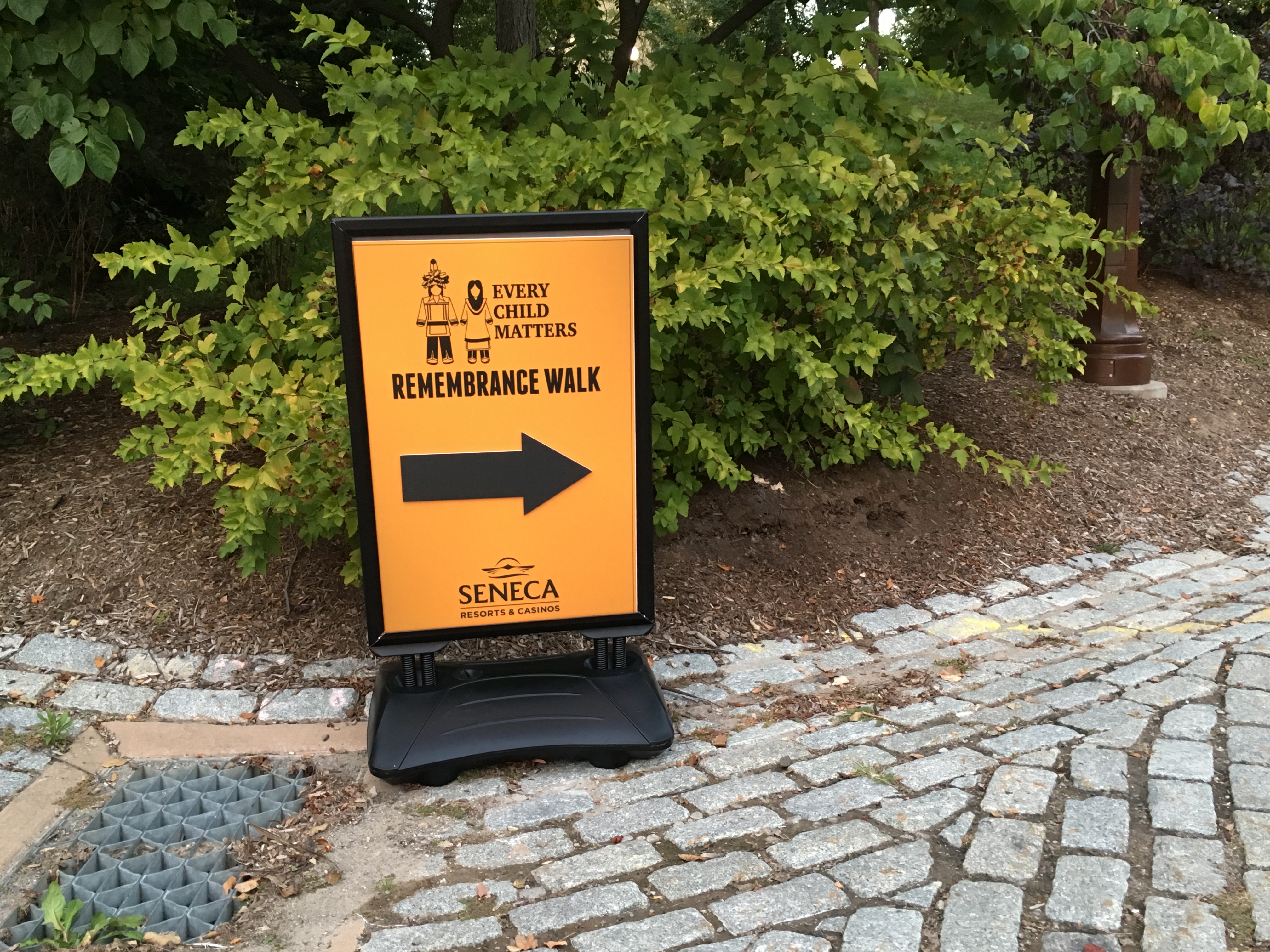
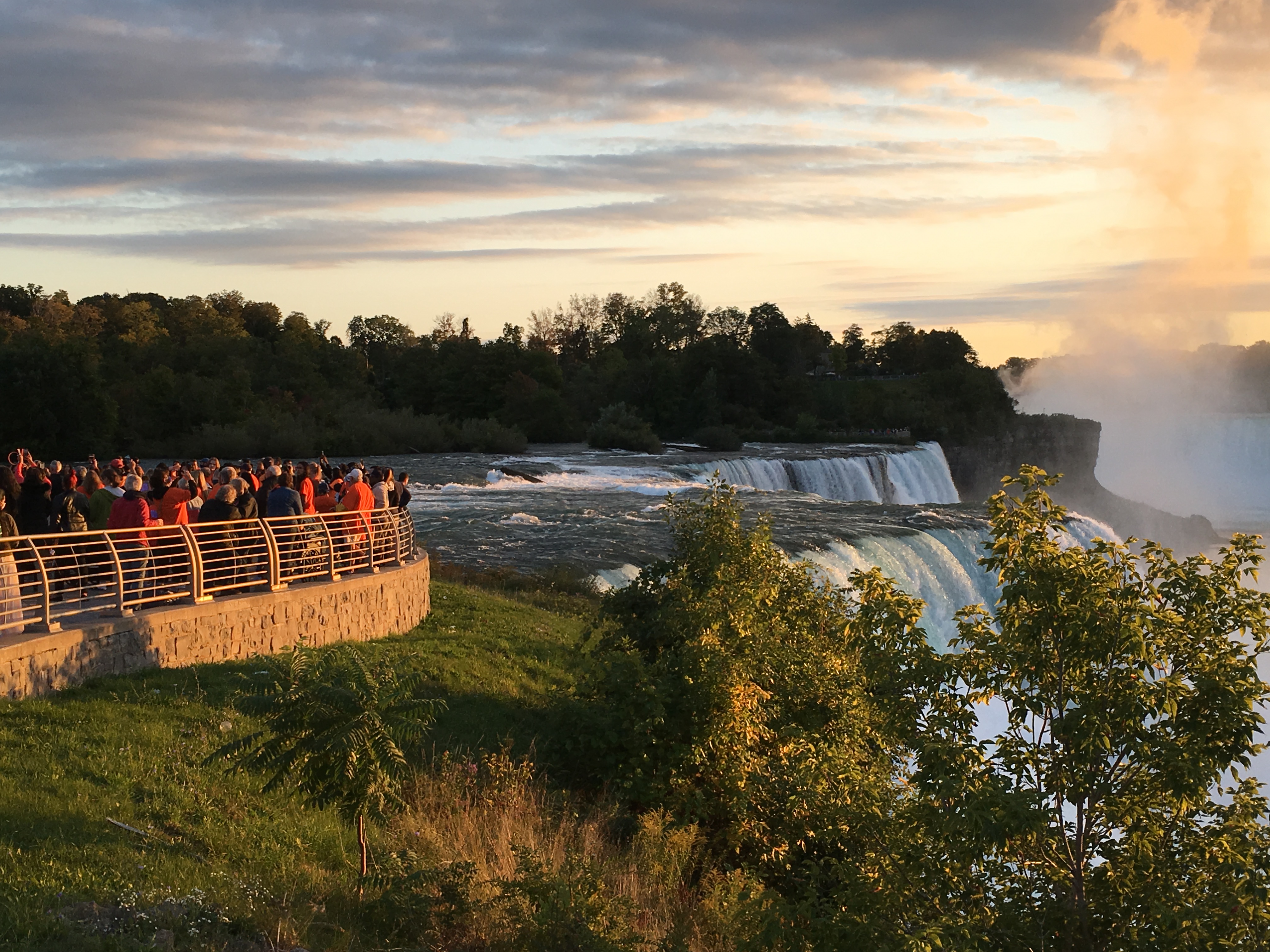
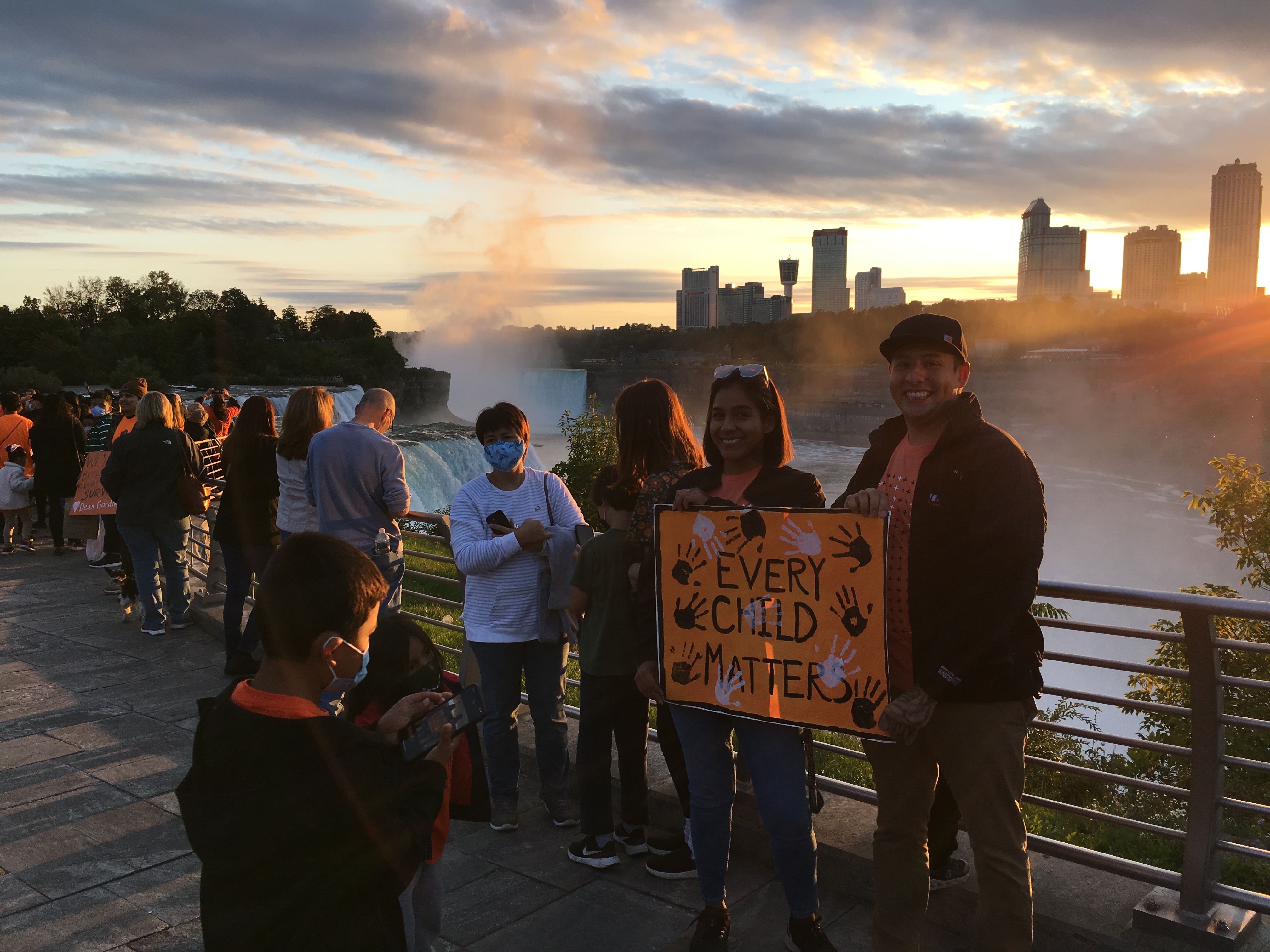
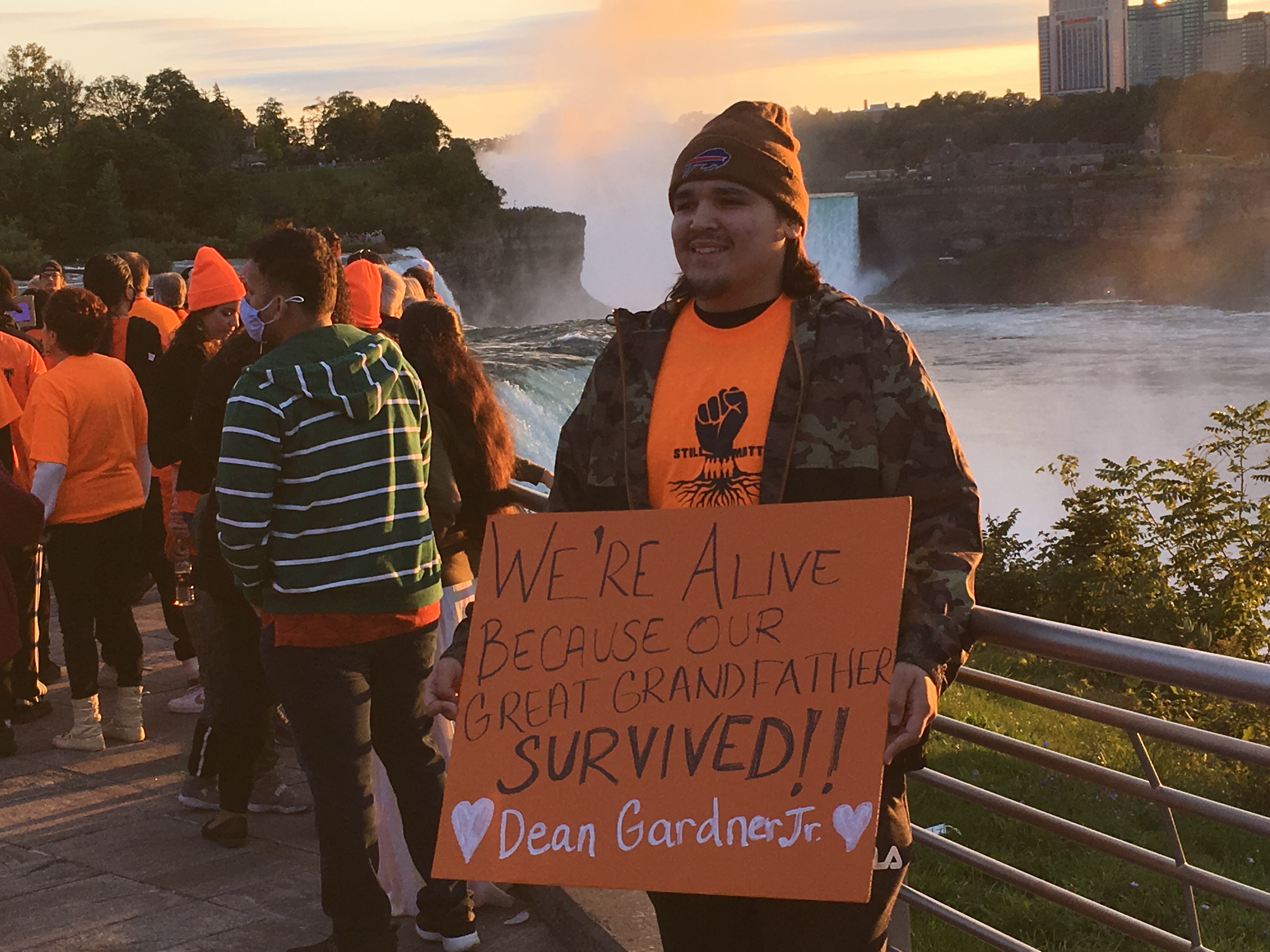
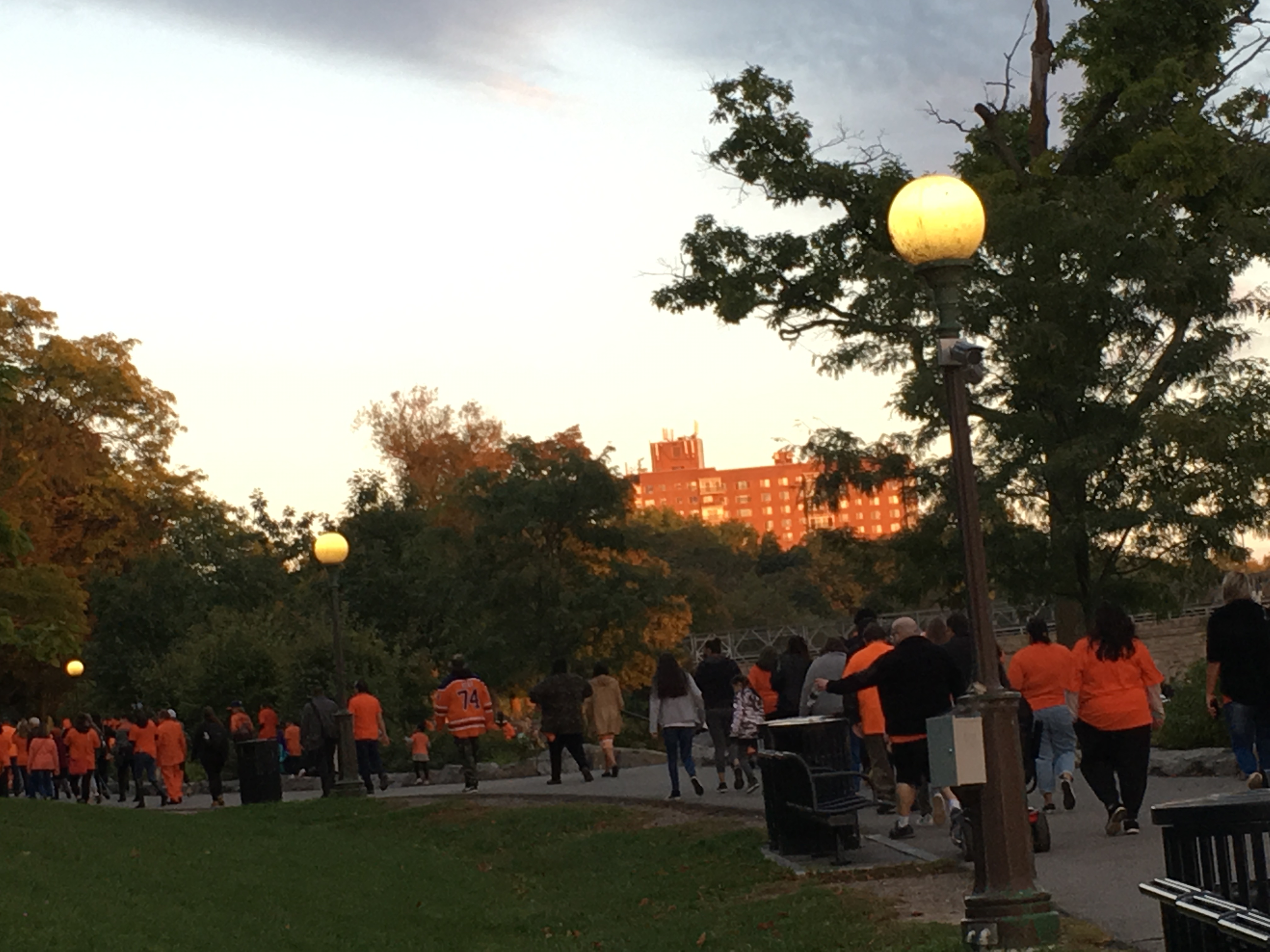
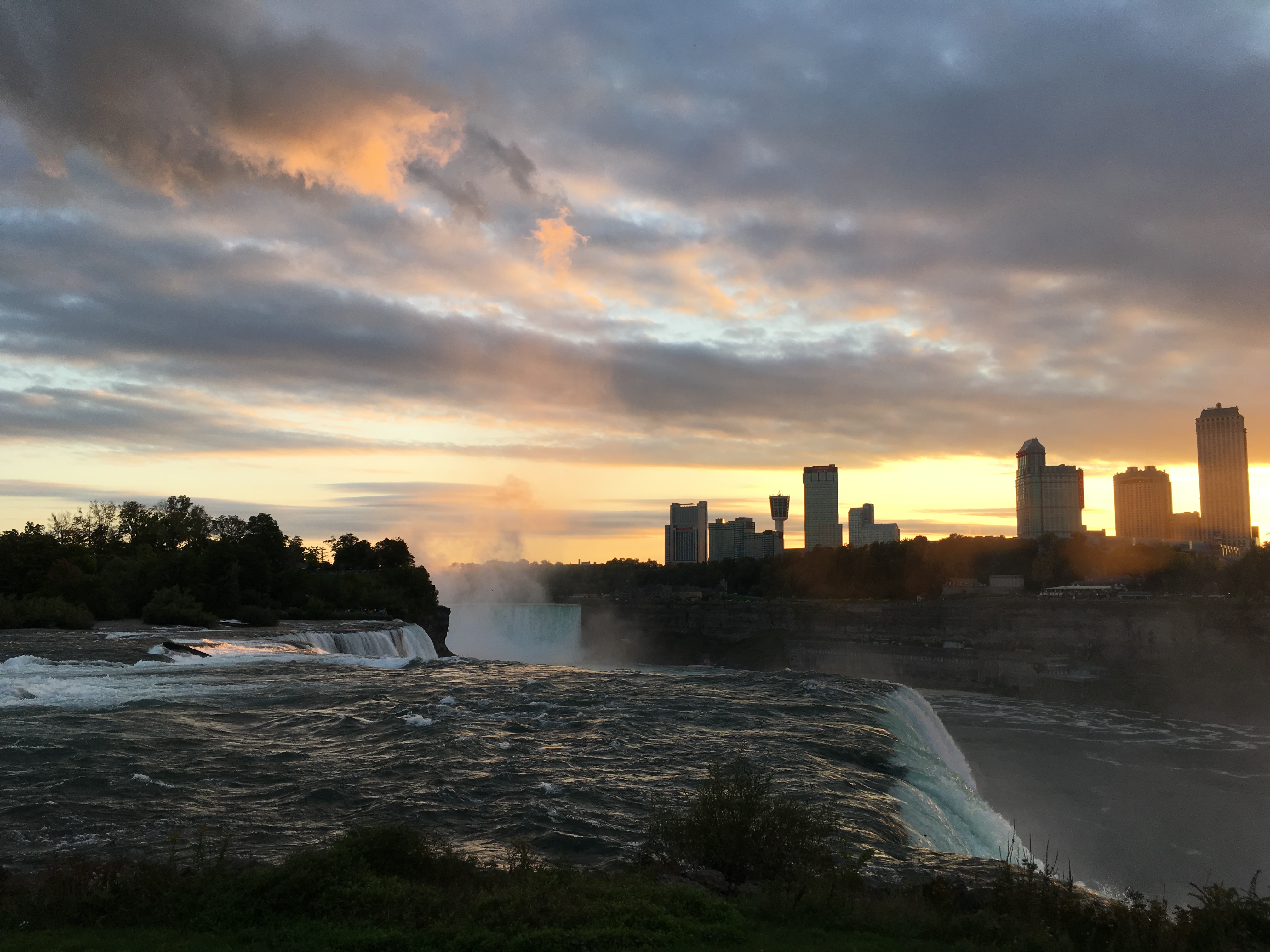
A powerful and irrefutable slogan – Every Child Matters – has become a tangible and accessible symbol of hope and solidarity within the truth and reconciliation movement.  A Remembrance Walk – sponsored by the Seneca Gaming Corporation – took place in Niagara Falls, USA yesterday evening in honor of residential school survivors and in memory of those who did not survive.  Several thousand walkers participated in the event, many of whom wore orange shirts proclaiming “Every Child Matters.”  [Today’s Buffalo News includes an article that explains the symbolism of the orange shirt under the headline, “Students honor Indigenous children victimized in schools.“] 

IMG_9148

I was among the walkers.  And, I was embarrassed by the fact that I had forgotten to wear an orange top until a youthful grandmother, proudly carrying her beautiful, four-month-old grandson so that he also could see the sea of people, assured me that the important thing was that I was there to remember.  

Here are images of the Remembrance Walk, capturing, I hope, not only the warm and embracing mood of the crowd, but the serenity that I don’t ever recall experiencing in the past when visiting Niagara Falls’ famous cataracts.

IMG_9131

IMG_9132

IMG_9133

IMG_9128

IMG_9137

IMG_9142

IMG_9153

IMG_9151 (2)

With All Due Respect,

Art Giacalone

Cities, towns and villages have limited, but important, opt-out and zone-out powers under NY’s cannabis law

Posted by Arthur J. Giacalone on September 29, 2021
Posted in: Cannabis. Leave a comment

[This posting is not intended to be legal advice, or a substitute for consultation with a lawyer, but I hope you’ll find it informative.]

The focus last spring when New York State enacted the Marijuana Regulation & Taxation Act [MRTA] was on the “adult-use” aspect of the law – that adults 21 years of age or older may legally use and possess cannabis.  Attention was also shown the social and economic equity aspects of the new cannabis law, its recognition of the devastating collateral consequences and racially disparate impact of existing cannabis laws, and MRTA’s goal of promoting racial, ethnic and gender diversity.  

But the media rarely addressed the many other questions raised by MRTA, from where cannabis-related facilities – such as retail shops and “pot farms” – will be located, to what role, if any, local communities, residents and taxpayers will have in the decision-making process. 

To understand what powers local municipalities have or don’t have under MRTA, one needs to know the types of activities requiring a license to operate under the nascent cannabis law.  [Note: I will not be writing here about medical marijuana or hemp, subjects also included in the comprehensive legislation].  The primary activities, as defined at Section 3 of MRTA, are:

– Cultivation, the growing, cloning, harvesting, drying, curing, grading, and trimming of cannabis.

– Processing, the extraction of concentrated cannabis and/or compounds, and the blending, extracting, or otherwise manufacturing concentrated cannabis or cannabis products (such as edibles or vaporization oil).

– Distribution, the selling at wholesale of cannabis and/or cannabis products (except medical cannabis).

– Retail sale, the selling at retail of adult-use cannabis and cannabis products to cannabis consumers.

– On-site consumption, the consumption of cannabis (smoking or vaping) in an area licensed under MRTA.

Local Municipalities and Adult-use Retail Dispensaries & On-Site Consumption

A.  Opt-out Potential.

Not surprisingly, municipalities have no authority to make adult-use of cannabis illegal within their boundaries.  And, of the five activities outlined above, MRTA provides a city, town, or village the power to “opt-out” of – that is, choose to prohibit from locating within their jurisdiction – only two categories of adult-use cannabis activities, “retail dispensaries” and “on-site consumption.”  [MRTA Section 131(1)]

But the authority to opt-out comes with two major caveats:  First, a municipality must pass a local law by December 31, 2021 to opt-out of allowing adult-use cannabis retail dispensaries and/or on-site consumption operations withing its boundaries.  If it doesn’t, the city, town, or village will be unable to opt-out at a later date.  Second, any local law opting out of adult-use retail dispensaries or on-site consumption licenses is subject to a permissive referendum, pursuant to Section 24 of the Municipal Home Rule Law, giving local voters the ability to petition for the right to decide whether or not to approve the local law.  [MRTA Section 131(1)-(2)]

Given the fast-approaching December 31, 2021 deadline for enactment of local laws opting out of retail dispensaries or on-site consumption sites, local officials – as well as, residents and organizations interested in educating or influencing their local representatives concerning the opt-out issue – do not have the luxury of zoning out, daydreaming, or otherwise ignoring this one-time option.  

B.  Time-Place-Manner Regulations.

Municipalities do not face an all-or-nothing decision regarding retail dispensaries and on-site consumption operations.  The MRTA allows villages, towns, and cities to adopt regulations – through its local zoning powers – addressing the time, place and manner of such activities.  Here is how that authority is described by the Office of Cannabis Management:

[T]owns, cities and villages are permitted to pass local laws and regulations governing the time, place and manner of adult-use retail dispensaries and on-site consumption licenses provided that the local law and regulations do not make the operation of the license unreasonably impracticable as determined by the Cannabis Control Board. For example, cities, towns, and villages are permitted to pass laws and regulations pertaining to local zoning and the location of licensees, hours of operations and adherence to local building codes. Municipalities may not issue local licenses to cannabis licensees.  [Emphasis added.]

[See the NYS Office of Cannabis Management’s take on what is in the cannabis law relating to local governments here.]  Note:  In contrast to the December 31, 2021 mandated deadline for opting-out of retail dispensaries and on-site consumption sites, MRTA does not set a date by which time-place-manner regulations must be adopted by local municipalities.

As indicated in the above quote, the regulations adopted by a local municipality must not be “unreasonably impracticable,” and it is the state’s Cannabis Control Board that will determine whether a municipal regulation has breached this undefined and remarkably imprecise standard. 

When deciding whether or not to adopt specific local laws or regulations regarding retail dispensaries and/or on-site consumption, municipal officials should be aware that that the cannabis law itself contains – for lack of a better term – a number of time, place, and manner restrictions, including, for example, the following:

– ” No premises shall be licensed to sell cannabis products, unless said premises shall be located in a store, the principal entrance to which shall be from the street level and located on a public thoroughfare in premises which may be occupied, operated or conducted for business, trade or industry.”  [MRTA Section 72(5)]  Note:  MRTA does not contain a similar provision regarding the location of on-site consumption facilities.

– “No cannabis retail licensee shall locate a storefront within five hundred feet of school grounds as such term is defined in the education law (of the State of New York) or within two hundred feet of a house of worship.”  [MRTA Section 72(6)]

– “No cannabis retail licensee shall sell alcoholic beverages, nor have or possess a license or permit to sell alcoholic beverages, on the same premises where cannabis products are sold.”  [MRTA Section 85(3)]  Note: “Cannabis product” means cannabis, concentrated cannabis, and cannabis-infused products for use by a cannabis consumer.”  [MRTA Section 3(9)]

– “No applicant shall be granted an adult-use on-site consumption license for any premises within five hundred feet of school grounds as such term is defined in the education law (of the State of New York) or within two hundred feet of a house of worship.”  [MRTA Section 77(4)]

– In addition to prohibiting adult-use cannabis advertising and marketing “designed in any way to appeal to children or other minors,” advertising and marketing is prohibited “within or readily observed within 500 feet of the perimeter of a school grounds, playground, child day care providers, public park, or library.”   [MRTA Section 86(2)(d) & (e)] 

There are a variety of approaches a city, village, or town might consider in order to regulate adult-use cannabis retail dispensaries and on-site consumption sites, including, for example:

(1) limiting the zoning districts in which such activities are allowed (e.g., permitting such activities “by right” only in specified commercial and/or industrial districts);

(2) prohibiting either or both activities within specified distances from residential districts, existing residences, schools, playgrounds, parks, day care facilities, houses of worship, etc.; and/or

(3) requiring all retail dispensary or on-site consumption licensees to obtain a “special use permit” from the designated municipal body, clearly identifying specific criteria that must be met regarding each activity to ensure that the activity is not detrimental to nearby properties or the zoning district in which it would be located.

In drafting and adopting local laws or regulations pertaining to adult-use activities, it is important to remember that MRTA expressly provides the Cannabis Control Board with the power to determine whether or not local enactments “make the operation of such licensed retail dispensaries and/or on-site consumption sites unreasonably impracticable.”  [MRTA Section 131(2)]  A municipality’s legislative body must find a balance between regulating time, place, and manner in a reasonable fashion, and trespassing upon the CCB’s sole authority to determine whether or not a potential licensee has met the statutory criteria for issuance of a particular license.

C.  Notification to municipalities.

MRTA contains a provision requiring a potential applicant to alert a local municipality of its intention to seek a license for a premise located within its jurisdiction.  [MRTA Section 76]  There is, however, an ambiguity in the cannabis law.  The title of the section reads, “Notification to municipalities of adult-use retail dispensary or on-site consumption license.”  However, the text (which is not well written) refers to “filing an application for licensure as an adult-use dispensary or registered organization [pertaining to medical cannabis], adult-use cultivator processor distributor retail dispensary or an on-site consumption licensee.”  [Note:  New York’s appellate courts have consistently held that it is the language of the text, not the title or subtitle, that controls how a statutory provision is to be interpreted.]  

This is what the Office of Cannabis Management currently says about the notification provision:

At least 30 days prior to applying for an adult-use retail dispensary or on-site consumption license, an applicant must notify the municipality of the applicant’s intent to apply for such license. The notification must be made to the clerk of the village, town, or city, or if in the city of New York, the community board in which the proposed premise is located. When the municipality expresses an opinion for or against the granting of the license, the opinion shall be deemed part of the record and used by the OCM to determine whether to grant or deny the application. The Cannabis Control Board must then respond in writing to the city, town, village, or community board, with an explanation of how such opinion was considered in the granting or denial of an application.

Given the pervasiveness of MRTA’s preemption of local authority (discussed next), and the potential adverse impacts large adult-use cannabis cultivation and processing facilities may have on the environment, on utilization of energy, and on social and economic equity goals, it is critical that Section 76’s notification provision be liberally construed to include all adult-use cannabis activities.  [See the discussion in my April 6, 2021 post regarding a 1.3 million square-foot cannabis cultivation and processing facility proposed for location at the southern end of Buffalo’s Outer Harbor.]

Local Municipalities and Cultivator, Processing, & Distributor Licenses

MRTA prohibits cities, towns, and villages from opting out of adult-use cannabis licenses for cultivation, processing, and distribution.  Other than the limited exceptions relating to retail dispensaries and on-site consumption sites, all municipalities – including counties – are preempted by New York’s cannabis law from adopting any rule, ordinance, regulation, or prohibition pertaining to the operation or licensing of adult-use cannabis.  [MRTA Section 131] 

Whether or not the Office of Cannabis Management and/or the Cannabis Control Board expressly acknowledge that MRTA’s “Notification to municipalities” requirement applies to cultivation, processing, and distribution licenses, it would make sense for concerned municipalities to express their concerns in writing to the OCM and CCB.  Such submissions should emphasize the ways in which the proposed license would fail to promote public convenience and advantage, public health and safety, and the public interest of the community, or would conflict with or adversely impact the various criteria and interests embodied in MRTA.  The following is a partial list of MRTA’s selection criteria and statutory interests:

– preventing access to cannabis by those under the age of twenty-one years [MRTA Section 13(3)(a)];

– the promotion of social and economic equity, by prioritizing consideration of applications by applicants who are from communities disproportionately impacted by the enforcement of cannabis prohibition or who qualify as a minority or women-owned businesses, distressed farmers, or service-disabled veterans.  [MRTA Sections 87(1), 10(2)];

– the avoidance of market dominance [MRTA Section 10(2)];

– furthering the public interest by limiting the number, classes, and character of licenses in proximity to each other, and within a particular municipality or geographic area [MRTA Section 64(1)(g)(ii)];

– the effect of granting a license on pedestrian and vehicular traffic and parking in proximity to the location [MRTA Section 64(1)(g)(iv)];

– the effect of granting a license on existing noise levels at the location [MRTA Section 64(1)(g)(v)];

– the goals of increasing climate resiliency, and minimizing or eliminating adverse environmental impacts, including water usage, energy usage, carbon emissions, waste, pollutants, harmful chemicals, and single-use plastics [MRTA Section 64(1)(g)(vi)];

– for adult-use cultivator or processing licenses, the environmental and energy impact of granting a license, including compliance with energy standards [MRTA Section 64(1)(k);

– for adult-use on-site consumption licenses, the absence of a demonstrated need for spaces to consume cannabis.  [MRTA Section 77(5)(d)]

Limitations on adult use of cannabis

Although a bit off-topic, this posting will end with a brief summary of how smoking and vaping of adult-use cannabis is still restricted in New York State.

MRTA amends other New York State laws to make it lawful to smoke or vape cannabis in private homes, private residences, private automobiles, and in a hotel or motel room rented to one or more guests.  [See amended Public Health Law, Section 1399-q.]  Nonetheless, officials – and New York State’s residents – should be aware of the ways in which the enactment of NY’s cannabis law does not make the smoking or vaping of cannabis automatically lawful everywhere within the Empire State: 

(1) As expressed at Section 2 of MRTA (“Legislative findings and intent”), “Nothing in this act is intended to limit the authority of any district, government agency or office or employer to enact and enforce policies pertaining to cannabis in the workplace; to allow driving under the influence of cannabis; to allow individuals to engage in conduct that endangers others; to allow smoking cannabis in any location where smoking tobacco is prohibited; or to engage in any conduct that violates federal law or to exempt anyone from any requirement of federal law or pose any obstacle to the federal enforcement of federal law.”  [MRTA Section 2]

(2) The MRTA legislation amends New York’s Indoor Clean Air Act [Public Health Law, Article 13-E] to add cannabis, and, by doing so, prohibits the smoking or vaping of adult-use cannabis anywhere smoking and vaping of tobacco is prohibited.   That includes, for example, all schools and school grounds, colleges and universities, places of employment, bars, restaurants (with narrow exceptions), public transportation, hospitals, public and private offices, all indoor arenas, and zoos.  [For additional information, see Guide to the NYS Clean Indoor Air Act ]

With All Due Respect,

Art Giacalone
BuffNews Editorials Helped Enable Cuomo and Albany’s Corrupt Environment

Posted by Arthur J. Giacalone on August 17, 2021
Posted in: Andrew Cuomo, Buffalo News, Political Corruption, Zephyr Teachout. Leave a comment

Within days of Gov. Andrew Cuomo’s announcement that he would resign his post as New York State’s chief executive, the Buffalo News ran an editorial describing the atmosphere in our state’s capital as “an environment long drenched in corruption and entitlement.”  As I read the opinion piece, I was struck by its hypocrisy, and crafted a letter-to-the-editor in response. 

Not surprisingly, my 300-word submission has not seen the light of day, and will almost certainly not be published in the newspaper’s “Everybody’s Column.”  I’d like to share my thoughts with the readers of this blog.  Here’s my L-T-E.  to which I’ve added links to the editorials referenced in it, and an image or two:

August 12, 2021

Dear Editor,

This newspaper’s August 11, 2021 editorial – with its August 12th print-version headline, “Fixing Albany” – states that a change in Albany’s culture will come “by virtue of the ethics and good sense of its elected leaders.”  Ironically, the positions expressed by the editorial board and staff of the Buffalo News during Gov. Andrew Cuomo’s tenure in office have contributed to our state’s environment of corruption.

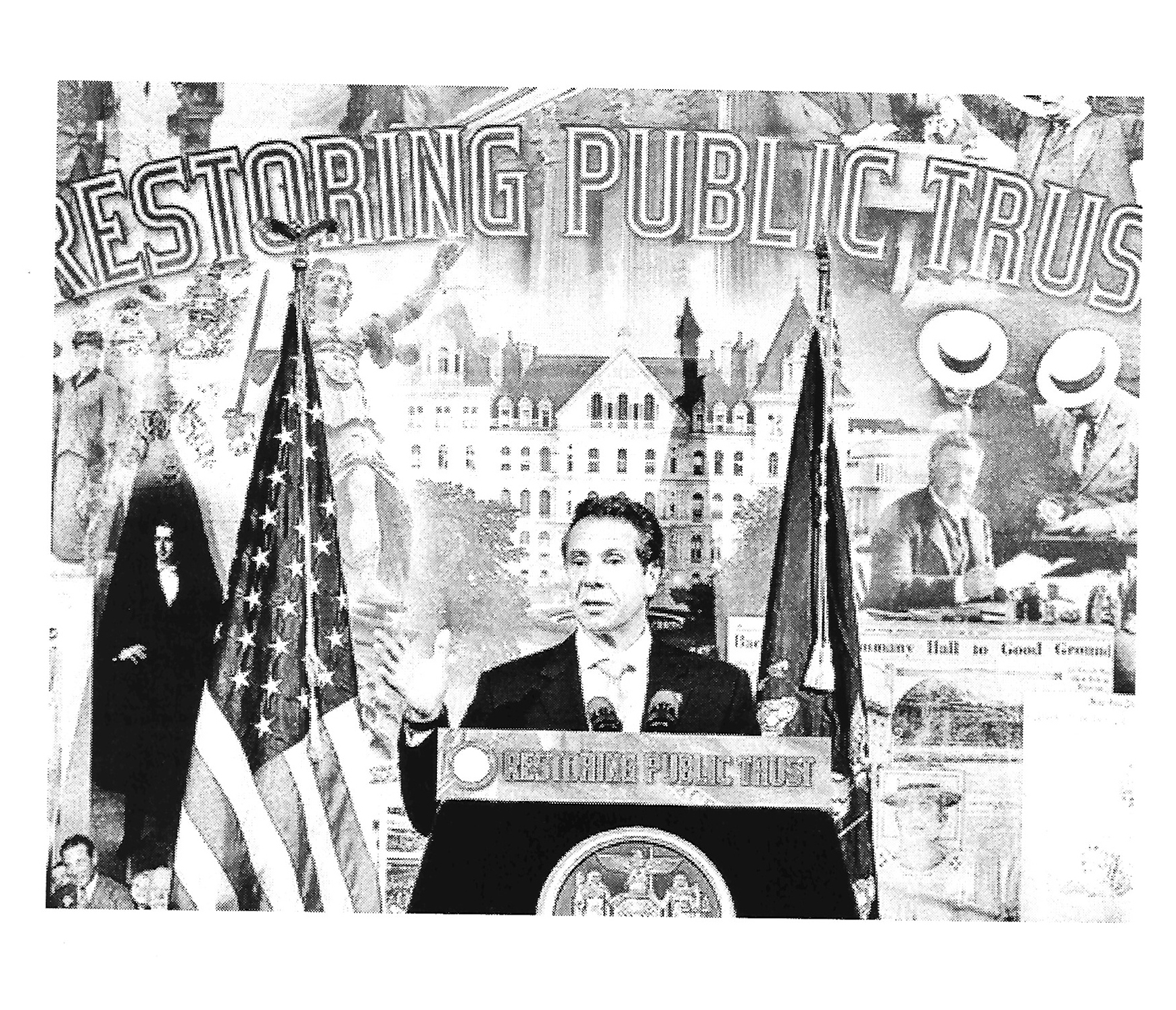
[Gov. Cuomo’s ironic slogan, “Restoring Public Trust”]

In July 2014, an editorial characterized the Governor’s efforts to hinder the activities of the Moreland Commission – an entity he established to investigate corruption in Albany – as “not just disappointing,” but “shameful.”   A mere three months later, the editorial staff endorsed Cuomo’s re-election, calling him “surely the best friend Western New York has ever had in the governor’s office.”  While sheepishly admitting, “we wish he had handled the Moreland Commission issue better,” such transgressions were forgiven given the Governor’s “remarkable focus” on rebuilding WNY’s economy through the Buffalo Billion.

Both the 2014 and 2021 editorials recognize that merely “swimming” in Albany’s “polluted waters” encourages unethical and self-serving behavior.  Nonetheless, in August 2014 the editorial page set aside its customary practice of not making endorsements in primary elections to urge voters to choose Cuomo over Fordham law professor Zephyr Teachout.  While Teachout – one of our nation’s leading experts on corruption – was described as thoughtful, energetic, and interesting, she was dismissed by the editorial staff as “a political novice.”   

[Zephyr Teachout at 2014 fundraiser in East Aurora]

In July 2018, the editorial board attempted to distance the Governor from the “Buffalo Billion scandal” following the conviction of two Cuomo allies, Louis Ciminelli and Alain Kaloyeros.  Acknowledging that the convictions “will become fair game” for gubernatorial candidates later that year, the opinion piece proclaimed:  “But it’s important to draw a distinction between valuable economic development and the corruption that may come to play.

I strongly disagree.  Economic ends never justify a politician’s unethical means.

Sincerely,

Arthur J. Giacalone

Thanks for reading my piece.

With All Due Respect,

Art Giacalone

“Stupid” selection process continues as party leaders deny WNY voters choice in selecting Supreme Court judges

Posted by Arthur J. Giacalone on August 13, 2021
Posted in: Judiciary, Stupidity. Leave a comment

Under the headline, “Bipartisan deals again guarantee win for Supreme Court candidates,” Buffalo News political reporter, Bob McCarthy, reports in this morning’s newspaper how the voters in Western New York will once again have no choice in determining the selection of State Supreme Court justices.  Leaders of the Republican, Democratic and Conservative parties have “cross-endorsed” four candidates for four openings.  As McCarthy reports, “[T]he bipartisan backing allows all four to run unopposed and guarantees their election in November.” 

The U.S. Supreme Court concluded thirteen years ago that New York’s process for determining the options available to its electorate when voting on State Supreme Court jurists does not violate the First Amendment.  Perhaps the best known expression of disdain for New York’s judicial selection process came from the pen of Associate Justice Stephen Breyer.  While concurring with Justice Scalia’s 2008 opinion in NYS Bd. of Elections v. Lopez Torres – that the Empire State’s system is not violative of the First Amendment – Justice Stevens, joined by Justice Souter, made the following observation:

     “While I join Justice SCALIA’s cogent resolution of the constitutional issues raised by this case, I think it appropriate to emphasize the distinction between constitutionality and wise policy. Our holding with respect to the former should not be misread as endorsement of the electoral system under review, or disagreement with the findings of the District Court that describe glaring deficiencies in that system and even lend support to the broader proposition that the very practice of electing judges is unwise. But as I recall my esteemed former colleague, Thurgood Marshall, remarking on numerous occasions: ‘The Constitution does not prohibit legislatures from enacting stupid laws.’”

Stupid and unwise seems accurate to me.  But my criticism of the selection process for these important judicial positions is not aimed at the four anointed candidates, so I will not name them here.  I will, however, point out that each has been guaranteed a fourteen-year post with a $210,900 annual salary.

Rather than reinvent the wheel in setting forth my critique of New York State’s flawed system of selecting Supreme Court justices (who are the trial court judges, despite their lofty title), I will direct you to my May 5, 2016 posting on this topic and beyond: “NY’s System of Selecting Judges Isn’t the Only Obstacle to Assuring an Ethical Judiciary.”  That piece includes the following reflection on

With All Due Respect,

Art Giacalone

Andrew Cuomo’s Resignation – Restoring Public Trust and His Daughters’ Faith

Posted by Arthur J. Giacalone on August 10, 2021
Posted in: Andrew Cuomo. Leave a comment

Two themes have often recurred in Gov. Andrew M. Cuomo’s discourse:  public trust and the importance of family.

Both subjects played an important role in his New Year’s Day inaugural address in 2015.  The speech was entitled “The Family of New York,” and the Governor emphasized the phrase, “trust is government’s lifeblood.”  That latter term – expressing such a lofty and self-evident concept – seemed both ironic and hypocritical to me coming from the lips of a political figure who had done so many things to weaken the public’s (or, at least, my) confidence in its government.  [I’ll insert below links to a number of my writings expressing dissatisfaction with Andrew Cuomo’s approach to governance.]

The concept of restoring the public’s trust in its political leaders was so significant to the son of the late-Gov. Mario Cuomo that Andrew adopted it as a motto for his 2014 re-election campaign.

Restoring Trust - gray photo0001

The word “family” has been used both literally and figuratively by Gov. Cuomo.  Yes, he has spoken broadly and grandly of the family of New York, of its strength and resilience.  But, not even an Andrew Cuomo skeptic such as myself could doubt the love, admiration, and concern for his three daughters – twins Mariah and Cara, and the youngest, Michaela – expressed during his daily Covid-19 briefings in the spring of 2020 (his moment of national acclaim), and repeated during his resignation announcement around noon today.

Gov. Cuomo Announces Resignation 08-10-2021

I realize that many – if not most – New Yorkers and pundits were surprised that the man known for his defiant and arrogant personality reached the decision to resign his post as governor (effective in fourteen days).  But, frankly, I wasn’t. 

Last evening, I re-read many of the articles and posts I had penned concerning the abrasive and deceptive governor.  That exercise left two thoughts in my mind:  the Governor’s oft-expressed desire to restore public trust, and his love for his daughters (who are about the same age as my children).  I realized that resignation – sooner, rather than later – would be the only way that Andrew Cuomo, the politician, could start the process of restoring the confidence of New Yorkers in the process of governing, and the most fruitful way that Andrew Cuomo, the father of three young women, could begin the healing of any damage that may have been done to his daughters’ faith in their father by the allegations of sexual harassment and Attorney General Letitia James’ investigation report. 

With All Due Respect,

Art Giacalone

P.S.  Here are links to some of my writings regarding the soon-to-be former Governor:

https://withallduerespectblog.com/2019/02/22/buffnews-editors-give-cuomo-a-free-pass-on-amazon-hq2-riverbend/

BuffNews editors give Cuomo a free pass on Amazon HQ2 & RiverBend

https://withallduerespectblog.com/2018/07/14/buffalo-billion-verdict-spell-checking-hand-wringing-bid-rigging-and-beyond/

Buffalo Billion Verdict: Spell-checking, Hand-wringing, Bid-rigging and beyond

https://withallduerespectblog.com/2017/04/27/environmental-protection-steamrolling-vs-streamlining/

Environmental protection: Steamrolling vs. Streamlining

https://withallduerespectblog.com/2016/06/01/guess-what-gerry-buchheit-has-in-common-with-jeremy-jacobs-sr-and-the-pegulas/

Guess what Gerry Buchheit has in common with Jeremy Jacobs Sr. and the Pegulas?

https://withallduerespectblog.com/2015/10/13/really-sam-hoyt-and-george-maziarz-together-on-an-obscure-hydropower-panel/

Really, Sam Hoyt and George Maziarz together on an “Obscure Hydropower Panel”?

https://withallduerespectblog.com/2015/04/21/adam-zyglis-pulitzer-prize-winner-pulls-no-punches/

Adam Zyglis – Pulitzer Prize Winner Pulls No Punches regarding Andrew Cuomo

https://withallduerespectblog.com/2015/03/19/1044/

Buffalo’s “Economic Rebirth” Provides a Dubious Lesson for Upstate New York

https://withallduerespectblog.com/2015/02/19/cuomo-attempts-to-reduce-three-men-in-a-room-to-one-with-his-linkage-budget/

Cuomo Attempts to Reduce “Three Men In A Room” to One with his “Linkage” Budget

https://withallduerespectblog.com/2015/01/08/information-delayed-is-information-and-justice-denied/

 The Cuomo Administration’s refusal to provide access to Peace Bridge expansion documents enhances public’s distrust of government

https://withallduerespectblog.com/2014/08/29/sam-hoyts-apology-for-his-brainwash-comment-raises-questions-for-his-boss-gov-andrew-cuomo/

Sam Hoyt’s Apology for his “Brainwash” Comment raises Questions for his Boss – Gov. Andrew Cuomo

https://withallduerespectblog.com/2014/08/21/cuomos-approach-to-peace-bridge-expansion-reveals-pattern-of-deception-abuse-of-power/

Cuomo’s Approach to “Peace Bridge Expansion” Reveals Pattern of Deception, Abuse of Power

https://withallduerespectblog.com/wp-content/uploads/2014/01/pb-cuomo-et-al-bullying-june-2013.pdf

“King Andrew” Sixty Years Too Late to Control New York/Canadian Border

https://withallduerespectblog.com/wp-content/uploads/2014/01/pb-right-to-clean-air-not-signature-bridge-july-2011.pdf

Residents Have ’Right’ to Clean Air and Good Schools, Not a ‘Signature’ Bridge

Posts navigation

← Older Entries
Newer Entries →
  • CATEGORIES

  • February 2026
    M T W T F S S
     1
    2345678
    9101112131415
    16171819202122
    232425262728  
    « Nov    
  • DISCLAIMER

    This blog is provided for general informational purposes only. It should not be construed as legal advice and is not intended to be a substitute for legal counsel. Persons requiring legal advice should retain a properly licensed lawyer. No attorney-client relationship will be formed based on use of this site and any comments or posts to this blog will not be privileged or confidential. *************** This blog's author, Arthur J. Giacalone, does not intend or consider the communications at this blog to be ATTORNEY ADVERTISING. The primary purpose of the communication is not for the retention of Mr. Giacalone's legal services. [See definition of "Advertisement" at Part 1200, Rules of Professional Conduct, Rule 1.0(a).] Nonetheless, in case the proper authorities choose to treat this web site as ATTORNEY ADVERTISING, the street address, phone number and email address of the law office of Arthur J. Giacalone are: 17 Oschawa Avenue, Buffalo, New York 14210; (716) 436-2646; AJGiacalone@twc.com.
Blog at WordPress.com.
With All Due Respect
Blog at WordPress.com.
  • Subscribe Subscribed
    • With All Due Respect
    • Join 62 other subscribers
    • Already have a WordPress.com account? Log in now.
    • With All Due Respect
    • Subscribe Subscribed
    • Sign up
    • Log in
    • Report this content
    • View site in Reader
    • Manage subscriptions
    • Collapse this bar
 

Loading Comments...