With All Due Respect

Photos and musings by Arthur J. Giacalone

  • About The Author
  • About This Blog
  • Pre-WADR Archives

Buffalo News’ flawed and biased journalism – who is watching the “watchdog”?

Posted by Arthur J. Giacalone on July 26, 2021
Posted in: Buffalo News, Byron Brown, City of Buffalo, India Walton. Leave a comment

The Buffalo News displayed its flawed and biased journalism – and willingness to engage in junkyard-dog politics – with its July 19 through 21 articles aimed at undermining India Walton’s mayoral campaign.

Under the ironic caption, “Buffalo News Watchdog,” the newspaper splashed across the top of its June 20, 2021 front page the following headline:

Drug complaint probed at Walton’s apartment in ’18 – Man who stayed at house did time for selling coke

Not only does the ambiguous subheading imply a non-existent link between the 2018 “drug complaint” at the mayoral candidate’s former apartment and the cocaine conviction, it is not until the third paragraph of the article that readers are told that the police found no evidence of drugs being sold at Walton’s house, and that neither India Walton, nor the “man who stayed at [her] house,” were charged with any crime.  [The on-line version of the article, was published July 19, 2021 under the tamer headline, “Mayoral candidate Walton left rental in ’18 after landlord accused friend of dealing drugs from house.“]

This sensationalized “story” was based on the allegations of a landlord “who did not want his name used,” who admits that he never saw drugs or drug activities at the house, and who based his concerns on the word of an unnamed “lady next door.”  Most significantly, as noted above, the police reports obtained by the Buffalo News “do not indicate that police had proof of drugs being sold in Walton’s home.”

In a nutshell, proof of any wrongdoing by India Walton is totally absent.  And, the public has no way of knowing what if any connections may exist between the anonymous landlord and Byron Brown.  In such a situation, an unbiased and responsible news organization would not have published the original article.

But, irresponsible accusations and innuendo have a life of their own.  Equivocation by Erie Democratic Party Chairman Jeremy J. Zellner, regarding the Democratic party’s continued support of Ms. Walton’s campaign, provided the Buffalo News the opportunity to print a second story on July 21, 2021.  This time the headline adorned the top of its local section:  “Dems mull questions over Walton friend – Zellner to weigh input on party’s ‘concerns’.”  The article that followed began in an intentionally eye-catching fashion:  “An allegation of drug activity at a house rented by Democratic mayoral nominee India B. Walton three years ago cast new perspective on her campaign…”

Zellner, as Democratic Party chairman, should have expressed outrage at the Buffalo News for its irresponsible front page accusations against the winner of the Democratic primary for the Mayor of Buffalo.  City of Buffalo residents deserve stronger and more forceful leadership than what the chairman exhibited this past week.

The biggest problem we have in Western New York, however – if we wish to see a fair and honest mayoral campaign – is the reality that our region’s self-appointed “watchdog” needs a watchdog of its own.

With All Due Respect,

Art Giacalone

India Walton’s values will open City Hall to its residents

Posted by Arthur J. Giacalone on July 12, 2021
Posted in: B-N Medical Campus, Buffalo News, Byron Brown, City of Buffalo, Fruit Belt, Gentrification, Green Code, Nadine Marrero, TM Montante Development. Leave a comment

[The Buffalo News published this article in its “Another Voice” column on-line on July 12, 2021, and in the July 13, 2021 print version of the newspaper.  The two versions are not identical, with each eliminating portions of my original submission.  I will provide the full version of my piece below, using burnt orange text for the portion missing from the on-line version in the BN, and green for the sentences eliminated in the print version.  I will also add a few supporting links below.]

https://buffalonews.com/opinion/another-voice-india-walton-s-values-will-open-city-hall-to-its-residents/article_5c215b70-e31d-11eb-a037-d71562707eb9.html

Another Voice: India Walton’s values will open City Hall to its residents  

  • Arthur J. Giacalone

Mayor Byron Brown recently told the Buffalo News editorial board of his desire “to make Buffalo one of the best post-pandemic places to live, work, raise a family and invest.” His write-in campaign speaks of “the incredible momentum and progress his administration has achieved.”

The numbers don’t support such a rosy assessment of the four-term mayor’s accomplishments.

For most Americans, homeownership is the primary form of investment. Nationwide, nearly 64% of residents own their homes. The percentage of homeowners in Buffalo has decreased steadily from an already-low 45% in 2010, to 40.7% in 2019. In other words, nearly three of five residents in the city where Brown has been mayor since 2006 are renters.  

In 2019, 30.1% of Buffalonians were living in what the federal government defines as poverty, a rate nearly three times that of our nation as a whole. White, non-Hispanics constitute more than a quarter of Buffalo’s poor.

Most troubling, Buffalo has the second highest percentage of childhood poverty of all major American cities, 43.4%. Only Cleveland’s rate is higher. In 2005, the year prior to Brown becoming the city’s chief executive, the child poverty rate was “only” 37.5%. In 2016, six cities had a higher percentage of their youth living in poverty than Buffalo. Five of those six mayors found ways to improve their standing.

These disturbing trends have occurred during Brown’s tenure despite – or, perhaps, as a result of – his administration’s stridently pro-developer perspective.

India Walton’s platform is centered on people, and a belief that housing, health care, healthy food and a quality education are basic human rights. Her energies will not be spent concocting ways to provide tens of millions of dollars of tax abatements to politically connected developers, as the Brown administration did when it attempted to bail out a distressed private developer by declaring the Gates Circle area “blighted.”

Economic development under Walton will focus on neighborhood-driven projects. She will not ignore the harmful aspects of gentrification that have burdened the residential streets adjoining the Buffalo Niagara Medical Campus. Her administration will not encourage project sponsors to circumvent the standards established in Buffalo’s Green Code.

Most importantly, Buffalo’s iconic City Hall will no longer be hostile toward its residents. Communities will be provided tools to help establish ground-up neighborhood planning efforts. Affordable housing will be championed, and Walton will not be dissuaded by the corporate elite from proposing mandatory inclusionary housing laws that require developers to set aside a set percent of units in new or refurbished buildings for lower-rent apartments.

Lastly, the 60% of Buffalonians who rent their homes will no longer be left out of the zoning and planning process. Working with the Common Council, the Walton administration will amend the provision in Brown’s Green Code that mails public hearing notices to absentee landlords, but not to tenants.

With All Due Respect,

Art Giacalone

The Riverline Neighborhoods Await Transformation

Posted by Arthur J. Giacalone on June 12, 2021
Posted in: Brian Higgins, City of Buffalo, South Buffalo, WNY Photos. 2 Comments

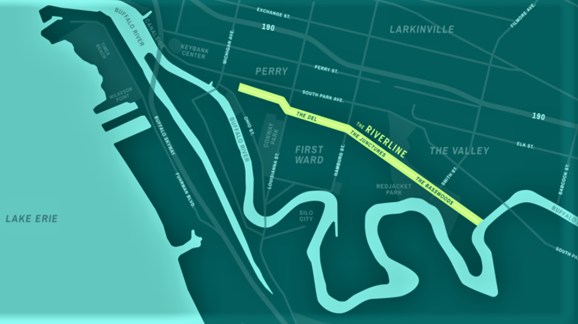
U.S. Rep. Brian Higgins recently indicated that he would like to see “The Riverline” project receive $10.5 million from President Joe Biden’s proposed highway bill.  Are you wondering that “The Riverline” is?  The Western New York Land Conservancy – a not-for-profit land trust that is developing the project – describes The Riverline as a “a nature trail and greenway” that will transform the abandoned DL&W rail corridor and link downtown Buffalo to the Buffalo River.

The 1.5-mile greenway will traverse three working class Buffalo neighborhoods, Perry, The Old First Ward, and The Valley.  While they have experienced economic and social stress for decades, the Land Conservancy envisions The Riverline assisting these neighborhoods build “a shared future of equity, opportunity, and prosperity.”

(WNYLC)

You can learn much about The Riverline concept – “a vision created by the community” – by visiting the Land Conservancy’s website and immersing yourself in the project’s design drafts.  The renderings are detailed, informative, and intriguing.  You’ll discover that the linear trail will have gateway entries, bridges, and two miles of paths.  Conceived primarily as a refuge – with nature trails and wildlife views – The Riverline will include an abundance of gardens (of both the neighborhood and butterfly variety), as well as passive recreation areas.

But the zoning-law-attorney in me needed to experience something beyond concept drawings.  I’ve learned from decades of assisting residents in communities throughout Western New York that nothing beats a “site visit” if I want to truly begin to understand a neighborhood and imagine the impact of a proposed project (even if the site visit is a mile-and-a-half long).

So, despite the daunting heat predicted for later that day, I spent 2 or 3 hours on June 7th walking the neighborhoods that will be touched by The Riverline, taking photos, and making mental connections between the colorful concept drawings and the real world.  The images that follow will be “organized” into three groupings, reflecting the Riverline’s three sections, The Del, The Juncture, and The Basswoods.

THE DEL

The Riverline begins at the corner of Moore and Miami streets, and proceeds in a southeasterly direction, initially on the north side of Miami Street, then on Miami’s south side, with an elevated berm eventually dropping to street level at Louisiana, Alabama, and Hamburg streets.  Here’s the view looking east down Miami St. from Moore St.:
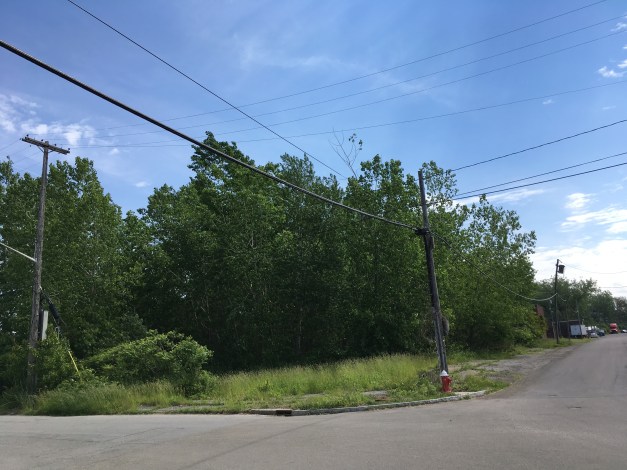
IMG_8433

Just steps away, at Ohio St. and Moore, you’ll find the Buffalo River Fest Park:

IMG_8427

IMG_8432

And, as you peer down Miami St. from Moore, this is what is right behind you:
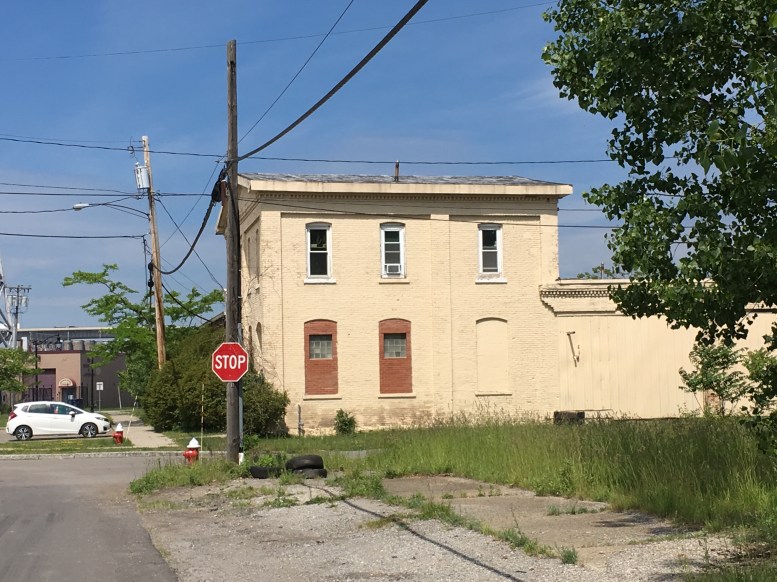
IMG_8422

As you head easterly down Miami St. towards Chicago St., The Riverline will be on your left:
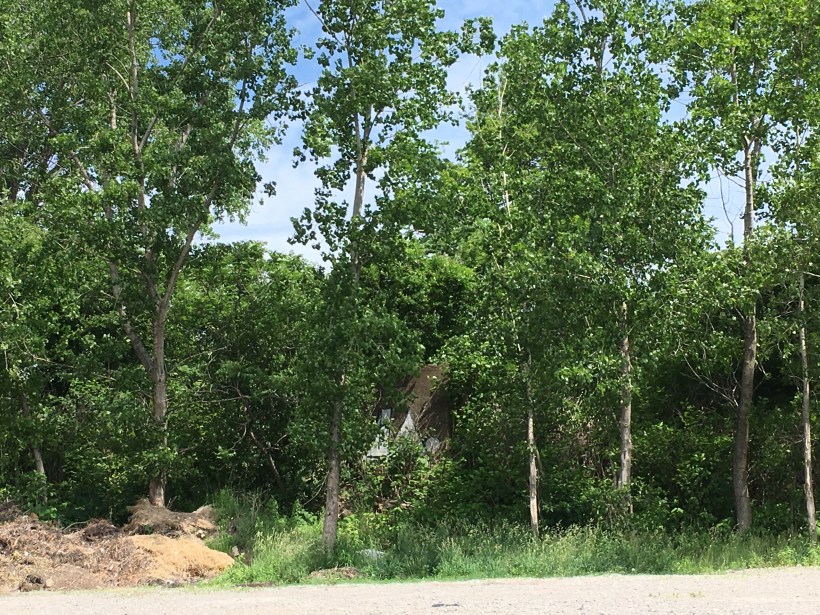
IMG_8420

And here’s the scene on your right:

IMG_8421

This is the view looking westerly back down Miami once you’ve reached Chicago St.:

IMG_8412

Awaiting you at the northeast corner of Miami and Chicago is an abandoned brick building:

IMG_8435

But there’s a pleasant surprise as you peak around the corner of that tired brick structure:

IMG_8442

IMG_8444

Here are views heading east down Miami from Chicago:
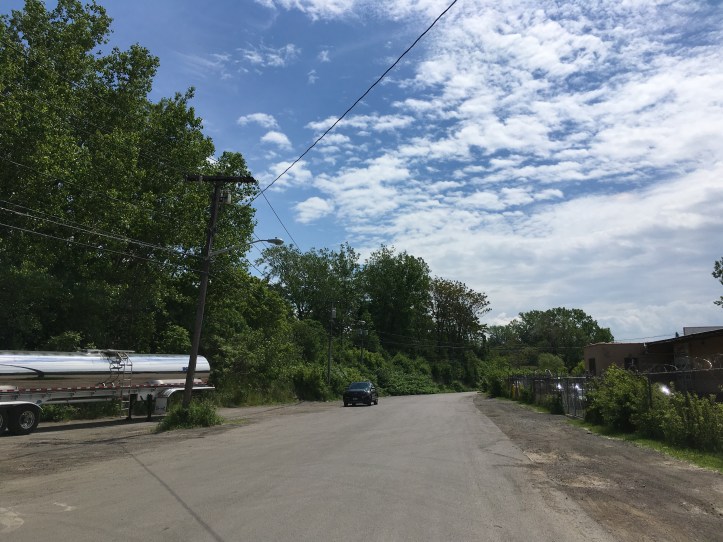
IMG_8451

IMG_8456

IMG_8457

The next cross street is Louisiana:

IMG_8458

The Riverline path switches to the south side of Miami as you proceed easterly from Louisiana St.:

IMG_8464

IMG_8466

But the north side of Miami St. is totally different, and makes you aware of the proximity of the future nature trail to this mixed industrial and residential neighborhood:

IMG_8468

IMG_8472

IMG_8475

This is the view of the Riverline directly across Miami St. from these houses:

IMG_8486

You soon come to Alabama St.:

IMG_8479

This is a picture of the residential block looking north down Alabama from Miami St. heading towards South Park Avenue:

IMG_8480

At the end of that block, you’ll find a struggling South Park commercial area, and a reminder of where you are:

IMG_8498

IMG_8499

Back to Alabama and Miami, this is what you’ll encounter as you look southeast across Alabama just south of Miami St.:

IMG_8488

Then there’s Mackinaw St.:

IMG_8489

And a lovely single-family home at 169 Alabama St., looking proud a half-block beyond Mackinaw:

IMG_8491

As you proceed southerly down Alabama, you’ll find a neighborhood stalwart, Our Lady of Perpetual Help R.C. Church:
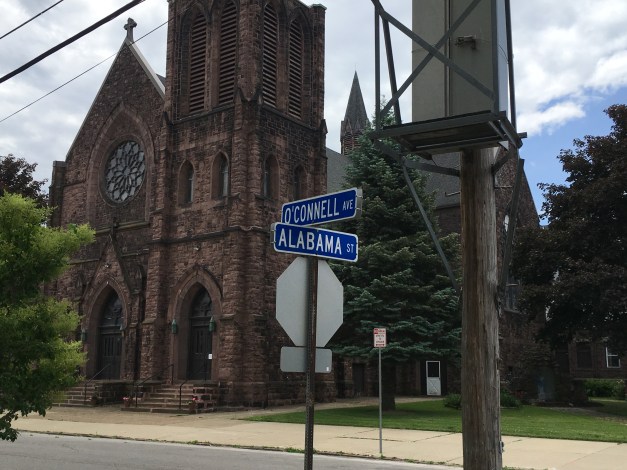
IMG_8492

You’ve reached the end of “The Del” community as you walk easterly down Mackinaw or Miami to Hamburg St.

THE JUNCTURE

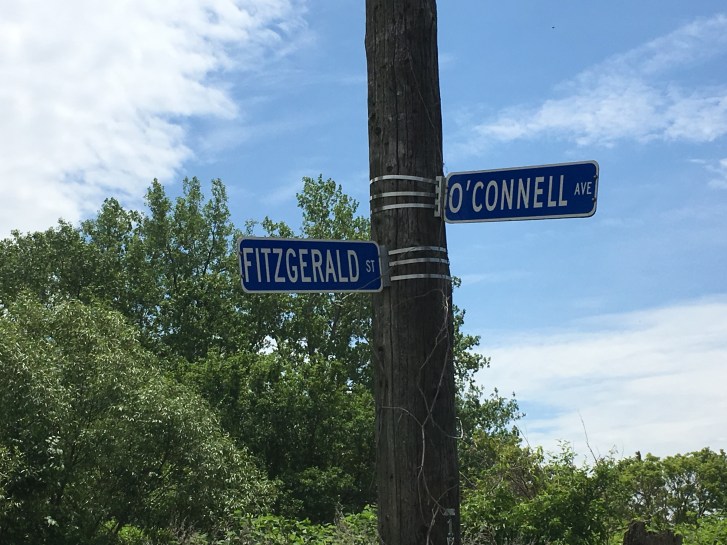
I have a bit of a confession to make here (and, I won’t blame it on the heat).  After I crossed Hamburg Street on my self-guided tour, I made the mistake of criss-crossing the various streets – Sidway, Mackinaw, Katherine, Fitzgerald, and O’Connell – without taking notes of precisely where I was as I took each photo.  So, I’m not 100% certain of either the street or direction I was looking (or, both) while capturing some of the images that follow.  My apologies.  But, at least, now I have an excellent reason to re-visit “the site” in the near future.

By the way, the moniker given to this section of The Riverline, The Juncture, reflects a prominent feature of the neighbor, its proximity to the intersection of two active railroad tracks.  The photos of tracks inserted below were taken from a point just beyond the dead end of Mackinaw St. east of Fitzgerald.  The Riverline will include an impressive trestle bridge providing its users with panoramic views of the railroad looking to the north and south.

Back to the site visit.

IMG_8509

These are images looking easterly down Mackinaw from Katherine Street.
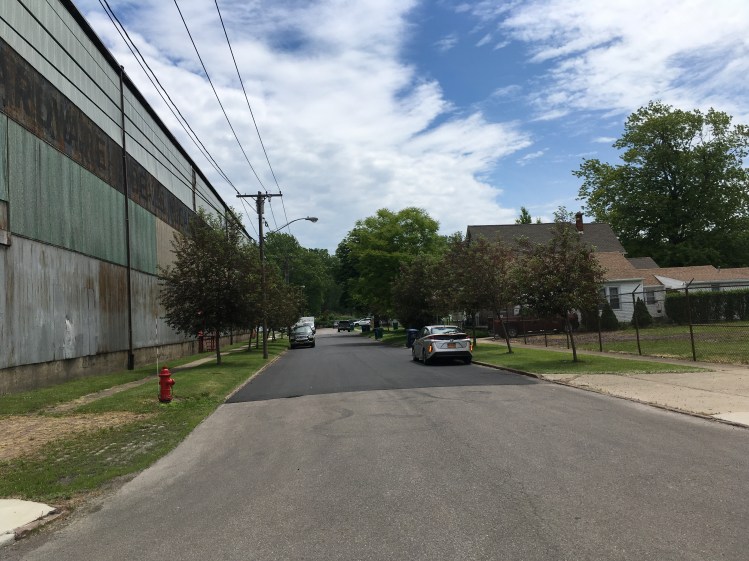
IMG_8517

IMG_8520

IMG_8522

IMG_8526

These are the last homes on Mackinaw as you approach the Dead End sign and RR tracks:

IMG_8528

IMG_8529

My first glimpse of the tracks:

IMG_8530

IMG_8531

I’d call this the juncture, or junction, or, perhaps, intersection:

IMG_8532

And, here’s the view from ground level as I turned around:

IMG_8533

If I’m reading the design drafts correctly, The Riverline will be traversing the existing neighborhood through what are now mostly mowed fields, and lastly a mature stand of trees southeast of the corner of Fitzgerald and O’Connell streets.  The trestle bridge will then take nature lovers across the railroad tracks and continue southeasterly.

IMG_8535

IMG_8538

IMG_8539

IMG_8542

These are O’Connell St. homes near Fitzgerald (if my memory serves me):

IMG_8545

IMG_8543

Now it’s time to leave The Juncture and head by car down South Park to the intersection of Smith and South Park (just before the road goes over a bridge and past the Tesla complex).  Our destination:  the third and final section of The Riverline called The Basswoods.

THE BASSWOODS 

I still have much to learn about both The Riverline’s vision and the existing terrain.  I found the following excerpt from Buffalo News reporter Mark Sommer’s April 28, 2021 article to be quite helpful:

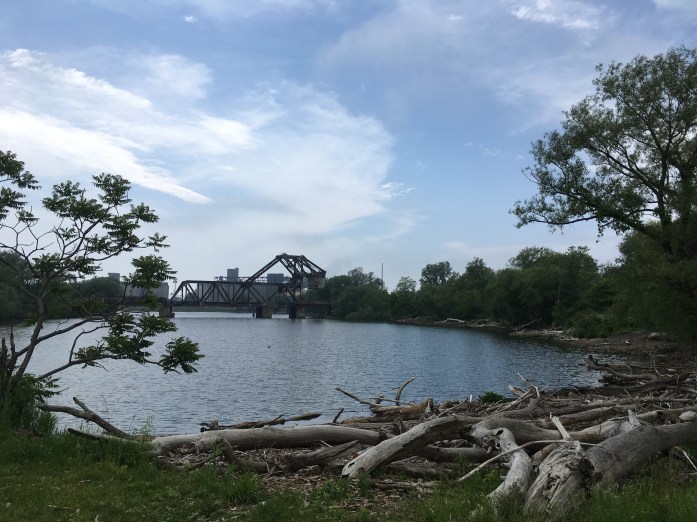
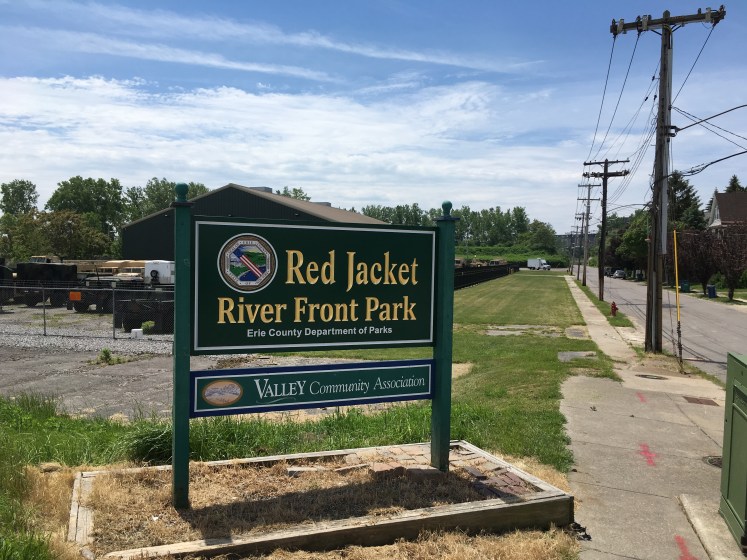
“… [The Riverline] disappears east of Katherine Street [Mark’s referring to the trestle bridge] before picking up again adjacent to Red Jacket Riverfront Park.  From there, the trail would cross one of Buffalo’s busiest railroad lines over an existing bridge south and east of Smith Street and end at a half-bridge over the Buffalo River with views of the South Park Avenue lift bridge, the Buffalo Color peninsula and the Tesla plant.”

My photos pick up at South Park Ave. and Smith Street, heading down Smith in the direction of railroad tracks and two “art walls”:
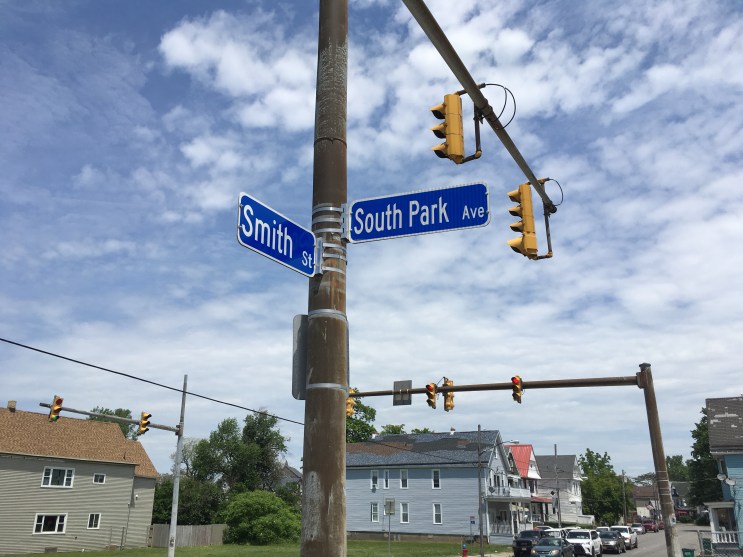
IMG_8546

IMG_8550

IMG_8553

IMG_8555

IMG_8556

IMG_8557

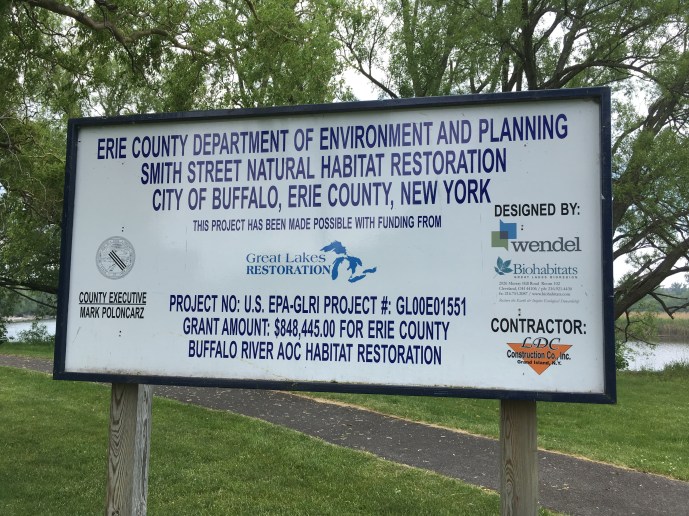
I came upon a pleasant surprise when I reached the end of the “art wall.”  As I looked north and west – in the direction I picture The Riverline’s trestle bridge would be gracing the terrain someday soon – I not only found a helpful sign, but also an Erie County field office/bus attending a herd of hungry goats (“Goats at Work”) energetically removing invasive plants in advance of The Riverline’s arrival, and then, down a picturesque path, basswood trees (I presume):

IMG_8565

IMG_8584

IMG_8587

IMG_8589

When I returned to Smith Street, I momentarily admired the other “art wall” bookending the road, and walked southeasterly for the final segment of my site visit:
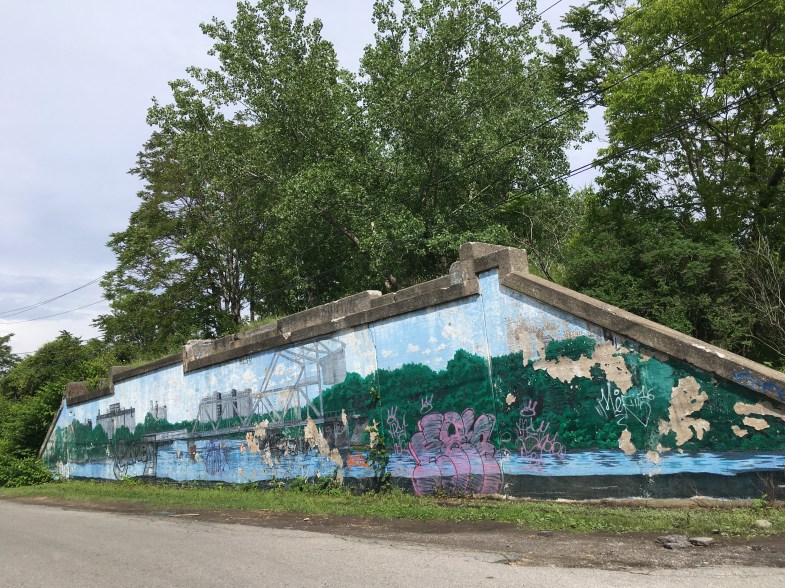
IMG_8591

IMG_8566

IMG_8569

IMG_8572

IMG_8583

IMG_8575

That’s my last photo for now.  But, I know that I did not reach the end of The Riverline, and look forward to future exploring.  Meanwhile, you may want to click on the link above to Mark Sommer’s April 28th report.  It includes a photo of a plank bridge, by Sharon Cantillon, with the following caption:  “Buffalo’s Riverline park is expected to end at this bridge, overlooking the Buffalo River and the Tesla plant.”

I hope this posting has whet your appetite to learn more about The Riverline and the many other endeavors happening in Buffalo to protect, preserve, and enhance our natural and built resources.

With All Due Respect,

Art Giacalone
BOPC responds – and I reply – to Caz Park pathway concerns

Posted by Arthur J. Giacalone on June 3, 2021
Posted in: Cazenovia Park, Christopher Scanlon, City of Buffalo, Olmsted Parks, South Buffalo. Leave a comment

On June 1,  I wrote here about my concerns regarding plans to remove about 700 feet of asphalt pathway in Cazenovia Park – alongside and providing views of the Cazenovia Creek.  On June 2, Stephanie Crockatt, Executive Director of the Buffalo Olmsted Parks Conservancy, replied by email to many of the issues that I raised concerning plans to remove the asphalt pathway and concrete steps at Cazenovia Park.  Ms. Crockatt’s correspondence confirms BOPC’s plan to, in fact, eliminate that portion of the upper pathway starting at Warren Spahn Way.  I share her correspondence below, and provide my initial response to her comments in brackets and bold print.  Also, I am attaching a pdf containing a slide presentation, provided to me on June 3 by BOPC’s Director of Planning and Advocacy, Brian Dold, reflecting Caz Park history and BOPC’s current proposal for pathway reconstruction, etc. Caz Park – June 2021 slide presentation

*****************

From: “Stephanie Crockatt”
To: AJGiacalone@twc.com
Cc: “Andy Rabb”, “Greg Robinson”, “Councilmember Scanlon – South”
Sent: Wednesday June 2 2021 4:33:51PM
Subject: Cazenovia Paths/Stairs

Mr. Giacalone and Ms. ______________,

The Conservancy appreciates your outreach on the topic of the pathway reconstruction along the southern edge of Cazenovia Creek.

As you may know, these paths have been in rough condition for years, with numerous complaints from the community.  Thankfully in working with the City and funding allocations, we were able to partner on a restoration project.

[AJG:  Every person with whom I have spoken in Caz Park since May 27 is pleased to hear that the bumpy and uneven condition of the asphalt pathway, primarily found between Cazenovia St. and the northern set of concrete steps, will be removed and replaced.  However, not one of the two or three dozen park-goers was aware of the plan to remove a 700-foot portion of the asphalt pathway that provides proximity and views of the creek.]

The project stems from our master plan’s five-year priority project update.  You may recall the Conservancy held several public input sessions throughout 2018 and into 2019 in working to determine projects the communities around the Olmsted parks would like to see elevated in attention and improvement.  Number 4 for Cazenovia Park is the pathways.

[AJG: I was in attendance at the Cazenovia Park public sessions in 2018-2019.  Not once did I hear anyone from BOPC state or suggest that pathway attention and improvements would involve removal of approximately one-third of the existing asphalt pathway along the creek’s shore.  The fact that South District Councilmember Christopher Scanlon – for whom pathway improvements is a very high priority – did not know on May 27 that any of the asphalt pathway would be removed and replaced by lawn reflects a failure by BOPC to keep our elected representative, much less the users of Caz Park, adequately informed.]

Yes, in this project there are areas where the path will be relocated to the correct historical alignment.  This is due to the fact that the current high pathway (and the staircases) were part of a DPW project – maybe 30 or 40 years ago – which tried to address the flooding, ice damming and other creek impacts on the park.

[AJG: The original plans for Cazenovia Park included a 20-acre recreational lake as its centerpiece, separated into two sections by a carriage bridge and featuring two islands.  As existing signage in the park describes, the original plan “allowed park-goers more access to the water than in other, larger parks.”  Later changes in the park altered “the once pastoral landscape” by introducing an ice-skating rink, community center, and an indoor swimming pool, etc.  The pursuit of “historic integrity,” by removal of a popular section of pathway that provides proximity and views of the creek not available from the “historic parallel route,” appears to be little more than a fanciful conceit attainable only at the expense of current park-goers (who now have the option of experiencing the contrasting ambience of either the high or low road).] 

The high berm constructed along the southern shore was not part of the Olmsted alignment or topography, and some of those higher paths have actually become a safety hazard.  The odd staircases are not historic and are not something the Conservancy would advocate to keep or even ask the City to continue for deferred maintenance expenses.

[AJG: The reality is that the high berm is not being eliminated and is, most likely, a permanent feature in the park and obstacle to any meaningful replication of the Olmsted alignment or topography.  The berm, along with the concrete steps, are a testament to the unrealistic nature of the original Olmstedian plans.  The “odd staircases” (which I believe have been there for more than a half-century) provide an excellent opportunity for educating the public about both the history of Caz Park and the difficulties of creating a park adjacent to a mighty creek.  Olmstedians should embrace such an educational effort.]

The process the Conservancy follows in such planning and design decisions is to first vet with the public, which we did in 2018-2019.  We then work with City parks and engineering on historic realignments, repairs or renovations in mapping out the project.  We pass the designs through our Design Review Committee with the Conservancy which is a group of community volunteers and professionals.  We then take final designs through to the Preservation Board for their approval, which also has a public input component.

[AJG: No matter BOPC’s intent, the vetting process as a means to educate and obtain the consensus of the public was extremely flawed.  The Preservation Board process added to the misinformation.  Not only was the subject line for the May 27 meeting devoid of any reference to removal-without-replacement of a significant section of asphalt pathway (“Reconstruct and realign asphalt pathways and remove concrete steps”), the publicly available documents lacked a narrative, and failed to include informative images of the actual plans.]

It is unfortunate that the project is causing you concern, but I can assure you that we take every project seriously in it’s historical context and integrity, public safety aspects, and sustainability as to further investment and/or anticipated aging and repairs.

[AJG: BOPC can demonstrate its commitment by: (a) asking the City to discontinue implementation of any aspect of the project other than removal and replacement of the asphalt pathway between Cazenovia Street and the northern concrete steps; and (b) conducting a well-advertised public forum at the Caz Park community center to allow the users of Caz Park the opportunity to learn about the final designs, and to express their preferences regarding the portion of the asphalt pathway commencing at Warren Spahn Way, and the other features of the proposed project.]

If you would like to speak with me directly or perhaps even meet out on site with our staff landscape architect, Greg Robinson, let me know.

[AJG: I would appreciate the opportunity to meet on site with you, Greg Robinson, and perhaps BOPC’s Brian Dold, as well as Councilmember Chris Scanlon.  Thank you.]

Best,

Stephanie

Stephanie Crockatt

Executive Director, Buffalo Olmsted Parks Conservancy

716-838-1249×16 Office / http://www.bfloparks.org

With all due respect,

Art Giacalone

Caz Park pathway inexplicably slated for removal

Posted by Arthur J. Giacalone on June 1, 2021
Posted in: Cazenovia Park, Christopher Scanlon, City of Buffalo, Olmsted Parks, South Buffalo. Leave a comment

[For an update of this posting, please see https://withallduerespectblog.com/2021/06/03/bopc-responds-and-i-reply-to-caz-park-pathway-concerns/ .]

[A version of the following post was published as a letter-to-the-editor in the Buffalo News “Everybody Column” on June 5, 2021.]

Cazenovia Creek is the heart of Cazenovia Park, providing a feature missing from the other gems in the Queen City’s Olmsted Park system’s crown.

IMG_8308

Despite the creek’s unique role, the public will soon lose the ability to safely and conveniently walk, run, or bike along a substantial portion of the Caz Creek shoreline if plans approved by Buffalo’s Preservation Board on May 27 are implemented.

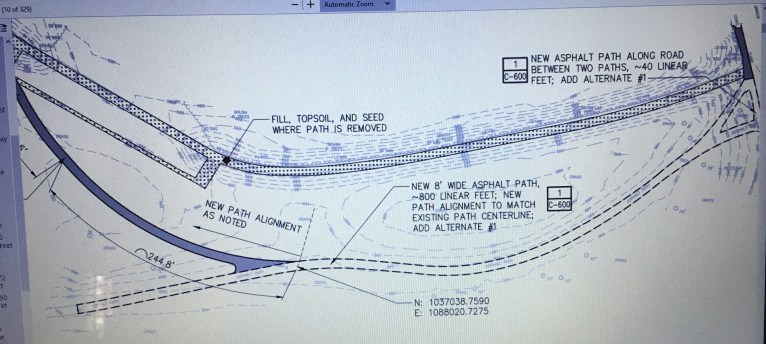
IMG_8316 (2) [Detail from city’s engineering plans showing the section where asphalt will be replaced by lawn.]

Parkgoers are currently able to traverse an asphalt pathway that starts at Warren Spahn Way (across from a public parking lot) and hugs the creek for about 2,080 feet, the length of just over 5 football fields.

IMG_8344 [Beginning of asphalt pathway, across from Warren Spahn Way parking lot, slated for removal.]

The bumpiest section of the pathway – closest to Cazenovia Street – will be removed and replaced with a new asphalt path, a worthy improvement.

IMG_8385

Unfortunately, about 700 feet of the path, the section that starts at the bridge near the public parking lot and extends to the northern set of concrete steps, will be removed and not replaced with a new pathway, but filled with topsoil, seeded, and turned into lawn.

IMG_8321 [Part of 700-foot pathway slated for removal, replaced with lawn.]

IMG_8381 [Section of asphalt path extending between two sets of concrete steps, slated for removal without replacement.]

IMG_8383 [View of creek from pathway section that will not be replaced.]

The public was unaware of this disturbing aspect of the plan.  The official description of the proposal merely states, “Reconstruct and realign asphalt pathways and remove concrete steps.” The documents available to the public (and, apparently, the Preservation Board), included no narrative, and no discussion of the reasons a 700-foot long portion of the asphalt pavement would not be replaced.

IMG_8373 [Northern set of concrete steps slated for removal and replacement with lawn.]

Even the South District Councilmember, Chris Scanlon, did not know the specifics of the proposed project.  An hour before the Preservation Board’s vote to approve the plans, my Councilmember emailed me that, “the pathways along the creek are not being removed, they are being replaced.”  Mr, Scanlon was incorrect, despite proclaiming that replacing the deteriorated paths “has been a major priority of mine.”

IMG_8336 [View of creek through portion of path slated to be removed and not replaced.]

It is bad enough that no public explanation has been given for removal of the iconic concrete steps – a physical reminder of Cazenovia Park’s history.

IMG_8375 [Southern concrete steps, slated for removal and replacement by lawn.]

IMG_8265 [Northern concrete steps, slated for removal and replacement by lawn.]

There is no excuse for limiting the public’s ability to walk, run and bike along the creek without providing a meaningful explanation for diminishing that option.

IMG_8322 (2)_LI [An activity that will be impossible to enjoy if plans to remove the asphalt pathway and replace it with grass is implemented.]

If implemented, the approved plan, apparently proposed by the Buffalo Olmsted Park Conservancy and endorsed by the South District Councilmember, will eliminate the existing choice offered to Cazenovia Park users:  to take the high road or low road.

IMG_8288 [If implemented, removal of the path alongside Cazenovia Creek will force walkers, runners, and bicyclists to all use the path on the left in this photo, unable to see the creek.]

For the sake of transparency and fairness, Buffalo Olmsted Park Conservancy and city officials owe it to the public to reconsider this plan, with input from a fully-informed public.

If you agree, you can express your views to the following individuals:

Christopher P. Scanlon, South District Council Member at:  65 Niagara St., Room 1401, Buffalo, NY 14202; cscanlon@city-buffalo.com; 716-851-5169.

Stephanie Crockatt, BOPC Executive Director at:  84 Parkside Ave., Buffalo, NY 14214; 716-838-1249; www.bfloparks.org.

Andrew R. Rabb, Dep. Commr. For Parks & Recreation at:  arabb@city-buffalo.com; 716-851-5553.

Thank you.

With All Due Respect,

Art Giacalone

I’m no Red Jacket, but…

Posted by Arthur J. Giacalone on May 29, 2021
Posted in: Buffalo News, Native American, South Buffalo, White Privilege. 1 Comment

The May 29, 2021 print version of the Buffalo News includes an article that I had sent to them for its “first-person column” it calls MY VIEW.  Here’s a link to the on-line version.  I like the heading they chose to use, “Red Jacket’s values still resonate today,” and I am truly grateful to the newspapers for printing my piece.   But, I have one major disappointment.  The printed newspaper – the column seen by the most eyes – omits the following sentence:  “…The media vilified us, showing little regard for the protection of cultural artifacts and Native American beliefs….”  I had chosen those words carefully, purposely not identifying the source of the condemnation.  What follows is an annotated version of my article, with some images added.  When you arrive at the deleted sentence, you will find a link to the primary “media” attack.  I think you can guess the source.

Red Jacket’s values still resonate today

No one would mistake this Italian-American lawyer with the famous Seneca, Red Jacket.

I can’t speak of ancestors whose knowledge and respect for this land extend back millennia.  [See my maternal grandparents’ 1920 marriage certificate.]

I’m no orator.  A judge once exclaimed that I wasn’t eloquent enough to change his mind.

No U.S. president has ever bestowed a peace medal on me, although a local publication named me Western New York’s “Best Gadfly.”

Red Jacket and I were, nonetheless, both born along the Genesee River (although two centuries apart).  And, we both chose to spend our later years near what the City of Buffalo now calls the Seneca Indian Park on Buffum Street in South Buffalo.  It is the latter coincidence that creates a connection between me and the Seneca spokesman.

The “Seneca Indian Park” – 1.6 acres of serenity, mature trees and gently sloping lawn – is an ancient burial ground, and part of a Seneca village that served as the heart of the Buffalo Creek reservation.  Red Jacket adamantly proclaimed that he never wanted to leave the village – not even upon his death.  Keeping with his final wishes, he was buried in 1830 beneath a large walnut tree at the west end of the current park.

Saturday Morning Shadows at Seneca Indian Park 04-24-21

Red Jacket was an ardent traditionalist and protector of Seneca culture, skeptical of both Christian missionaries and land speculators.  I share his views.  When I discovered in 2018 that a Buffalo developer and local charter school wanted to build a high school and gymnasium on Buffum Street, a hundred yards from the park, I investigated the project.  The State’s historic preservation office had classified the land “archeologically sensitive” due to its proximity to the old burial grounds and Seneca village.  [See SHPO 06-19-18 letter re 102 Buffum]  The city officials and developer didn’t care, and approved the project without investigating the adverse impacts on cultural and archeological resources.

Two neighbors and I challenged the expansion in court.  [See Giacalone v. WNYMCS – Petition] The media vilified us, showing little regard for the protection of cultural artifacts and Native American beliefs. [E.g., see BuffNews 08-17-2018 editorial.] Fortunately, the charter school’s administration decided to hire an archeological firm to study the issues we had raised.  The consultants agreed that the project area is “very sensitive for archaeological resources,” and the charter school located its high school elsewhere.

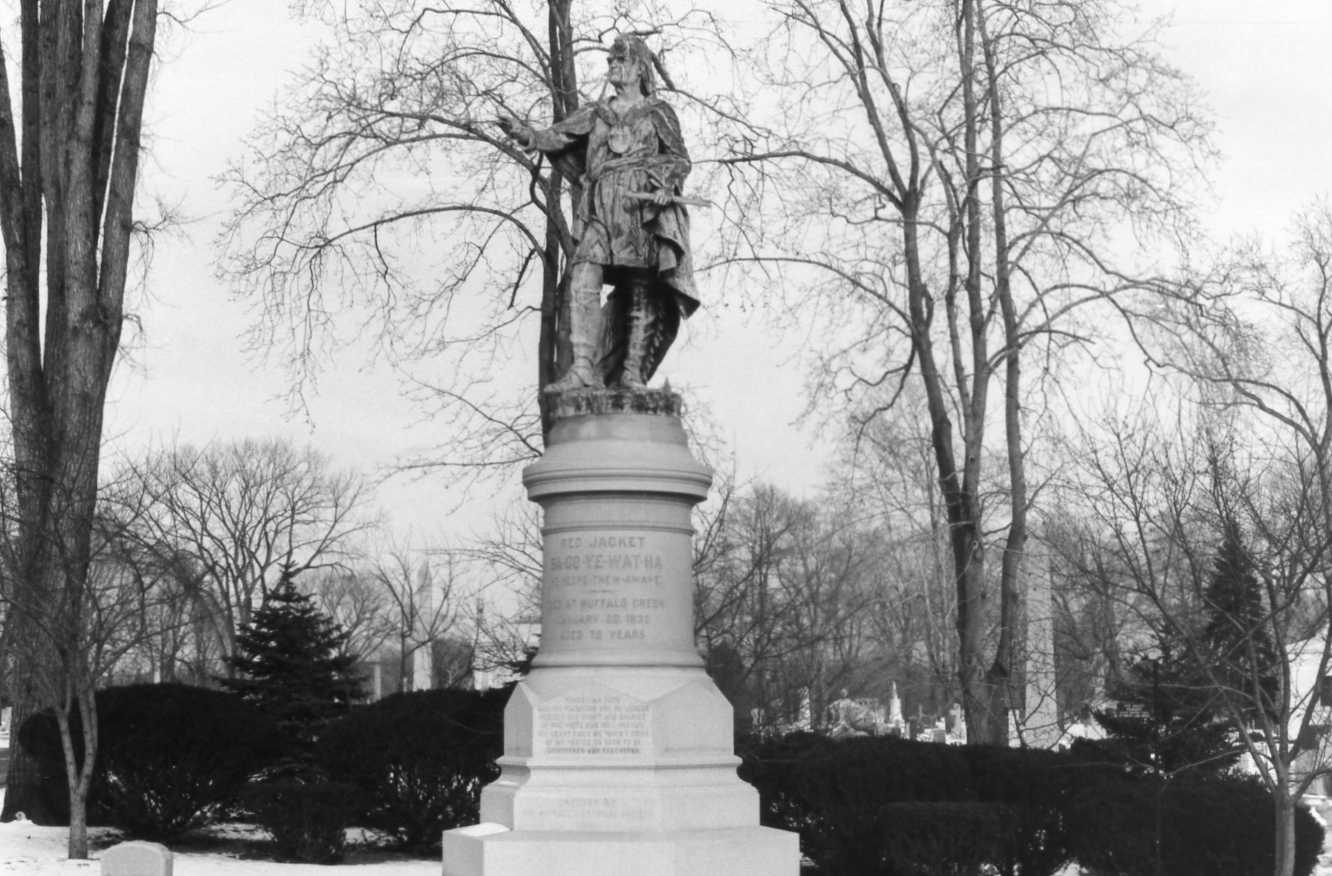
Red Jacket would not be surprised that this positive result required a fight.  His skepticism was justified and prophetic.  Despite his final wishes, his remains were removed from the Buffum Street site and reinterred near a monument at Forest Lawn Cemetery.  Ironically, the following words of the great orator are memorialized there:

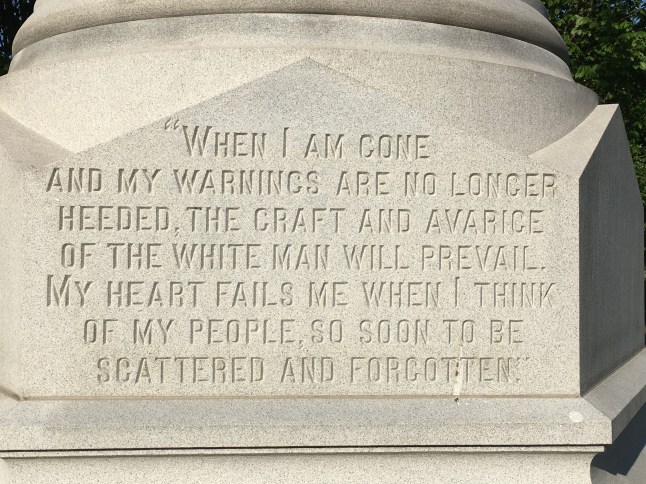
“When I am gone and my warnings are no longer heeded, the craft and avarice of the white man shall prevail.  My heart fails me when I think of my people, who are soon to be scattered and forgotten.”

Red Jacket's When I Am Gone quote

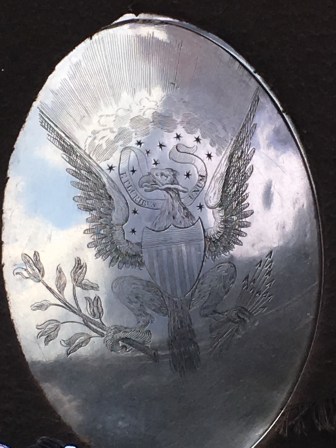
His people were scattered 12 years after his death by the “Treaty of 1842.”  But, as highlighted by the  May 17th ceremony in Salamanca honoring the return of Red Jacket’s Peace Medal to the Seneca Nation, his people have not been forgotten.  They continue their fight for the sovereignty reflected in the 1792 symbol of peace.

Red Jacket medal - front sni IMG_8088

A hopeful note.  On the day after the repatriation celebration, a group of the charter school’s students were visiting the Seneca Indian Park.  Their teacher proudly assured me that this multi-racial group had been taught the history of the site, and the importance of respecting the culture and beliefs of all peoples.

With All Due Respect,

Art Giacalone
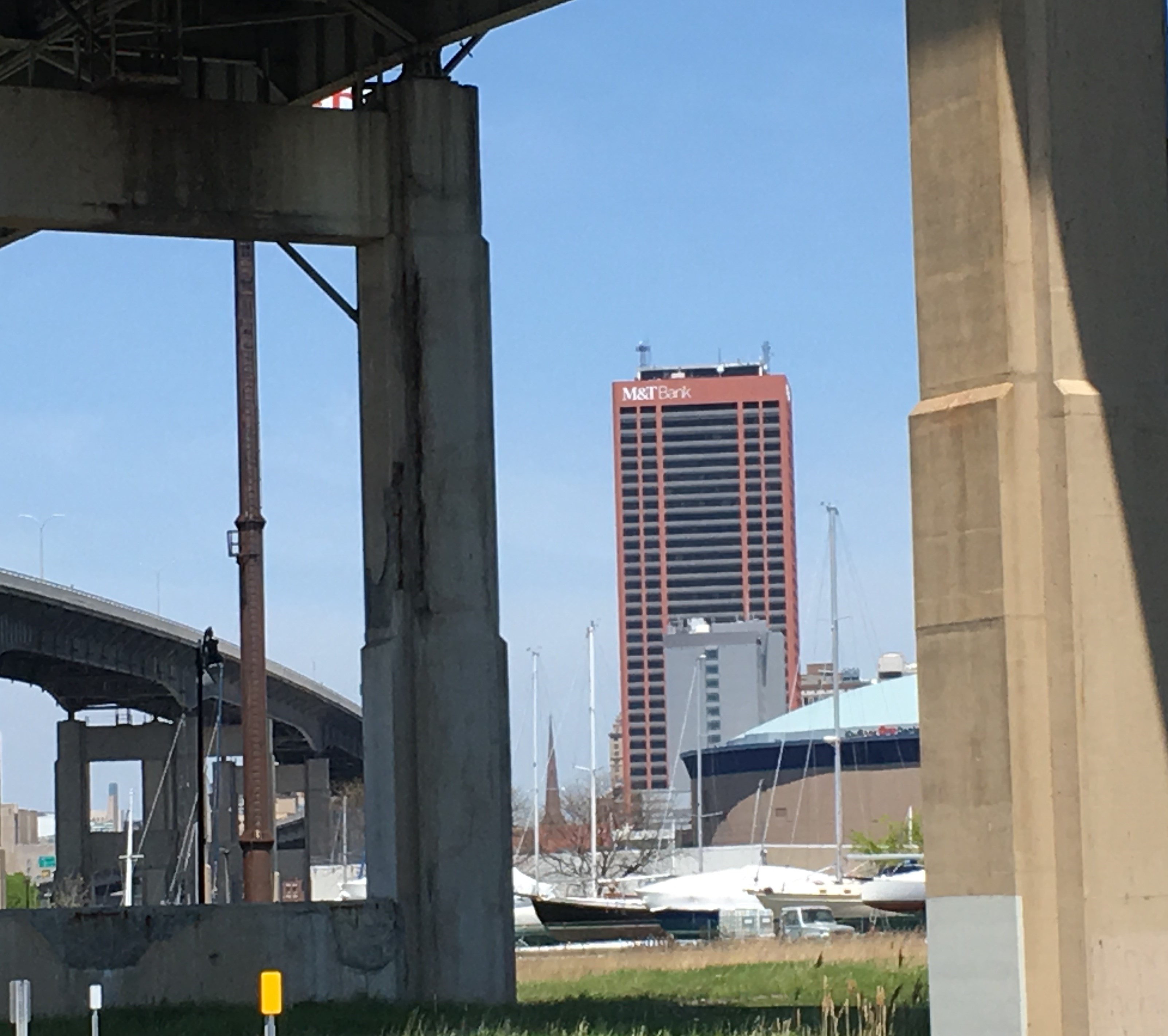
Framed by Buffalo’s Iconic Skyway

Posted by Arthur J. Giacalone on May 23, 2021
Posted in: City of Buffalo, South Buffalo, Waterfront, WNY Photos. Leave a comment

Photos taken May 18, 2021.

IMG_8119

IMG_8129 (2)

IMG_8123

IMG_8126 (3)

IMG_8127 (2)

IMG_8134

IMG_8133

IMG_8182 (2)

IMG_8183 (2)

IMG_8157

With All Due Respect,

Art Giacalone

Due Respect for Otetiani a/k/a Red Jacket

Posted by Arthur J. Giacalone on May 19, 2021
Posted in: City of Buffalo, Native American, Red Jacket a/k/a/Otetiani, South Buffalo. 1 Comment

The land on which my home was constructed in 1910, on Oschawa Avenue off Indian Church Road at the southeastern edge of the City of Buffalo, is historically part of the Seneca Nation’s Buffalo Creek reservation.  My parcel is just a few hundred feet southeast of ancient burial grounds near what is now the corner of Buffum (formerly, Buffam) Street and Fields Avenue.  A 1.6-acre portion of the burial site is now called Seneca Indian Park by the City of Buffalo, and was designated a local landmark in 2011 by the City Common Council.

Saturday Morning Shadows at Seneca Indian Park 04-24-21

A primary reason for the landmark designation is the site’s affiliation with a Seneca named Otetiani (“Always Ready,” or more commonly known as Red Jacket).  Here is an excerpt from the Seneca Indian Park landmark submission papers to justify the creation of the landmark:

      Red Jacket was among the most important and influential Seneca leaders of the late 1700s – early 1800s.  The village at Buffam Street had two important foci:  the prehistoric village site and Red Jacket’s cabin.  He lived middle and later years of his life in this village, walking along Buffalo and Cazenovia Creeks, conducting business at the council house a short walk away, even receiving the occasional white visitor.  Red Jacket was adamant that he never wanted to leave the village – not even upon his death.  He was buried accordingly, beneath a large walnut tree at the West end of the current Seneca Indian Park.  Red Jacket’s former burial site is thus far more significant because it is more closely associated with his life and final wishes – indeed his cultural beliefs – than his current resting place in Forest Lawn Cemetery or any other site in Western New York.  Buffam Street is significant because it was Red Jacket’s chosen and original burial location.  This simple choice articulates the site’s significance even though Red Jacket’s body is no longer buried there.  Red Jacket is a person of outstanding importance in Seneca history, the most ardent and recognizable protector of Seneca culture during his lifetime… [Emphasis added.]

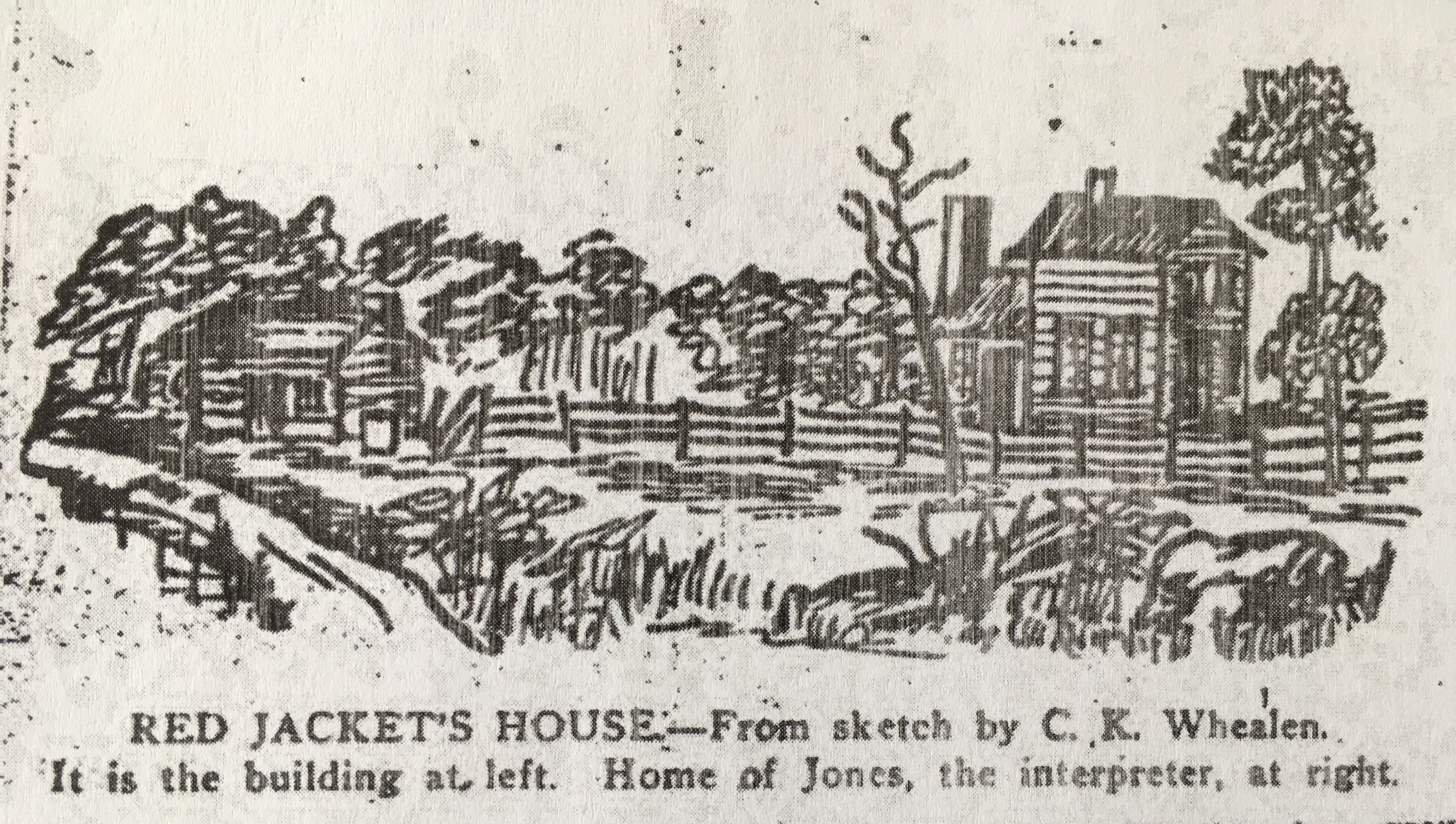
Red Jacket's House

Buffum Street grave sites

Forest Lawn - Red Jacket (Red Jacket memorial in Forest Lawn Cemetery, Buffalo, NY, photo by Art Giacalone circa 1980)

The landmark submission document also includes the following description of Otetiani/Red Jacket:

… Red Jacket, a prominent and well-spoken Seneca diplomat who lived in Buffalo Creek during the middle and later years of his life, was among the most ardent of Seneca traditionalists.  His conservatism showed in his skepticism of Christian missionaries and land sales to speculators…  He was involved in most of the land deals during the 1790s, as well as the delicate negotiations with U.S. emissaries interested in securing the Seneca’s neutrality at a time when Indian parties were ravaging American settlers in the Ohio Valley.  Red Jacket’s peace advocacy earned him a medal from president George Washington in 1792, and the Seneca remained neutral during the settlement of Western New York.

As you most likely know, on May 17, 2021, the Onöhsagwë:de’ Cultural Center, in Salamanca, New York , hosted a joyous celebration to honor the return to the Seneca Nation of the Red Jacket Peace Medal.  I had the honor of sitting outdoors in the sun as part of the crowd attending the “repatriation” ceremony.  It was with great pride and respect that the Seneca people welcomed home a truly significant cultural artifact.  While I’ll talk a bit about May 17 below, that momentous event is not the focal point of this posting. 

Red Jacket medal - front sni (Red Jacket Peace Medal, photo courtesy of Seneca Nation)
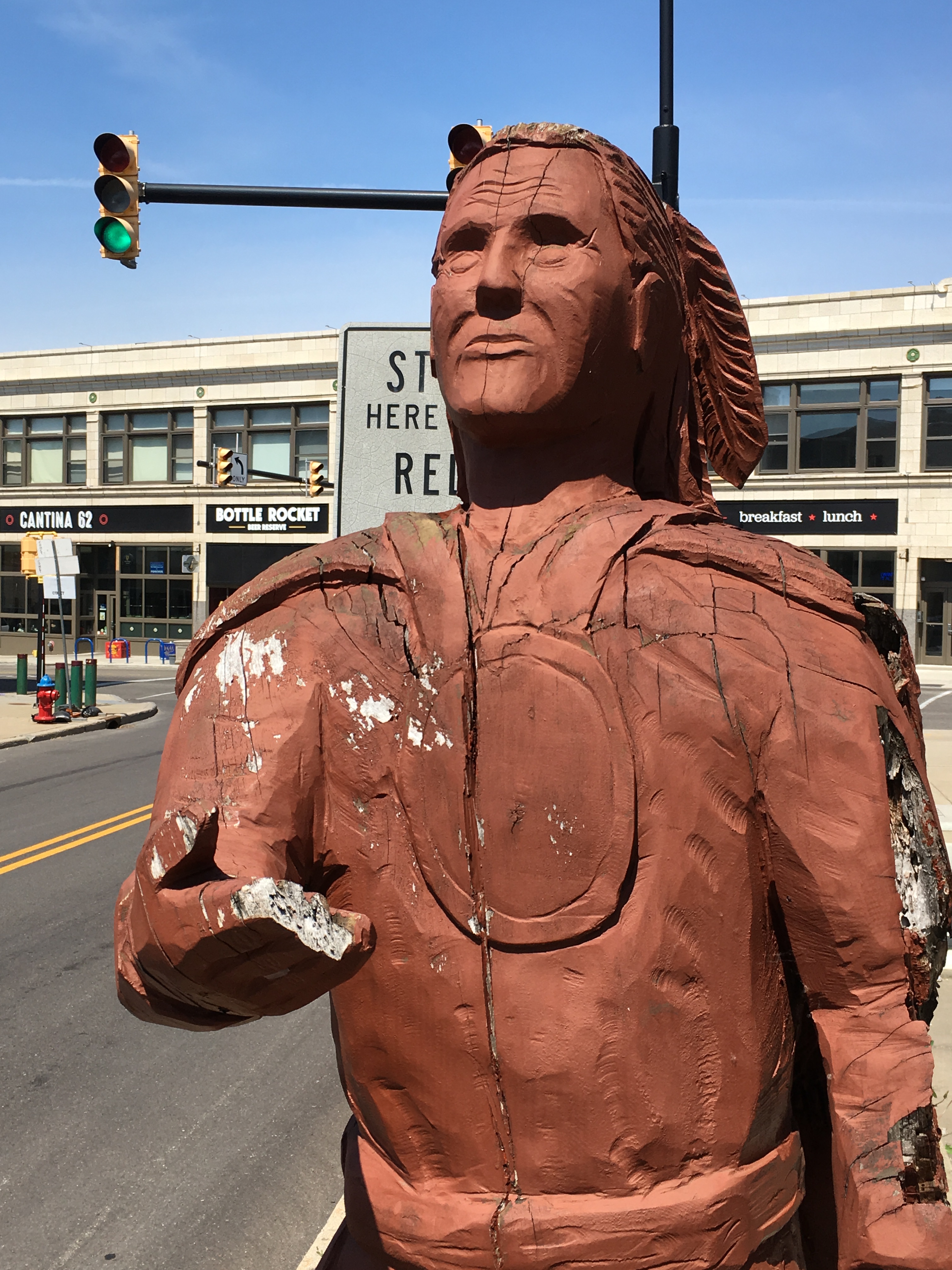
The information at the beginning of this piece, regarding the significance to Red Jacket and the Seneca Nation of the Buffum Street area, was provided for a reason.  Just four blocks or so from the site of the Seneca Indian Park – at the corner of Cazenovia and Seneca Streets – stands a (larger than?) life-size statue of a Native American.  Although the person represented by the wooden sculpture is not identified, he is conspicuously wearing a prominent oval-shape medal around his neck, and, most certainly, is Otetiani or Red Jacket.

There is one major problem, as reflected in the following photos.  Over the years, the statue has been vandalized and is significantly damaged:

IMG_8203 

IMG_8190

IMG_8200

IMG_8197

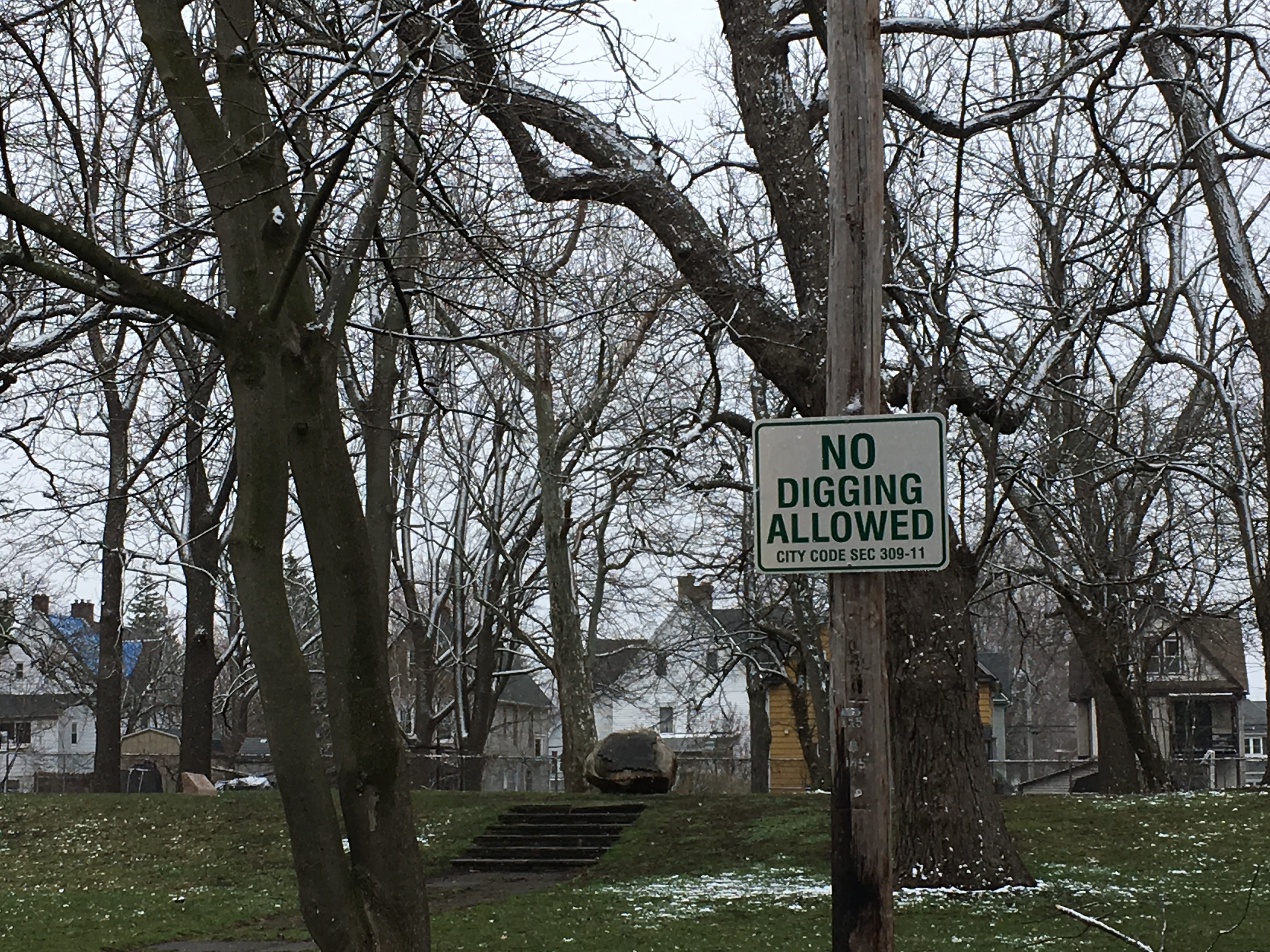
I am unable to identify the sculptor, and am unaware of when or how the statue’s location was chosen.  But it stands next to Cazenovia Street in the City of Buffalo’s right-of-way.  Officials at the city’s Parks department were cooperative earlier this year when they learned that metal detectorists and artifact-hunters had been digging at the Buffum Street sacred burial site.  They responded by putting up a “No Digging” sign. 

Seneca Indian Park - Buffum St. NO DIGGING ALLOWED sign 04-01-2021

I have no reason to believe that Buffalo South District Council Member Christopher P. Scanlon and Commissioner of Public Works, Parks & Streets, Michael J. Finn, would not be equally willing to see the statue of Red Jacket returned to its original glory once the sculpture’s current condition is brought to their attention.  I urge anyone interested in seeing this restoration project commenced and expeditiously brought to fruition to reach out to these public officials:

Hon. Christopher P. Scanlon, 65 Niagara Square, Room 1401, Buffalo, NY 14202; (716) 851-5169; cscanlon@city-buffalo.com.

Hon. Michael J. Finn, 65 Niagara Square, Room 502, Buffalo, NY 14202; (716) 851-5636; mfinn@city-buffalo.com.

Now let’s get back to the May 17, 2021 celebration.

Seneca Nation President Matthew Pagels, and Cultural Center Director Joe Stahlman, can certainly do a much better job than I explaining the importance to the Seneca people of the “repatriation” of the Red Jacket Peace Medal.  So here’s the Seneca Nation’s news release.  But I do want to share two quotes that I feel capture the spirit of the day:

“This medal represents what lives inside each and every Seneca — the heart of a sovereign people and our rightful recognition as such,” said Seneca Nation President Matthew B. Pagels. “This is our identity as a Nation. It cannot be owned, bought or sold. It belongs to all of us and is passed from generation to generation so it can live forever.”

“I like to remind the United States that the Haudenosaunee — especially the Seneca – play an important role in your early survival; that is what I see when I look upon the medal,” said Dr. Joe Stahlman, director of the Seneca-Iroquois National Museum. “We need to have moments of reconciliation. There are things from the past that still matter to many of us of here today and we need to talk about them. We need to all heal and find peace.”

I also want to mention a few of the dignitaries in attendance at the repatriation ceremony (frankly, I prefer the term “reMatriation”) who played central roles – alongside Dr. Stahlman and President Pagels – in making the return happen:  Melissa Brown, Executive Director, Buffalo History Museum; State Senator Sean Ryan; Robert Jones, Seneca Nation Councilor; and, Walter Mayer, Buffalo History Museum’s Senior Director of Collections.  

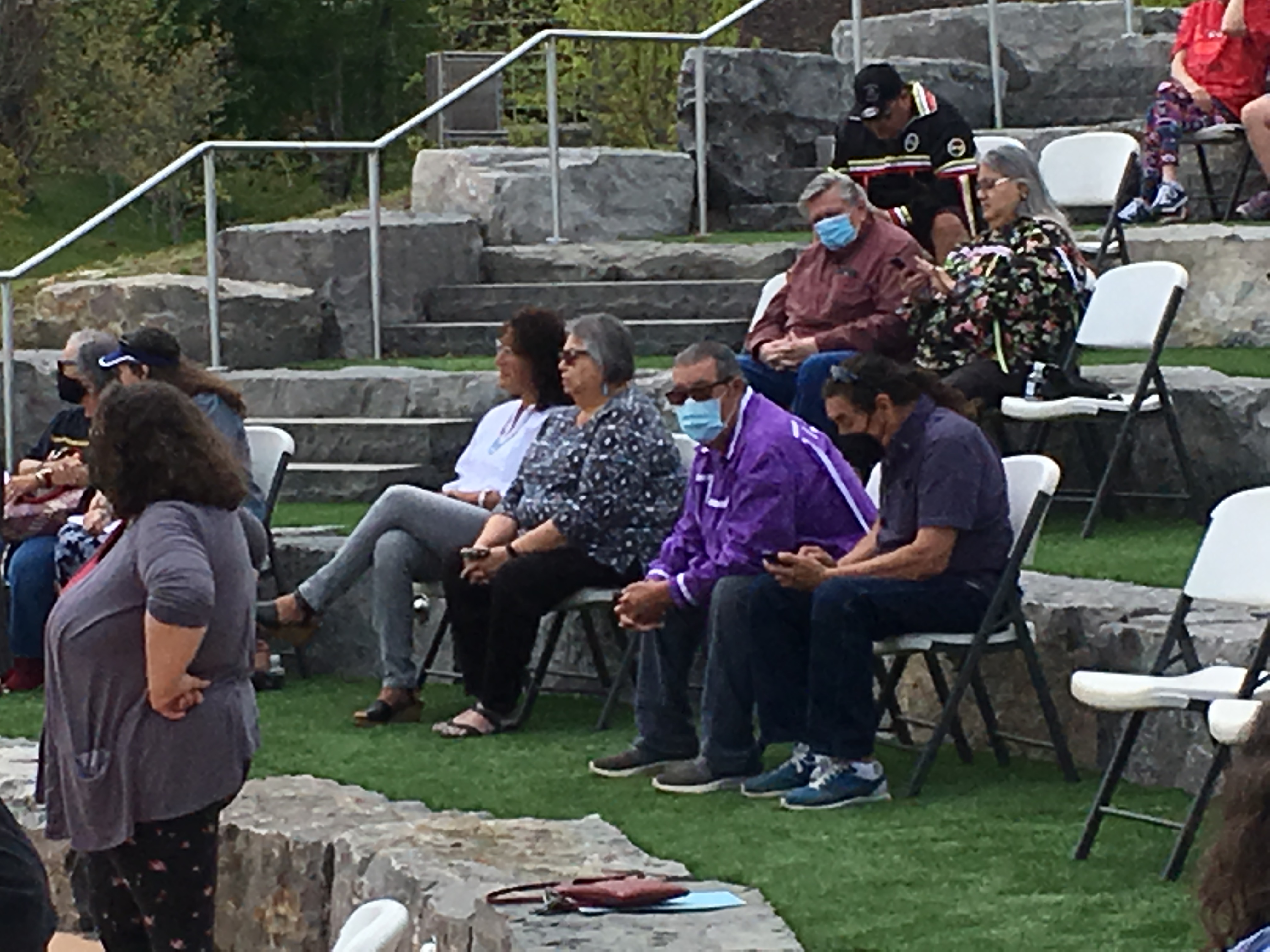
Lastly, I’ll end this post with images of the rarely-seen reverse side of the Peace Medal (the side closest to Otetiani’s heart) gifted by George Washington to Red Jacket in 1792 (and, reflecting the sky on 05/17/2021); the most significant piece of the cake crafted for the celebration; and, importantly, some of the folk in attendance. 

IMG_8088 (Peace Medal’s reverse side, photo by Art Giacalone 05/17/2021)

IMG_8085 (Photo by Art Giacalone, 05/17/2021)

IMG_8070

IMG_8073

IMG_8051

With All Due Respect to Otetiani and the Seneca,

Art Giacalone

Many things in common with Rochester’s lilac trees

Posted by Arthur J. Giacalone on May 12, 2021
Posted in: Highland Park/Lilac Festival, Olmsted Parks, Rochester NY, WNY Photos. 1 Comment

Perhaps an internet troll who critiqued my most recent letter-to-the-editor was correct when he suggested that I must have way too much time on my hands given the things I worry about (the particular topic, the dignity of Native Americans).  I rejected the notion until I realized what I had running around in my brain while driving home this afternoon from a visit to Rochester’s Lilac Festival.  I was thinking about the things I have in common with the many lilac trees gracing the hilly park located in the southern portion of the town of my birth:

First, the lilac trees and I not only have deep roots in the Flour/Flower City, we both started our lives adjacent to Highland Avenue – the trees in Highland Park, my twin brother David and I down the road at Highland Hospital.

Detail - Connie with Arthur David & Linda

Second, we both hang out at an Olmsted-designed park.  I walk and/or bicycle daily through South Buffalo’s Cazenovia Park.  They spend all 24/7, twelve months of the year in the aforementioned Olmsted gem, Monroe County’s Highland Park.

IMG_8043 (2)

Third, casual observers checking us out today might have superficially concluded that the lilac blossoms and I were both a bit past our prime.  And,

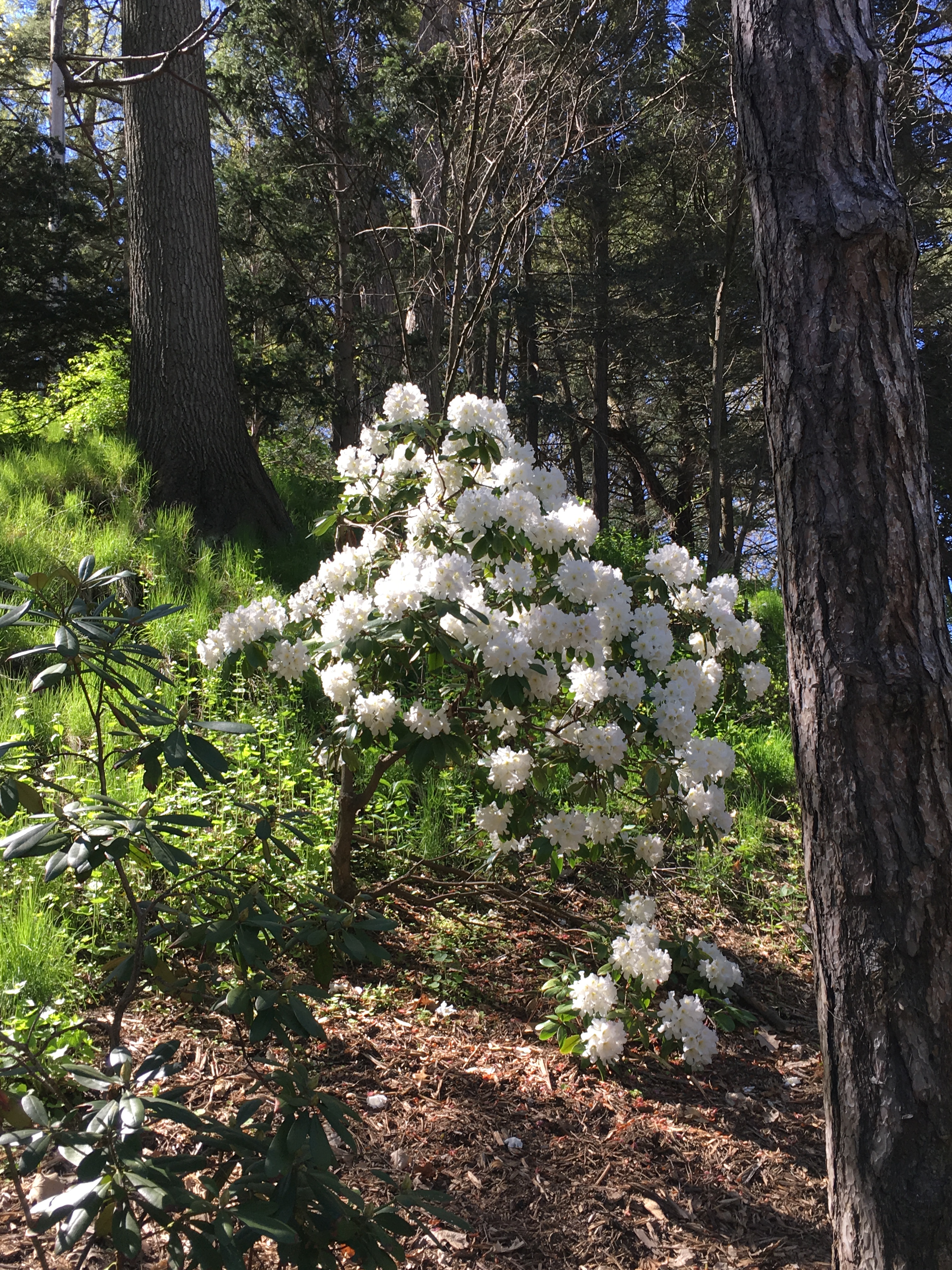
Fourth, just as anyone stopping by this zoning/environmental lawyer’s website might be surprised (perhaps, disappointed) if they expected my blog to always be playing the same old note, a person who thinks a “lilac festival” only offers lilacs would be quite surprised (and, most likely, not disappointed) by the variety of vegetation one’s senses have the opportunity to explore at this annual event.   

Here’s proof:

IMG_8041

IMG_7967

IMG_7966 (2)

IMG_7964 Paperbark Maple (Western China)

IMG_7975

IMG_7978

IMG_7969

IMG_7973

IMG_7976 (2)

IMG_7986

IMG_8001 Daybreak Magnolia

IMG_8002

IMG_7997

IMG_7994 Elizabeth Magnolia

IMG_8030

IMG_8027 (2)

IMG_8011 Brozzoni Saucer Magnolia

IMG_8008

IMG_8017 Ricki Magnolia

IMG_8013 [?]

IMG_8003

IMG_8026

IMG_8038 Katsura Tree (planted 1919, coincidentally, the year my father was born)
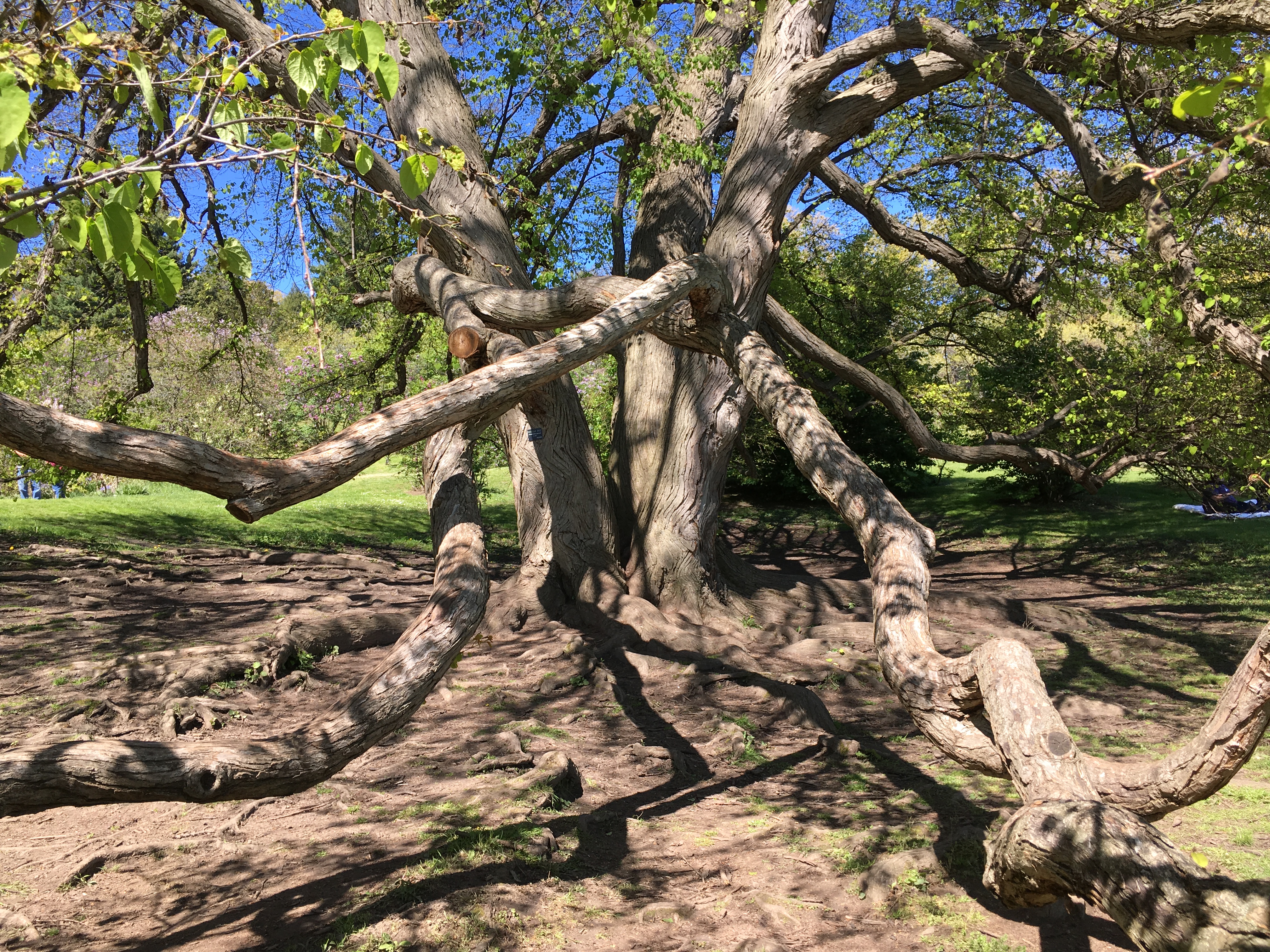
IMG_8034

IMG_8039 Lilac-colored Lilacs

IMG_8021

With All Due Respect,

Art Giacalone

P.S.  Bonus picture.  My daughter, on the right, sitting in the Katsura tree in 2009:

IMG_7944 (2)

For the unfortunate not strolling Caz Park today

Posted by Arthur J. Giacalone on May 2, 2021
Posted in: Cazenovia Park, City of Buffalo, Olmsted Parks, South Buffalo, WNY Photos. Leave a comment

Click on the photo if you’d like to enlarge it.

With All Due Respect,

Art G.

Posts navigation

← Older Entries
Newer Entries →
  • CATEGORIES

  • February 2026
    M T W T F S S
     1
    2345678
    9101112131415
    16171819202122
    232425262728  
    « Nov    
  • DISCLAIMER

    This blog is provided for general informational purposes only. It should not be construed as legal advice and is not intended to be a substitute for legal counsel. Persons requiring legal advice should retain a properly licensed lawyer. No attorney-client relationship will be formed based on use of this site and any comments or posts to this blog will not be privileged or confidential. *************** This blog's author, Arthur J. Giacalone, does not intend or consider the communications at this blog to be ATTORNEY ADVERTISING. The primary purpose of the communication is not for the retention of Mr. Giacalone's legal services. [See definition of "Advertisement" at Part 1200, Rules of Professional Conduct, Rule 1.0(a).] Nonetheless, in case the proper authorities choose to treat this web site as ATTORNEY ADVERTISING, the street address, phone number and email address of the law office of Arthur J. Giacalone are: 17 Oschawa Avenue, Buffalo, New York 14210; (716) 436-2646; AJGiacalone@twc.com.
Blog at WordPress.com.
With All Due Respect
Blog at WordPress.com.
  • Subscribe Subscribed
    • With All Due Respect
    • Join 62 other subscribers
    • Already have a WordPress.com account? Log in now.
    • With All Due Respect
    • Subscribe Subscribed
    • Sign up
    • Log in
    • Report this content
    • View site in Reader
    • Manage subscriptions
    • Collapse this bar
 

Loading Comments...