With All Due Respect

Photos and musings by Arthur J. Giacalone

  • About The Author
  • About This Blog
  • Pre-WADR Archives

Queen City Landing “PUD” is as ludicrous as Common Council’s “blighted” Gates Circle

Posted by Arthur J. Giacalone on January 27, 2020
Posted in: Buffalo News, City of Buffalo, Development, Gerald A. Buchheit Jr., South Buffalo, Waterfront. Leave a comment

The Buffalo News editorial staff recently expressed support for Gerry Buchheit’s efforts to have his 20-acre Outer Harbor parcel designated a “Planned Unit Development” [PUD]zoning district by Buffalo’s Common Council.  Apparently, no one at One News Plaza took time to educate themselves on the purpose and criteria for creating a PUD district.  In fact, it seems as if the opinion writers at our region’s largest newspaper (despite the importance of their role) are caught in a silo where they don’t bother to go beyond the myopic words of the paper’s business reporters when reaching a position on important development matters.

My effort to share a different perspective with BN’s readership (and, the editorial staff) – by way of a letter-to-the-editor – appears not to have been deemed worthy of print.  [Although the Sunday Buffalo News did find room for a letter from an individual who refers to opponents of the 20-story Queen City Landing tower as “narrow-minded, blind and ‘my way or no way’ fanatics,” as well as “hypocrites.”]

So, I’m sharing my letter-to-the-editor with the readers of this blog:

January 23, 2019

Outer Harbor “PUD” as ludicrous as “blighted” Gates Circle

Dear Editor,

Migratory birds are disoriented by the bright lights of a stand-alone tower, especially in inclement weather. Perhaps that’s what happened to the Buffalo News editorial staff when Queen City Landing’s proposed 20-story Outer Harbor project found itself in the midst of a seiche of opposition at a recent hearing.

It was last November when a Buffalo News editorial perceived the illogic in designating a portion of Gates Circle, one of Buffalo’s finest neighborhoods. “blighted.” It viewed with 20-20 vision the problem of a city “pushing legal boundaries” to make huge tax breaks available to a financially-strapped developer. And, it called City Hall’s maneuver a “sham” – noting that “words matter,” and praising a court ruling, which had declared the designation as contrary to the law’s intent, “a victory for common sense.”

Three months later, a News editorial appears blind to a similar display of City Hall’s arrogance and willingness to distort the law to help out a developer, Queen City Landing’s proposed “Planned Unit Development” adjacent to Lake Erie’s Small Boat Harbor.

Prior uses of the PUD zoning device in Buffalo involve multiple buildings, on multiple parcels, with a variety of identified uses and architectural styling. They represented, at least arguably, “planned” and “unified” development, as required by Buffalo’s Green Code.

In contrast, Mr. Buchheit is masquerading one mixed-use tower standing on the front 8 acres of a 20-acre parcel, and zero plans for the rear 12 acres, as a PUD. This illogical proposal was not born of creativity and innovation, the objective of a Planned Unit Development, but of Buchheit’s desperate need to circumvent the Green Code’s six-story, 90-foot height limits for his Fuhrmann Blvd. property.

As with Gates Circle, words matter, and common sense and the law’s intent must prevail.

With All Due Respect,

Art Giacalone

Buffalo’s Planning Board and Public are owed a balanced Staff Report on Buchheit’s QCL project

Posted by Arthur J. Giacalone on January 20, 2020
Posted in: City of Buffalo, Development, Gerald A. Buchheit Jr., Green Code, South Buffalo, Waterfront, Zoning Law. 1 Comment

          [On January 13, 2020, Mayor Byron Brown’s Office of Strategic Planning (OSP) provided its “Staff Report” – transcribed in its entirety below – regarding Gerald Buchheit’s proposed 20-story tower to the City Planning Board shortly before the opening of the board’s meeting. The Planning Board was scheduled to determine – without public input – three important matters relating to Queen City Landing’s proposed Planned Unit Development (PUD)/rezoning application at 975-1005 Fuhrmann Blvd.: first, recommend to the Common Council whether to approve or disapprove the proposed PUD; second, render its SEQRA “Determination of Significance” deciding whether to require the applicant to prepare a draft Environmental Impact Statement or end the environmental review; and, third, conduct a “Consistency Review” to determine if the proposed project complies with the goals and objectives of the City’s Local Waterfront Revitalization Program (LWRP).

            In theory, the staff report is intended as an objective assessment of the proposed project by the city’s planning office professionals.  From my experience, the report is heavily relied upon by Planning Board members as they review a pending application, and it often forms the bases for the board’s “findings of fact” on a pending application.

            It is clear to me that staff report on the QCL project is not a balanced assessment of the PUD application. To help correct that deficiency, I will annotate the “staff report” below to provide additional information or perspectives not shared by the OSP staff with the Planning Board members. To limit any confusion, the text of the staff report will be underlined below.  My bracketed and italicized comments will follow each paragraph of the staff report.

      For the record, I have opposed (see, for example, Giacalone Letter to Common Council 01-02-20), and have assisted environmentalists and Outer Harbor activists in opposing, the various iterations of Mr. Buchheit’s Queen City Landing tower projects.  Thanks.  Arthur J. Giacalone, Attorney-at-Law and South Buffalo resident.]

 CITY OF BUFFALO

PLANNED UNIT DEVELOPMENT

Property Location/Name:     Queen City Landing (975 Fuhrmann Blvd.)

Proposed Use:                        Mixed Use building

Existing Zoning:                    N-1S Secondary Employment center/C-W Waterfront corridor

Surrounding Zoning:            N-1S, D-OG (Open Space – Green)

Existing Land Use:               Vacant land

Surrounding Land Use:       Vacant land, park, marina

Action Requested:                 Planned Unit Development

Date of Public Meeting:        January 13, 2020

Summary

The proposed project includes the development of a 20-story mixed use building on the former Freezer Queen industrial site along the Lake Erie waterfront. The project includes 35,000 SF of restaurant, retail, and commercial space on the ground floor, structured parking on floors two through five, 19,000 SF of restaurant/banquet space of [sic] the sixth floor, and 206 residential units above the sixth floor. In addition, the site will include a ground floor waterfront terrace, surface parking, public bike and walking paths that connect [with] the existing multi-use waterfront trail along Fuhrmann Blvd., as well as a public marina.

[- The proposed 54,000 SF of restaurant, retail, commercial and banquet space more than triples the 16,615 SF of non-residential space approved in 2016/2017.

– To accommodate the increased commercial/non-residential activities, the 2019 project proposes a 61% increase in total parking spaces – from 355 to 572 – including a doubling in surface parking spaces from 111 to 222-vehicles, requiring a surface parking lot covering more than an acre-and-a-half of land.

– The number of residential units has increased from 198 to 206.]

Background

The City previously approved a plan for a 23-story building in May 2016 (the current plan reduces the building height by three stories/48 feet, integrates the stand along [sic] parking structure into the principal building, reduces the building footprint and impervious coverage of the site, while increasing the green space).

 [- The 2016 and 2017 approvals of the prior project were approved under the former zoning ordinance. Pursuant to Section 511-151 (“Limitations on approval”) of the former code, the Planning Board’s January 3, 2017 amended site plan approval was rendered invalid when the applicant failed to obtain a building permit and commence construction within one year of the site plan’s issuance. In accordance with UDO Section 1.3.3B (“Previously Granted Approvals”), the project’s previous approval is revoked, and the provisions of the UDO govern.

 – While the combined footprint of the 3-story standalone parking garage plus the 23-story tower approved in 2016 is smaller than the footprint of the proposed structure, the footprint of the proposed structure is twice the footprint (width-times-the-length) of the previously approved tower (approx. 34,800 SF vs. approx. 17,480 SF), the proposed structure is 100 feet longer than the 2016/2017 version (290’ vs. 190’), and the gross floor area of proposed structure is 67,000 SF greater than the 23-story tower.

 – If the applicant’s FEAF is correct, the decrease in impervious surfaces is less than one-seventh of an acre (0.14 AC), from 3.88 AC to 3.74 AC. However, if QCL’s Nov. 2019 site plan is accurate when it identifies the impervious area as 3.85 AC, the decrease is only 0.03 AC.

 – As a result of the significantly larger footprint of the proposed building, and the doubling of service parking spaces, the increase in greenspace/pervious areas is less than one-seventh of an acre (0.14 AC).]

Consistency with the Comprehensive Plan

Standard 1: The planned unit development is consistent with the spirit and intent of this Ordinance and the Comprehensive Plan.

Analysis: The proposed project is consistent with the Comprehensive Plan’s policy of Transforming Buffalo’s Economy and specifically its priority to clean up and redevelop brownfield sites. In addition, the project may align with the Comprehensive Plan’s policy to Restore Ellicott, Olmstead, and the Waterfront, specifically its priority to reconnect to the waterfront by improving waterfront access and leveraging waterfront assets for appropriate economic development. However, there is some public sentiment that residential development on the Outer Harbor is inappropriate but the use of the site as mixed use is allowed by right.

[- In 2006, the Common Council adopted “Buffalo’s Comprehensive Plan – Queen City in the 21st Century.”  It was based on “a set of key principles”: sustainability, smart growth , and two simple rules, “fix the basics” of municipal service delivery and maintenance of the urban environment, and “build on the assets” of the community and great urban heritage. It can be argued that the PUD application is inconsistent with most, if not all, of these key principles.

 – It may be a stretch to claim that the proposed project is consistent with the Comprehensive Plan’s policy of “Transforming Buffalo’s Economy.” T he full statement of the policy is as follows:  “3. Transform the city’s economy to meet the needs and opportunities of the 21st century and to provide the material basis for the revitalization of the whole city.”  The proposed PUD’s combination of residential units, retail, and restaurant/banquet space is hardly transformative, or focused on the city’s 21st century needs and opportunities.

– The UDO defines the city’s comprehensive plan as much more than any one document (as implied by the staff report’s reliance on a single policy from the 2006 “Queen City in the 21st Century”): That is, “Comprehensive plan. The materials, written and/or graphic, including maps, charts, studies, resolutions, reports, and other descriptive materials that identify the goals, objectives, principles, guidelines, policies, standards, devices, and instruments for the immediate and long-range protection, enhancement, growth, and development of the City of Buffalo, which have been adopted and may be amended by the City in accordance with the General City Law.” The UDO itself, and Buffalo’s LWRP (Local Waterfront Revitalization Program) fall within this definition of the city’s comprehensive plan.

– A strong argument could be made that the PUD application is inconsistent with numerous policies and objectives set forth in Buffalo’s LWRP, including, for example:

            – Protect and enhance features which contribute to the LWRA’s scenic quality (such as    marinas, piers, wharfs, sunsets, and unique waterfront landscapes).

            – Protect significant fish and wildlife coastal habitats (Small Boat Harbor, Tifft Nature Preserve, and Times Beach Nature Preserve).

            – Protect the Niagara River Globally Significant Important Bird Area.

            – Avoid disruptions to bird migration by the maximum extent practicable.

            – Maximize coastal resiliency.

            – Consider potential impacts of climate change on Buffalo’s coastal area.

            – Minimize property damage and risk to humans from flooding and erosion.

            – Maintain and protect shoreline protective features.]

The proposed PUD is located within the UDO’s N-1S Secondary Employment zone. Per the UDO, the N-1S zone addresses “mixed use employment centers primarily located along the New York Central Belt Line, often defined by mid-rise and large footprint industrial structures.” While the proposed PUD is consistent with the N-1S zone’s call for intensive mixed-use development, it should be noted that the site is not located along the Belt Line and its context is not defined by mid-rise industrial buildings (though the site once contained such a structure).

 [- When determining whether the proposed construction of a 20-story building at 975/1005 Fuhrmann Blvd. is inconsistent with the spirit and intent of the UDO, one cannot overlook the fact that the following standards were established by the Common Council for the N-1S zoning district: the exclusion of “Tower” as a permitted building type; and, the 6-story and 90-foot height limited for the allowed building types, “loft building” and “civic building.” More broadly, the UDO’s exclusion of “towers” from all districts other than N-1D (the downtown district) reflects an intent to exclude buildings of the proposed 20-story structure’s substantial height and density from the N-1S and all districts other than N-1D.

– “Building Type” is not among the regulatory categories that an applicant may apply to waive or modify under the UDO’s PUD provisions. As noted, a tower is a building type not permitted in the N-1S zone. The public has strongly questioned whether the applicant’s characterization of its 20-story building as a “loft” is an improper effort to circumvent the UDO’s prohibition against constructing a tower in the N-1S zone, and the Common Council’s lack of authority to waive a” building type” restriction when establishing a PUD. It should be noted that, under the UDO, the maximum height allowed for a loft building in any zone is 6 stories, and the applicant’s proposed 20-story “loft” lacks the following features associated with lofts: naturally lit, tall ceilings, expansive windows, and light wells.

– It should also be noted that the applicant’s architect, Duncan Bates, referred to the proposed structure as a “residential tower” when testifying at the January 14, 2020 public hearing before Common Council’s legislative committee.]  

Land Use

Standards (sic). 2. The planned unit development allows for the creative and innovative development of property that would otherwise not be possible through strict application of the standards of this Ordinance. 5. The planned unit development will maximize transportation efficiency. 6. Whether the planned unit development will provide for public benefits not otherwise required by this Ordinance. 7. The planned unit development will be sufficiently served by or provide services, utilities, and infrastructure as required by the Buffalo Sewer Authority, Buffalo Water Board, Department of Public Works, Parks, and Streets, and Fire Department.

Page 1 of 2

Analysis: The proposed PUD allows for additional building height in order to take advantage of the vast waterfront views, while incorporating a mix of uses including restaurant, retail, and other commercial activities which would likely serve as a waterfront attraction. The waterfront site is accessed by one road and would generally require automobile access due to limited transportation alternatives in the area most of the year. The applicant states the public benefit includes public pathways which will connect to the existing multi-use pathway along Fuhrman (sic) Boulevard and will loop around the proposed building which would provide additional public waterfront access.   The project also proposes a public marina and a waterfront terrace at the ground level as a public benefit or amenity. As stated in the previous (sic) adopted negative declaration the proposed PUD will be sufficiently served by or provide services, utilities, and infrastructure as required by the Buffalo Sewer Authority, Buffalo Water Board, Department of Public Works, Parks, and Streets, and Fire Department though additional extensions may be required to service the site.

[- The proposed PUD does not appear to offer “creative and innovative development” of the parcel, and differs little conceptually from the project approved under the old zoning ordinance. Combining residential, retail and restaurant/event space in the same building is hardly creative or innovative when each of the uses is permitted in the N-1S zone, and the concept of “mixed-use” buildings is a cornerstone of the UDO/Green Code.

– The applicant’s Letter of Intent states that the sixth-story restaurant/banquet space will provide guests “with spectacular views of the waterfront,” and “will impress guests with a unique and picturesque experience.” Given the scenic waterfront views available from the sixth floor, it appears that occupants of floors 7 through 20 could be afforded notable waterfront views without being located on land situated in close proximity to the Lake Erie shoreline.

– The PUD proposal fails to offer the noteworthy types of public amenities listed in the UDO, such as affordable housing units, below-market commercial incubator space, green building systems, adaptive reuse of heritage resources, reserved or dedicated open space, accessible building and site exceeding USAB minimum standards, use of renewable energy sources, water conservation and reuse, or restoration of natural features. Also, the Brownfield cleanup of the site occurred prior to the proposed PUD application, and, therefore, would not be a product of the creation of the PUD.

– The applicant does not dedicate any part of the site to public use, but is merely allowing the public to bike or walk on its multi-use path and use its boat slips. These same amenities – a bike/walking path looping around the principal building, and 300 feet of boat slips – were part of the 2016/2017 project. There appears to be no reason that they could not be a part of a project under the UDO without creation of the requested PUD.

– It is difficulty to suggest that the proposed PUD would “maximize transportation efficiency” when the site would generally require automobile access due to limited transportation alternatives in the area most of the year. The applicant’s TDMP describes the project site as “Car-Dependent” with “Almost all errands requiring a car” and a “Walk Score” of 1 on a scale of 0 to 100 (with 100 representing the highest rated location), and as “Minimal Transit” with a “Transit Score” of 21 out of 100. While “it is possible to get on a bus,” the closest bus stop is near the Small Boat Harbor, and no current bus route is available to stop at the project site.]

Compatibility

Standard 3. The planned unit development will be compatible with, and not impede the normal and orderly development and improvement of, adjacent property. 4. The planned unit development will promote a coordinated site and building design to enhance the relationship of buildings to public space, the interconnectedness of rights-of-way and blocks, and social vitality.

Analysis: Much of the surrounding area is zoned for Open Space and will therefore have very limited development. The provision of residential adjacent to open space could provide a built in constituency and user group for the open space or could potential (sic) create conflicts depending on the use of the open space. The project will provide public access pathways along the waterfront that will connect to nearby waterfront attractions via the existing multi-use waterfront trail. A public marina will be incorporated, providing a public amenity. Although the PUD shows how the site would relate to the public right-of-way it lacks detail about the development of the rest of the peninsula which could help to determine if the entire parcel will be developed in a coordinated manner.

Page 2 of 2 [End of Staff Report]

 [- Strong public sentiment has been expressed that the fact that much of the surrounding area is zoned for – and, actually used as – open space, marinas, parks, etc., underscores the incompatibility of the proposed project with nearby property. Note that under the UDO, “a new tower may not cast new shadows upon any D-OG, D-OS, or D-ON zone from 12 noon to 2 pm on September 21.” The adjacent Small Boat Harbor is zoned D-OG (Green).                                                                              

– There is a stark contrast in size, scale, and character of the proposed PUD building to adjacent and nearby structures, and the nature of the nearby parks, marinas, walkways, piers, etc. The applicant has not provided tangible visual assessments, such as graphic viewshed and line-of-sight analyses, or more sophisticated visual simulations and digital viewshed analyses, from any of the potentially impacted areas of the Lake Erie shoreline, to facilitate an objective assessment of the proposed project’s impacts on the existing character and scenic quality of the Local Waterfront Revitalization Area. 

– It appears that the vehicular traffic generated by the proposed project would impede the normal and orderly use of the adjacent public bike/pedestrian path. If we use the TDMP’s “baseline site generated trips” figure of a total of 346 vehicle trips during the weekday PM peak hour, a vehicle entering or exiting the project site will be crossing the adjoining public bike/pedestrian path once every 10.4 seconds. If one were to treat the “modal share objective travel demand” figure of 267 vehicle trips entering or exiting the project site during the weekday PM peak hour as realistic, 267 vehicle trips per hour translates to one vehicle crossing the adjoining bike/pedestrian path every 13.4 seconds.

– The popularity of the Outer Harbor for a wide variety of outdoor activities, and the frequency of bumper-to-bumper traffic on Fuhrmann Blvd. and full parking lots when events are held there, suggest that its open space and facilities are not being underutilized. The applicant has not addressed the impacts during the 18-month projected construction period of construction-related vehicles on either the adjoining street or public bike/pedestrian path.

– There is strong public sentiment that proposing a one-building PUD on 8 acres of the site, while the applicant acknowledges that it has no redevelopment plans for the site’s remaining 12 acres, contradicts the UDO’s intent that a PUD be a “planned” and “unified” development. Allowing the applicant to belatedly submit a proposed “plan” for the rear 12 acres could weaken the UDO’s objectives of creating a planned and coordinated PUD district. ]

With All Due Respect,

Art Giacalone

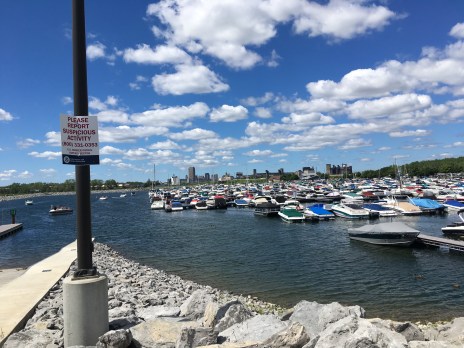
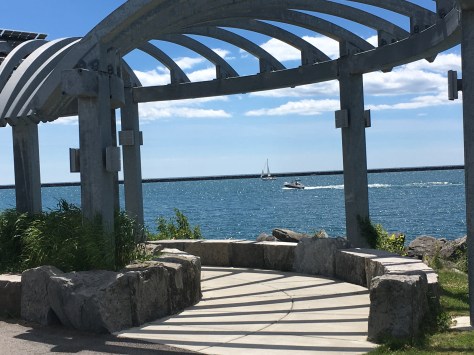
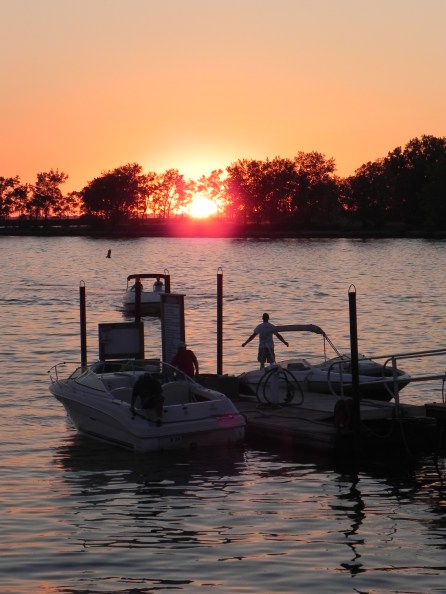
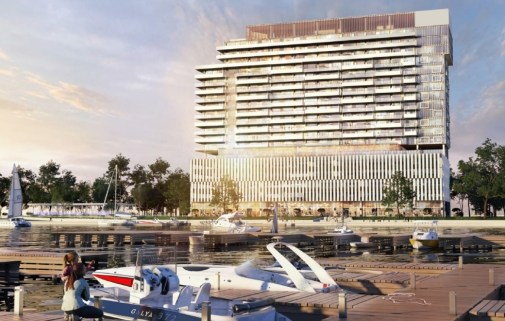
P.S.  Below is a rendering of the QCL proposal, followed by some photos of the Outer Harbor shoreline, paths, marinas and parks.

QCL 2019 rendering

IMG_1835

IMG_1818

IMG_1832

IMG_0277

IMG_0298

DSCN6689

DSCN7639


Jonathan Epstein perfects press-release journalism with Buchheit article

Posted by Arthur J. Giacalone on January 12, 2020
Posted in: Buffalo News, City of Buffalo, Development, Gerald A. Buchheit Jr., Jonathan D. Epstein, Waterfront, Zoning Law. Leave a comment

[Disclosure:  I represented a group of environmentalists and Outer Harbor activists in 2016-2018 challenging Gerald Buchheit’s 23-story version of the Queen City Landing project, and continue to express my opposition to QCL’s plans for 975-1005 Fuhrmann Blvd.  See, for example, Giacalone Letter to Common Council 01-02-20.]

What does Western New York’s biggest newspaper do two days before a public hearing on the controversial Queen City Landing project on Buffalo’s Outer Harbor?

Does it present an objective piece reflecting the pros and cons of the project?  No.

Does it explain what a “Planned Unit Development” [PUD] is, and explore the reasons that the request by Gerald Buchheit, QCL’s owner, to create a PUD at the Fuhrmann Blvd. site is considered a distortion of the PUD concept by a variety of Buffalonians?  [See for example, Sam Magavern’s Queen City Landing letter 01-09-20]  Absolutely not.

Of course, taking one of these approaches would actually be considered journalism.

Instead, we, the public, are subjected to excruciatingly one-dimensional piece by Jonathan D. Epstein, the Buffalo News business reporter.  His “reporting” is little more than a propaganda piece for the developer. While Jonathan may not have literally inserted his name on a Queen City Landing press release, he may as well have.  [Here’s the article.]

IMG_4433 (2)

[Note: Mr. Epstein has even stopped calling the proposed 20-story tower a tower, and is following QCL’s lead and just referring to it as a building.  He’s certainly well trained.]

QCL 2019 rendering

If a Pulitzer Prize were given for “press-release journalism,” I would not hesitate to nominate Jonathan’s January 12, 2020 article.

By the way, the only opportunity for the public to speak to the decision-makers regarding Buchheit’s proposed PUD will be the public hearing before the Common Council’s Legislative Committee on Tuesday, January 14, 2020 at 1:00 P.M. in the 13th-floor Common Council Chambers, Buffalo City Hall.  If you’re interested, please be there.

With All Due Respect,

Art Giacalone


It’s not a Tower – it’s a 20-Story Loft – and other QCL Tall Tales

Posted by Arthur J. Giacalone on January 2, 2020
Posted in: City of Buffalo, Development, Gerald A. Buchheit Jr., Green Code, Jonathan D. Epstein, South Buffalo, Waterfront, Zoning Law. Leave a comment

I’d like to share with you a letter that I mailed on this second day of 2020 to our nine City of Buffalo Councilmembers (including the newest legislators, Lovejoy District’s Bryan Bollman, and Fillmore District’s Mitchell Nowakowski – Congratulations gentlemen!).

Among the myriad issues raised in my correspondence is the following nugget regarding Queen City Landing’s efforts to characterize its latest proposal as a 20-story “loft”:

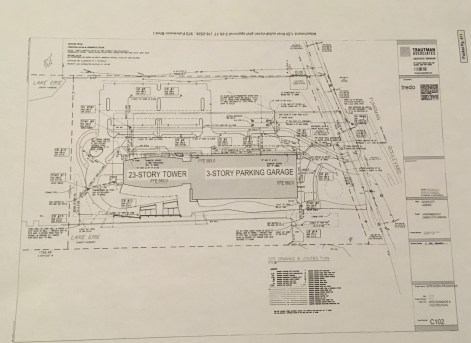
G.  Throughout QCL’s 2016/2017 application process, site plan documents consistently and accurately referred to the main structure proposed for the 975/1005 Fuhrmann Blvd. parcel as a “23-STORY TOWER.” Now, curiously, QCL refuses to use the dreaded “T-word” – TOWER when describing its proposed 20-story building. The reasons for the change in nomenclature are obvious, despite the fact that what is being proposed here is unquestionably a tower: First, a tower is a “building type” which is not allowed in the N-1S district. And, most importantly, under the Green Code, the Common Council lacks the power to waive “Building Type” requirements when establishing a PUD. So we have Buchheit’s proposed 20-story tower now masquerading as a 20-story “loft building”.

QCL 2019 rendering QCL’s 2019/2020 proposed 20-story tower.
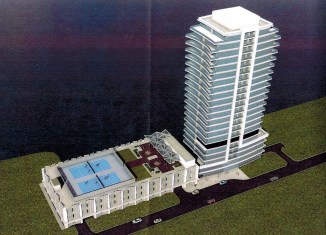
Bird's Eye View from Fuhrmann Blvd. QCL’s 2016/2017 23-story tower

For the record, not even Buffalo News business reporter Jonathan Epstein was fooled by QCL’s less-than-lofty sleight-of-hand, referring a number of times to the newly proposed “tower” in his 11/18/19 article that announced Queen City Landing’s most recent proposal for the site of the former Freezer Queen facility.

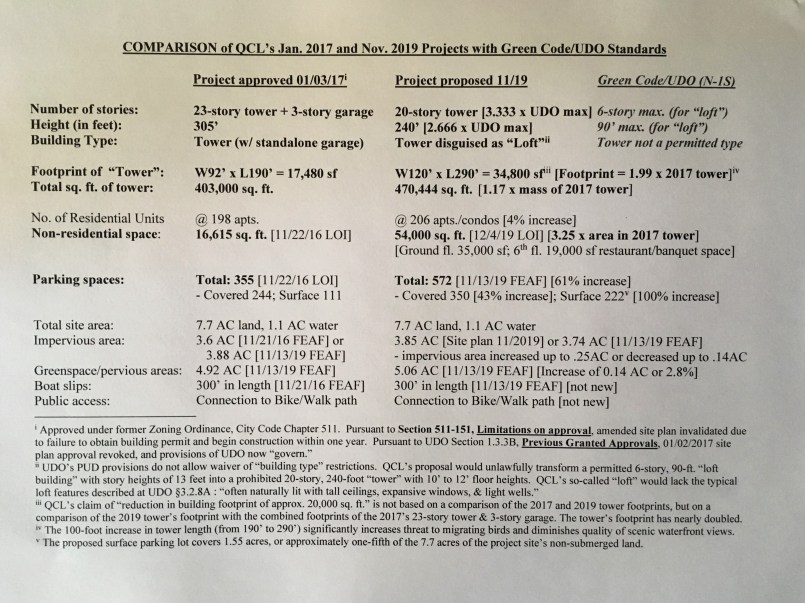
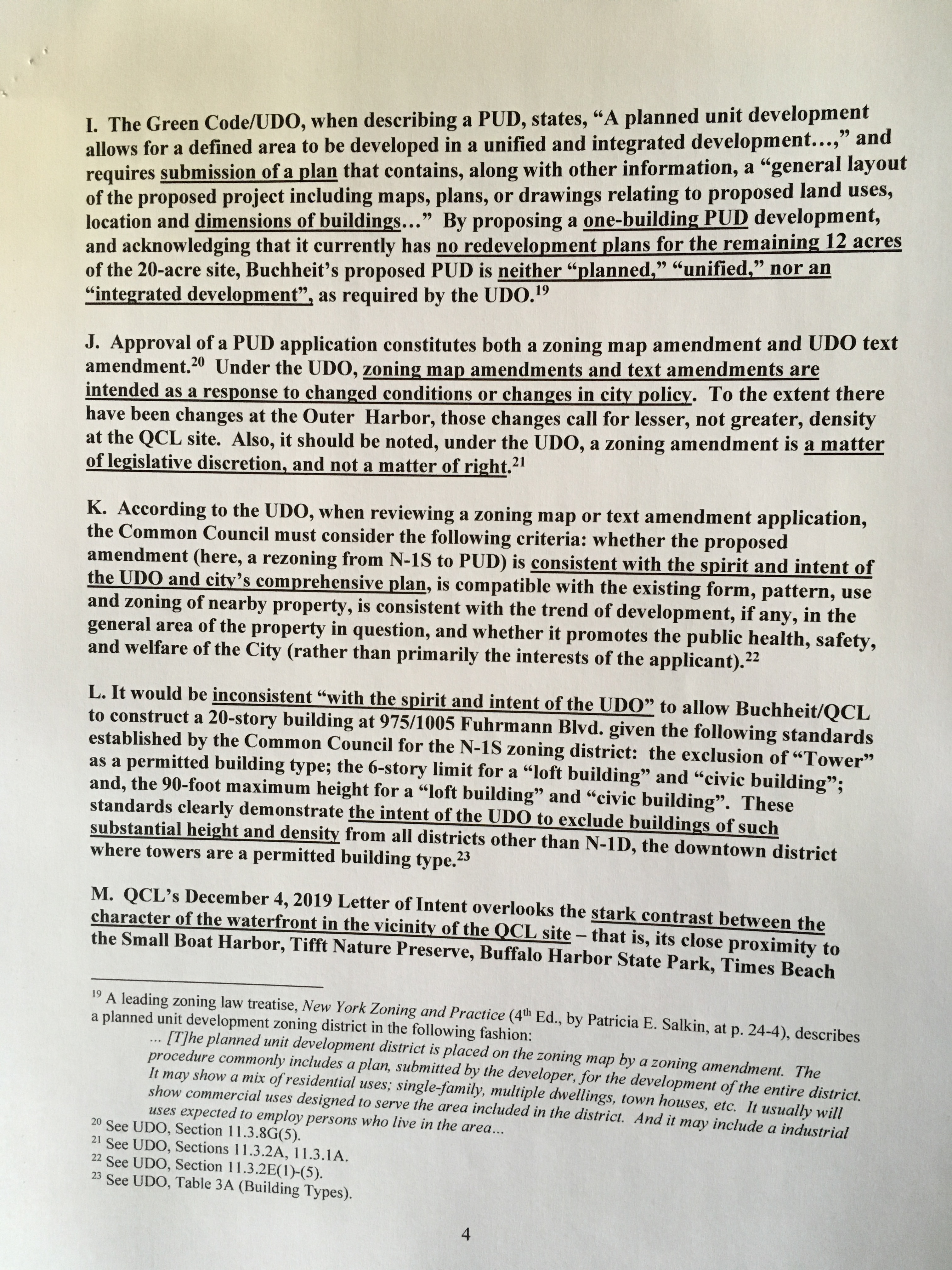
You can peruse my letter here, Giacalone Letter to Common Council 01-02-20, and also review the chart accompanying my correspondence where I compare side-by-side QCL’s latest redevelopment plans for 975-1005 Fuhrmann Blvd. with both the 23-story tower plan approved in 2016/2017 and the requirements of Buffalo’s Green Code (officially known as the Uniform Development Ordinance or UDO), Chart Comparing QCL 2017 v. 2019 v. UDO 12-30-19.

Or you can check out the chart, as well as the pages of the January 2, 2020 letter, below:

QCL Comparison Chart 01-02-2020.JPG

AJG Letter to Common Council  p1.JPG

AJG Letter to Common Council  p2.JPG

AJG Letter to Common Council  p3.JPG

AJG Letter to Common Council  p4.JPG

AJG Letter to Common Council  p5.JPG

With All Due Respect,

Art Giacalone


Ten reasons not to invest in, vote for, or reside at Buchheit’s 20-story tower

Posted by Arthur J. Giacalone on December 18, 2019
Posted in: Gerald A. Buchheit Jr., Green Code, South Buffalo, Waterfront. Leave a comment

Let me be totally frank with you.

I certainly don’t have the financial resources to invest in a major development proposal, especially one of Gerry Buchheit’s glitzy “vanity projects” on Buffalo’s waterfront. And, let’s face it, if he’s willing to characterize me as “an obstructionist … [who] objects to everything” when talking to a Buffalo News reporter, he’s unlikely to ask me to join him in a business venture.

And, I’ve never run for elected office in the City of Buffalo, much less been honored by its citizens with a position on the Common Council, so I won’t be voting on the latest version of Queen City Landing at the former site of the Freezer Queen plant.

And, at this stage in my life, I’d much rather bicycle the four miles from my South Buffalo home to the Outer Harbor to take photos of its beauty than to live there.

Nonetheless, as a public service, I do have some opinions to share.

I would not invest in Queen City Landing’s 20-story tower proposal because:

No. 1: Gerry Buchheit has a history of promising the moon, and then, not long thereafter, moving on to a different concept when unanticipated problems arise or a new idea attracts his attention.

The 20-story tower project submitted to Buffalo City Hall in mid-November 2019 is, by my count, the sixth different proposal Mr. Buchheit has presented for the Outer Harbor parcel that he purchased in 2007. [Here’s a chronology cobbled together from various media reports: Buchheit-QCL Chronology 12-17-19.]

Gerry’s plans have included a $300 million office/retail/hotel project in 2010 that he boasted “would put Buffalo on the map,” a $40 – 60 million conversion of the then-existing Freezer Queen building into 120 luxury apartments that he proclaimed in 2015 would be “the best of the best,” and a $60 – 80 million, 23-story tower (with an adjacent 3-story parking garage), approved by City Hall in 2017, that Gerry said was part of his effort “to put Western New York, especially Buffalo, back on the map, as it used to be.”

[Note: Mr. Buchheit’s history of proposing projects and then abandoning them may be unrivaled, even if one chooses to disregard his “ambitious plan” in 2002 (when his casino development group, Northstar Development Corp., owned the Statler Towers) to convert the Convention Center and the first two floors of the Statler Towers to casino space, construct a parking tower, and develop an entertainment/restaurant/retail complex stretching along the block between Delaware Avenue and Franklin Street.]

Buchheit's 2008 plans Buchheit’s 2008 proposal.

Buchheit's 2015 plans Buchheit’s 2015 proposal.

Bird's Eye View from Fuhrmann Blvd..jpg Buchheit’s 2016 proposal.

QCL 2019 rendering Buchheit’s 2019 proposal.

No. 2: Buchheit’s geotechnical consultant’s 2016 report raises the potential for excessive post-construction settlement at the site, resulting from soft and loose subsurface conditions, the tower’s heavy foundation load, and the need to significantly raise site grades to address flooding issues.

I’m not an engineer. But, the detailed characterization of the soil, sub-surface conditions, bedrock and groundwater conditions present at the Queen City Landing site, as described in the May 2016 report by Buchheit’s geotechnical consultants, and a number of the conclusions expressed in that report, convince me that there are substantial risks and the potential for unanticipated expenses for any project of the scale and intensity of the QCL proposal. [A summary of facts and conclusions from that geotechnical report that I found most worrisome are included in my October 30, 2017 post.]

No. 3: Damaging storms along Buffalo’s Lake Erie shoreline in 2019 portend an increased frequency and severity of such events, creating a precarious location for 200+ residential units and a variety of commercial enterprises.

Buffalo’s extensive shoreline saw more than its share of severe and damaging storms in 2019, experiencing menacing weather in late February, and twice during the week of October 27th.

According to the headline for a December 15, 2019 Buffalo News article, “At least $10M needed to fix Bird Island Pier, breakwall after October storms.” As explained in that report by Deidre Williams, “The breakwall – which is 2,200 feet long and is on the north end of the Outer Harbor near the U.S. Coast Guard station – is designed to prevent waves from crashing into the shoreline and flooding Ralph C. Wilson Jr. Centennial Park – formerly LaSalle Park – and parts of downtown Buffalo.”

Buffalo’s Outer Harbor, including Buchheit’s 20-acre parcel at 975/1005 Fuhrmann Blvd., was hit extremely hard during the week of October 28. OUR OUTER HARBOR – a group of organizations and individuals concerned about the appropriate development of the Outer Harbor – has concluded that a “climate emergency” exists along this vulnerable section of the Lake Erie shoreline:

“Two extremely powerful October storms created significant seiches and  hit Buffalo’s Outer Harbor during the Week of October 28 – November 1 2019. The second was more powerful than the first with wind gusts of up to 70 mph and a seiche that approached 12 feet on the Outer Harbor.  Combined with historic high-water levels on Lake Erie, the storm slammed into the coast line, overtopping and damaging areas including Gallagher Beach, Buffalo Harbor State Park, the proposed Queen City Landing development site, and Times Beach Nature Preserve. Governor Cuomo has declared a State of Emergency and FEMA resources are being considered for relief of damaged breakwalls, piers, and other infrastructure. Climate change and human development are affecting the livability of Great Lakes cities and Buffalo, is a primary target for increased damages due to severe weather and high-water conditions.  It is time to recognize that the Buffalo Outer Harbor is a “barrier island’ that protects the city. Parkland, developed along this coastline will ensure both public accessibility during the good times and public safety in the bad.” [Emphasis added.]

I would not vote to approve Queen City Landing’s latest iteration, or to rezone the site to create a Planned Unit Development (PUD) district, for a variety of reasons, including:

No. 4: The future of this site should be determined by the vision of the Common Council as expressed in the Green Code/UDO, not by a fickle developer.

As I wrote in greater detail in a December 9, 2019 post, Gerry Buchheit’s failure to obtain a building permit and begin construction of the 23-story tower plan approved in early January 2017 invalidates the design and site plan approval for that project, and subjects both his 2017 plan and his latest 20-story tower proposal to the requirements and standards of the Uniform Development Ordinance (UDO), informally known as the “Green Code.”

Under the Green Code, the Queen City Landing site is zoned “N-1S.” A “tower” is not a permitted building type in N-1S districts, and the maximum stories and building height allowed in N-1S districts are 6 stories, and 90 feet, respectively. The drastic contrast between Mr. Buchheit’s two most-recent proposals for the former Freezer Queen site and the standards set forth in the Green Code for the N-1S district can be seen in this chart: Chart Comparing QCL 2017 v. 2019 v. UDO.

No. 5: Rezoning of 975/1005 Fuhrmann Blvd. must be consistent with the City of Buffalo’s “comprehensive plan” as expressed in the Green Code/UDO, must be intended to promote the general welfare (not to benefit the owner of the property), and must be responsive to changed conditions in the community.

It would be unlawful for the Common Council to rezone the QCL parcel to allow a development that is not consistent with the city’s comprehensive plan, and is not calculated to benefit the entire community. By enacting the Green Code/UDO in late December 2016/early January 2017, our elected officials expressed the community’s plan for development for the QCL site.

Buchheit’s 20-story tower proposal is not in accordance with that plan, and is intended to benefit the property’s owner, not the wider community. Additionally, the only pertinent change in the community – an increased awareness of the frequency and severity of significant weather events, and the need to protect and preserve ecological diversity and resiliency – require a decrease in the intensity of development in the Outer Harbor, not the construction of a building of substantially greater mass and scale than envisioned in the Green Code.

No. 6: Buchheit’s proposed 20-story tower cannot be reconciled with the goals for the Outer Harbor in the draft LWRP embraced in 2016 by the Common Council: protecting the scenic quality of the coastal area; enhancing the enjoyment and appreciation of visitors to the Outer Harbor’s parks, marina, walkways and nature preserves; preserving and improving state- and locally-designated natural habitats; and, avoiding disruption of bird migration “to the maximum extent practicable.”

It is impossible to reconcile the vision for Buffalo’s Outer Harbor embraced by the LWRP with the plan proposed by Queen City Landing, LLC, and Gerry Buchheit, Jr. For example, the mass and scale of Buchheit’s 20-story tower contradicts a critical policy in the draft LWRP, protection of the overall scenic quality of Buffalo’s coastal area, including unique waterfront landscapes such as marinas, piers, wharfs and mooring areas, waterfront sunsets, and the Great Lakes Seaway Trail Scenic Byway. [Here’s the entire draft Local Waterfront Revitalization Program: LWRP.]

LWRA Natural Resources detail

No. 7: The Queen City Landing project would impede the goal of a creating a world-class state park encompassing the vast majority of the Outer Harbor.

Construction of Gerry Buchheit’s latest proposal for 975/1005 Fuhrmann Blvd. – with its 470,444-square-foot tower, 206 residential units, parking for 570 vehicles, etc. – would constitute a substantial impediment to the long-term goal of making most of the Outer Harbor a State Park. [See the plan announced in September 2019 by Partnership for the Public Good.] Expanding the existing state park at the Outer Harbor would further many important goals, including: protecting important, fragile natural and historic assets; providing prime locations for fishing, sailing, hiking, birding and other recreation accessible to city residents; and, connect with Niagara River Greenway and Empire State Trail.

And here’s why I would not want to live in Mr. Buchheit’s 20-story tower:

No. 8: It is not only cold and windy for many months of the year at the Outer Harbor, residents would not have easy access to food markets, stores and services, employment opportunities, or a variety of urban conveniences we take for granted in a neighborhood setting.

Anyone accustomed to life in an urban neighborhood – conveniently walking or bicycling to nearby destinations – would find himself or herself incredibly restricted at the Queen City Landing site. If you have the need for a residence with an expansive view of Lake Erie, you might be better off waiting for the Seneca One tower to offer apartment and condominium units. At least then you’d have downtown Buffalo at your front door.

No. 9: Closure of the Skyway due to weather conditions, while inconvenient for commuters, could pose a substantial health and safety risk for Queen City Landing residents.

As Western New Yorkers know, closure of the Skyway due to wind and snow storms is not uncommon. Access to and from Fuhrmann Boulevard becomes a significant challenge for emergency vehicles. And, most problematic of all, during extreme weather events where evacuation may be necessary, the Skyway cannot be relied upon as an evacuation route.

No. 10: Migratory bird species are attracted to large lighted buildings during their nocturnal migration, resulting in large numbers of deaths, and QCL’s proposed 20-story tower would be located in the “Niagara River Globally Significant Important Bird Area” in close proximity to two important state-designated bird and wildlife habitat areas – Tifft Nature Preserve and Times Beach Nature Preserve.  

Sorry to be gruesome, but locating Mr. Buchheit’s 20-story tower in the Niagara River Globally Significant Important Bird Area would almost certainly lead to a high number of collisions of migrating birds with the QCL building. As observed in a research article by Scott R. Loss, a scientist at the Migratory Bird Center, Smithsonian Conservation Biology Institute, National Zoological Park, Washington, D.C.:

(1) Migratory species are attracted to large lighted buildings during their nocturnal migration; this attraction causes a large amount of mortality at low-rises and high-rises as birds either immediately collide with lighted buildings or become entrapped before later dying of collision or exhaustion.

(2) Hundreds to greater than one thousand birds per year have been found at intensively monitored buildings in or near areas with a high concentration of birds during migration. [See S.R. Loss research article – published Jan. 2014.]

It is not far-fetched to suggest the possibility that residents of the proposed Queen City Landing tower could wake up one morning to the “soul-crushing scene” experienced by workers at a 23-story tower in Galveston, TX, as they arrived on May 4, 2017 “to find nearly 400 dead or dying birds lying lifeless on the ground.” As reported by Houston TV station KHOU:

“The Houston Audubon Society says the bird kill was likely caused by a combination of bad weather and bright lights. They believe Wednesday night’s storms caused the flock to fly lower to the ground and they say bright office lights attract birds which can cause them to crash into buildings.”

So now you have the first ten reasons that I would not want to invest in, vote for, or reside at Buchheit’s 20-story tower.

With All Due Respect,

Art Giacalone

Queen City Landing facts Jonathan D. Epstein – Buffalo News business reporter – hasn’t told you

Posted by Arthur J. Giacalone on December 12, 2019
Posted in: Buffalo News, City of Buffalo, Development, Gerald A. Buchheit Jr., Jonathan D. Epstein, South Buffalo, Waterfront. Leave a comment

I’ve been amazed over the years on the content of development-related articles written by Buffalo News business reporter Jonathan D. Epstein.  The reports are often so one-sided that I can’t help but wonder how closely they track the developer’s press release or the friendly conversation Jonathan may have had with a project’s sponsor.

While the “article as press release” phenomena is not new, I’ve also been witnessing something even more damaging to the public’s right to know:  development-related articles with half-truths, omissions, and misleading characterizations that put developers in a sympathetic light, and portray a project’s opponents as sinister.

Here are several examples from two recent articles written by Mr. Epstein concerning developer Gerald Buchheit’s latest proposal to construct a mixed-use tower on the Outer Harbor at the site of the former Freezer Queen facility – one published November 18, 2019  under the heading, “Queen City Landing project revised with 20 floors at Outer Harbor,” and one on December 9, 2019 headlined, “Queen City Landing opponent warns city about approvals and process“:

QCL 2019 rendering

Delays in constructing Buchheit’s 23-story tower (approved in 2016/early 2017):

According to Epstein:  His first article states, “Construction has been delayed as lawsuits over the project’s approvals moved through the court system.”  It also provides the following quote from Buchheit’s spokesperson, Phil Pantano:  “For the past two years, Jerry [Buchheit] was handcuffed with a project that he couldn’t build.  He couldn’t move forward because of outside influences,  He utilized that time, aside from completing the remediation at the site, to really review and refine his vision and plan for the project.”

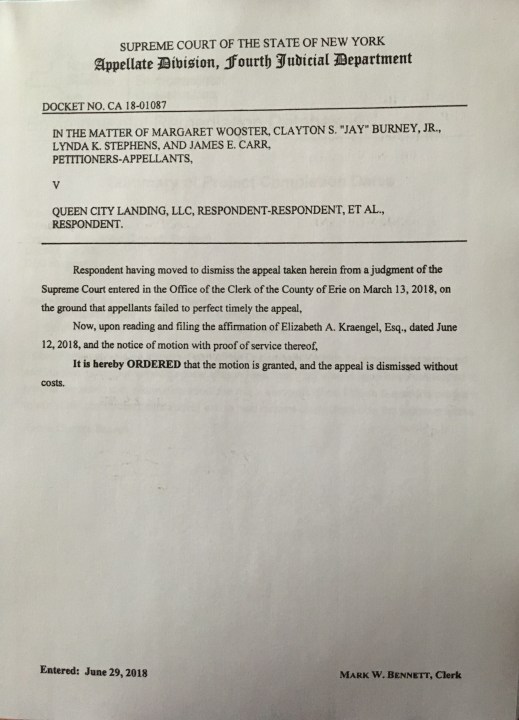
Unmentioned facts: All litigation challenging the approvals given by the City of Buffalo for the Queen City Landing project ended nearly a year-and-a-half ago, on June 29, 2018,  when the Appellate Division, Fourth Department, entered its order dismissing the appeal in Wooster et al. v. Queen City Landing, LLC.  [AD4 Dismisses Wooster Appeal 06-29-18] Also, the NYS Department of Environmental Conservation issued its “Certificate of Completion” for Queen City’ Landing’s Brownfield Cleanup Program to remediate the site one year ago, on December 14, 2018.

IMG_4303 (2)

Size and footprint of the newly proposed tower:

According to Epstein:  The Nov. 18th article tells of a proposed 470,444-square-foot tower, reduced from 23 to 20 stories, with 206 residential units,  a restaurant and 9,455-square-feet of retail space and galleria on the ground floor, and an 18,426-square-foot event and banquet facility on the sixth floor.  It also references 350 covered parking spaces built into the tower, and an additional 220 surface parking spaces.  According to Epstein, “The complex would now occupy 30% less land.”

Unmentioned facts:   The reader is not told whether the 20-story tower is, in fact, shorter in height than the previously-approved tower.  Nor does the Epstein article advise the public that:

(a) the proposed 470,444 square foot, 20-story tower has a substantially larger footprint and mass than the previously approved 23-story tower, with a total gross floor area that is 67,444-square-feet larger than the 23-story tower;

(b) the 570 proposed parking spaces equals 52% more spaces than the 375 total parking spaces approved in 2016/2017 (apparently, additional parking would be needed to accommodate the expected traffic generated by the proposed 18,426-square-foot event and banquet facility, a use not included in the prior plan);

(c) if the “complex” does, in fact, occupy 30% less land (we don’t know, for example, if this figure includes the surface parking area), it reduction is due to one fact: under the previously approved project, the majority of the “occupied” land consisted of the 3-story parking garage, not the most controversial aspect of the project, the 23-story tower.

IMG_4347 (2)

Content of the December 9, 2019 letter submitted to City’s Zoning Administrator:

[Full disclosure:  I am the person who wrote and delivered the 12/09/19 letter on behalf of myself and Margaret Wooster, Jay Burney, Jim Carr, and Lynda Stephens.] [Giacalone Letter to Zoning Administrator 12-09-19]

According to Epstein: “Giacalone says Buchheit has to start from scratch with a new municipal review – this time, under the city’s new Green Code – because the earlier approval from January 2017 under the old code was no longer valid after more than a year. Also, he said, the new zoning for the property doesn’t allow a “tower” as one of the four building type options, and caps new building height at six stories.  So variances from the Zoning Board of Appeals will also be necessary.”

The full story:

(a) Although Jonathan takes the liberty of stating as fact, “Giacalone says Buchheit has to start from scratch with a new municipal review…,” my December 9th letter never addresses the issue of whether the review must “start from scratch.”  I intentionally avoided that legal issue until I have had a chance to closely review the entire application.  [As mentioned in the 12/09/19 correspondence, I was not allowed access to any of QCL’s application when I visited City’s Office of Strategic Planning on November 25, 2019 with one of my clients.]  Mr. Epstein’s attribution of the “start from scratch” command to me is false and a liberty that he, as a reporter, should not be allowed to take.

Note:  My request that the Buffalo News print a correction regarding that attribution, and/or provide the public with an on-line link to the actual letter, has been rejected by Jonathan’s boss, David Robinson. [Email exchange 12-11-19 requesting correction]

(b) Epstein’s December 9, 2019 article fails to indicate that the letter filed with the Zoning Administrator, Nadine Marrero, provides specific support for the claims that the City Planning Board’s January 3, 2017 application for its 23-story tower is no longer valid, and that the Green Code’s 6-story limit and prohibition of “towers” at the former Freezer Queen site now apply to Buchheit’s project(s).  That support includes verbatim quotes of the pertinent provisions in both Buffalo’s former zoning ordinance and current “Green Code”.

The Buffalo News fails to serve its readership and the public in the manner they deserve when its reporters write articles concerning major (and, controversial) development projects that do little more than provide the developer’s spin, attempt to paint opponents in a negative light, fail to substantively detail the opponents’ position, and/or take liberties with what an opponent has actually stated.  Western New York’s largest newspaper must do better.

With All Due Respect,

Art Giacalone


Buffalo’s Green Code catches up with Buchheit’s QCL tower

Posted by Arthur J. Giacalone on December 9, 2019
Posted in: City of Buffalo, Development, Gerald A. Buchheit Jr., Green Code, South Buffalo, Waterfront, Zoning Law. 1 Comment

[Full disclosure: On December 9, 2019, I filed a letter with the City of Buffalo’s Planning Director/Zoning Administrator, Nadine Marrero, on behalf of myself and four City of Buffalo residents and environmental activists, regarding Queen City Landing, LLC’s latest proposal for the former Freezer Queen property on Buffalo’s Outer Harbor.  You can read that letter (minus the documents accompanying it) here: Giacalone Letter to Zoning Administrator 12-09-19.]

Gerald Buchheit was in a hurry, it seemed, back in 2016 and early 2017, to obtain all the zoning-related approvals he needed for his 23-story, mixed-use project proposed for Buffalo’s Outer Harbor.  And City Hall’s bureaucrats and elected officials were more than willing to accommodate him, by scheduling public hearings before Buchheit’s submissions were complete, proceeding without the thorough environmental assessment that (theoretically) accompanies an Environmental Impact Statement, etc., etc.

Bird's Eye View from Fuhrmann Blvd.

Why the rush?  Buchheit’s team needed to have an approved project in place before the long-awaited “Green Code” – known officially as the Uniform Development Ordinance [UDO] – was enacted by Buffalo’s Common Council, signed by Mayor Byron Brown, and placed into effect.

While the developer wished to build Buffalo’s tallest residential tower – in the midst of an important migratory bird pathway, adjacent to the Small Boat Harbor , and in close proximity to the ecologically significant-but-fragile Lake Erie shoreline – the Green Code had a very different vision for the former Freezer Queen site at 975/1005 Fuhrmann Blvd.:  the “N-1S” zoning designation for that property would not only prohibit construction of a tower, it would limit the height of the allowed “building types” to a maximum of six stories.

Buchheit and his team won the sprint to the finish line.  QCL obtained all of the zoning and planning approvals that he needed for his 23-story mixed-use tower prior to the April 3, 2017 effective date of the Green Code/UDO.   [The last of those approvals – the City Planning Board’s approval of a Final Subdivision Plat – was granted on March 13, 2017, just three weeks before the UDO went into effect.]

So Buchheit had managed to avoid the much stricter requirements for the former Freezer Queen project.  But, whether or not he knew it, the need to remain steadfast was not over.

Included among the approvals granted to QCL under the former Zoning Ordinance was the City Planning Board’s January 3, 2017 resolution granting QCL’s Amended Site Plan application.  [That’s the same day Mayor Brown signed the Green Code/UDO into law with a provision delaying the effective date of the city’s new zoning ordinance to April 3, 2017.]

Chapter 511 of the City Code placed an important restriction on a developer who burdens the city officials – and, the public – with proposals to construct a project.  More specifically, Section 511-151 of the prior Zoning Ordinance, entitled, “Limitations on approval,” states:

Section 511-151. Limitations on approval. No design and site plan approval shall be valid for more than one year from the date of issue, unless a building permit is issued and construction has actually begun within that period and is commenced within that period.

The one-year anniversary of the Amended Site Plan approval occurred on January 3, 2018 (as a matter of fact, we are fast approaching the passage of three years from the date the City Planning Board issued its design and site plan approval for QCL’s 23-story tower at the former Freezer Queen site).

According to the City’s Office of Permit and Inspection Service, QCL has never applied for, much less obtained, a building permit to construct the 23-story tower subsequent to its receipt of the January 3, 2017 Amended Site Plan approval. Therefore, pursuant to Section 511-151, QCL no longer has a valid design and site plan approval for the 2016/2017 project.

Not surprisingly, the Green Code/UDO specifically addresses, at Section 1.3 (Transition Rules), the manner in which projects which had been granted approvals prior to the April 3, 2017 effective date of the UDO are to be treated. Generally, such projects may proceed in accordance with the previously granted approvals. However, at Section 1.3.3B, the UDO expressly revokes a prior approval “if the applicant fails to act before any approval expires,” and instructs that the provisions of the UDO then govern. More specifically:

1.3.3 Previously Granted Approvals

…  B.  If the applicant fails to act before any approval expires, including any periods of extension granted, the provisions of this Ordinance govern and the previous approval is revoked.

As a result of the above-quoted zoning provisions, Queen City Landing, LLC, no longer possess a valid design and site plan approval to construct the previously approved 23-story project. And, of even greater significance, the standards and requirements of the Green Code/UDO now govern both the project approved by the City of Buffalo in 2016/2017, and the latest “vanity project” Buchheit has proposed for 975/1005 Fuhrmann Blvd., a 20-story apartment/condominium/event/banquet facility.

Under the UDO, a developer is required to select a “building type” that is allowed to be constructed within the zone where a proposed project is to be located, and the project must comply with the standards for that building type.  The UDO’s “TABLE 3A: BUILDING TYPES” identifies which building types are permitted in each zoning district.

IMG_4306 (3)

As set forth in Table 3A, the only building types permitted in an N-1S zone – which is 975/1005 Fuhrmann Blvd.’s zoning classification – are “Attached House”, “Civic Building”, “Flex Building”, and “Loft Building”. A “Tower” is a building type that is not “permitted” in an N-1S zoning district.

Additionally, as noted above, a review of the pertinent sections of the UDO indicates that the maximum number of stories allowed for any of the four building types permitted in an N-1S zone is six stories. (See UDO Section 3.2.2E (Attached House, max. 4 stories, 52’); Section 3.2.4E (Civic Building, max. 6 stories, 90’); Section 3.2.7E (Flex Building, max. 1 story); and, Section 3.2.8 (Loft Building, max. 6 stories, 90’).

Clearly, Buchheit’s latest plan – a 20-story mixed-use project – is stunningly inconsistent with the Green Code/UDO’s vision for 975/1005 Fuhrmann Blvd.

QCL 2019 rendering

And it is also totally out of character with the current and envisioned uses of the Outer Harbor.

LWRP map detail rec areas - LEGEND

Accordingly, at a minimum, the 2019 QCL project requires not only design and site plan review by the City Planning Board, but also substantial variance(s) from the Zoning Board of Appeals.

Two final thoughts for now, regarding the justifications Mr. Buchheit’s team has apparently expressed in an attempt to explain their lengthy delay in proceeding with QCL’s plans for an Outer Harbor tower.

First, an article published in the November 19, 2019 Buffalo News, written by business reporter Jonathan Epstein, reports that , “Construction has been delayed as lawsuits over the project’s approvals moved through the court system.”  In fact, litigation challenging the city’s approvals for QCL’s 23-story tower project ended nearly a year-and-a-half ago, on June 29, 2018, when the Appellate Division, Fourth Department, issued its order dismissing the appeal in Wooster et al. v. Queen City Landing, LLC, et al.  Here’s a copy of the appellate court’s order:

IMG_4302 (2)

Second, the 11-19-19 Buffalo News article also mentions that QCL used the intervening time “completing remediation at the site.”  However, it was twelve months ago, December 14, 2018, that the NYS Department of Environmental Conservation issued its “Certificate of Completion” for QCL’s Brownfield Cleanup Program. Here’s the DEC’s “Summary of Project Completion Date”:

IMG_4303 (2)

With All Due Respect,

Art Giacalone

“The Lawrence” highlights what’s lousy with Bflo’s land use laws

Posted by Arthur J. Giacalone on November 25, 2019
Posted in: B-N Medical Campus, Byron Brown, City of Buffalo, Development, Fruit Belt, Gentrification, Green Code, SEQRA, Zoning Law. Leave a comment

Tim LeBoeuf and his Symphony Property Management, LLC, have big plans. They would like to construct “The Lawrence,” a 5-story, 131-unit market rate apartment project on Michigan Avenue and Maple Street.

If built, The Lawrence would be the first major residential project encroaching on the Fruit Belt, a historically rich, economically poor, predominately non-white neighborhood. It is a neighborhood situated immediately east of the Buffalo Niagara Medical Campus (BNMC), bordered by Michigan Avenue to the west, Jefferson Avenue to the east, Best Street to the north and the Kensington Expressway to the south, with High Street serving as its focal point. The Fruit Belt’s streets, which include names such as Grape, Peach, Lemon and Orange, consist primarily of one-family, two-family and three-family homes, nearly all of which stand no more than two stories high.

[Here’s a link to an informative brochure “Architectural Guide to the Fruit Belt” – as well as a link to an intensive survey of the Fruit Belt neighborhood’s history, people, and distinctive building stock.  See P.S. below for additional information.]

BNMC and Fruit Belt map

Three peculiarities stand out to me as I review the papers filed with the Mayor’s Office of Strategic Planning in support of “The Lawrence”:

First, the submitted documents refer to “building” and “structure” as if the development consists of only one building. In fact, what is being proposed are two large buildings, one on Michigan Avenue facing the medical campus, and one on Maple Street, surrounded by the Fruit Belt neighborhood. [Note: The official terminology used in the Zoning Board of Appeals (ZBA) “agenda” continues the misleading reference to a lone building, “983 Michigan Avenue – Construct Multiple-Unit Residential Building.”]


IMG_4185 (3)

Second, Tim LeBoeuf’s application uses at least three different titles for the project: “The Lawrence Market Rate Apartments,” “Michigan Avenue/Medical Campus Apartments,” and “The Lawrence Michigan Avenue Apartments.” Notably, none of the names references the project’s location within the Fruit Belt, or seems to target as potential tenants current Fruit Belt residents.

Third, consistent with the various names given to the proposed development, the project seems designed to ensure that its “market rate” tenants can, if they choose, have virtually no interaction with the people who presently call the Fruit Belt their home (other than driving their vehicles to and from the enclosed ground floor parking and the adjacent street). Patios are located internally. None of the units will have balconies facing either Maple Street or Michigan Avenue. The prolonged Maple Street expanse gives the impression of an unwelcoming wall.

IMG_4288 (3)


The more I think about the proposed development’s details – and the political, social, and legal context in which it was submitted and is being processed – the more I realize that “The Lawrence” proposal epitomizes virtually all that is (from my perspective) wrong with the land use, zoning, and development processes in the City of Buffalo. And the more I am reminded that much of what I view as detrimental to the interests and effectiveness of city residences is: (a) rooted in the pro-development philosophy of Mayor Brown; and, (b) facilitated by the all-too-often docile and ineffective actions of the city’s legislators, the Common Council, headed by its President, Darius Pridgen (who is also the Ellicott District Councilmember, and, therefore, tasked with the responsibility of representing the interests of the voters in and around the Fruit Belt).

More specifically:

1.  THE primary function of the Green Code is to provide a “Green Light” to development, not, as promised, to preserve neighborhoods or protect the quality of life of residents.

When Mayor Byron Brown announced the Buffalo Green Code back in 2011, city residents were promised a land use plan that would preserve the character of neighborhoods and encourage future development that was consistent with the prevailing patterns. Residents were told that the historic fabric in a neighborhood – typical lot sizes, scale of existing buildings, and the intensity of development – as well as what residents wanted to see in their neighborhoods, would provide the foundation for future growth. That’s not what we got.

The Green Code, crafted, not by our legislative body, the Common Council, but primarily by and under the supervision of the Mayor’s Office of Strategic Planning, supplanted these lofty goals with a competing set of interests: the desire of developers to maximize profits.

The new zoning ordinance increases the ability of developers and commercial interests – not City residents and their elected Common Council members – to decide where new construction will occur by not only significantly increasing the amount of land “available for as-of-right development” (that is, without the need for rezoning or the grant of a special use permit by the Common Council), but also by greatly increasing the density of the projects permitted “by right.”

2. The Green Code, and the state-mandated “environmental review” that preceded it, ignored the adverse impacts of gentrification on less affluent neighborhoods such as the Fruit Belt, and encouraged displacement of longtime residents and homeowners by allowing commercial and residential buildings out-of-scale with the surrounding community.

Buffalo’s Common Council was the official the “lead agency” responsible under SEQRA (the State Environmental Quality Review ACT) to take a “hard look” at the potential adverse impacts of the proposed new zoning and development law – that is, the Uniform Development Ordinance or “Green Code.” Rather than preparing, or, at a minimum, closely supervising preparation of the state-mandated “draft environmental impact statement” that preceded the enactment of the Green Code, Buffalo’s elected legislators let the Mayor’s Office of Strategic Planning perform the lion’s share of this crucial task.

Despite protests (by me, AJGiacalone’s DGEIS comments 03-15-16, and others), the SEQRA study prepared by the Office of Strategic Planning failed to address significant legal and moral issues, such as: To what the extent would Mayor Brown’s vision for Buffalo – manifested in the “Green Code” – result in the displacement of low-income, mainly non-white residents from their neighborhoods?  Would a zoning code that allows “as of right” construction of large mixed-use commercial buildings (what the Green Code calls “Commercial Block” buildings) on portions of Michigan Avenue and High Street near the medical campus, and large residential buildings (referred to in the Green Code as “Stacked Units”) throughout the Fruit Belt, accelerate gentrification and the displacement of Fruit Belt residents?

BGC Stacked Units dark0001

BGC Commercial Block dark0001

The failure of Buffalo’s executive and legislative officials to openly and objectively confront these issues has left many residents vulnerable. Tim LeBoeuf’s proposed apartment project, and the fashion by which it is handled by Buffalo City Hall, will undoubtedly begin the process of answering these and related questions that the Brown Administration and the Common Council chose not to address prior to enacting the Green Code.

3.  Even when a zoning ordinance gives developers an extremely generous “inch,” some (most?) will try to take the proverbial “mile”.

The Green Code that was enthusiastically approved by Mayor Brown and the Common Council in early 2017 designates the portion of the east side of Michigan Avenue directly across the street from the Buffalo Niagara Medical Campus, as well as most of High Street between Michigan Avenue and Jefferson Avenue, an “N-2E” (Mixed Use Edge) zone. Under Buffalo’s zoning ordinance, an N-2E zone allows “by right” development of “Commercial Block” mixed-use buildings, and “Stacked Units” residential buildings, up to three-stories in height and on lots as wide as 120 feet.

The Green Code places virtually all of the remainder of the Fruit Belt’s residential streets, including Maple Street, in the “N-2R” (Residential) zone. While Commercial Block buildings are not allowed by right in an N-2R zone, under Buffalo’s zoning ordinance, “Stacked Units” residential buildings, up to three-stories in height and on lots as wide as 75 feet, are permitted “by right” in N-2R.

As written, the Green Code magnanimously allows a developer to construct “by right” on Maple Street a three-story, 15,750 square-foot apartment building on one or more parcels of land totaling up to 75 feet in width. Likewise, Buffalo’s zoning ordinance permits construction “by right” on Michigan Avenue of a three-story, 25,200 square-foot apartment building on parcel(s) of land as wide as 120 feet.

But that was not enough for Mr. LeBoeuf and company.

LeBoeuf’s Symphony Property Management is seeking approval to combine fifteen (15) parcels – six on Michigan Avenue totaling 181.5 feet in width (when the maximum width allowed in an N-2E zone is 120’), and nine on Maple Street totaling a whopping 260 feet in width (when the maximum permissible lot width in the N-2R zone is 75’). And the developer wants The Lawrence buildings to reach five stories in height – despite the Green Codes 3-story limit in both N-2R and N-2E zones.

All in all, the total square footage of The Lawrence as proposed is approximately 136,800 square feet of new, market rate apartments (I say “appears” because LeBoeuf’s papers do not supply this figure). As stated in the papers submitted in support of the proposed development, Symphony Property Management has chosen this “density and scale” in order “to provide a financially feasible project that does not rely on public funds to sustain itself.” LeBoeuf’s application then states that “the proposed scale is not out of character with the surrounding context of the Buffalo Niagara Medical Campus.” Revealingly, no mention is made of the inconsistency between the 5-story, 131-unit, 136,800-square-foot girth of the “The Lawrence” project, and the modest density and scale of Fruit Belt neighborhood it would surely dominate.

To demonstrate the extent to which LeBoeuf’s proposal is dramatically out of character with the surrounding Fruit Belt neighborhood, I have compiled “Property Information” from the City’s on-line site regarding the fifteen residential properties on or adjacent to Maple Street nearest to the fifteen parcels sought to be combined for the proposed apartment project. Here’s what the city’s official data reveals:

– Number of units: The 15 nearest residences – each containing one, two, or three units – have a total of 27 units, as compared to the 131 units proposed for The Lawrence.

IMG_4054

IMG_4063

– Number of stories: While LeBoeuf and company would like to build two 5-story structures, the average height of the 15 nearest residences – none of which is over two stories in height – is 1.67 stories.

IMG_4061

– Square footage of buildings: The total area of the 15 nearest residential structures is 33,343 square feet. As noted above, The Lawrence as proposed totals approximately 133,800 square feet.

IMG_4070

– Lot sizes: LeBoeuf would like to construct 133,800 square feet of market rate apartments on just 1.014 acres of land. In contrast, the total area of the 15 nearest developed lots is 1.402 acres, about 40% larger than The Lawrence composite site.

– Density of development: Most revealing of all, the 15 nearest residences comfortably support 19.25 units per acre, while The Lawrence proposal would dramatically alter the character of the Fruit Belt neighborhood with its 129.2 dwelling units per acre.

Symphony Property Management certainly is trying to make the most out of the very generous opening to the Fruit Belt provided by the authors of the Green Code.

4.  Byron Brown’s Administration has created an environment in which “sophisticated” developers, their architects, and lawyers, don’t even try to present a proposal that meets the specific requirements of the Green Code.

As Mayor, Byron Brown appears to have filled City Hall with planners, administrators, and lawyers who understand, in the words of a friend of mine, His Honor’s “doctrine of development”: do everything you can to facilitate a developer’s proposal. On top of that, thanks to his longevity as mayor, Byron Brown has appointed – or, at a minimum, reappointed – every single member of the two entities meant to make the zoning process fair and transparent: the City Planning Board, and the Zoning Board of Appeals.

Given the pro-development bent at City Hall, the professionals who work for developers – and, the developers themselves – have figured out that they don’t need to exert themselves too strenuously in an effort to meet the requirements of the Green Code. Indeed, the “doctrine of development” has led to a world where projects are filed that require not only multiple variances from the ZBA, but, as with the LeBoeuf proposal, need in excess of 20 such deviations from the criteria set forth in Buffalo’s zoning ordinance.

IMG_4226 (2)

This approach leaves residents confused, cynical, and rightfully distrustful of the City of Buffalo’s land use and development process.

It also shows how City Hall has chosen to disregard a quote (attributed to Austrian-born architect Christopher Alexander) that had graced early documents disseminated on behalf of Mayor Brown’s “Green Code”: “Every increment of construction must be done in such a way as to heal the city.”

With All Due Respect,

Art Giacalone

P.S.  The Fruit Belt brochure and intensive level survey were commissioned by the Fruit Belt/McCarley Gardens Housing Task Force, overseen and managed by Preservation Buffalo Niagara,  funded by the Preservation League of New York State and the Buffalo Niagara Medical Campus.  The project consultant on the intensive level survey was Preservation Studios.

Judge lawyers not by the color of their shoes or cachet of their law degrees…

Posted by Arthur J. Giacalone on November 20, 2019
Posted in: Buffalo News, Byron Brown, City of Buffalo, Corporate Welfare, Development, Judiciary, TM Montante Development. Leave a comment

IMG_4192

It was gratifying to see the Buffalo News editorial board’s opinion, published on line on November 18, 2019, under the headline:  Editorial: Common sense on Gates Circle.

The editorial board praises the November 15, 2019 decision by the Hon. Mark A. Montour, Justice of the New York State Supreme Court, for “reject[ing] the (City of Buffalo’s) ludicrous logic of calling Gates Circle ‘blighted’ to get tax breaks (for private developer TM Montante Development LLC).” 

As the attorney who brought the lawsuit on behalf of Buffalo resident Daniel Sack, I certainly concur with the editorial’s conclusion:  “Montour’s ruling is a victory for common sense.”  But I need to note that this is also a victory for individuals, such as Dan, who are willing to stand up and proclaim:  City officials, you are abusing the intent of the law, and I am going to challenge you in court.

[If you’re interested in learning about the legal and factual background of the case, please read my November 16th blog post , and if you’d like to see the court’s perspective first-hand, here’s Justice Montour’s decision : Justice Montour’s Decision in Sack v. Buffalo Common Council-TM Montante.]

But the real purpose of this posting is to briefly follow up on one curious comment in the Buffalo News editorial:  “… [I]t does not take a white-shoe law firm to know the difference between a high-end neighborhood and a sham.”

I agree.  It shouldn’t matter how prestigious or large a law firm is, or the school where a lawyer has obtained her or his degree.  Each person given the privilege to practice law in New York State should not only have the capacity to look at a legal issue in an objective and logical manner, but also — whether a government lawyer, a private practitioner, or in-house counsel – should possess the courage and integrity to say to his/her client or boss:  With all due respect, this makes no sense.

One final thought.  Our city’s elected and appointed officials – from Mayor, to Common Councilmembers, to planning and agency staffs – must also apply common sense and a desire to follow the law when they are making decisions on our behalf.  They are not off the hook simply because an issue involves the meaning or purpose of a statute or law.

With All Due Respect,

Art Giacalone


City of Buffalo’s misuse of state law to aid developer exposed by State Supreme Court

Posted by Arthur J. Giacalone on November 16, 2019
Posted in: Buffalo Urban Renewal Agency, Byron Brown, City of Buffalo, Corporate Welfare, Development, Elmwood Village, TM Montante Development. Leave a comment

I’m posting below a Press Release sent 11-16-2019 to WNY reporters to tell them of Justice Mark Montour’s Decision in Sack v. Buffalo Common Council-TM Montante.  [To read what the Buffalo News reported in response to the court’s decision, click here.  To read the editorial issued by the Buffalo News editorial board praising the ruling as “a victory for common sense,” click here. For background on this matter, from my perspective, please click here and here.]

State Supreme Court annuls “Linwood Lafayette Urban Development Assistance Area” designation at former Millard Fillmore Hospital Gates Circle site

Court declares Buffalo Common Council’s action “arbitrary and capricious” and without a “rational basis,” sets aside city’s “gerrymandered” inclusion of Gates Circle and rights-of-way on Delaware, Linwood & Lafayette in the LLUDAA, and questions the “curious” branding of a prominent neighborhood as a “slum.”

A November 15, 2019 Decision of the Hon. Mark A. Montour, Justice of the Supreme Court, annuls and sets aside the City of Buffalo’s April 16, 2019 resolution creating the “Linwood Lafayette Urban Development Action Area” [LLUDAA] at the site of the former Millard Fillmore Gates Circle Hospital, and holds that the designation is “inconsistent with the policy and purposes stated in Article 16, Section 691 of the New York State General Municipal Law.”  [Here’s the text of GML Section 691.]

Creation of the Linwood Lafayette Urban Development Action Area had been requested this past spring by TM Montante Development LLC, proposed to Buffalo’s Common Council by the Buffalo Urban Development Agency [BURA], and endorsed by Mayor Byron Brown’s Office of Strategic Planning, as a mechanism to provide the Tonawanda developer with enhanced tax incentives and financial assistance.

The legal challenge to the city’s creation of the LLUDAA was brought by petitioner Daniel Sack, a long-time Elmwood Village resident. Mr. Sack argued that the generous financial assistance available once a city designates an Urban Development Assistance Area was not intended as a way to jump-start Montante’s redevelopment of the Gates Circle site, but was meant for use only in a very narrow situation: as an incentive to private businesses to correct or prevent blight and deterioration of city-owned property where the property had been acquired through urban renewal powers, tax foreclosure proceedings, or similar processes, and the land is “appropriate for urban development.”  [Here’s Sack Petition-Complaint.]

Justice Montour’s Decision agrees with petitioner’s argument, and sternly rejects the Common Council’s argument that its exercise of discretion was not reviewable by the court. The court’s ruling also questions the city’s “gymnastic exercise of juxtaposing terms and language” to justify its branding of the Gates Circle neighborhood a slum, observing: “So, if the LLUDAA is in the middle of a ‘vibrant and affluent neighborhood’ considered to be a ‘prominent area’ of the City” – as the Common Council concedes – “then it begs the question how the area can be a ‘slum’ in danger of further deterioration.”

Linwood Lafayette UDAA map

Mr. Sack’s attorney, Arthur J. Giacalone, had the following reaction to the decision: “The court has rightfully insisted that we must be a city of laws. It will be a great day for city residents when City Hall becomes as bold and imaginative when addressing the needs of Buffalo’s less fortunate as it was in its efforts to bail out an underfinanced private developer.”

With All Due Respect,

Art Giacalone

Posts navigation

← Older Entries
Newer Entries →
  • CATEGORIES

  • February 2026
    M T W T F S S
     1
    2345678
    9101112131415
    16171819202122
    232425262728  
    « Nov    
  • DISCLAIMER

    This blog is provided for general informational purposes only. It should not be construed as legal advice and is not intended to be a substitute for legal counsel. Persons requiring legal advice should retain a properly licensed lawyer. No attorney-client relationship will be formed based on use of this site and any comments or posts to this blog will not be privileged or confidential. *************** This blog's author, Arthur J. Giacalone, does not intend or consider the communications at this blog to be ATTORNEY ADVERTISING. The primary purpose of the communication is not for the retention of Mr. Giacalone's legal services. [See definition of "Advertisement" at Part 1200, Rules of Professional Conduct, Rule 1.0(a).] Nonetheless, in case the proper authorities choose to treat this web site as ATTORNEY ADVERTISING, the street address, phone number and email address of the law office of Arthur J. Giacalone are: 17 Oschawa Avenue, Buffalo, New York 14210; (716) 436-2646; AJGiacalone@twc.com.
Blog at WordPress.com.
With All Due Respect
Blog at WordPress.com.
  • Subscribe Subscribed
    • With All Due Respect
    • Join 62 other subscribers
    • Already have a WordPress.com account? Log in now.
    • With All Due Respect
    • Subscribe Subscribed
    • Sign up
    • Log in
    • Report this content
    • View site in Reader
    • Manage subscriptions
    • Collapse this bar
 

Loading Comments...