With All Due Respect

Photos and musings by Arthur J. Giacalone

  • About The Author
  • About This Blog
  • Pre-WADR Archives

Why won’t Buffalo City Hall enforce the Green Code?

Posted by Arthur J. Giacalone on June 7, 2017
Posted in: Byron Brown, Chason Affinity, City of Buffalo, Development, Elmwood Village, Green Code. Leave a comment

[A version of this post was published by The Public on June 14, 2017 under the headline, “Elmwood-Forest and the Green Code.”  You can read it here.]

The City of Buffalo’s long-touted new zoning law – the Uniform Development Ordinance (UDO) or “Green Code” – has been in effect citywide for two months. Is that too short a time period for members of Mayor Byron Brown’s planning staff to familiarize itself with its provisions and apply its requirements to Chason Affinity’s proposed “1111 Elmwood” project at the southeast corner of Elmwood and Forest avenues?

Or, are we just seeing more of the same from the ninth floor of City Hall? That is, are the staff members of the Mayor’s Office of Strategic Planning (headed by Executive Director Brendan Mehaffy), and the city’s Division of Planning (under the leadership of Nadine Marrero) being willfully indifferent or blind to zoning, planning and environmental requirements that might slow down or derail a proposed development project?

I’m not in a position to know with certainty whether it is ignorance, indifference, incompetence, or some unidentified reason. What I do know is that Chason Affinity’s project is not being held to the requirements of either the former zoning ordinance or newly-enacted Green Code/UDO. While an excellent report by WBFO’s Chris Caya diplomatically includes a question mark in its headline – Does proposed Elmwood Village project violate the Green Code? – the answer, in my opinion, is a clear and unequivocal YES!

Please note, I am not saying – as many well-intentioned individuals have argued – that Chason Affinity should be prohibited from proposing a project that requires “variances” from the specific requirements of the zoning ordinance. Both New York State law and the Green Code/UDO mandate that a property owner or project sponsor have access to the variance process – that is, the ability to apply to the city’s Zoning Board of Appeals [ZBA] in an attempt to demonstrate at a public hearing that he/she should be relieved of a particular requirement in the zoning code.

I’m saying that there are provisions of the Green Code/UDO that Chason Affinity’s proposed project violates, and that the city’s planning staff are, intentionally or otherwise, disregarding those requirements and allowing the application process to proceed without addressing that non-compliance.

If you are interested in the details, please read the letter that I sent on June 5, 2017 to James Comerford, Jr., Commissioner of the City’s Department of Permit & Inspection Services [who is empowered under the Green Code/UDO to provide “written interpretations” of the UDO provisions], and Ms. Marrero [who, as “Zoning Administrator,” is the person who makes a “determination of completeness” when a project sponsor applies for a discretionary approval under the UDO from the Common Council, City Planning Board, or Zoning Board of Appeals (ZBA)].  Here’s a link to that correspondence: Letter to Comerford-Marrero re 1111 Elmwood 06-05-17

And here is a quick summary of the primary areas of non-compliance that I believe the Mayor’s planning staff has so far ignored:

Issue No. 1 – Combination of lots

The Green Code/UDO’s “Elmwood Village Standards” include the following provision: “No more than two lots in the Elmwood Village, existing at the time of the adoption of this Ordinance, may be combined for the purposes of new construction in an N-2C or N-2E zone.” Chason Affinity’s Elmwood Ave. property is located in an N-2C zoning district, and consists of 10 lots, extending 321.5 feet.

Chason Affinity claims that it combined these lots in 2016, but has not provided any public support for that assertion. There was only one lawful way in 2016 for the project sponsor to consolidate its lots: obtain approval of such consolidation from the City Planning Board after a public hearing. Zoning Administrator Marrero has stated in a recent email that consolidation of the Chason Affinity parcels was not completed through the Planning Department, but, apparently, through “Assessments.”

Despite the apparent failure of Chason Affinity to lawfully combine “more than two lots”, Ms. Marrero has allowed the proposed 1111 Elmwood project to proceed before the Planning Board and – as currently scheduled – the ZBA on June 21, without addressing this significant issue. While Chason Affinity’s 10-lot combination extends over 320’ on Elmwood Avenue, the two-lot limitation would restrict the Elmwood Ave. frontage – and, the length of the building – to less than 82 feet – and would eliminate the need to demolish 8 of the ten of the existing century-old buildings.

Exh 76 - Front yards 1095-1121 Elmwood

Issue No. 2 – Chason Affinity’s hybrid “Commercial Block”/“Stacked Units” building

The Green Code/UDO is clear. A project sponsor must “select” which allowed building type it proposes to construct, and then comply with the standards for that building type. This form-based approach to zoning was an integral feature of the new zoning code. But Chason Affinity has failed to comply with this requirement, and is attempting to have its building treated as both a Commercial Block building where convenient, and Stacked Units building where a Commercial Block building is inappropriate.

The most disturbing aspect of this issue is that the Zoning Administrator and City Planning Board are allowing the project sponsor to get away with this flagrant disregard of this basic Green Code/UDO requirement.

Issue No. 3 – Conflicts with “Commercial Building” and “Stacked Units” requirements

Whether or not the intention of the Green Code/UDO is to permit a “hybrid” building, the residential-only portions of the proposed monolith – the southern portion of the Elmwood Ave. frontage, and the portion of the building located at 605 and 607 Forest Ave. – violate a number of the requirements for a “Commercial Block” building and “Stacked Unit” buildings.

City Hall has treated the Chason Affinity application as “complete” without requiring the project sponsor to apply for additional variances despite the following examples of non-compliance with Green Code/UDO requirements:

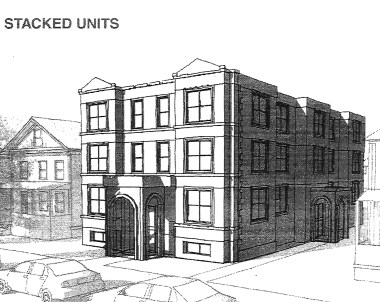
(a) The residential-only portion of the building located at 605-607 Forest Ave. violates the following “Stacked Units” requirements: (i) there appears to be no “shared entry”;  (ii) it lacks a second side yard (which would make it a free-standing structure); and (iii) it appears to lack the required rear yard.

BGC Stacked Units dark0001

(b) If the “condominium portion” of the building on Elmwood Avenue is a Commercial Block building, as claimed by Chason Affinity, it currently violates the “Commercial Block” requirement that the ground floor consist of “retail or service uses.”

(c) If, in fact, the “condominium portion” of the building on Elmwood Avenue is meant to be a “Stacked Units” building, it violates the Green Code/UDO’s exclusion of “Stacked Units” in the N-2C District. It also lacks the required “shared entry” and second side yard.

Please contact City of Buffalo officials and demand compliance with the Green Code/UDO

Zoning, planning, and environmental laws are meant to be applied as written, not as a project sponsor or Mayor Brown’s Administration wants to interpret it to expedite or ease a project’s construction.  If you agree with this sentiment – whether or not you support or oppose Chason Affinity’s project – please contact the following officials by phone, email, letter, or in person, to demand that the law be objectively and fully applied:

Mayor Byron Brown: bbrown@city-buffalo.com; 716-851-4841

Brendan Mehaffy, Executive Director of Office of Strategic Planning [and, Nadine Marrero’s boss]: bmehaffy@city-buffalo.com;  716-851-4769

Nadine Marrero, Director of Planning/Zoning Administrator: nmarrero@city-buffalo.com; 716-851-0172

James Comerford, Jr., Commissioner of City’s Department of Permit & Inspection Services: jcomerford@city-buffalo.com; 716-851-4972

Timothy Ball, Esq., Corporation Counsel: tball@city-buffalo.com;  716-851-4343

Joel Feroleto, Esq., Delaware District Councilmember: jferoleto@city-buffalo.com; 716-698-1207.

Thank you for your advocacy!

With all due respect,

Art Giacalone

Medical aid in dying: Should NYers have the option?

Posted by Arthur J. Giacalone on May 31, 2017
Posted in: Buffalo Law Journal Columns by AJG, Medical aid-in-dying. Leave a comment

UPDATE: On September 7, 2017, New York’s highest court – the New York Court of Appeals – ruled that terminally ill people in this state do not have a state constitutional right to medical aid-in-dying, or, as the court refers to it, physician-assisted suicide.  [Here is the court’s 09-07-17 decision: NYCA Myers v. Schneiderman 09-07-17]  The court also concluded that New York’s assisted suicide statutes cannot properly be interpreted as excluding physicians who provide aid-in-dying.  The ruling was reported in the New York Times and Buffalo News.

The May 29, 2017 print version of the Buffalo Law Journal published my column – titled “Medical aid in dying: Should NYers have the option? – where I explain the “what” and “why” of this medical term of art, and the predicament of terminally ill patients in NYS who find the final stages of life unbearable, but currently have no way to achieve a peaceful death.

The column is available to the public on-line at the BLJ website.

I hope you find the piece informative. If you wish to learn more regarding this topic, I recommend that you visit the website of End of Life Choices New York at http://endoflifechoicesny.org/.

With All Due Respect,

Art Giacalone

P.S. The Buffalo News reported on the May 30, 2017 oral argument at New York State’s highest court regarding efforts to make medical aid-in-dying legal in NYS.

Fight to stop Queen City Landing’s 23-story tower continues

Posted by Arthur J. Giacalone on May 30, 2017
Posted in: City of Buffalo, Development, Gerald A. Buchheit Jr., SEQRA, Waterfront. Leave a comment

On May 30, four City of Buffalo residents – Margaret Wooster, Jay Burney, Lynda K. Stephens and James E. Carr [referred to as the “Wooster Appellants”] – continued their legal battle challenging the procedures and quality of the city’s environmental review for the 23-story glass-and-steel tower proposed for the site of the former Freezer-Queen facility on Buffalo’s Outer Harbor.

Bird's Eye View from Fuhrmann Blvd.

As lawyer for the Wooster Appellants, I served a “Motion to Reargue” asking the Appellate Division, Fourth Department, to reconsider its May 5, 2017 “Memorandum and Order” which affirmed the lower court’s dismissal of my clients’ lawsuit.  [Click here to read the Appellate Division’s decision with my “sticky notes”:  Wooster-Riverkeeper Annotated 05-05-17 AD4 Decision.]

The Motion to Reargue alleges that the appellate court “overlooked or misapprehended” a number of legal and factual points when it rendered its May 5th ruling.   You can read the arguments raised on behalf of the Wooster Appellants in the following document:  AD4 – Wooster REARGUE Supporting Affirmation.

The Appellate Division, Fourth Department – which is the intermediate state appeals court serving the Western New York area – will rule on the motion (including whatever papers it receives on behalf of the project sponsor, Queen City Landing, LLC, and the City of Buffalo) on or after June 12, 2017.

With all due respect,

Art Giacalone


Buffalo’s Green Code: Historic Revision or Hype?

Posted by Arthur J. Giacalone on May 18, 2017
Posted in: Buffalo Law Journal Columns by AJG, Byron Brown, Green Code, Uncategorized. Leave a comment

The May 15, 2017 edition of the Buffalo Law Journal published my column – titled “Buffalo’s Green Code: Historic Revision or Hype?” – where I compare promises made by Mayor Byron Brown’s administration and the actual ordinance that went into effect citywide on April 3, 2017.

The column is available to the public on-line at the BLJ website.

I hope you’ll enjoy the piece.

With All Due Respect,

Art Giacalone

Galveston, oh Galveston, we have seen your seabirds dying

Posted by Arthur J. Giacalone on May 16, 2017
Posted in: Gerald A. Buchheit Jr., SEQRA, Waterfront. Leave a comment

On May 4, 2017, workers at the American National Insurance building in Galveston, Texas arrived to work to find nearly 400 dead or dying birds lying lifeless on the ground. The migrating birds – including yellow and orange warblers, orioles, and other species – “had crashed into the 23-story building … after flying across the Gulf of Mexico” as they headed north to their nesting grounds.

CCI051617

A Houston TV station – KHOU – offered the following explanation for this tragedy:

“The Houston Audubon Society says the bird kill was likely caused by a combination of bad weather and bright lights. They believe Wednesday night’s storms caused the flock to fly lower to the ground and they say bright office lights attract birds which can cause them to crash into buildings.”

There are many ways to describe what occurred 1,500 miles from the shoreline of Lake Erie on Thursday, May 4, 2017. A soul-crushing scene. A colorful carpet of death. A harbinger of what will happen on Buffalo’s Outer Harbor if Queen City Landing’s 23-story, glass-and-steel tower is built.

[Note: Full disclosure. I am the attorney representing four City of Buffalo residents and environmentalists in legal proceeding challenging the City of Buffalo’s approvals for the Queen City Landing project.  See Appellants’ Consolidated BrIef in Wooster-Riverkeeper – signed]

Freezer Queen site tower

The latter description – a foreshadowing of what may occur at the site of the former Freezer-Queen building – became substantially more likely as a result of action taken about 70 miles to the east of the Queen City on May 5, 2017, the day after the massive Galveston bird kill.

On that date, the intermediate New York State appeals court in Rochester – known as the Appellate Division, Fourth Department – ruled that the City of Buffalo Planning Board had not violated the State Environmental Quality Review Act [SEQRA] when it approved construction of the 23-story Queen City Landing tower without first requiring preparation of an “Environmental Impact Statement” [EIS].  [See Wooster-Riverkeeper 05-05-17 AD4 Decision] An EIS, if properly done, would have required the project sponsor to consider reasonable alternatives, including a shorter tower, and a structure made of other than glass and steel, to avoid adverse environmental impacts to resident and migratory bird populations to the “maximum extent practicable.”

In the words of the Appellate Division:

“The record establishes that the Planning Board took the requisite hard look and provided a reasoned elaboration of the basis for its determination regarding the potential impacts of the project on … migratory birds, especially in light of the project’s conformance with accepted governmental guidelines to mitigate bird impacts. “

Regrettably, and contrary to the court’s assertion, the appellate record clearly establishes that two of the critical mitigation measures endorsed by the U.S. Fish & Wildlife Service – in a document titled “Reducing Bird Collisions with Buildings and Building Glass Best Practices” – are not part of the plans presented to the City of Buffalo by the project sponsor and property owner, Queen City Landing, LLC.  While the developer did express an intent to incorporate some of the “best practices” into its tower, two of the USFWS’s most significant “best practices” were excluded:

First, “Avoid over-use of glass; keep the percentage of total glass below 40% of surface area.” The stubborn insistence of QCL’s manager, Gerald A. Buchheit, Jr., to build an iconic glass structure made the voluntary compliance with this essential mitigation measure an impossibility.

Second, “Ensure that any lights that are not motion-activated are turned off at night; especially … upper story interior lighting…” QCL – perhaps anticipating resistance from, and lack of control over, the tenants residing in the proposed 200 luxury apartments – failed to commit to this important “best practice” for avoiding nighttime bird collisions.

We can’t overlook the fact that the Queen City Landing site is located at the gateway to the “Niagara River Globally Significant Important Bird Area,” and in close proximity to two important and state-designated bird and wildlife habitat areas – Tifft Nature Preserve and Times Beach Nature Preserve.  The Outer Harbor is also notorious for its high winds and substantial storms.  Given the proposed location for the 23-story, glass-and-steel tower, it is difficult to conceive of an acceptable excuse for the City Planning Board’s failure to ask Queen City Landing’s representatives to identify which of the “best practices” measures it had omitted from its plans.  It is even more difficult to grasp how the appellate court could conclude that the Planning Board had taken the mandatory “hard look” at potential impacts to migratory and resident bird populations.

LWRP map detail - natural resources

Not surprisingly, reading the reports of what tragically occurred on May 4, 2017 in a coastal town, on a windy, stormy evening, at an illuminated, 23-story tower, has fortified my clients willingness to continue their legal battle to stop construction of the proposed Queen City Landing project until an objective and comprehensive environment impact statement is prepared by the project sponsor. To that end, my clients intend to file a “motion to reargue” which asks the Appellate Division, Fourth Department, to reconsider its May 5, 2017 rulings, as well as a motion seeking permission to appeal the Appellate Division’s unfavorable decision to the State’s highest court in Albany.

With All Due Respect,

Art Giacalone

P.S. Here’s a video of Glen Campbell singing Galveston – considered one of country music’s greatest songs – written by Jimmy Webb.

Environmental protection: Steamrolling vs. Streamlining

Posted by Arthur J. Giacalone on April 27, 2017
Posted in: Andrew Cuomo, Buffalo Law Journal Columns by AJG, Donald J. Trump, SEQRA. Leave a comment

The April 24, 2017 edition of the Buffalo Law Journal published my column – titled “Environmental protection: Steamrolling vs. Streamlining” – in which I compare and contrast the approaches of the Trump administration and Gov. Cuomo’s Department of Environmental Conservation (DEC) to obtain the same end, the weakening of environmental protections

The column is available here, BLJ column – Environmental protection Steamrolling vs. streamlining, and, I believe, to the public on-line at the BLJ website.

I hope you’ll enjoy the piece.

With All Due Respect,

Art Giacalone

Derail Buffalo Train Station Decision until Environmental Review Performed

Posted by Arthur J. Giacalone on April 18, 2017
Posted in: Andrew Cuomo, Byron Brown, City of Buffalo, Development, SEQRA. Leave a comment

Unlike many Buffalonians, I have yet to make up my mind where Buffalo’s new train station should be located. [Frankly, I still haven’t concluded that we “need” to replace the admittedly sad Amtrak Station now servicing our “city of no illusions.”] But I am certain of one thing: A decision as momentous, and with such multi-generational implications as the site of the region’s new train complex, should be preceded by a careful assessment and comparison of the potential adverse environmental impacts of the various sites under consideration.

New York State has a law – SEQRA, the State Environmental Quality Review Act – that requires our local and state officials and agencies to give serious consideration to environmental factors when engaging in “planning and policy-making activities that may affect the environment and commit the agency to a definite course of future decisions.” [See 6 NYCRR 617.2(b)(2).] The environmental assessment envisioned by SEQRA is meant to occur “at the earliest possible time” in the planning process – when it is still practical to modify the decision in order to mitigate adverse environmental effects.

In my opinion, there is a strong legal argument that SEQRA’s mandated environmental review should be taking place now, before the preferred site is announced for a new train station. By doing the environmental assessment at this stage in the planning process, the government decision-makers and the public would have pertinent data and information to help guarantee an informed and balanced determination – one that would allow a meaningful comparison of the environmental, social and economic impacts of each location being considered.

Unfortunately, neither the Cuomo administration, nor the City of Buffalo, has exhibited a willingness to comply with the letter and spirit of SEQRA, especially when the goal is to “fast-track” the decision-making process. A meaningful examination of the likely adverse environment impacts that might result from selecting a particular site is not what is occurring.

[Note: The term “environment” is broadly defined by SEQRA: “Environment means the physical conditions that will be affected by a proposed action, including land, air, water, minerals, flora, fauna, noise, resources of agricultural, archeological, historic or aesthetic significance, existing patterns of population concentration, distribution or growth, existing community or neighborhood character, and human health. “ 6 NYCRR 617.2(l).]

Opinions being expressed by politicians, community leaders, preservationists, and ordinary citizens focus on a myriad of reasons for preferring one site over another. Residents of Buffalo’s East Side are hopeful that locating the Amtrak station at the long-idled Central Terminal would help to infuse private investment and new vitality to their neighborhood. A group of architects, struck by the scale and majesty of this “architectural icon,” also supports the Central Terminal as the site of a new train station. City of Buffalo Mayor Byron Brown appears to be stressing “price tag” as the most significant factor, which, controversially, would appear to favor a downtown location.

But no one seems to be concerned about the short-term and long-term impacts on the environment of constructing and operation a train station, much less as multi-modal facility.

CCI041817

The Buffalo News is pushing for a downtown location. Its April 13, 2017 editorial embraces “the likely immediate impact” of keeping the Amtrak station downtown, as opposed to what it views as the mere “prospects for future benefits” of the Central Terminal site. While I don’t understand such a shortsighted perspective, I am truly flabbergasted by the editorial board’s justification for building a new station at all: “… Simply because the state has made $25 million available to begin the work…”

That comment brings to mind the apparent reason Western New York’s media and politicians suddenly became obsessed with the need to decide now where to locate a new train station: Gov. Andrew Cuomo offered last October to pay one million dollars for a study if his “selection committee – headed by Mayor Byron Brown – could reach a determination on the preferred site within six months. To fan the fire a bit more, New York’s chief executive – sounding more each day like our nation’s 45th President – recently threatened to make Mayor Brown pay for the ongoing engineering study assessing the various locations if a choice isn’t announced by April 26.

This is not the way a rational community should be making important decisions.

I realize that Buffalo’s Mayor often feels obliged to do what Gov. Cuomo requests of him. But I would have hoped that Buffalo has at least one elected official capable of seeing the wisdom of making fully-informed and prudent decisions regarding such a major project. Not Congressman Brian Higgins, who provided the following statement last October: “Fast track the selection of a new site, its design, and construction,” Higgins said. “[It’s] a good thing for Western New York. There’s good reason to be optimistic.” Not State Senator Tim Kennedy, who exclaimed, “Governor Cuomo is supporting Congressman Higgins’ call and ensuring that the job gets done. A new station is needed, and we must move expeditiously to achieve that, wherever it may be located.”

It is inexcusable that the State of New York is expending one million dollars to the NYS Department of Transportation’s hand-picked engineering consultant firm, WSP Parsons Brinckerhoff – for a “Buffalo Train/Intermodal Station Location Study” that does not include the environmental review mandated by SEQRA. And, no one should be fooled into thinking that the engineering study requested by the Cuomo Administration is the equivalent of an “Environmental Impact Statement” prepared in compliance with SEQRA. Not one of the seven specific factors included in the report’s “Statement of Purpose & Needs” pertains directly or indirectly to protecting and preserving the environment. Similarly, the sixteen “Guiding Principles for the New Buffalo Station” are silent as to the need to limit adverse impacts to the environment.

Buffalonians must demand that the “fast-tracking” of a decision concerning a new train station be halted until a SEQRA “lead agency” is chosen, and an Environmental Impact Statement is prepared.

With All Due Respect,

Art Giacalone


Echoes of the ‘Saturday Night Massacre’

Posted by Arthur J. Giacalone on April 13, 2017
Posted in: Buffalo Law Journal Columns by AJG, Uncategorized. Leave a comment

The Buffalo Law Journal published, in the April 10, 2017 edition of its newspaper, what I trust will be the first of many columns written by me concerning topics of interest (we hope) to the Western New York community.  That column – reflecting personal memories I have from January 1974 shortly after Special Watergate Prosecutor Archibald Cox was fired in the infamous “Saturday Night Massacre” – is available to the public on-line at the BLJ website.

I hope you’ll enjoy the piece.

With All Due Respect,

Art Giacalone

Proposed SEQR regulations: developers and SEQR-adverse agencies win, the environment and public lose.

Posted by Arthur J. Giacalone on March 5, 2017
Posted in: Development, SEQRA. 2 Comments

When a government agency talks about “streamlining” environmental regulations, and increasing “speed and efficiency” and “regulatory certainty for applicants and municipalities,” you can be certain that the effect (if not the conscious intent) will be decreased environmental protections and a reduction in the public’s ability to meaningfully participate in the decision-making process. That is precisely what will occur if the current version of the New York State Department of Environmental Conservation’s proposed amendments to the State Environmental Quality Review Act’s regulations are adopted without significant changes.

The last thing New York should be doing is weakening its environmental review process when – on the national level – the Trump Administration is intent on repealing environmental regulations, weakening environmental enforcement, and allowing more fossil fuel production. [For example, see this and this and this.] If you agree that NYS should be strengthening, not undermining, its environmental laws, I urge you to analyze the proposed amendments to the SEQR regulation,  submit written comments by May 19, 2017 to the New York State Department of Environmental Conservation, Division of Environmental Permits, Attn: James J. Eldred, Environmental Analyst, 625 Broadway, Albany, New York 12233-1750 or by e-mail to: seqra617@dec.ny.gov, and, if possible, participate at the public hearing to be held on March 31, 2017 at 1:00 pm at 625 Broadway, Albany, New York, Public Assembly Room 129.

UPDATE regarding public hearings:

The State DEC’s latest notice – at http://www.dec.ny.gov/enb/20170322_not0.html – has expanded the locations where a public hearing will be held on the proposed changes to the SEQR regulations.  In addition to the original hearing scheduled for March 31 in Albany, public hearings will take place in New Paltz on April 6, Hauppage on April 13, and Rochester on April 18. 

A discussion of ten of my biggest concerns follows below.  If you agree with any or all of the comments I raise, or if you have other concerns relating to either the Draft Generic Environmental Impact Statement (DGEIS), or the proposed amendments to the SEQR regulations, please let the DEC know.  Also, if you click here you can read my “sticky notes” reflecting my initial thoughts on the proposed amendments: seqr-regs-proposed-revisions-ajg-sticky-notes-02-22-17

[Note: I use “SEQRA” to refer to the legislation, that is, the State Environmental Quality Review Act, enacted in 1975 and found at Article 8 (Environmental Quality Review) of New York State’s Environmental Conservation Law, and “SEQR” when referencing SEQRA’s implementing regulations found at 6 NYCRR Part 617 (State Environmental Quality Review).]

  1. THE primary motivation behind the proposed amendments appears to be a desire to add categories of projects and activities not subject to review under SEQRA. The DEC’s SEQR rulemaking continues the same trajectory it has been on for decades: substantially increasing the types of actions and projects that do not have to undergo any SEQRA review (“Type II actions”), while identifying no new categories of activities presumed to have a significant adverse environmental impact and require an environmental impact statement (“Type I actions”).

Under SEQR, there are three categories of “actions” or projects: “Type I actions” which carry with them a presumption that they are likely to have a significant adverse impacts on the environment and, therefore, may require the systematic environmental analysis embodied in an “Environmental Impact Statement” [EIS]; “Type II actions” which are actions or projects the DEC has determined will not have a significant impact on the environment, and, therefore, are not ever subject to review under SEQRA; and, “Unlisted actions” which are all actions not identified as a Type I or Type II action, and which, therefore, must undergo the SEQR review process (but, do not carry with them a presumption that an EIS may be required).

The 1987 SEQR regulations contained 12 categories of “Type I actions” bearing a presumption that they will significantly impact the environment and require an EIS, and 21 categories of “Type II actions” which do not have to undergo any SEQR review. The 1996 SEQR regulations – currently in effect – contain 11 categories of “Type I actions” and 37 categories of “Type II actions.” The DEC’s proposed amendments hold the “Type I actions” to 11 categories, but increase the “Type II actions” to 54 categories – an increase of 46% from the current regulations, and 157% from the 1987 version (despite no substantive changes to the enabling SEQRA legislation).

One need look no further than the “Needs and Benefits” statement in the DEC’s DGEIS to confirm what a reading of the proposed regulatory changes reflects: the primary motivation for the proposed amendments is to expand the “Type II” list:

Needs and Benefits

“The last major amendments to the SEQR regulations occurred two decades ago. This rule making is intended to update the SEQR regulations with additional Type II actions, i.e., adding more actions to the list of actions not subject to further review under SEQR, and with other changes more fully described in the express terms and accompanying environmental impact statement…”

DGEIS, p. 54.  Although SEQRA’s legislative purpose and mandates have not changed, the DEC has chosen to please local government agencies and project sponsors who want less and less environmental review, and has justified expansion of the Type II list by proclaiming that the “reduced SEQR workload” will occur “at no cost to the environment.” [DGEIS, p. 12]

  1. By substantially increasing the types of projects on the “Type II actions” list, the DEC’s proposed SEQR regulations substantially decrease the information available to the public – as well as to the government decision-makers – to determine a proposed project’s potential impacts on the environment. It also eliminates a government agency and project sponsor’s obligation to systematically consider alternatives and mitigation measures.

A project or class of actions placed on the SEQR regulations “Type II” list will never have to face the scrutiny associated with the “environmental impact statement” [EIS] process. As the current SEQR regulations explain: “An EIS provides a means for agencies, project sponsors and the public to systematically consider significant adverse environmental impacts, alternatives and mitigation.” [6 NYCRR Section 617.2(m)] The primary purposes of an EIS is “to inform the public” and other public agencies as early as possible about a proposed action that may significantly affect the quality of the environment, and “to solicit comments” which will assist the lead agency in determining the environmental consequences of the proposed action. [ECL Section 8-0109(4)]

But it is not only the EIS process that is eliminated by placement of an action on the Type II list. According to the current and proposed SEQR regulations, if he action is a Type II action, the agency’s only responsibility under SEQRA is to identify the fact that it is on the Type II list and, is, therefore, not subject to SEQR. “The agency has no further responsibilities.” [6 NYCRR Section 617.6(a)(i)] The project sponsor has no obligation to fill out and submit to the local or state agency the “environmental assessment form” [EAF] – a form used by an agency to assist it in determining the environmental significance or nonsignificance of actions. As noted in the current SEQR regulations, a properly completed EAF provides enough information to describe the proposed action, its location, its purpose and its potential impacts on the environment. [6 NYCRR Section 617.2(m)] There is no analogous information-gathering tool mandated under state law to ensure that equivalent information is available for consideration by the public and agencies when a proposed project is not subject to SEQR review.

Knowledge is power. Depriving the public of the information contained in an EAF, much less an EIS, substantially diminishes the public’s opportunity to be fully informed, and its ability to meaningfully comment on a proposed project. As a result, the public’s ability to influence the decision-making process is significantly reduced – precisely the goal of a project sponsor (and, sadly, many government agencies and officials). The public and the environment suffer, while the project sponsor and government agency enjoy a “speedy and efficient” approval process.

  1. Although the Environmental Impact Statement [EIS] is “the heart of the SEQRA process,” and only 200 EISs are prepared statewide on a yearly basis, the DEC’s proposed regulatory changes do nothing to motivate or compel state and local agencies to comply with the letter and spirit of SEQRA.

New York’s appellate courts have long recognized that an EIS is “the heart of the SEQRA process.” They have also held repeatedly that the threshold for requiring preparation of an EIS is “relatively low.” The critical role of the EIS in the environmental review process, and the significance of public access to the information, was explained by the Appellate Division, Third Department in Shawangunk Mountain Environmental. Assn. v. Planning Board of Town of Gardiner, 157 AD273, 275-276 (AD3 1990):

“… The EIS process is especially designed to insure the injection of full, open and deliberative consideration of environmental issues into governmental decision making. The EIS process guarantees comprehensive review of a project’s adverse environmental effects, consideration of less intrusive alternatives to the proposed action, including “no-action”, and consideration of mitigation measures. To assure accountability of the lead agency and avoidance of any oversight in that agency’s assessments, the regulatory scheme requires public access to the information by making the draft and final EIS available with sufficient lead time to afford interested persons an opportunity to study the project, its environmental effects and proposed mitigating measures, and then comment thereon. Additional safeguards are found in the substantive requirements that the lead agency must act and choose among alternatives so as to minimize adverse environmental consequences, consistent with other social, economic and policy considerations, and must then make appropriate written findings to that effect.”

Despite the vital importance of the environmental impact statement process to the goals of SEQRA, the DEC’s proposed amendments do nothing to encourage lead agencies to comply with the statutory mandate that, “All agencies (or applicant as hereinafter provided) shall prepare, or cause to be prepared by contract or otherwise an environmental impact statement on any action they propose or approve which may have a significant effect on the environment.” [ECL Section 8-0109(2)] [Emphasis added.]

As noted in the DGEIS, “only about 200 EISs are prepared on a yearly basis for tens of thousands of actions that are presumably the subject of a negative declaration.” [DGEIS, p. 58] This notably minute number of EISs per year, given the “relatively low threshold” for requiring one and the tens of thousands of actions subject to SEQRA, is underscored when one considers that New York state has more than 1,500 local municipalities (cities, towns, and villages), in addition to a myriad of state departments, agencies, and authorities each obligated to comply with SEQRA. According to the DEC’s-EIS-statistics from 1985 through 1995, there was an average of approximately 350 EISs prepared annually two decades ago, and the number of EISs – especially those prepared at the request of local agencies – began decreasing dramatically in the 1990s. One might anticipate that the agency entrusted with the responsibility of adopting rules and regulations implementing the State Legislature’s intent when it enacted SEQRA would be troubled by the precipitous decline in the number of proposed projects undergoing the comprehensive review envisioned by SEQRA, and take steps to reverse the trend. Not the DEC.

The proposed SEQR regulations provide neither carrot, nor stick, to reverse the increasingly bold disregard – by state and local agencies – of the requirements of SEQRA.   [For just a few examples, see this post, and this article: buffalo-law-journal-05-21-12-publication-of-ajgs-seqra-op-ed ] Wholly absent is any effort to “insure that agencies will err on the side of meticulous care in their environmental review,” as called for by New York’s highest court. Rather, we have a toothless regulatory framework that will continue a situation where government agencies and project sponsors have “an incentive to cut corners and then cure defects only after protracted litigation, all at the ultimate expense of the environment.” [See King v. Saratoga County Bd. of Supervisors, 89 NY2d 341 (NYCA 1996).]

As it has done in the past, the DEC has rejected requests to establish a board or council to review SEQR decisions made by state and local lead agencies. Here’s the justification given for not considering these requests (and, in doing so, leaving only costly judicial intervention as the remedy available when SEQRA’s mandates appear to have been ignored): “This issue has been rejected because it is outside of the scope of this regulatory action. Establishing a board or council that could issue a binding decision would require legislation and a change to Article 8 of the Environmental Conservation Law.” [See Final Scope, p. 14.] [Emphasis added.]

As the following point shows, the DEC does not seem to as concerned about not exceeding its rulemaking powers when expanding the Type II list – and, thereby, weakening the SEQR review process.

  1. Contrary to its own rulemaking authority, the DEC has improperly used the SEQR regulation as a tool for “incentivizing” redevelopment and alternative energy projects by identifying numerous categories of activities as “Type II actions” exempt from environmental review under SEQRA.

SEQRA gives the State’s Commissioner of Environmental Conservation the authority pursuant to Section 8-0113(1) of the Environmental Conservation Law [ECL] to “adopt rules and regulations implementing the provisions” of – no surprise – Article 8 (Environmental Quality Review) of the ECL. Therefore, the purpose of the SEQR regulations is to implement the intent and requirements of SEQRA, not to implement or further other State laws or policies. The DEC’s proposed amendments ignore this statutory limitation on the Commissioner’s rulemaking powers.

The Final Scope adopted by the DEC in 2012 in furtherance of its desire to amend the SEQR regulations, while expressing its reasons for its broad expansion of the Type II list, reflects the DEC’s failure to respect the boundaries of its authority under SEQRA:

“… A second and more important reason for many of the proposed additions to the Type II list is to try and encourage environmentally compatible development. Many of the additions attempt to encourage development on previously disturbed sites in municipal centers with supporting infrastructure and encourage green infrastructure projects and solar energy development. Others proposed items will remove obstacles encountered by municipalities when developing affordable housing in cooperation with not-for-profit organizations. The overall goal is to provide a regulatory incentive for project sponsors to further the State’s policy of sustainable development.” [See Final Scope, p. 5.]

Smart growth, sustainable development, green infrastructure, etc. may be worthwhile goals, but they should not be promoted at the expense of the environmental review process mandated by SEQRA. For the DEC to expand its Type II list to encourage such development exceeds the DEC Commissioner’s authority under SEQRA, and creates a myriad of concerns, including, without limitation, the following:

** The DGEIS relies on “the potential benefits of directing growth into existing municipal centers” when explaining the rationale behind many of its proposed new Type II categories. [DGEIS, p. 27] However, the DEC has long-expressed the principle that, “The determination of significance is a threshold determination which should not balance benefits against harm, but which should consider whether a proposal has any probable significant adverse impacts. [Balancing social and economic benefits] may only be done in Findings following an EIS.” [See THE SEQR HANDBOOK, 3rd Edition (2010), p. 79 (Emphasis added).] To effectuate the purposes of SEQRA, this principle should apply equally to the decision by DEC to determine categorically that classes of actions do not have a significant impact on the environment.

** The DEC argues that building a structure on a previously disturbed lot with existing road, sewer and water infrastructure substantially reduces the number and severity of potential impacts that must be considered in an environmental review. Similarly, it claims that generally when properties have existing infrastructure “the suite of environmental issues is very limited.” These assertions disregard a basic principle: An EIS must be prepared if a proposed action “may include the potential for at least one significant environmental impact.” [6 NYCRR Section 617.7(a)(1)] [Emphasis added.]   A class of actions should never be added to the Type II list if it is foreseeable that in some instances – depending on the configuration of the parcel, or nearby manmade or natural resources – one or more aspects of the environment, including non-physical elements in SEQR’s definition of “environment” such as aesthetics or existing neighborhood or community character, may be adversely impacted.

** The DEC attempts to justify its encouragement of developing existing sites in municipal centers by pointing to the state’s “Smart Growth Public Policy Infrastructure Act” [“Smart Growth Act”] found at Article 6 of the Environmental Quality Review Act. The express “purpose” of the Smart Growth Act is “to augment the state’s environmental policy,” not to weaken laws such as SEQRA. Not only is this “policy” not part of the ECL Article 8 provisions underpinning the DEC’s SEQR rulemaking authority, the introduction to the “smart growth public infrastructure criteria” expressly mandates that state agencies “meet( ) other criteria and requirements of law governing approval, development, financing and state aid for the construction of new or expanded public infrastructure.” [ECL Section 6-0107(1)] Compliance with SEQRA’s mandates is one of such “requirements of law.” Additionally, the most effective way to effectuate one of the Smart Growth Act criteria – “to protect, preserve and enhance the state’s resources, including agricultural land, forests, surface and groundwater, air quality, recreation and open space, scenic areas, and significant historic and archeological resources” [ECL Section 6-0107(2)(d)] – is to conduct the site-specific environmental assessment required under SEQRA and its regulations.

5. The protections currently provided to historic buildings, sites and districts listed (or deemed eligible for listing) on the National Register of Historic Places, whenever proposed projects are located within or contiguous to the historic resource, are greatly diluted under the proposed amendments to the SEQR regulations.

Through use of the “Type I” list – which creates a presumption that a proposed action “is likely to have a significant adverse impact on the environment” – the current version of the SEQR regulations provides some legal protection to historic resources impacted by a proposed project occurring within or substantially contiguous to a historic building, site or district listed (or, deemed eligible for listing) on the National Register of Historic Places. Currently, the size or scale of the proposed project or activity does not matter. [6 NYCRR Section 617.4(b)(9)] That would change substantially if the proposed amendment becomes law.

As proposed, only a project “that exceeds 25 percent of any threshold established” in the SEQR regulation’s Type I list would be deemed a “Type I action” carrying with it a presumption that an Environmental Impact Statement may be required. [See proposed Section 617.4(b)(9).] For example, to be treated as a Type I action, the proposed action would have to involve: the rezoning of at least 6.25 acres; construction of 250 residential units in a municipality with a population greater than 150,000 but less than a million, or 625 units in a city with a population of one million or more; for a non-residential activities, physical alteration of at least 2.5 acres, or parking for 250 vehicles, or, in a municipality with more than 150,000 residents, construction of a facility exceeding 60,000 gross square feet.

Of equal or greater concern, the proposed amendments add to the list of Type II actions exempt from SEQR review construction, without regard to whether the project involves demolition or if the site includes or is substantially contiguous to a designated or eligible historic structure or district, construction of a residential or commercial building up to 40,000 square feet of gross floor area, if no change in zoning or a use variance is required, and the parcel is in the downtown area of any city or town having at least 250,000 residents (including Buffalo) within a quarter mile of a commuter rail station or within a transit-oriented zoning district. [See proposed Section 617.5(c)(22).]

  1. The proposed amendments make “acquisition of less than one hundred acres of land for parkland” a Type II action exempt from SEQR review, whether the land is to be used for active or passive recreational activities, and whether or not all or a portion of the land is a significant wildlife habitat or possesses sensitive environmental features.

As proposed, Section 617.5(c)(45) of the SEQR regulations would classify “acquisition of less than one hundred acres of land for parkland” a Type II action not subject to SEQR review. To allow acquisition of up to 100 acres of parkland to be exempt from SEQR review can easily lead to segmentation and a failure to consider likely environmental impacts at the earliest possible time, disregarding two important mandates of SEQRA. Furthermore, 100 acres is a large piece of land – especially in an urban area. If situated along or near a shoreline or natural habitat, the land proposed for acquisition could include, or be adjacent to, ecologically sensitive areas that could be adversely impacted by a broad array of potential activities that could occur in a so-called “parkland” – from nature walks, to organized sports, to large, loud gatherings. These issues call for an informed discussion and assessment of options and potential impacts PRIOR TO acquisition. By eliminating SEQR review at the acquisition stage, the public’s ability to have a meaningful role in the decision-making process could be adversely impacted.

 7. Although the DEC recognizes that “location does matter” when one considers a project’s environmental impacts, the proposed expansion of categories included in the Type II list substantially reduces the ability of a municipality or a concerned public to take into consideration a proposed project’s specific natural and manmade surroundings, or the existing neighborhood or community character.

The DEC recognizes that “location does matter” when one considers a project’s environmental impacts. [DGEIS, p. 27] Nonetheless, many of the provisions in the proposed version of the SEQR regulations disregard substantial distinctions between locations of a proposed project which would result in environmental impacts disparate in scale and character. Here are but three examples:

** The City of Buffalo, with its population of 258,703, is treated the same as New York City, with its 8,550,405 residents, regarding construction of a residential or commercial building with a gross area of less than 40,000 square feet on land in “a municipal center” where a prior building has been abandoned or demolished. [See proposed Section 617.5(c)(22).]

** Likewise, the “Type I” threshold – triggering the presumption that it will have a significant impact on the environment – for construction of non-residential parking spaces is 1,000 vehicles for all municipalities having a population of 150,000 or more, including Buffalo and NYC.

** Similarly, the “Type I” threshold – triggering the presumption that it will have a significant impact on the environment – for construction of non-residential facility is 240,000 square feet of gross floor area for all municipalities having a population of 150,000 or more.

  1. Despite the fact that State law mandates that a Zoning Board of Appeals comply with SEQRA and its implementing regulations, and consider whether a proposed variance will have an adverse effect or impact on the physical or environmental conditions in the neighborhood or district, a proposed amendment to the SEQR regulations would exempt from the SEQR review process virtually all applications for “area variances” where the zoning code or ordinance (such as Buffalo’s newly adopted “Green Code”) does not regulate density.

New York’s statutory law defines “area variance” as the authorization by the zoning board of appeals [ZBA] for the use of land in a manner which is not allowed by the dimensional or physical requirements of the applicable zoning regulations. The granting of variances is the most prominent power exercised by a municipality’s ZBA. To ensure that ZBAs systematically consider the potential environmental impacts of its decisions, state law expressly mandates that ZBAs “shall comply with the provisions of the state environmental quality review act and its implementing regulations.” [See, for example, General City Law Section 81-a(11).] Additionally, state statutory law directs a ZBA to consider “whether a proposed variance will have an adverse effect or impact on the physical or environmental conditions in the neighborhood or district” when deciding whether to grant or deny an area variance. [See, for example, GCL Section 81-b(4)(b)(iv).]

Despite the State Legislature’s clear intent that SEQRA be an integral part of a ZBA’s “area variance” determination, the following proposed amendment would exempt from SEQR review virtually all applications for area variances in municipality’s where the zoning code or ordinance (such as Buffalo’s newly adopted “Green Code”) does not regulate density: Section 617.5(c)(17): “granting of area variances not involving a change in allowable density and lot-line adjustments.” There is no valid justification for this proposal, and it should be deleted in its entirety.

  1. The blanket exemption from SEQR review of the “reuse of a commercial or residential structure where the activity is consistent with the current zoning law or ordinance” inappropriately ignores the significance of location and existing neighborhood character when determining whether a proposed action may have a significant environmental impact.

The DEC proposes to add the following massive category to the Type II actions” list: Section 617.5(c)(23): “in a city, town or village with an adopted zoning law or ordinance, reuse of a commercial or residential structure where the activity is consistent with the current zoning law or ordinance.” This category is too broad, and could leave nearby residents and property owners facing significant adverse impacts. For example, in a city such as Buffalo, which has just enacted a new zoning code that focuses on “form” and greatly expands allowable uses in many zoning districts, structures that had been used for primarily residential purposes could, without SEQR review, be converted to predominantly commercial usage without an informed assessment of the impacts on nearby properties, traffic levels, etc. Similarly, if an existing building has been vacant for a substantial period of time, re-use could have a significant impact on the character of the neighborhood, noise, traffic patterns, privacy, etc.

A similar proposal was championed by business and government “stakeholders” prior to enactment of the 1996 version of the SEQR regulations. It should be rejected again.

Note: Also see the discussion following point “7” above.

  1. The DEC’s presumptions that local agencies will conscientiously address adverse environmental impacts resulting from projects newly exempt from SEQR review through the municipal land use review process (that is, comprehensive planning, zoning and special use permits, site plan review, etc.), and that government decision-makers and the public will have access to adequate information and data when assessing the potential impacts of a project, are belied by the pre-SEQRA history of government decision-making, the decades-long resistance against the SEQR review process, and the government and business “stakeholders” enthusiastic support for the expanded Type II list.

The State Environmental Quality Review Act was enacted in 1975. Its adoption was met with resistance and, at times, hostility from local and state officials (who resented having to deal with analysis and data intended to lead to an informed decision on proposed policies, projects, and activities, compelled government agencies to explain their actions, and empowered citizens), and from the business community (who opposed a process that added costs, slowed down the approval process, and empowered citizens).

Then-Governor Hugh Carey’s memorandum approving the 1975 legislation explained the crucial need for the environmental review law and the critical role it was intended to play:

“… In recent years it has become abundantly clear that state and local agencies have not given sufficient consideration to environmental factors when undertaking or approving various projects or activities… The information provided by the impact statement will allow state and local officials to intelligently assess and weigh environmental factors, along with social, economic and other relevant considerations in determining whether or not a project or activity should be approved or undertaken…”

The depressingly low number of EISs being prepared by the State’s 1,500+ towns, villages, and cities [see the discussion following point “3” above], the persistent lobbying over the decades by local (and, state) agencies to “streamline” the SEQRA review process [despite the infinitesimal percentage of actions subjected to the EIS process], and the current enthusiasm of government and business “stakeholders” for the expanded Type II list, reinforces my belief – informed by 28 years of practicing land use and environmental review law – that a SEQRA-less review process will adversely impact the environment, and decrease the role of residents in determining how their community’s will be developed.

With All Due Respect,

Art Giacalone
 

Reflections on Ciminelli’s Sudden Segmenting of Arbor + Reverie

Posted by Arthur J. Giacalone on January 26, 2017
Posted in: City of Buffalo, Development, Elmwood Village, SEQRA. Leave a comment

As a zoning and environmental review lawyer who has observed Ciminelli and its lawyers (including Adam S. Walters, Esq.) for many years, I’d like to share my thoughts regarding Ciminelli’s sudden decision to – in the words of a Buffalo News headline – “withdraw[ ] Bidwell portion of Elmwood project.”

First, if you are concerned about the overdevelopment of the Elmwood Village, you must not take any comfort in the opening words of Mark Sommer’s January 26, 2017 article in Western New York’s biggest daily newspaper: “The Arbor + Reverie project proposed for Elmwood Avenue is now just Reverie. Ciminelli Real Estate Corp. has decided to focus on gaining approval for a four-story building that would be built north of Potomac Avenue. The company is withdrawing the more controversial part of the project at the corner of Elmwood and Bidwell Parkway, said developer Paul Ciminelli.”

ciminellis-reverie

You can rest assured that Ciminelli has no plan to abandon the Bidwell-to-Potomac portion of the project. As Jim Fink reports, in his January 26th article in Business First: “Ciminelli officials confirmed it will not — for now — seek the demolition of a series of buildings between Potomac Avenue and Bidwell Parkway that comprise the Arbor portion of the $40 million mixed-use project.” [Emphasis added.]

ciminellis-arbor

Note: As of 7 PM on 01/26/2016, Ciminelli’s own website – under the heading “current news” – includes a slightly edited version of Mr. Fink’s article, retaining the “for now” reference in the original article.

Second, no doubt Ciminelli regrets “the recent combative statements” spoken by one of its Phillips Lytle attorneys – John G. Schmidt, Jr., Esq. – at the January 12th Buffalo Preservation Board meeting. [Read the not-so-veiled threat of litigation reported in the Buffalo News.] But, despite the company’s embarrassment, Ciminelli’s disclaimer, that those fighting words are “pretty uncharacteristic of how we operate and collaborate with the community,” rings hollow. In my opinion, any neutral observer who has attended a public information meeting where residents express ardent displeasure with a proposed Ciminelli project – including at the Waterfront Village last summer – would not be surprised when the developer’s representatives respond in an arrogant or hostile fashion.

Third, I admire Adam Walters’ knowledge of the law and calm demeanor. He makes a rather convincing “good cop” to the many “bad cops” you find representing developers in Western New York. But the public, the media, and public officials must keep in mind that every public utterance by Mr. Walters is meant to advance is client’s ultimate goal: To construct both the Reverie and Arbor halves of the Elmwood Village development. So when Adam pleasantly refers to “a small vocal group that is going to oppose the project,” and proclaims, “We love the ability to work through the concerns,” take it with a substantial grain of salt.

Fourth, residents who are concerned about preserving the historic fabric and character of the Elmwood Village should hope that Delaware Council Member Joel Feroleto was merely being diplomatic when he said, “I think [Ciminelli’s] plan to withdraw the application for Arbor will be welcomed by the community.” Mr. Feroleto and the Elmwood/Bidwell/ Potomac neighborhood must remain vigilant and not allow opposition to the entire project to be diluted by the separation of the “Arbor” from the “Reverie.” Things really have not changed. As Jim Fink reported in his January 26th Business Frist article, “Ciminelli said the intent all along was to phase the Arbor + Reverie buildings.” That intention is clearly expressed at the “Arbor + Reverie” website, which dreamily proclaims:

“We’re planning a phased approach to the project, ensuring that every step we take forward is considered, compliant and done with a respectful eye toward the shared interests of our vision and our community’s need.

Phase 1:  The journey begins on the northern Elmwood block, the future location of Reverie. This phase will include all residential and retail spaces associated with Reverie, as well as construction on Ashland Avenue and rehabilitation on Potomac Avenue.

Phase 2:  Once construction of Reverie is underway and to a point of substantial completion, our team will begin work on Arbor, located on the southern block of the site. This phased approach will help minimize construction impact on our surrounding neighborhood.”

map-elmwood-potomac-bidwell-area

Fifth, the symbiotic relationship between the Reverie and Arbor portions of Ciminelli’s development plans has a direct impact on the environmental review process mandated by the State Environmental Quality Review Act (SEQRA). Two SEQRA principles must be kept in mind:

*** Segmentation. SEQRA prohibits “segmentation,” that is, “the division of the environmental review process of an action [or project] such that various activities or stages are addressed under [SEQRA] as though they were independent, unrelated activities, needing individual determinations of significance.” [See 6 NYCRR 617.2(ag), 617.3(g).] In other words, when considering whether a project requires a Draft Environmental Impact statement because it might have a significant adverse impact on one or more aspect of the environment, the presumption is that the lead agency is to consider the entire set of activities, stages or steps involved in a proposed project.

*** Cumulative impacts. When deciding whether a proposed project – such as the Reverie – may result in a significant adverse impact on the environment, “the lead agency must consider reasonably related long-term, short-term, direct, indirect and cumulative impacts, including other simultaneous or subsequent actions which are: (i) included in any long-range plan of which the action under consideration is a part; (ii) likely to be undertaken as a result thereof; or (iii) dependent thereon.” [See 6 NYCRR 617.7(c)(2).] In other words, the SEQRA review conducted by the City of Buffalo’s designated lead agency must take into consideration the “cumulative impacts” of the Reverie and the Arbor.

Sixth, finally, when conducting its SEQRA review of Ciminelli’s proposed Arbor + Reverie project, the lead agency must keep in mind [with reminders from Councilmember Feroleto and the public] that “environment” is broadly defined under SEQRA to include both the existing character of a community or neighborhood, and historic resources. [See 6 NYCRR 617.2(l).] Given the location of the proposed Ciminelli project within the Elmwood (West) Historic District – and, the surrounding area’s listing in New York State and National Registers of Historic Places – the observations contained in the December 19, 2016 letter from the State’s Historic Preservation Office (“SHPO”) to the City’s Planning office are pertinent to Ciminelli’s demolition and construction plans. While written specifically to address plans by Chason Affinity to demolish a dozen buildings on the southeast corner of Elmwood and Forest avenues, the following comments in shpos-12-19-2016-letter relate equally to the Arbor + Reverie project:

… [T]he demolition of 12 contributing buildings in the National Register district will adversely impact the district. Furthermore, the monumental scale of the new complex will dwarf the surrounding areas, which are composed primarily of two and three-story residential and commercial buildings. The project eliminates the rhythm of the existing streetscape and introduces new construction that will impose, in our opinion, visual impacts that will clearly and demonstrably alter the setting and environment of both Elmwood historic districts.

rendering-of-affinity-project

UPDATE: Jan. 28, 2017, 9:10 AM:

Seventh, a headline in the January 28, 2018 Buffalo News announces that, “Ciminelli withdraws demolition permit applications.” The supposedly conciliatory move by the Arbor + Reverie developer is much less significant than Ciminelli Real Estate may want the public to think. When demolition of one or more building is part of a broader project and development plan – as it is here – the impacts related to demolition must be part of the SEQRA review process for the entire project.  According to SEQRA, “A project sponsor may not commence any physical alteration related to an action until the provisions of SEQR have been complied with.”  [6 NYCRR 617.3(a)]  Not surprisingly, “demolition” is included as an activity in SEQR’s definition of “physical alteration.”  [6 NYCRR 617.2(ac)] Given the requirements of State law, it would be unlawful for Ciminelli to demolish any of the buildings related to the Arbor + Reverie project until the environmental review mandated by SEQRA is completed.  And, that process is just beginning.

With All Due Respect,

Art Giacalone
Posts navigation

← Older Entries
Newer Entries →
  • CATEGORIES

  • February 2026
    M T W T F S S
     1
    2345678
    9101112131415
    16171819202122
    232425262728  
    « Nov    
  • DISCLAIMER

    This blog is provided for general informational purposes only. It should not be construed as legal advice and is not intended to be a substitute for legal counsel. Persons requiring legal advice should retain a properly licensed lawyer. No attorney-client relationship will be formed based on use of this site and any comments or posts to this blog will not be privileged or confidential. *************** This blog's author, Arthur J. Giacalone, does not intend or consider the communications at this blog to be ATTORNEY ADVERTISING. The primary purpose of the communication is not for the retention of Mr. Giacalone's legal services. [See definition of "Advertisement" at Part 1200, Rules of Professional Conduct, Rule 1.0(a).] Nonetheless, in case the proper authorities choose to treat this web site as ATTORNEY ADVERTISING, the street address, phone number and email address of the law office of Arthur J. Giacalone are: 17 Oschawa Avenue, Buffalo, New York 14210; (716) 436-2646; AJGiacalone@twc.com.
Blog at WordPress.com.
With All Due Respect
Blog at WordPress.com.
  • Subscribe Subscribed
    • With All Due Respect
    • Join 62 other subscribers
    • Already have a WordPress.com account? Log in now.
    • With All Due Respect
    • Subscribe Subscribed
    • Sign up
    • Log in
    • Report this content
    • View site in Reader
    • Manage subscriptions
    • Collapse this bar
 

Loading Comments...