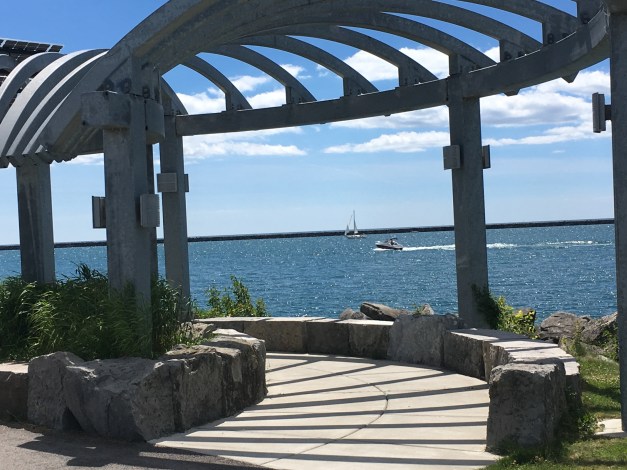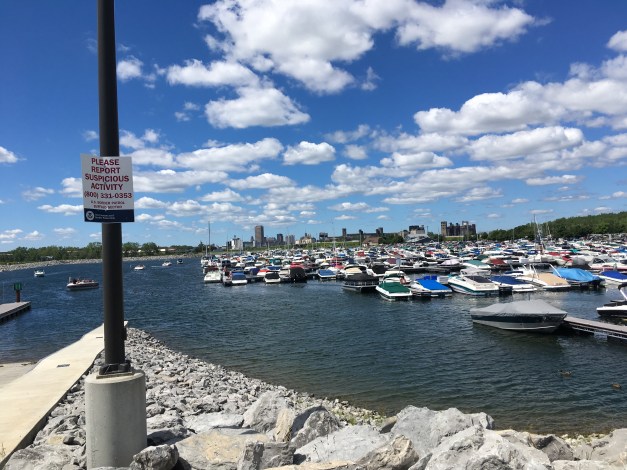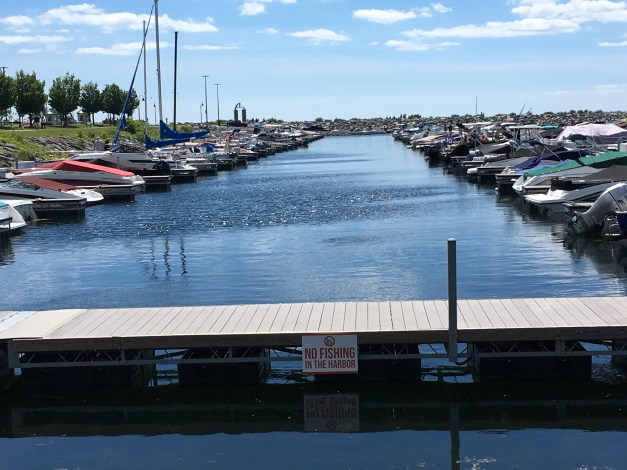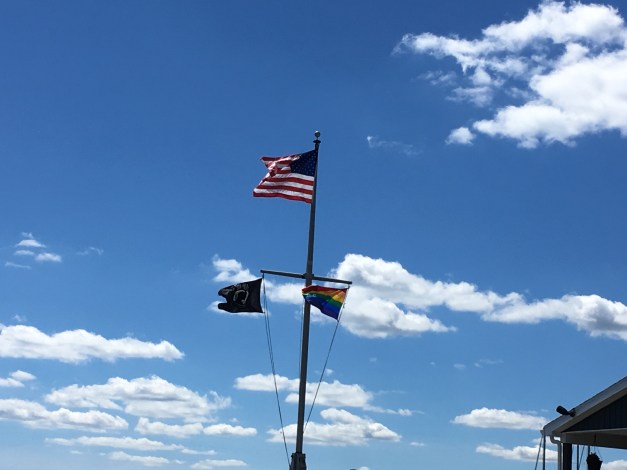
With All Due Respect

Photos and musings by Arthur J. Giacalone

  • About The Author
  • About This Blog
  • Pre-WADR Archives

Betsy Ross 13-Star Flag at South Buffalo residence confirms Colin Kaepernick’s concerns

Posted by Arthur J. Giacalone on July 10, 2019
Posted in: South Buffalo, White Supremacy. 1 Comment

First things first: The flag-related image that I find most offensive is that of Donald Trump hugging, kissing, and fondling the red-white-and-blue symbol of the USA.

Trump hugging flag detail

That being said, the recent controversy surrounding Nike’s decision to pull a special edition shoe with a 13-star flag on its heel, in response to concerns expressed by activist and former NFL quarterback Colin Kaepernick that the image is offensive and tied to slavery, is both poignant and complex.

Nike's Betsy Ross flag shoe Nike’s Air Max 1 Quick Strike Fourth of July shoe

There’s a part of me that would like to push back against the usurpation of historic symbols – by hate groups and bigoted individuals – by obscuring whatever meaning they have imbued in the object by using/wearing/waving it myself. But I realize that such action by one 69-year-old Italian American male in Buffalo, New York would have miniscule impact, and might cause further offense, discomfort, and consternation.

So I won’t be lobbying for Nike to liberate the controversial shoe. But I will address hateful symbolism in my South Buffalo neighborhood.

While there may be doubts about whether Betsy Ross – an 18th-century Philadelphia seamstress – actually designed the 13-star flag, there is no uncertainty regarding Colin Kaepernick’s conclusion that the so-called “Betsy Ross flag” is being waved and worn by a segment of our society as a symbol of white supremacy. I’m confident that I have seen evidence supporting that conclusion a mere three blocks from my humble home.
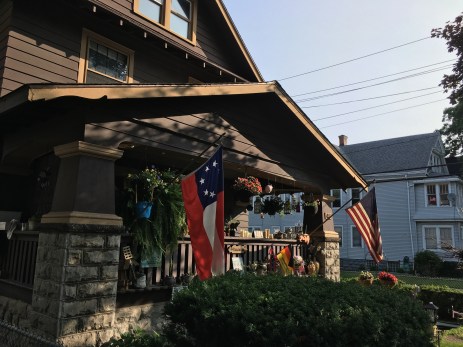
IMG_1952 40 Indian Church Rd. (taken by AJG 07-08-2019)

For the past four years, I have observed an ever-changing front porch display at 40 Indian Church Road. The house is situated a short walk from Seneca Street and Cazenovia Park at the northwest corner of Parkview Avenue and Indian Church. While the dark brown, well-kept century-old residence may initially appear welcoming, the occupants’ choice of symbols and words reflect – in my opinion – the sentiments of bigots and white supremacists.

A day or so after the initial national coverage of Nike’s decision to pull its “Air Max 1 Quick Strike Fourth of July” shoe, the facade at 40 Indian Church suddenly displayed two large flags: the “Stars and Bars”, which sports three broad stripes and is the first national flag of the Confederate States of America, and the 13-star, 13-stripe “Betsy Ross” flag.

If I had not frquently walked by the corner of Indian Church and Parkview, I might have thought that the flag-hanger was trying to highlight the dissimilar aspects of the two flags, and the fact that they couldn’t be easily mistaken for one another. But I’m well aware of the series of flags and signs at 40 Indian Church Road that have defiled the neighborhood for years. And, I could also see the carefully arranged objects resting between the pair of 3’ by 5’ flags. With that information in hand, I do not hesitate to interpret the “Stars and Bars” and “Betsy Ross flag” display at 40 Indian Church as a glorification of an America where slavery was legal and the federal government’s power was insubstantial.

Nestled amongst the flowers and front-yard knick-knacks on July 8th was/is a cluster of three hand-held flags: the well-known Confederate battle flag (with the red field and diagonal dark blue cross and white stars), the German national flag, and the “Gadsden Flag” – a historical American Revolution flag with a yellow field depicting a coiled rattlesnake and the words “DON’T TREAD ON ME.” [The Gadsden flag is often described as an example of a historic symbol co-opted by groups such as the Tea Party and the white supremacists movement.] There also was/is a choo-choo train weather vane sporting a small Confederate battle flag.

Betsy Ross at 40 Indian Church detail

Kalendas 07-08-19 detail (taken by AJG 07-08-2019)

[Note: I first started noticing the DON’T TREAD ON ME proclamations a number of years ago planted in rural front yards in Wyoming County alongside anti-Obama, “Repeal the Safe Act” and anti-Cuomo signs.]

As I wrote here about two years ago [see https://withallduerespectblog.com/2017/08/21/buffalo-must-address-homegrown-bigotry/], 40 Indian Church Road and its pro-Confederacy displays are situated diagonally across the street from BEREA Church of God in Christ (C.O.G.I.C.) and its predominantly non-white attendees.  Although it is no longer in sight, there was a period of time when a sign with an image of cross-hairs unambiguously proclaimed, “WARNING – IF YOU CAN READ THIS, YOU ARE IN RANGE,” reinforcing the aggressive message of the multiple Confederate and “DON’T TREAD ON ME” flags.

DSCN8742 (taken by AJG Aug. 2017)

As recently as May 2019, 40 Indian Church Road simultaneously flaunted three large Confederate flags: the Confederate battle flag, the “Blood Stained Banner” (the third national flag of the Confederacy), and the “Stars and Bars.”
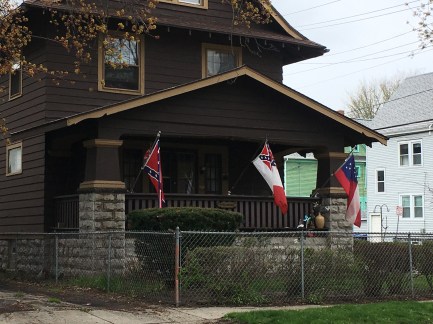
IMG_1241 (taken by AJG 05-02-2019)

A month-and-a-half earlier, a Confederate battle flag and flag of Germany were joined by a banner that frequently is on display at 40 Indian Church Road, a Texas “COME AND TAKE IT” flag with a white field, a black star, and the silhouette of an M4 AR15 machine gun. This defiant proclamation is an updated version of a flag used in 1831, at the first battle of the Texas Revolution against Mexico, which contained the phrase “Come And Take It” and depicted a black star and a small cannon.

IMG_0940 (taken by AJG 03-20-2019)

When not displaying Confederate flags, or co-opting provocative symbols from the past, the residents of 40 Indian Church Road have expressed their support for an individual viewed by many as a racist and white supremacist, Donald J. Trump:
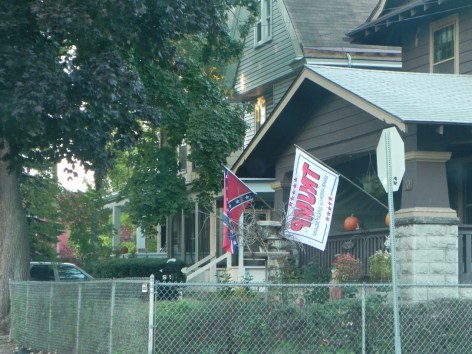
Trump flag at 40 Indian Church (taken by AJG 10-24-2016)

I have chosen not to interact with the residents at 40 Indian Church Road when I walk or bicycle by.  I’m not particularly proud of that fact, but I don’t see myself as the appropriate person to initiate a meaningful discussion. But it would be fascinating to hear a conversation between Colin Kaepernick and the folk who live at 40 Indian Church Road on the issues raised by “the Nike controversy.”  Or, on a more practical level, it might be a useful step forward if a community leader were to reach out and facilitate a discussion between the person or persons who “speak” through the flags displayed at 40 Indian Church Road and the leaders and churchgoers at BEREA C.O.G.I.C.

With All Due Respect,

Art Giacalone

P.S. I wonder if this is a topic that could be raised with the organizers of the 100th Year Centennial celebration promoted in the banner currently above the church’s front door:

IMG_2025

Summery Photos of the Outer Harbor’s Southern Half, Really

Posted by Arthur J. Giacalone on July 1, 2019
Posted in: Christopher Scanlon, City of Buffalo, Gerald A. Buchheit Jr., Green Code, South Buffalo, Waterfront, WNY Photos. Leave a comment

I’ve been trying to write a post about Buffalo’s Common Council for days now.  But focusing on the ways such an uninspiring legislative body functions is, well, depressing.  To boot, summer weather has finally arrived in Western New York.

So, I’m going to embrace the suggestion from a trusted friend and sometime “guardian angel.”  Rather than pen another gloomy post involving Council President Darius Pridgen, South District Council Member Chris Scanlon, or Delaware District’s Joel Feroleto, etc., I will  share some photographs that I took on the sunny and breezy final day of June, 2019 along Buffalo’s shoreline.

But, first, I must split a hair.

My environmental allies, the fishing public, the media, State officials, the Erie Canal Harbor Development Corporation (ECHDC), and virtually every knowledgeable and sensible WNY’er that I’ve encountered, would agree that the pictures that follow were snapped on my trek around the southern portion of Buffalo’s Outer Harbor.

However, the City of Buffalo’s Common Council, at the recommendation of Mayor Byron Brown’s Office of Strategic Planning, excluded from the definition of the “Outer Harbor” contained in the “Green Code” [officially, Uniform Development Ordinance] everything south of the former Ford complex (Terminal A and Terminal B).  In doing so, our esteemed legislators have excluded, from the protections of criteria intended to protect the Outer Harbor from inappropriate future development, the following:  the former Freezer-Queen parcel (where Gerry Buchheit may or may not still wish to construct a 23-story glass-and-steel tower), the Small Boat Harbor,  Buffalo Harbor State Park, Gallagher Beach, the Tifft Street Pier, etc.  [Note:  Here’s how the city in its proposed LWRP, the ECHDC, and State DEC, interpreted the boundaries of the Outer Harbor prior to Mr. Buchheit’s proposed Queen City Landing tower at the former Freezer-Queen site:  Outer Harbor defined by LWRP-ECHDC-DEC.]

In other words, the enlightened world will think of the following photos as images of Our Outer Harbor.  I hope you’ll enjoy them:

IMG_1811

IMG_1817

IMG_1818

IMG_1822

IMG_1832

IMG_1834

IMG_1835

IMG_1838

IMG_1839

IMG_1840

And, here are my favorite images for what you will not see – the proposed 23-story tower!

IMG_1844

IMG_1845

With All Due Respect,

Art Giacalone 

P.S.  Please contact Buffalo’s Common Council Members (especially South District Councilman Christopher Scanlon), as well as the Mayor’s office, and insist that the Green Code be amended immediately to include ALL of the Outer Harbor in the “Outer Harbor boundaries” as defined at Section 5.3.3C(1)(a) of the Uniform Development Ordinance.  Thank you.

Half-and-Half’s façade falls on Elmwood Avenue’s Shaken Block

Posted by Arthur J. Giacalone on June 25, 2019
Posted in: Chason Affinity, Elmwood Village. 1 Comment

[Full disclosure: For nearly a decade, I represented and assisted in various ways residents and property owners on Granger Place and Forest Avenue fighting to preserve the character of their historic Elmwood Village neighborhood, and prevent the demolition of the buildings at the corner of Elmwood and Forest avenues.]

It has been a rough year-and-a-half on the block of Elmwood Avenue between Forest and Bird that developers and the media have often referred to as “The Gateway” to the Elmwood Village.

First, near the end of December 2017, eleven century-old structures at the southeast corner of Elmwood and Forest were demolished to make way for Chason Affinity’s “1111 Elmwood Avenue” mixed-use project.  This destructive dismantling of a highly intact historic neighborhood occurred despite the stern warnings expressed in a December 2016 letter from New York State’s Historic Preservation Office (SHPO).  Notably, the state’s premier preservation agency advised the City of Buffalo that Chason Affinity’s demolition plans would “adversely impact” the Elmwood (East) and (West) Historic Districts, and that the “monumental scale” of the new complex would dwarf the surrounding area, eliminate the rhythm of the existing streetscape, and impose visual impacts that would clearly and demonstrably alter the setting and environment of the Elmwood Village.

Neither Chason Affinity, nor Delaware District Council Member Joel Feroleto, were moved.

DSCN8981

DSCN8990

DSCN8935

Then, a horrific early-morning fire at 1074 Elmwood Avenue on May 7, 2019 not only destroyed a residential building, but tragically took the life of a 55-year-old tenant, Curtis Brown.

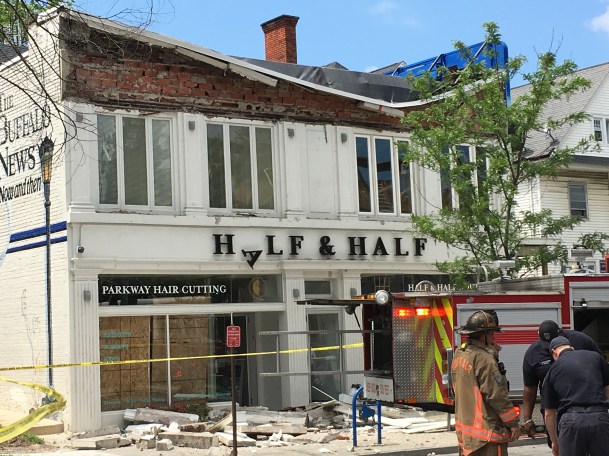
The latest misfortune – while insignificant when compared to the May 7th blaze – occurred around 1:00 PM today, June 25, 2019.  A major portion of the façade at 1086-1088 Elmwood Avenue – home of the Half & Half boutique and Parkway Hair salon – collapsed and tumbled to the sidewalk on a beautiful and sunny summer afternoon.  Fortunately, as reported in the media, no passers-by or individuals inside the commercial and residential structure were injured when the façade suddenly failed.

IMG_1701

IMG_1708

I happened to be walking down Elmwood in the direction of Forest Avenue not long after the debris landed on the sidewalk, so I was able to take the photographs inserted above.  Ironically, the purpose of my stroll was to check out the current status of the Chason Affinity project.  I certainly didn’t expect to see another unfortunate event on this gateway block.

As of the 6 PM newscast on WIVB-TV, the cause of the façade collapse was still being investigated.  A woman identified as the owner of the building – Kilby Bronstein – told the reporter that the building’s roof was new, and that she was relieved that no one was hurt.  An April 2017 story on-line refers to Jennifer and Kilby Bronstein as the new owners of Half & Half boutique.

Debra Sidel, the prior owner of Half & Half and the 1086-1088 Elmwood building, was a staunch supporter of Chason Affinity’s demolition plans and massive Elmwood Avenue complex.  She voluntarily provided a sworn affidavit to the developer in support of a lawsuit that extinguished deed restrictions (dating from 1892) which had prohibited construction of any commercial structure at the southeast corner of Elmwood and Forest.  [According to City of Buffalo property information, Ms. Sidel sold 1086-1088 Elmwood Avenue on January 19, 2016 for $575,000.00 to Brockport Land Associates, LLC.]

By the way, Chason Affinity’s project is being constructed diagonally across the street from 1086-1088 Elmwood Avenue and its broken façade.  [Note:  1086-1088 Elmwood was built in 1915.]  I’m certainly not a structural engineer, and it may just be a coincidence, but I can’t help but wonder:  Did any of the substantial demolition, excavation, or construction activities in furtherance of the “1111 Elmwood Avenue” development shake the ground or otherwise adversely impact the structural integrity of the home of Half & Half boutique?  Just asking.

IMG_1706

IMG_1715

With All Due Respect,

Art Giacalone

Maritime Charter appears to have abandoned plans for a Buffum Street high school

Posted by Arthur J. Giacalone on May 24, 2019
Posted in: Christopher Scanlon, City of Buffalo, Native American, South Buffalo. 2 Comments

[UPDATE:  WNY Maritime Charter School’s website finally is acknowledging its plan to renovate 2193 South Park Avenue for its high school students.  Their calendar indicates a meeting for Wednesday, September 18, 2019, at 2193 South Park: 

“High School Renovation Public Meeting:

What:  New High School Renovation Public Meeting

When:  9/18/2019, 5:30 PM – 7:00 PM

Where: 2193 SOUTH PARK AVENUE, Buffalo NY 14220

On Wednesday, September 18, 2019, from 5:30-7pm, we will be holding a public meeting at 2193 South Park Ave, Buffalo, NY 14220 to discuss our renovation of the building for our high school students.”

I think that it’s time for us to confidently celebrate our success at stopping the proposed Buffum Street expansion!]

It has been a year-long battle.  [See, for example, Giacalone v. WNYMCS – Verified Petition ]   But it looks as if a quiet South Buffalo neighborhood – and ancient indigenous burial grounds – will not be encroached upon by a three-story high school building and 24,000-square-foot athletic facility.

I was told today that Western New York Maritime Charter School has signed a contract to purchase the former Buffalo Public School No. 29 facility at 2219 South Park Avenue from South Buffalo Charter School.  The parties have yet to determine a closing date.

IMG_1441 2219 South Park Ave.

It is not clear whether Maritime plans to use the South Park Avenue building solely as its high school (which is currently located on Genesee Street near downtown Buffalo), or as both its high school and middle school.  The 2219 South Park facility, at 63,795 square feet, has approximately the same gross floor area as the three-story high school building Maritime proposed to construct adjacent to the existing Buffum Street middle school.

For the past two years, Maritime’s middle school has been operating at 102 Buffum Street in South Buffalo, a few blocks from Seneca Street.  The Buffum Street community has not opposed Maritime’s middle school, which comfortably fits the scale and intensity of the building’s historic use as Buffalo Public School No. 70.

  DSCN9653 102 Buffum Street

In contrast, Maritime’s expansion plans for a high school and athletic building have met substantial resistance – by residents at the Common Council’s June 2018 public hearing, in two legal proceedings brought in State Supreme Court, and by various indigenous activists.  The location chosen by Maritime for its expansion plans created two major concerns.

The existing Buffum Street school is surrounded on the south, east and west by one-story and two-story residences (on Buffum and Silverdale Place), and on the north by an undeveloped field which borders the rear yards of single-family homes on Zittel Avenue.  The narrow, quiet residential streets surrounding former School No. 70 were not meant to accommodate the traffic and activities associated with a high school.  Maritime’s planned expansion threatened the character of the existing neighborhood, and the ability of nearby residents to peacefully enjoy their homes.

DSCN9642 Buffum St. homes

Of equal (if not greater) importance, the 102 Buffum Street parcel is located within an area designated “archeologically sensitive” by the State Historic Preservation Office [SHPO].  It played an important role historically as the site of the Buffalo Creek Reservation’s Mission House (school), and is situated within a couple hundred feet of the Seneca Indian Park.  Additionally, the 102 Buffum Street parcel and surrounding area is considered sacred by Seneca and other indigenous peoples as the site of ancient burial grounds.

DSCN9588 Seneca Indian Park

Initially, Maritime and city officials, including, significantly, Councilmember Christopher Scanlon, chose to disregard the potential harm the expansion plans posed to archeological and historic resources.  However, this past September, Maritime hired an archeological firm, Panamerican Consultants, Inc., to conduct what is known as a “Phase 1A” archeological investigation of the project site.

I’m not a mind reader, but it appears that the results of the archeological study may have convinced Maritime to abandon its plans to construct its high school and athletic facility at 102 Buffum Street, and to search for other options.  If my assumption is correct, and Maritime has decided, at a minimum, to move its high school to the South Park Avenue address, I feel it will be a WIN-WIN situation for all involved:

First, human remains will not be desecrated, or archeological resources adversely impacted, by development at the Buffum Street site.

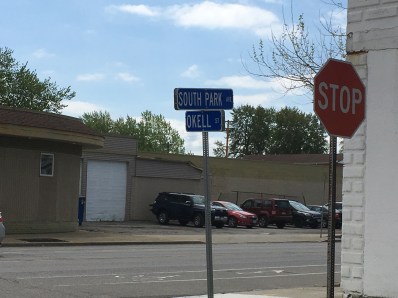
Second, while the 102 Buffum Street site is on a narrow residential street, surrounded by homes, and three blocks from Seneca Street’s commercial strip, 2219 South Park Avenue is located on a major street and bus route with adjoining commercial activities:

IMG_1449

IMG_1437


IMG_1447

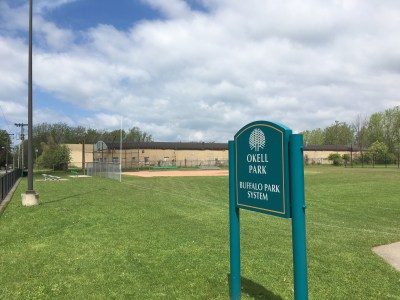
Third, in contrast to 102 Buffum Street (where the undeveloped area is sloped, has substantial drainage problems, and could not be readily used for recreational activities), 2219 South Park is adjacent to a city park with ballfields, basketball courts, and playground facilities:

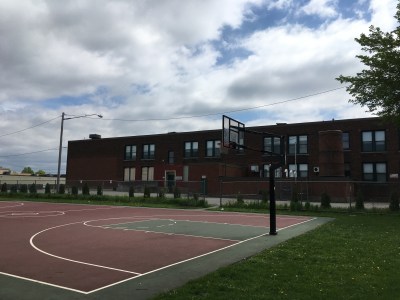
IMG_1426 Okell Park

IMG_1429 View of rear of school


IMG_1431 View from rear of school

I look forward to the official announcement of Maritime charter school’s purchase of the 2219 South Park Avenue facility, and its plans for Buffum Street.  And, I wish them well!

With all due respect,

Art Giacalone

Lilac Festival 2019

Posted by Arthur J. Giacalone on May 19, 2019
Posted in: Highland Park/Lilac Festival, Olmsted Parks, Rochester NY, WNY Photos. 1 Comment

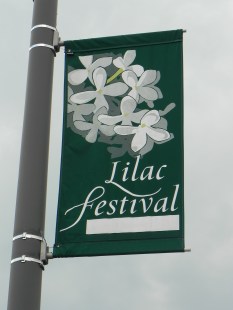
Here’s a bouquet of images from the 2019 lilac festival at Highland Park, Rochester’s Olmsted park.

DSCN0166

DSCN0157

DSCN0153

DSCN0111

DSCN0107

DSCN0151

DSCN0147

DSCN0103

DSCN0098

DSCN0145

DSCN0140

DSCN0143

DSCN0097

DSCN0090

DSCN0134

DSCN0130

DSCN0128

DSCN0083

DSCN0122

DSCN0121

DSCN0084

DSCN0079

DSCN0118

DSCN0116

DSCN0077

DSCN0073

DSCN0075

DSCN0114

DSCN0066

DSCN0062

DSCN0059

DSCN0045

DSCN0042

DSCN0040

DSCN0047

DSCN0039

DSCN0036

DSCN0069

DSCN0037


DSCN0033

DSCN0032DSCN0168

With All Due Respect and Admiration,

Art Giacalone

FOR SALE: GATES CIRCLE Fountains-and-all (favorable terms available)

Posted by Arthur J. Giacalone on April 18, 2019
Posted in: City of Buffalo, Corporate Welfare, Development. Leave a comment

As you stroll down Chapin Parkway with your Akita Inu or Norfolk Terrier, or while enjoying a  cocktail in the Canterbury Woods penthouse lounge, have you ever fantasized about owning Gates Circle?  Have the historic fountains, stairways and greenery captured your imagination?  If so, you no longer have to be content with viewing this E.B. Green-designed masterpiece from a nearby triangular island or a stylish lofty perch.  Thanks to the ingenuity of Mayor Byron Brown’s staff and City Hall sycophants, YOUR DREAM CAN NOW COME TRUE!

IMG_1016

On April 16, 2019, Buffalo’s Common Council voted unanimously to create the “Linwood Lafayette Urban Development Action Area”  [UDAA]   So it would look as if they were complying with a state-mandated requirement that at least 60% of the real property within the UDAA be city-owned, the clever bureaucrats on City Hall’s ninth floor drew the UDAA’s boundary lines to include the public right-of-way on Delaware, Linwood, and Lafayette avenues, and, most importantly, all of Gates Circle!

Linwood Lafayette UDAA map

By including Gates Circle as part of the newly formed Linwood Lafayette Urban Development Action Area, the Common Council has designated this historic public space and all the other land in the UDAA “as appropriate for urban development.”

TM Montante Development may have been shameless enough to request creation of the UDAA.  But, the state law authorizing the City of Buffalo to form the UDAA does not limit who can propose a project for all or a portion of the designated area, and empowers the city to sell or lease the land “to any person, firm or corporation.”  So your dream can come true!

IMG_1143 Christian Campos, TM Montante Development President, awaits 04/16/2019 Common Council vote on UDAA.

Here’s the best part: Not only might you be chosen to own (or, if you prefer, lease for up to 99 years) Gates Circle, by creating the UDAA, the Common Council now has the power to give you incentives to encourage your participation in this program (as if you need an incentive!), including generous 20-year tax exemptions and remarkably favorable loans.

FULL DISCLOSURE:  Some cranky old Buffalonians (who believe that our government officials should strive to follow the letter and spirit of the law) have insisted that the Common Council misused the state law that allows a city to designate a UDAA – General Municipal Law, Article 16.  They claim that Article 16 and the creation of a UDAA was never intended as a mechanism for bailing out an under-financed developer whose plans for an ambitious private project have encountered unanticipated complications.  From their perspective, Article 16’s generous incentives were designed to encourage hesitant private enterprises to partner with a municipality to correct blight and substandard conditions at city-owned properties that had been acquired through urban renewal or condemnation powers.  So, if the designation of the Linwood Lafayette Urban Development Action Area is challenged in court, you may have to give Gates Circle back to the residents of the City of Buffalo.  [Check out this for background information.]

COMMISSIONS:  Buffalo officials aren’t likely to ask for a commission for arranging the sale of Gates Circle to you.  [However, if past history is a guide, it probably wouldn’t hurt to donate generously to the campaign chests of the mayor and the various councilmembers.]

IMG_1148 Darius Pridgen, Council President/ Ellicott District Member/Bishop/Pastor/Entrepreneur/Self-proclaimed Article 16 expert. 

With All Due Respect,

Art Giacalone

Open Letter to Buffalo’s Common Council on UDAA

Posted by Arthur J. Giacalone on April 15, 2019
Posted in: City of Buffalo, Corporate Welfare, Development. Leave a comment

PREFACE:   I really would like to engage the City of Buffalo’s Common Council in an honest, objective conversation regarding a proposal to create the “Linwood Lafayette Urban Development Assistance Area” at the site of the former Millard Fillmore Gates Circle Hospital.  So far I’ve had no takers.  An April 2, 2019 post here expressed my primary concerns, and was sent to the nine members of the Common Council within a day or so of its posting.  None of our city legislators replied (although Councilmember David Franczyk, while serving as chair of the legislative committee’s April 9th meeting, showed awareness of the issues I had posed, and kindly allowed me an opportunity to provide a “reader’s digest” version of my comments during the public meeting).  I followed up with an April 11th email message to each of the Common Councilmembers – which is set forth in full below – inviting the elected officials to contact me with any questions raised by the email or the issues I had presented orally on April 9.  Perhaps my letter-to-the-editor, printed in the April 15, 2019 Buffalo News – under the headline, “Pridgen wants to offer gift that may not be deserved,”  will be more effective in generating a response.  I’ll update this post if and when I hear from a Councilmember.

Meanwhile, here’s what I emailed to Buffalo’s governing body on April 11, 2019:

Common Council needs objective legal advice on BURA/TM Montante’s  proposed UDAA, not a “fig leaf”

Dear Council President and Councilmembers,

I am writing to you as a City of Buffalo resident who strongly believes that government officials and agencies must consistently strive to make decisions that are consistent with the letter and spirit of the law.  A lesser approach to governing weakens the public’s confidence in the fairness and integrity of both the decision-makers and the decision-making process.

As a lawyer who has spent more than four decades interpreting and studying state and local laws, I am convinced that the request by BURA and TM Montante Development to designate the Linwood Lafayette Urban Development Assistance Area (UDAA) contradicts the purpose of Article 16 of New York’s General Municipal Law (GML).  [Please note, I am not opposed to TM Montante Development’s redevelopment plans at the site, only to the designation of the proposed UDAA as a mechanism for restarting the stalled project.]

In my professional opinion, an objective reading of GML Section 691 (Article 16’s “policy and purposes” provision) establishes that the creation of a UDAA was never intended as a mechanism for bailing out an under-financed developer whose plans for an ambitious private project have encountered unanticipated complications.  To the contrary, Article 16’s generous incentives were designed to encourage hesitant private enterprises to partner with a municipality to correct blight and substandard conditions at city-owned properties that had been acquired through urban renewal or condemnation powers.

The authority to designate UDAA districts was intended to apply to narrow and specific circumstances which are not present at the Delaware-Linwood-Lafayette site.  The limited applicability of Article 16 almost certainly explains why this body has not seen a similar request for many years.

As Buffalo’s governing body, you are collectively faced with a significant issue of legislative intent that will set an important precedent throughout the city, not merely in the Ellicott District.  For that reason, I ask each of you to proceed cautiously and to give careful consideration to this matter before casting a vote to approve or disapprove the request.

While I appreciate the request made by Council President Pridgen at the April 9th legislation committee meeting for a written opinion on a number of legal issues raised during that proceeding, it is imperative that this body receive objective legal advice which will provide you with a meaningful basis for rendering your determination.  With all due respect to Scott Billman, Esq., it is difficult to see how BURA’s general counsel – the person who prepared the “permission request” submitted to the Common Council and City Planning Board – is in a position to provide an unbiased and neutral assessment of the legality of the proposed designation.  [You may also wish to question whether the city’s law department is able to provide objective legal advice on this issue given the Corporation Counsel’s position as a member of BURA’s board of directors.]

I am available to answer any questions that you may have regarding this correspondence, as well as the legal and factual matters that I previously raised at the April 9, 2019 legislation committee meeting, and in my April 2, 2019 blog post:  https://withallduerespectblog.com/2019/04/02/proposed-linwood-lafayette-udaa-shamelessly-distorts-intent-of-law/.

Thank you.

Respectfully submitted,

Arthur J. Giacalone

Note:  If you believe that the issue of compliance with the letter and spirit of our laws, and the integrity of governmental decision-making, are critical issues for the City of Buffalo, I urge you to contact one or all of the members of our city’s Common Council: dpridgen@city-buffalo.com; dfranczyk@city-buffalo.com <dfranczyk@city-buffalo.com>; jgolombek@city-buffalo.com; cscanlon@city-buffalo.com; darivera@city-buffalo.com; rfontana@city-buffalo.com; uwingo@city-buffalo.com

With All Due Respect,

Art Giacalone


Proposed Linwood Lafayette UDAA shamelessly distorts intent of law

Posted by Arthur J. Giacalone on April 2, 2019
Posted in: Byron Brown, City of Buffalo, Corporate Welfare, Political Contributions. Leave a comment

Some might call the proposed formation of the Linwood Lafayette Urban Development Action Area (UDAA) – at the former Millard Fillmore Gates Hospital campus – a creative use of an urban renewal agency’s powers.  I see it as a shameless distortion of a tool intended to correct conditions in municipally-owned slums and blighted areas.

Linwood Lafayette UDAA map

Article 16 of the State’s General Municipal Law (GML) is entitled “Urban Development Action Area Act.”  Its “policy and purposes” section recognizes the existence of “municipally-owned areas” which are slum or blighted, or are becoming slum or blighted areas.  In order to ameliorate the blighted conditions in these municipally-owned areas, Article 16 gives cities such as Buffalo broader rights and powers to offer enhanced tax incentives and financial aid to encourage business enterprises to undertake corrective projects.

Buffalo’s Common Council has designated the Buffalo Urban Renewal Agency (BURA) as the agency authorized to carry out the purposes and provisions of GML Article 16.  According to its mission statement, BURA strives to “create quality and vibrant living in Buffalo New York through neighborhood driven development projects.”  Its website expressly encourages Buffalo residents “to be involved with BURA,” and states that its “goal is quite simple:  to become a resource and partner to City residents, community development agencies, and staff in seeking results to the most pressing issues facing the Buffalo area.”

Under its current leadership, however, BURA is pursuing a different goal:  to provide corporate welfare to financially-troubled private developers, in this instance, TM Montante Development and the Montante Group Companies.

Byron Brown photo       IMG_1013

BURA is controlled by Mayor Byron W. Brown.  As Mayor, Brown sits as chair of BURA’s nine-member board of directors.  Three of the board’s members hold high-level positions in the Brown Administration (and, therefore, serve at the pleasure of the Mayor):  the Executive Director of the City’s Office of Strategic Planning (Brendan R. Mehaffy), who also functions as BURA’s Vice-Chairman; the City’s Corporation Counsel (Timothy A. Ball, Esq.); and, the City’s Commissioner of Administration and Finance (currently, Donna Estrich).  The Mayor also hand-picks two citizen board members, ensuring his command over a majority of the 9-person board.

Neither the process used to prepare the proposed Linwood Lafayette UDAA, nor the substance of the proposal presented to the City of Buffalo’s Planning Board and Common Council, complies with the requirements, purposes, or intent of either the Urban Development Action Area Act, or BURA’s own mission statement:

Deficiency No. 1.  The official request to create the Linwood Lafayette UDAA, submitted to the City’s Common Council and Planning Board in February 2019, states that it is BURA that “respectfully requests” the designation.  However, a review of the agendas and minutes of the BURA Board of Directors – from March 2019 back to June 2018 – discloses that the BURA’s governing body never considered, much less approved, the request to proceed with the Linwood Lafayette UDAA designation.  [So much for transparency and neighborhood-driven development projects.]  Had the topic been placed on the board of directors’ agenda, its members (including three Common Council members), the media, and, most importantly, the public, would have known in advance of this “creative” use of GML Article 16’s incentives and financial aid.

[Note:  It appears that the “permission request” filed with the Common Council was prepared by Scott Billman, BURA’s Counsel. Frankly, I would not be surprised if Mr. Billman was merely following instructions from the head of the Mayor’s Office of Strategic Planning (and, BURA Vice-Chair), Brendan Mehaffy.]

Deficiency No. 2.  No objective, rational observer would describe the community within which BURA proposes to create the Linwood Lafayette UDAA as a slum or blighted area.  Even the intended beneficiary of the proposed UDAA – TM Montante Development – proclaims that its proposed “Lancaster Square” project is “located in a premier urban, mixed-use neighborhood that the American Planning Association has selected as one of the 10 best neighborhoods in America.”

IMG_1017

IMG_1010

IMG_1011

IMG_1025

Deficiency No. 3.  The “policy and purposes” of Article 16 is to provide incentives to eliminate slum or blight, or prevent slum or blight, in “municipally-owned areas” which were acquired pursuant to urban renewal powers, condemnation powers, or tax foreclosures.  [See GML Section 691.]  Article 16’s focus is not privately-owned real property.  Despite this fact, BURA’s request for UDAA designation is premised on “the present condition of the privately owned real property in the area [that purportedly] impairs the growth and development of the City of Buffalo municipality because the area is at significant risk of further deterioration and blight …”

[Note:  To the extent that the existing “blight” is created by demolition debris not promptly removed by TM Montante, Common Council President and Ellicott District Member Darius Pridgen and other elected and appointed officials must be asked:  Why haven’t you insisted that the City’s inspection office compel the property owner to comply with Section 103-38(E) of the City of Buffalo Code?  That provision requires removal of “material and debris resulting from demolition” within 5, 10, or 45 days, depending on the height of the demolished structure.] 

IMG_1032

Deficiency No. 4.  Consistent with Article 16’s policy and purposes, an area designated as an “urban development action area” must be “appropriate for urban development,” and at least 60% of the UDAA must consist of city-owned real property.  In a tortured effort to meet the 60% city-owned-real-property requirement of Article 16, the “creative” authors of the permission request have drawn the boundary lines of the UDAA to artificially include the entire width of adjacent public roads (that is, Delaware, Lafayette, and Linwood avenues), and historic Gates Circle.  These public rights-of-way were undoubtedly not acquired through urban renewal powers, condemnation, or tax foreclosure procedures.  And, in this context, they certainly cannot objectively be treated as areas “appropriate for urban development”:  TM Montante is not proposing to “develop” these public streets and adjacent traffic circle.  Additionally, even the site’s vacant parking garage, while clearly city-owned real estate and (it would appear) deteriorating, was built and operated for decades as a municipal parking ramp, and, presumably, is not the product of a recent condemnation or tax proceeding.  [See Buffalo Courier Express article from 1975: BCE19750122 re parking ramp .]

IMG_1016

IMG_1033

Deficiency No. 5.  Article 16 envisions the use of enhanced financial aid and tax relief as incentives to encourage otherwise hesitant business enterprises to participate in programs to correct blighted and deteriorated conditions on city-owned property.  The UDAA program is not intended to bail out a private developer who enthusiastically proposes and commences a massive development project, but then, in the words of the Buffalo News, “needs a new partner and financial help to make the project work.”  The Mayor-controlled BURA and Office of Strategic Planning have improperly and unwisely chosen to use BURA’s powers and resources, not to stimulate neighborhood-driven development, but to bail out a well-heeled, politically-connected developer.

[Note:  Although Darius Pridgen has only received a pedestrian $200 political contribution from TM Montante Development, in the past five years TM Montante and the Montante Group (which includes TM Montante and Montante Construction) have made generous contributions to:  Mayor Byron Brown ($1,000),  Councilmember Joel Feroleto ($1,000), State Assemblyman Sean Ryan ($1,000), State Senator Tim Kennedy ($1,850), and State Assemblywoman Crystal Peoples ($3,500).]   

Buffalo residents deserve an agency that truly focuses on “neighborhood driven” projects – rather than developer-driven handouts – and that works to benefit the public, rather than politically-astute development companies.

So, Buffalonians, get involved, and demand that your elected Common Council members deny BURA’s requested to designate the proposed Linwood Lafayette UDAA.

With All Due Respect,

Art Giacalone

P.S.  The Linwood Lafayette UDAA proposal is not the first time that Mayor Brown’s BURA has been involved in activity that appears to me to not further the interest of the public.  See for example Op-Ed – The Mayor The Carlo and BURA sent 03-06-13.

P.P.S.  Likewise, the Linwood Lafayette UDAA proposal is not the first time Buffalo’s “leaders” have embraced an unworkable and inappropriate plan for this site.  See Kaleida Health’s 7-12-2013 press release announcing Chason Affinity’s failed effort to recruit a veterinary school to the former Millard Fillmore Gates Circle campus: Kaleida press release 07-12-13 re Gates Circle

Joel Feroleto serves business donors, hurts Elmwood Village and its residents

Posted by Arthur J. Giacalone on March 13, 2019
Posted in: Carl Paladino, Chason Affinity, City of Buffalo, Development, Elmwood Village, Green Code, Joel Feroleto, Political Contributions. Leave a comment

[An abbreviated version of the following post was published on March 13, 2019 in the print version of the  Buffalo News Another Voice column.  You can read it on-line at https://buffalonews.com/2019/03/12/another-voice-feroletos-inaction-hurts-elmwood-village-residents/.]

[Full disclosure:  As a zoning and development lawyer, I spent years reviewing, critiquing and commenting on the Green Code (in the Buffalo News, ArtVoice, Buffalo Law Journal, etc.).  I also spent nearly a decade representing property owners in the vicinity of the Elmwood/Forest intersection in opposition to various proposed projects and in an effort to prevent demolition of the 11 buildings at that intersection.  I met with and shared my concerns with Councilmember Feroleto regarding both the Green Code and the Chason Affinity project as far back as November 2015.]

Joel P. Feroleto was sworn in as Delaware District councilmember on September 1, 2015.  When asked to describe the role of a Common Council member, he answered: “to be there for their constituents, and resolve all their issues.”

Joel Feroleto photo from prior bio

During the first few months of Joel’s service on Buffalo’s Common Council, the State’s Historic Preservation Office [SHPO] was in the process of deciding whether a significant portion of the Delaware District, nestled on the east side of Elmwood Avenue, was worthy of preservation and placement on the State and National Register of Historic Places.  During the review process, SHPO received only a handful of letters objecting to the designation.  Two of the objections were from Carl Paladino and William Paladino on behalf of Ellicott Development. A third objection was from an affiliate of the Chason Affinity companies, Affinity Elmwood Gateway Properties, owners of eleven properties located on the southeast corner of Elmwood and Forest avenues. [You can find the objection letters at pages 582, 583, and 587 of the Elmwood Historic District (East) application packet.  Elmwood Historic District EAST application.]

In December 2015, SHPO concluded that the 2,540 properties comprising the “Elmwood Historic District (East)” met the National Register criteria, and in March 2016 the Elmwood Historic District – East was officially entered in the National Register of Historic Places.  As expressed in the public announcement, “[T]he National Park Service’s National Register of Historic Places is part of a national program to coordinate and support public and private efforts to identify, evaluate, and protect America’s historic and archeological resources.”

Exh 51 - SW corner Granger-Forest

As SHPO explained in a December 2016 letter to the City of Buffalo, a critical factor in determining whether a group of structures merits preservation and placement on the state and national Historic Register is whether they are part of a highly intact collection of historically interrelated buildings.  From the perspective of our state’s historic preservation office, each structure, by its existence, contributes to the overall historic environment, whether or not it individually possesses significant historic, cultural, or architectural value.  [See SHPO’s 12-19-2016 letter.]

In March 2016, a century or so after the Elmwood Historic District (East) was first developed, the Elmwood neighborhood was remarkably “intact” – more than ninety-six percent (96%) of its buildings were still in existence and considered “contributing properties” worthy of inclusion on the National Register.

You might think that Joel Feroleto, as the Delaware District councilmember, would aggressively fight to preserve each and every contributing building in the historic Elmwood district.  You would be wrong.

On March 11 of this year, a pair of Elmwood Village two-family residences, 619 and 621 W. Delavan Avenue, were demolished.  Both structures were identified as “contributing” properties in the Elmwood Historic District (East).  Councilmember Feroleto, it appears, chose to do nothing to stop this destruction and the resulting diminution of the larger historic district.

IMG_0909

IMG_0905

As noteworthy as the 2016 designation of the Elmwood Historic District (East) as a National Historic District may be, placement on the National Register was apparently much less significant to Mr. Feroleto than the fact that the buildings were owned by Ellicott Development.  According to state records, between October 2016 (the same month the Paladinos expressed their objection to placement of their Elmwood Village properties on the National Register) and September 2018, the various Ellicott Development entities made nine campaign contributions, totaling $1,450, to Joel Feroleto.

Even more troubling, Mr. Feroleto took no meaningful action to insulate eleven century-old structures at the corner of Elmwood and Forest avenues from the proverbial wrecking ball.  All eleven buildings were listed as “contributing properties” in the Elmwood Historic District (East).  These contiguous properties were owned by another objector to the National Register designation, the Chason Affinity companies.  Rather than being viewed as a valuable historic resource, it appears that these structures were considered – by Chason Affinity and Feroleto – as nothing more than obstacles to the developer’s plans for the massive “1111 Elmwood” mixed-use project.

DSCN1010

DSCN8981

DSCN8941

DSCN8948

DSCN8997

IMG_0897

It was September 2016 when Chason Affinity submitted its formal application to City Hall in furtherance of the Elmwood/Forest project.  Within 20 days of that filing, Feroleto received a $500 donation from the property owner, another $500 from the project’s architectural firm, and $250 from the law firm representing Chason Affinity.  [See Feroleto for Council contributions.]  Over the following two years, Feroleto was the recipient of additional contributions from the property’s owner, a principal of Chason Affinity, and the project’s general contractor, as well as a second donation from Chason Affinity’s law firm.

[Note:  In case you’re wondering, Councilmember Feroleto also has received significant contributions from other developers and businesses who have had substantial projects approved or under consideration by City Hall.  For example: Dash Markets ($3,500), Sinatra ($1,500, TM Montante ($1,000), and Benderson Development ($750).]

Ironically, when asked why he has been unwilling to take steps to protect historic Elmwood Village structures from the wrecking ball, Feroleto points to the “Green Code” – the city’s zoning and development ordinance adopted in 2017.  According to the councilmember, the Green Code was intended to expedite the zoning process by eliminating layers of review.  In the instance of the proposed W. Delavan Ave. demolitions, complying with the code resulted in no public input.

Conveniently forgotten by Feroleto was another purported goal of the Green Code, one that motivated many Buffalonians to advocate on behalf of the proposed new zoning law:  “Respect traditional development patterns… and preserve the city’s architectural heritage and the physical context that supports it.”  Also disregarded by the Delaware District councilmember was his role,  as a member and sole attorney on the city’s Common Council. in crafting and adopting the Green Code.

The zoning law approved by Joel Feroleto intentionally places economic development as a higher priority than the quality of life of residents and preservation of historic neighborhoods.  And, the Green Code omits language formerly included in  Buffalo’s zoning ordinance which expressly stated that “demolition of structures for reasons other than to preserve public health, safety and/or welfare are not encouraged.”  More significantly, Mr. Feroleto rejected the recommendation from his own community working group that the Green Code require that any demolition in the Elmwood Village business district obtain Planning Board and Common Council approval.

The slow-to-act councilmember recently claimed to be researching an amendment to the Green Code requiring a public hearing – not at the Common Council, but at the Planning Board – when similar demolitions are proposed in a historic district.  Obviously, such intentions (if sincere) were “too little, too late.”

Effective options were available if Joel Feroleto had truly wished to serve Delaware District residents and preserve the history and character of the Elmwood Village prior to the Elmwood/Forest and W. Delavan demolitions.  He could have swiftly and aggressively requested that the Common Council enact a moratorium barring any demolition (other than for safety reasons) until the councilmembers could consider and vote on an amendment to the Green Code which would require a public hearing and Common Council approval for demolitions within any city or national historic district.

In my opinion, Joel didn’t take any aggressive steps to protect the historic integrity of the Elmwood Village for a simple reason: his “constituents” are the wealthy and the politically-connected developers and businesses, not the ordinary citizen.  While he chose to disregard the protective measures proposed by his own community working group prior to adoption of the Green Code, he was certainly “there” for Chason Affinity and Ellicott Development.  And, he  certainly “resolved their issues” – the pesky presence of century-old structures.

The residents of the Elmwood Village and Delaware District deserve much better.  They’ll have an opportunity to do something about that in the voting booth later this year.

With All Due Respect,

Art Giacalone

Buffalo’s City Comptroller must be an independent fiscal watchdog, not a Byron Brown loyalist

Posted by Arthur J. Giacalone on March 10, 2019
Posted in: Byron Brown, City of Buffalo, Mark Schroeder, Political Contributions. Leave a comment

The City of Buffalo Charter (its “constitution”) creates two systems of checks and balances at City Hall:

First, the Mayor is given executive and administrative powers, while all “legislative power” – that is, the power to enact local laws and ordinances in accordance with the state constitution and laws – is placed (at least, officially) in the hands of the Common Council.

Second, the Charter creates the position of City Comptroller, and makes the Comptroller “head of the department of audit and control.”  Unlike the other city department heads – who are all appointed by the Mayor, confirmed by the Common Council, and serve at the pleasure of the Mayor – the City Comptroller is an elected office, chosen citywide by the voters every four years.  This arrangement helps ensure that the Comptroller functions independently from the Mayor and Common Council, and can serve city residents and taxpayers as an independent “fiscal watchdog.”

DSCN5144

As the Buffalo News editorial board recently observed, the office of Comptroller demands “checks and balances,” and the woman or man holding the position “must be independent enough to challenge any mayor on finances when appropriate.”

I believe that it is more critical than ever that the City Comptroller be an effective, independent watchdog.  That’s all we Buffalonians currently have.  The Common Council has effectively set aside its role as a counter-weight to Mayor Byron W. Brown and his administration.  To an unhealthy and unacceptable extent, our councilmembers acquiesce to the Mayor’s office and administrative appointees when it comes to formulating policy and identifying a vision for the Queen City’s future.  Absent are signs of the meaningful checks and balances envisioned by the Charter between the executive/administrative and legislative branches.

A prime example of our docile legislature was the Common Council’s belated and ineffective role in drafting, assessing, and enacting the city’s most significant “legislative” initiative in decades, the Uniform Development Ordinance (UDO), known informally as the “Green Code.”  [Note: I have previously expressed my thoughts on this topic at an October 2015 post,]

An independent City Comptroller is now the sole source of effective checks and balances at City Hall.  But that independence is threatened when a vacancy occurs in the midst of a four-year term, and the Common Council, and not the voters, fills the empty seat.  That is precisely where we find ourselves now.

The City Comptroller position has been vacant since February 1st when Mark J.F. Schroeder, who had been tenaciously serving as Comptroller since 2012, resigned to become head of New York’s motor vehicle department.  [Full disclosure: I supported Mark in his 2017 mayoral campaign against Byron Brown.  See https://withallduerespectblog.com/2017/09/08/why-im-voting-for-mark-schroeder-on-september-12th/.]

As a result of the opening, behind-the-scenes maneuvering is taking place.  In the words of  veteran Buffalo News political columnist Bob McCarthy, “Political intrigue is stalking City Hall this week… and angling is underway to fill the vacant comptroller’s office.”  Not surprisingly, Mayor Byron Brown and his Democratic allies are intent on assuring that Mark Schroeder’s successor will not be another thorn in the mayor’s side.  In an apparent step to ensure a harmonious and passive relationship between the next Comptroller and Mayor, local Democratic party leaders selected Erie County Legislator Barbara Miller-Williams as the party’s nominee to replace the vigilant Mark Schroeder.

BarbaraMiller-Williams photo

I am not professionally or personally familiar with Miller-Williams’ multi-faceted career, other than what I have read in newspapers and researched on-line.  According to her biography, prior to her position as a county legislator, she served on the city’s Common Council, and is both a retired Buffalo police officer and a retiree of the U.S. Army Reserve.  Ms. Miller-Williams holds both a B.S. degree in business administration, and Masters in Higher Education and Student Affairs Administration.  Notably, she is not a certified public accountant (although one need not be a CPA to meet the Charter’s qualification for the Comptroller position).

I am not questioning Miller-Williams’ integrity, or diminishing her many accomplishments.  However, while she promises an open and transparent relationship with the Brown administration, I have deep reservations regarding her independence and willingness to challenge either Byron Brown or her former Common Council colleagues.  Here’s why:

–  According to the Buffalo News, Barbara Miller-Williams “has reached a number of political milestones with [Mayor Byron] Brown’s help.”

– NYS Board of Elections records show that the Mayor’s “Brown for Buffalo” committee contributed nearly $2,000 to Miller-Williams’ county legislator campaign in 2011, and made additional contributions totaling $950 between 2013 and 2015.

– The Buffalo News also reports that Miller-Williams is “part of the Grassroots political club that has worked to elect dozens of politicians over the past three decades, including Mayor Byron W. Brown.”

– According to NYS Board of Elections records, “Brown for Buffalo” donated nearly $14, 000 to the Grassroots organization between 2013 and 2017.

City Hall under Mayor Brown’s leadership is a secretive and, at times, intimidating place.  It is understandable, when reviewing the following powers and duties the Charter vests in the City Comptroller, why Byron Brown and his allies on the Common Council would strongly prefer not to have an independent fiscal watchdog in their midst:

– The comptroller has unrestricted access to all employees, officials, offices, records, reports, files, and information and things of whatever nature as needed to carry out the comptroller’s duties, and possesses the power to investigate and to enforce by subpoena the attendance of witnesses or the production of document at such investigation.

– The comptroller has the power to conduct performance audits of all bureaus, offices, departments, boards, commissions, activities, functions, programs, agencies and other entities or services of the city to determine whether their activities and programs are: (i) conducted in compliance with applicable law and regulation; and (ii) conducted efficiently and effectively to accomplish their intended objectives.

– If the comptroller detects apparent violations of law or malfeasance or nonfeasance by an officer or employee, or information that indicates derelictions may be reasonably anticipated, the comptroller has the duty to report the irregularities to the council and the mayor, and, if the irregularity is potentially criminal in nature, to also notify the district attorney.

– The comptroller is obliged to submit to the common council, on or before the tenth day of May each year, a report assessing the accuracy of the revenue and expenditure estimates of the budget the mayor submits to the council.

– The comptroller has the authority to hire an independent consultant to conduct an audit of the performance of the common council staff every two years.

– The Charter provides the comptroller with the power to appoint, remove at his or her pleasure, and supervise the deputy comptroller, the city auditor, city accountant, and the investment and debt management officer.

– The comptroller has the duty to examine, audit and settle accounts of all officers, departments, boards commissions and other agencies of the city.

–  The comptroller also has the power to conduct financial and performance audits of all agencies and other entities a majority of whose members are appointed by city officials (most frequently, the Mayor) or that derive at least fifty percent of their revenue from the city.

[Note:  Additionally, pursuant to Section 34-a of the General Municipal Law of the State of New York, the Buffalo City Comptroller has the power to examine into the financial affairs of the Buffalo public school district and audit all school district accounts as the comptroller deems necessary.]

Clearly, given the breadth and depth of the City Comptroller’s authority and responsibilities, the position of Comptroller was created to provide Buffalo’s residents and taxpayers with an effective a fiscal watchdog at City Hall.  As expressed in a recent Buffalo News editorial, “Buffalo needs another fiscal watchdog who makes protecting the taxpayers a higher priority than keeping the political waters calm.”

The Common Council must vote no later than April 27 to appoint Mark Schroeder’s interim successor.  It may be tempting for councilmembers who are affiliated with Grassroots, or who have received substantial political contributions from “Brown for Buffalo” over the years – including Joe Golombek ($4,702.50), Joel Feroleto ($1,250), and Ulysees Wingo ($1,000) – to simply give their vote to Mayor Brown’s long-time ally, Ms. Miller-Williams.  But, we, Buffalo’s residents and taxpayers, must demand that each and every councilmember honestly and objectively give full consideration to all the candidates for the Comptroller vacancy, and, in the words of the Buffalo News editorial board, “[C]hoose a new comptroller who is independent enough to challenge the Brown administration on finances when it needs to be challenged.”

At last count, in addition to Miller-Williams, five individuals have submitted applications for appointment to the Comptroller’s seat:

* Vanessa A. Glushefski, who is a lawyer and the only CPA in the group.  Ms. Glushefski was appointed by Schroeder as Deputy Comptroller, and is currently serving as Acting Comptroller.

Vanessa Glushefski photo

* Common Council Member Richard A. Fontana, a seven-term representative of the City’s Lovejoy district.

* Patrick J. Curry, served seven years as Schroeder’s spokesperson and executive assistant.

* Jonathan D. Rivera, who works as an assistant to the commissioner of Erie County’s public works department.

* Scott J. Wilson, Jr., a college student who spent several years working in the Comptroller’s office in early 2018.

With All Due Respect,

Art Giacalone

P.S.  I believe that these are current email addresses for Common Council members:

dpridgen@city-buffalo.com; rfontana@city-buffalo.com; dfranczyk@city-buffalo.com; jgolombek@city-buffalo.com; cscanlon@city-buffalo.com; jferoleto@city-buffalo.com; darivera@city-buffalo.com; rwyatt@city-buffalo.com; uwingo@city-buffalo.com

Posts navigation

← Older Entries
Newer Entries →
  • CATEGORIES

  • February 2026
    M T W T F S S
     1
    2345678
    9101112131415
    16171819202122
    232425262728  
    « Nov    
  • DISCLAIMER

    This blog is provided for general informational purposes only. It should not be construed as legal advice and is not intended to be a substitute for legal counsel. Persons requiring legal advice should retain a properly licensed lawyer. No attorney-client relationship will be formed based on use of this site and any comments or posts to this blog will not be privileged or confidential. *************** This blog's author, Arthur J. Giacalone, does not intend or consider the communications at this blog to be ATTORNEY ADVERTISING. The primary purpose of the communication is not for the retention of Mr. Giacalone's legal services. [See definition of "Advertisement" at Part 1200, Rules of Professional Conduct, Rule 1.0(a).] Nonetheless, in case the proper authorities choose to treat this web site as ATTORNEY ADVERTISING, the street address, phone number and email address of the law office of Arthur J. Giacalone are: 17 Oschawa Avenue, Buffalo, New York 14210; (716) 436-2646; AJGiacalone@twc.com.
Blog at WordPress.com.
With All Due Respect
Blog at WordPress.com.
  • Subscribe Subscribed
    • With All Due Respect
    • Join 62 other subscribers
    • Already have a WordPress.com account? Log in now.
    • With All Due Respect
    • Subscribe Subscribed
    • Sign up
    • Log in
    • Report this content
    • View site in Reader
    • Manage subscriptions
    • Collapse this bar
 

Loading Comments...