With All Due Respect

Photos and musings by Arthur J. Giacalone

  • About The Author
  • About This Blog
  • Pre-WADR Archives

Chautauqua Institution: Beyond The Law

Posted by Arthur J. Giacalone on February 14, 2016
Posted in: Chautauqua Institution. Leave a comment

Government-like powers, without constraints, results in the demise of a national treasure.

Full Disclosure: I represent a group of preservationists and property owners who commenced a court proceeding to prevent demolition of the 123-year-old Chautauqua Amphitheater. But this is written on my own behalf as a concerned citizen, not as anyone’s lawyer.

The irony is palpable. Chautauqua Institution is acclaimed as a national forum for open discussion of public issues, democratic values, science, literature, and religion. But, as a corporate entity, it functions in a space beyond the reach of state and local laws which were enacted to enhance the quality of life, protect our environment, preserve historic resources, and foster transparency.

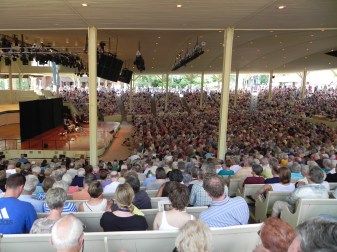
DSCN1974

Whether this situation is the result of unintended consequences, or a diabolical scheme, the governing body of Chautauqua Institution [“CI”] – that is, its 24-member Board of Trustees – wields land use and fiscal powers with far fewer constraints than our democratic system has wisely placed on its state and local officials:

1. Exemption from the town’s zoning requirements. The Town Board of the Town of Chautauqua amended its town code in 1994 to exempt CI’s main grounds from the requirements of the town’s zoning law. It justified this unusual move by referencing “the uniqueness of Chautauqua Institution,” and noting the comprehensive nature of the Institution’s own land use regulations. In doing so, the town’s role was reduced to ministerial functions, such as issuing building permits, while CI took full control of land use management within is fenced-in campus. That decision has enabled the CI Board of Trustees to approve demolition of the historic Chautauqua Amphitheater [“the Amp”] with virtually no outside oversight or interference. It has also deprived private property owners within CI’s main campus of procedural protections and review processes available to the vast majority of New York State residents.

DSCN1964

2. Exemption from the Institution’s own land use regulations. CI’s Board of Trustees has promulgated and oversees the enforcement of a comprehensive, 124-page set of rules known as the “Chautauqua Institution Architectural and Land Use Regulations” [“ALUR”]. ALUR includes a reassuring “Affirmation of Purposeful Stewardship” acknowledging the following principle: “Maintaining the physical fabric of the Chautauqua grounds is an essential contribution to safeguarding the historic, cultural, and aesthetic integrity of the Chautauqua Institution.” It also proclaims, with eye-catching emphasis, “WE ARE THE STEWARDS OF A NATIONAL TREASURE.”

DSCN7129

DSCN7125

There is, however, a major flaw. ALUR does not apply to property owned by Chautauqua Institution itself, only to the residences, hotels, and other real estate owned by individuals. The Institution’s land, including substantial open space and recreational acreage, and an estimated 100 buildings, falls outside the reach of CI’s own regulations and the town’s zoning requirements. This is a status akin to a sovereign’s unfettered control of its land, most inappropriate for a not-for-profit corporation in a democratic society.

3. Freedom from environmental review mandated by SEQRA. The State Environmental Quality Review Act [“SEQRA”] places an affirmative duty on all state and local government agencies to objectively assess whether a proposed project may have a significant adverse impact on the environment prior to making a “discretionary” decision to approve or fund the project. SEQRA’s definition of “environment” is broad, and expressly includes historic and aesthetic resources.

Zoning decisions by a town – such as zoning amendments, variances and site plan review – ordinarily trigger the SEQRA review process. By exempting CI’s main grounds from compliance with the town’s zoning regulations, the Town Board has eliminated “discretionary” decisions that would otherwise be preceded by the environmental review – leaving proposals such as demolition of the existing Amp and construction of its replacement beyond SEQRA’s protections.

CI’s Board of Trustees is not a state or local agency, and, therefore, has no obligation to comply with SEQRA. As a result, the owners of property within the Institution’s fenced-in campus are deprived of a crucial benefit enjoyed by other Town of Chautauqua and New York State residents: SEQRA’s substantive and procedural safeguards. The injustice of this deprivation is underscored by the fact that the real property owned by individuals within the Institution’s gates accounts for over half of the town’s total assessed valuation (and, one might assume, over half of its tax revenue).

4. Freedom from the Waterfront Consistency Law’s “consistency review”. In March 2008, the Town of Chautauqua approved the Chautauqua Lake Local Revitalization Program (LWRP) as a tool to preserve, enhance and utilize the natural and man-made resources along its waterfront area. The Chautauqua Institution grounds are included within the protected area.

DSCN0033

Not surprisingly, the LWRP identifies the Amp as one of “the primary historic resources” within the Chautauqua Lake communities, and places the venerable amphitheater, as well as the entire Chautauqua Institution Historic Landmark District, on the list of “Chautauqua Lake Communities Sites of Historic Significance.” The town’s apparent commitment to the protection of historic sites and buildings such as the Amp is reflected in the second of thirteen policies endorsed in the LWRP, “Preserve historic resources of the waterfront area of Chautauqua Lake,” and reinforced by the express call to, “Maximize preservation and retention of historic resources.”

Two months after adoption of the local waterfront program, the Town Board enacted the town’s Waterfront Consistency Law [“WCL”], which requires all “actions” undertaken within the waterfront area to be evaluated for consistency “with the LWRP policy standards and conditions.” Cynically, what the WCL appears to give with one hand, Chautauqua Institution and the Town of Chautauqua now argue it takes away with the other. The Institution and town insist that the WCL’s consistency review requirement is only triggered where the project requires a discretionary approval, and maintain that the only approvals required for the Amp project – as a result of the exemption of CI from the town’s zoning regulations – are non-discretionary approvals such as demolition and building permits.

Accordingly, Chautauqua Institution did not apply for, and the Town of Chautauqua did not require, a “consistency review” to determine whether demolition of the nationally acclaimed Amp is consistent with the LWRP policy to “preserve historic resources of the waterfront area of Chautauqua Lake.” This omission stands in sharp contrast to the burden state law places upon all state agencies. If New York State is considering a project within a waterfront area protected by an LWRP, it must conduct a “consistency review” prior to proceeding with the action.

5. Inapplicability of “Open Meetings Law” and “Freedom of Information Law.” New York State citizens have two protections intended to lessen arbitrary decision-making by government agencies and officials, and enhance the transparency of the governmental decision-making process: the “Open Meetings Law” and the “Freedom of Information Law” [“FOIL”]. Despite the government-like powers wielded by CI’s Board of Trustees, a 2011 ruling by a state appellate court holds that the Institution is not acting on the state’s behalf when it regulates activity on its grounds, and, therefore, that it is not “a public body” and is “not subject to the requirements of the Open Meetings Law.” The same legal principle would exempt Chautauqua Institution from the requirements of FOIL.

Without the protections afforded by these important state laws, CI’s land use and development decisions are allowed to take place behind closed doors rather than in an open and public forum.

The decision in 1994 by the Town of Chautauqua Town Board to exempt Chautauqua Institution’s main grounds from the town’s zoning laws has provided the Institution’s Board of Trustees the ability to unilaterally deprive future generations of the Amp, the authentic and irreplaceable “heart” of the Chautauqua Historic Landmark District. For that reason, the Town of Chautauqua is as responsible as CI’s leaders for the demise of a true National Treasure.

With All Due Respect,

Art Giacalone

Renters deserve as much respect as absentee landlords

Posted by Arthur J. Giacalone on January 26, 2016
Posted in: City of Buffalo, Development, Green Code. Leave a comment

Buffalo’s “Green Code” would deprive 144,000+ renters of a mailed notice of a zoning-related public hearing.

According to the 2010 U.S. Census, fifty-five percent of Buffalonians rent – rather than own – their residences. That means that more than 144,000 of the 261,310 people living in Western New York’s largest city are not living in owner-occupied housing units.

What’s significant about that fact? As currently written, Buffalo’s new zoning law, the “Green Code,” proposes to mail to property owners only a notice of a public hearing – before the Common Council, Zoning Board of Appeals, or City Planning Board – regarding a zoning application impacting their neighborhood. If not changed, the Green Code’s notice policy would exclude a majority of city residents from the most reliable and effective type of public notification – receipt in the mail of a written notice.

The Green Code’s approach to zoning notices is a step backwards from the notice requirements in Buffalo’s current zoning ordinance. The existing law calls for service of a notice “upon all owners and occupants” within a specified distance from a property seeking a zoning map change. Mayor Byron Brown’s administration – while claiming to seek input from all city stakeholders – has not explained its proposed weakening of the notice requirements by the exclusion of renters.

Unfortunately, the Green Code is not alone in promoting a policy adversely impacting tenants.  Other upstate cities – including Niagara Falls, Rochester, and Syracuse – also mail notices only to nearby property owners. But Buffalo’s Common Council now has a perfect opportunity to correct an unfair and unjustifiable notice process as it reviews the proposed Green Code.

The potential harm to a resident’s quality of life or a neighborhood’s character is just as substantial whether you own or rent your castle. As our state’s highest court asserted nearly 30 years ago: “A change in contiguous or closely proximate property obviously can as readily affect the value and enjoyment of a leasehold as the underlying ownership interest.” Despite this self-evident statement, the Green Code would perpetuate a system where absentee landlords are given greater protection than individuals and families who – through choice or circumstances – rent their residences.

Other forms of public notice are not as effective as a written notice in your mailbox – whether the card or letter is addressed to a specific resident or “current occupant.” A sign posted in front of a subject parcel is much less likely to catch the attention of a busy, elderly, or infirm resident than a post card in the mail. And it would be foolish to pretend that legal notices published in the Buffalo News classifieds are read by more than a tiny percentage of Buffalonians.

I urge Buffalo renters and their advocates to contact their Council Members, and the Green Code authors at the City’s Office of Strategic Planning, and demand a zoning process that treats tenants with at least as much respect as absentee landlords.

With all due respect,

Art Giacalone


What Would Buffalo’s Proposed “Green Code” Allow On Your Street?

Posted by Arthur J. Giacalone on December 9, 2015
Posted in: City of Buffalo, Development, Green Code. Leave a comment

HERE’S A CHECK-LIST FOR BUFFALO’S HOMEOWNERS & TENANTS

The latest version of the “Green Code” – the City of Buffalo’s proposed new zoning and development ordinance – places a majority of Buffalo’s residential streets in one of two zoning districts: “N-2R” or “N-3R.” Each of these districts is classified as “Residential.” But the vision the Green Code authors have of what makes an attractive and livable “residential” street or block or neighborhood may differ greatly from the desires of many of Buffalo’s homeowners and tenants.

In pursuit of a zoning code that emphasizes “economic development” and fosters a so-called “walkable city,” the proposed Green Code would allow  a wide variety of non-residential uses – as well as large apartment or condominium buildings – on blocks and in neighborhoods that today consist primarily of one- and two-family residences. The permitted uses fall into two categories: activities allowed “By Right” – that is, uses that do not require a public hearing or an approval by the Common Council or Zoning Board of Appeals; and, activities requiring a “Special Use Permit” after a public hearing and approval by the Common Council.

Note: Allowing a use by “Special Use Permit” provides nearby property owners and residents less protection from unwanted activities than zoning variances and zoning amendments, and are viewed by the courts – and developers – as the easiest type of zoning approval to obtain.

Here are links to the proposed citywide zoning map, as well as maps for each Council District:

Zoning Map – Citywide

Delaware Council District Zoning Map

Ellicott Council District Zoning Map

Fillmore Council District Zoning Map

Lovejoy Council District Zoning Map

Masten Council District Zoning Map

Niagara Council District Zoning Map

North Council District Zoning Map

South Council District Zoning Map

University Council District Zoning Map

THE FOLLOWING USES ARE ALLOWED “BY RIGHT” IN N-2R & N-3R ZONES:  WHICH OF THESE USES WOULD YOU WANT NEXT DOOR OR ON YOUR BLOCK? 

– ONE-FAMILY & TWO-FAMILY DWELLINGS: Yes ___ No ___

– MULTIPLE [3 or more] UNIT DWELLINGS:  Yes ___ No ___

– COMMUNITY GARDENS (food, crops, trees grown):  Yes ___ No ___

– MARKET GARDENS (indoor or outdoor retail sales):  Yes ___ No ___

THE FOLLOWING USES ARE ALLOWED BY “SPECIAL USE PERMIT” IN N-2R & N-3R ZONES:  WHICH OF THESE USES WOULD YOU WANT NEXT DOOR OR ON YOUR BLOCK?

– ASSEMBLY (community centers, halls, place of worship): Yes ___ No ___

– BED & BREAKFAST (up to 10 guests; max. 30-day stay):  Yes ___ No ___

– PUBLIC SAFETY FACILITIES (police, fire, med. emerg.):  Yes ___ No ___

– CONVERT EXISTING ONE-FAMILY HOME to add units:  Yes ___ No ___

– CONVERT EXISTING TWO-FAMILY HOME to add units:  Yes ___ No ___

– PRIMARY and SECONDARY SCHOOLS:  Yes ___ No ___

– UTILITIES & SERVICE, Minor (for local needs):  Yes ___ No ___

– WIRELESS COMMUNICATIONS (towers & facilities):  Yes ___ No ___

– “NEIGHBOR SHOPS” [See explanatory notes below.]:  Yes ___ No ___

Note:  “Neighborhood Shops” could be established or expanded in pre-1953 buildings originally built or subsequently modified for commercial use on the 1st floor.  Allowed uses include taverns, retail and service stores, restaurants (with live entertainment), professional offices, and industrial artisans. Max. size: 2,500 square feet. It does not matter whether the prior commercial use ended decades ago.

Note:  For some unexplained reason, the “Principal Uses” Table (“Table 6A”) in the latest version of the Green Code does not list “Neighborhood shops” as a potential use in N-2R and N-3R zones.

HOW LARGE AN APARTMENT BUILDING OR CONDOMINIUM DEVELOPMENT DO YOU WANT ON YOUR RESIDENTIAL STREET?

The proposed Green Code, if not changed by the Common Council, would allow so-called “Stacked Units” buildings – up to 3-stories in height – in N-2R and N-3R zones, on lots as narrow as 30’ wide, and as wide as 100’ on corner lots and 75’ on interior lots. In neighborhoods experiencing or threatened by gentrification, allowing buildings of this size on 75-foot or 100-foot wide lots will encourage developers to purchase several lots and demolish the existing one- and two-family houses.

Note: The Green Code does not require any off-street parking spaces.

BGC Stacked Units dark0001

As proposed, “Stacked Units” would be allowed to cover up to 80% of the lot in N-2R zones (70% in N-3R zones), with a zero-foot corner side yard, a rear yard as small as 15% of the lot depth, and placement of the building within 3 feet of a residence on an abutting lot.

Example: A three-story, 21,000-square-foot apartment or condominium building could be built – “by right” – on the corner of a residential street in an N-3R zone on a lot 100’ by 100’, and with no side yards if the residence on an adjoining lot was at least three feet from the lot line.

WILL THE GREEN CODE’S VISION FOR “RESIDENTIAL CAMPUSES” HARM THE QUALITY OF LIFE OF THEIR RESIDENTS?

The proposed Green Code includes a zoning district called “D-R Residential Campus.” The “Purpose” of such districts is described in the following manner:

The D-R zone addresses residential campuses, sometimes comprised of garden apartments or towers in a park, and organized as a large-scale, integrated development.

The “Residential Campus” designation can be found throughout the city: On the west side, the Shoreline and Pine Harbor apartments are labeled D-R. In the northeast corner, Highland Park is mapped D-R. Likewise, McCarley Gardens, south of the Buffalo Niagara Medical Campus, the Waterfront Village, adjacent to the Erie Basin Marina, and the Marine Drive Apartments, are all classified as D-R Residential Campus.

McCarley Gardens  DSCN2746

Not surprisingly, in the hands of the Green Code’s ardent “mixed use” proponents, the term “residential campus” embraces a dizzying array of non-residential uses alongside the residences:

THE FOLLOWING USES ARE ALLOWED “BY RIGHT” IN THE D-R ZONE:  WHICH OF THESE USES WOULD YOU WANT WITHIN YOUR RESIDENTIAL CAMPUS?

– ONE-FAMILY & TWO-FAMILY DWELLINGS:  Yes ___ No ___

– MULTIPLE [3 or more] UNIT DWELLINGS:  Yes ___ No ___

– DORMITORIES:  Yes ___ No ___

– GROUP HOMES:  Yes ___ No ___

– RESIDENTIAL CARE FACILITIES:  Yes ___ No ___

– ASSEMBLY (centers, halls, places of worship):  Yes ___ No ___

– CULTURAL FACILITIES:  Yes ___ No ___

– GOVERNMENT OFFICES:  Yes ___ No ___

– OPEN SPACE:  Yes ___ No ___

– PUBLIC SAFETY FACILITIES (police, fire, med. emer.):  Yes ___ No ___

– PRIMARY and SECONDARY SCHOOLS:  Yes ___ No ___

– COMMUNITY GARDENS (growing food, crops, trees):  Yes ___ No ___

– MARKET GARDENS (indoor or outdoor retail sales):  Yes ___ No ___

– MARINA, RECREATIONAL:  Yes ___ No ___

– PARKING LOTS, NEIGHBORHOOD:  Yes ___ No ___

– DISTRICT ENERGY SYSTEM:  Yes ___ No ___

– UTILITIES & SERVICES, MINOR (for local needs):  Yes ___ No ___

THE FOLLOWING USES ARE ALLOWED WITH A “SPECIAL USE PERMIT”:  WHICH OF THESE USES WOULD YOU WANT WITHIN YOUR RESIDENTIAL CAMPUS?

– LODGES OR PRIVATE CLUBS:  Yes ___ No ___

– BED & BREAKFAST (up to 10 guests; max. 30-days):  Yes ___ No ___

– HOTEL/HOSTEL:  Yes ___ No ___

– ROOMING HOUSE/S.R.O.:  Yes ___ No ___

– ALCOHOL SALES:  Yes ___ No ___

– AMUSEMENT FACILITIES, INDOOR:  Yes ___ No ___

– COMMERCIAL SCHOOLS:   Yes ___ No ___

– DAY CARE CENTERS:  Yes ___ No ___

– LIVE ENTERTAINMENT:  Yes ___ No ___

– MEDICAL CLINICS:  Yes ___ No ___

– OPEN-AIR MARKETS:  Yes ___ No ___

– RESTAURANTS (including live entertainment):  Yes ___ No ___

– RETAIL & SERVICE, GENERAL:  Yes ___ No ___

– TAVERNS:  Yes ___ No ___

– TOBACCO/HOOKAH/VAPING EST.:  Yes ___ No ___

– INDUSTRIAL, ARTISAN:  Yes ___ No ___

– PROFESSIONAL OFFICES:  Yes ___ No ___

– WIRELESS COMMUNICATIONS (cell towers, facilities):  Yes ___ No ___

Note: The proposed Green Code does little, if anything, to protect the current residents of ”Residential Campuses” such as McCarley Gardens from being pushed out of their homes to make way for new and more profitable development. To the contrary, by virtue of the wide variety of uses that would be allow on the so-called “Residential Campus,” the Green Code as currently drafted would provide a major incentive for developers to purchase and demolish a low-income residential development such as McCarley Gardens. 

LET YOUR COMMON COUNCIL MEMBER KNOW YOUR POSITION ON THESE AND OTHER GREEN CODE ISSUES:

Council President Pridgen at 851-4980 or dpridgen@city-buffalo.com; Council Member Richard A. Fontana at 851-5151 or rfontana@city-buffalo.com; Council Member David A. Franczyk at 851-4138 or dfranczyk@city-buffalo.com; Council Member Joseph Golombek, Jr. at 851-5116 or jgolombek@city-buffalo.com; Council Member Christopher P. Scanlon at 851-5169 or cscanlon@city-buffalo.com; Council Member Joel P. Feroleto at 851-5155 or jferoleto@city-buffalo.com; President Pro-Tempore David A. Rivera at 851-5125 or darivera@city-buffalo.com; Council Member Rasheed N.C. Wyatt at 851-5165 or rwyatt@city-buffalo.com; Council Member Ylysses O. Wingo, Sr. at 851-5145 or uwingo@city-buffalo.com.

With All Due Respect,

Art Giacalone

BUFFALO’s “GREEN CODE” – Tricks Taint the Treats

Posted by Arthur J. Giacalone on October 30, 2015
Posted in: Byron Brown, Elmwood Village, Fruit Belt, Green Code. Leave a comment

** Proposed zoning and development law needlessly jeopardizes the quality of life of residents in the name of economic development. ** 

There are plenty of attractive concepts in the recently released draft of Mayor Byron W. Brown’s ”Green Code” (known officially as the “Unified Development Ordinance” or UDO).  The image of a walkable, bicycle-friendly city.  Tree conservation and open space.  Designs for “complete streets”, including traffic calming measures and “road diets.”  Environmentally-friendly roofs.  Etc.  And there is no reason that the laudable aspects of the plan that has been touted by the Brown Administration since 2010 should not become the city’s official policy.

But the attractive aspects of the Green Code disguise a comprehensive land use and development plan that replaces the ultimate goal of zoning – promotion of public health, safety and general welfare – with a single-minded push for economic development.

img832

Under the Brown Administration’s scheme, zoning is no longer seen as a tool to protect residential streets from the increasing encroachment of commercial activities.  Instead, it is but one more tool to further “economic development,” by providing a mechanism for commercial uses to spread to virtually every residential block in Buffalo.

As reflected in Mayor Brown’s October 22nd press release, the quality of life of Queen City residents has become little more than an afterthought:

The Green Code … is the key element of Mayor Brown’s place-based economic development strategy aimed to further promote private and public sector investment, facilitate job creation, restore the environment and improve Buffalo’s quality of life for residents.

But a funny thing has happened during the half-decade that it has taken for the Mayor’s Office of Strategic Planning and a gaggle of handsomely-paid consultants to produce the latest version of the so-called “Unified Development Ordinance.”  According to His Honor, Buffalo has experienced “over $5.5 billion in new economic growth.”

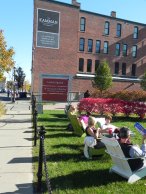
In other words, the city’s current zoning ordinance has not been an obstacle to a major economic boom.  This reality was underscored by the venue chosen for last week’s announcement of the filing of the Mayor’s Green Code proposal with the Common Council.  Mayor Brown’s exuberant promise to “revolutionize the development process” was proclaimed from an outdoor podium at Larkin Square.  The thriving Larkinville district, as well as projects such as HarborCenter, and the new Delaware North headquarters at Delaware and Chippewa, have grown and prospered despite the absence of the Green Code.

DSCN6918 DSCN6921

The fate of the Unified Development Ordinance lies in the hands of Buffalo’s Common Council.  As the city’s legislative body, the nine council members have the ultimate authority to approve, modify, or reject the 334-page proposal.  Here are some observations I urge them to keep in mind:

  1. As proposed, the draft Green Code would allow commercial and non-traditional residential activities on virtually every residential street.

The Brown Administration and Green Code advocates are enamored with the concept of “mixed use” neighborhoods where everything residents need is theoretically within easy walking distance of their homes.  At the October 22nd media event, Leslie Zemsky – known as the Larkin Group’s “Director of Fun” – told the assembled crowd that the Green Code would create “fun” by bringing back mixed use communities.

While that concept may sound attractive to the 20- to 40-year-olds and empty-nesters coveted by downtown developers, many City of Buffalo residents may not be enthralled at the thought of the following activities being allowed on their tranquil residential streets: restaurants (including live entertainment), retail and service stores, professional offices, industrial artisans, and taverns.   But that is precisely what is being proposed in the latest version of the Green Code for the vast majority of residential streets – in the University District, Parkside neighborhood, the West Side, the East Side, South Buffalo, the Fruit Belt or the Elmwood Village – through a device referred to as “neighborhood shops.”

In its current form, the Green Code would allow a “neighborhood shop” – including as disruptive an activity as a tavern with live entertainment – to be established in so-called “N-2R” and “N-3R” zones within “an existing commercial building,” even if the structure was last used for commercial purposes generations ago, if an applicant obtains a special use permit.

Disturbingly, the “neighborhood shop” concept is not reflected in the mechanism hailed by the Brown Administration as providing residents and developers a quick and easy way to immediately see which uses are allowed in each of the proposed zoning code’s twenty-two (22) zoning districts:  the PRINCIPAL USES Table.

Principal Uses Table p.6-4 Principal Uses Table p.6-5

The use table, known as “Table 6A:  Principal Uses,” is comprised of two pages, with the abbreviations for each of the 22 zoning districts listed horizontally, and approximately 86 “uses” listed vertically.  Accordingly to the Green Code text, the “Permitted” symbol, a black circle, “indicates that the use is permitted by-right in the zone,” while the “Special Use” symbol, a half-white/half-black circle, “indicates that the use requires a special use permit.”  The reader is then told:  “If a cell is blank, this indicates that the use is not permitted in the zone.”

That assertion, however, is not true.  The Principal Uses table fails to reflect the potential that neighborhood shops” are allowed with a special use permit in two prevalent “residential” zoning districts, N-2R and N-3R.  By not indicating the possibility that one or more of the five categories of so-called “neighborhood shops” could be coming to a currently residential block, residents are being misled to believe that their neighborhood is safe from encroachment by unwanted commercial activity, and the accompanying traffic, noise, and loss of privacy.

But even on blocks without a pre-existing commercial building, residential streets throughout Buffalo would be subjected to the following uses on any lot:  a bed-and-breakfast (with up to 10 guests); a cultural facility or place of assembly; a group home for unrelated persons with disabilities (including those who have undergone treatment for alcohol or drug addiction); “public safety facilities”; and a “market garden” open to the general public.

  1. The draft Green Code, by extensive reliance on the “Special Use Permit” process, would bring more uncertainty – not less – to Buffalo’s residential neighborhoods, and provide less protection to nearby residents and property owners than zoning amendments and variances.

The Mayor’s propaganda machine promised a new land use code that would bring “clarity and predictability” to the zoning process, allowing neighbors to have “certainty about what can and cannot be built next door.”  Unfortunately, the proposed Green Code does just the opposite.  By creating the potential for a wide variety of non-residential uses in residential neighborhoods through overuse of the “special use permit” process, residents on the vast majority of Buffalo’s residential streets – whether homeowners or renters – will be burdened with the possibility of living next door or down the block from unwanted commercial activities.

In its latest iteration, the Green Code’s “Principal Uses” table depicts the “Special Use” symbol more than one hundred sixty (160) times. That means that there are 160 different circumstances where a particular use might be allowed.  As noted above, that number does not include the availability of special use permits to establish or expand a “neighborhood shop” in a building originally constructed for commercial usage.


An activity requiring a special use permit is not allowed “by right,” but requires a property owner or authorized person (for example, a businessperson who does not own the property) to apply to the Common Council for a “special use permit.” The Green Code’s widespread reliance on the special use permit process not only creates uncertainties for nearby property owners and residents, it provides little protection and creates a false sense of security.

Developers and the business community generally prefer special use permits, and for a good reason.  New York’s courts have consistently ruled that when a legislative body – such as the Common Council – includes a use in a zoning law as an allowed activity if a special use permit is granted, it is making a finding that the use is in harmony with a community’s general zoning plan and will not adversely affect the neighborhood.  For that reason, an applicant possesses a much greater chance of obtaining a special use permit than it does a zoning amendment from the Common Council, or a variance from the Zoning Board of Appeals.  Not only are special use permits the easiest type of zoning approvals to obtain, they are the hardest approval for an unhappy neighbor to overturn in court.

  1. The Green Code team fails to adequately explain why the proposed new law emphasizes “Form” – that is, the types of buildings – over “Function” – how the buildings will be used.

The authors of the draft Buffalo Green Code have chosen to push aside the traditional approach to zoning and land use regulations – which emphasizes how land and buildings are used – and, without adequate justification, have proposed a “form-based code” where emphasis is on the type of buildings that are allowed, rather than the activities that are taking place in the building.

Hand-in-hand with the “form-based” approach taken by the Mayor’s Office of Strategic Planning is an effort to equate the physical look of a neighborhood or street with its “character.” While the “form” of buildings – especially their size and proximity to neighboring parcels – affects the character of a neighborhood or community, it is often the type of activities which occur within and around that structure that has the greatest impact on nearby properties and uses, especially nearby residences. This fact would be especially true if an existing building – constructed decades or a century ago for commercial usage but presently used for residential purposes – was allowed under the Green Code to revert back to a commercial activity as a “neighborhood shop.”

  1. The Green Code’s proposed elimination of all minimum parking requirements is unfair to existing businesses and nearby residential neighborhoods.

The Brown Administration has chosen to eliminate all minimum off-street motor vehicle parking requirements in its proposed zoning ordinance. The Mayor’s staff calls this a “market based approach,” based on the fiction that developers wishing to construct a new building, or expand an existing one, will always make certain that their tenants, customers, and employees have adequate parking facilities.

In the real world, however, developers are often tempted to skimp on off-street parking if given the opportunity, preferring to construct larger buildings that will provide additional revenue. When that happens, tenants and customers are compelled to park on the street. In areas where parking is already at a premium, existing businesses suffer when their lots are used by someone else’s customers, or their own customers can no longer find on-street spaces nearby. Worse of all, the excess parking spills over to neighboring residential streets, bringing with it noise, loss of privacy, and inconvenience.  Recent news stories reflect the fact that homeowners and tenants throughout Buffalo – from the Fruit Belt to the Lower West Side to the Elmwood Village – are already besieged by nonresidents parking near their homes, resulting in substantial inconvenience and loss of privacy.  The Green Code’s elimination of any minimum off-street parking requirement will greatly exacerbate that problem.

JAG the pirate

It is ironic that a proposed land use plan that eliminates the requirement that businesses provide off-street parking spaces for motor vehicles is being presented to the Common Council simultaneously with the news that the U.S. government is providing an additional $18 million to finish the task of returning cars to Buffalo’s Main Street. Here’s Byron Brown’s reported comment concerning the federal aid:

 “This will give us everything we need to have a beautiful lower Main Street that stimulates additional investment and job creation.”

Everything but an appropriate place to park those additional cars.

  1. The latest version of the Green Code fails to preserve the character and historic fabric of the Elmwood Village.

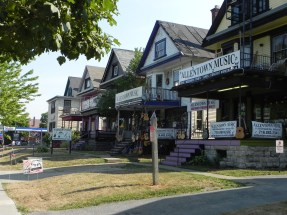
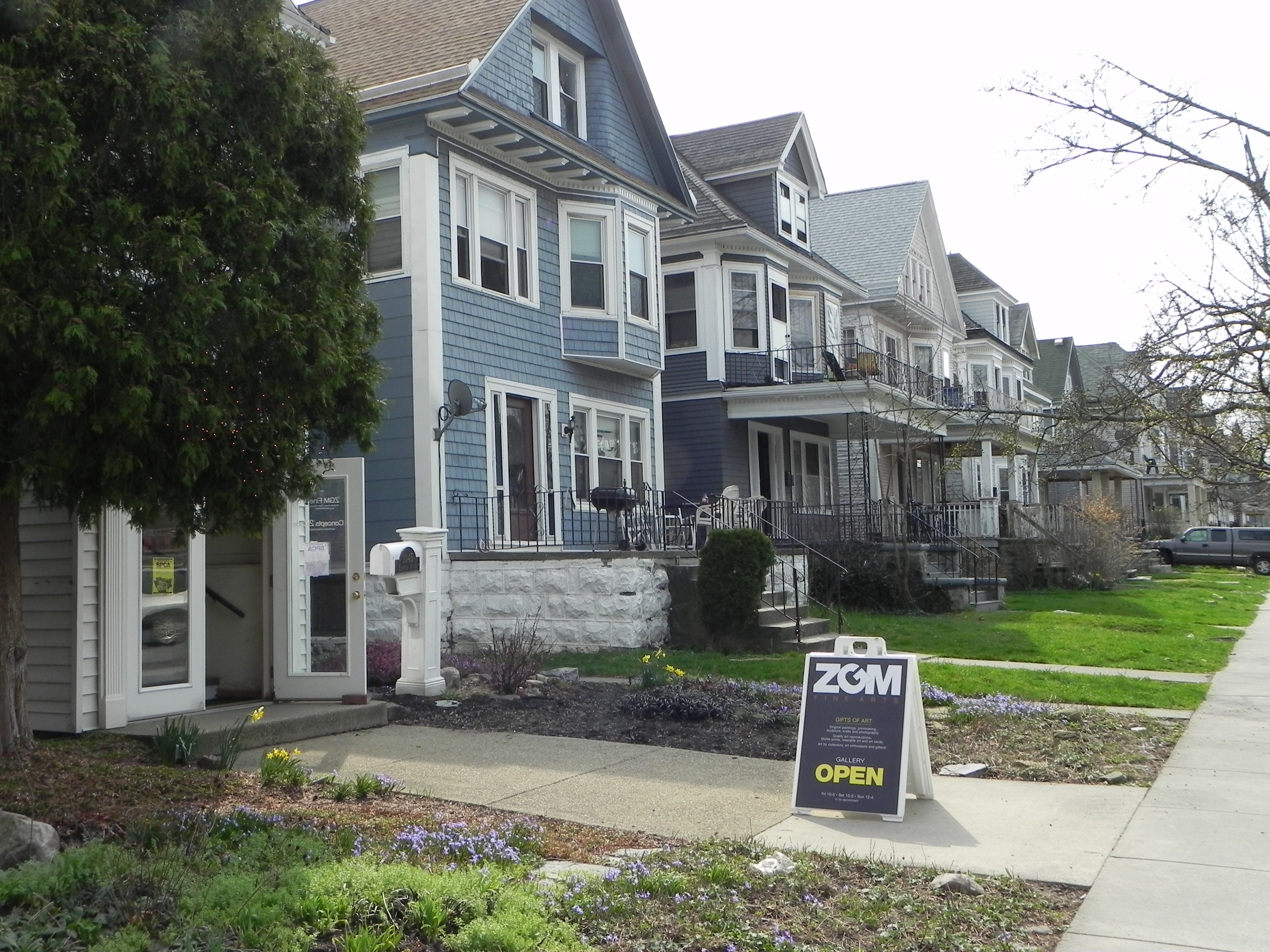
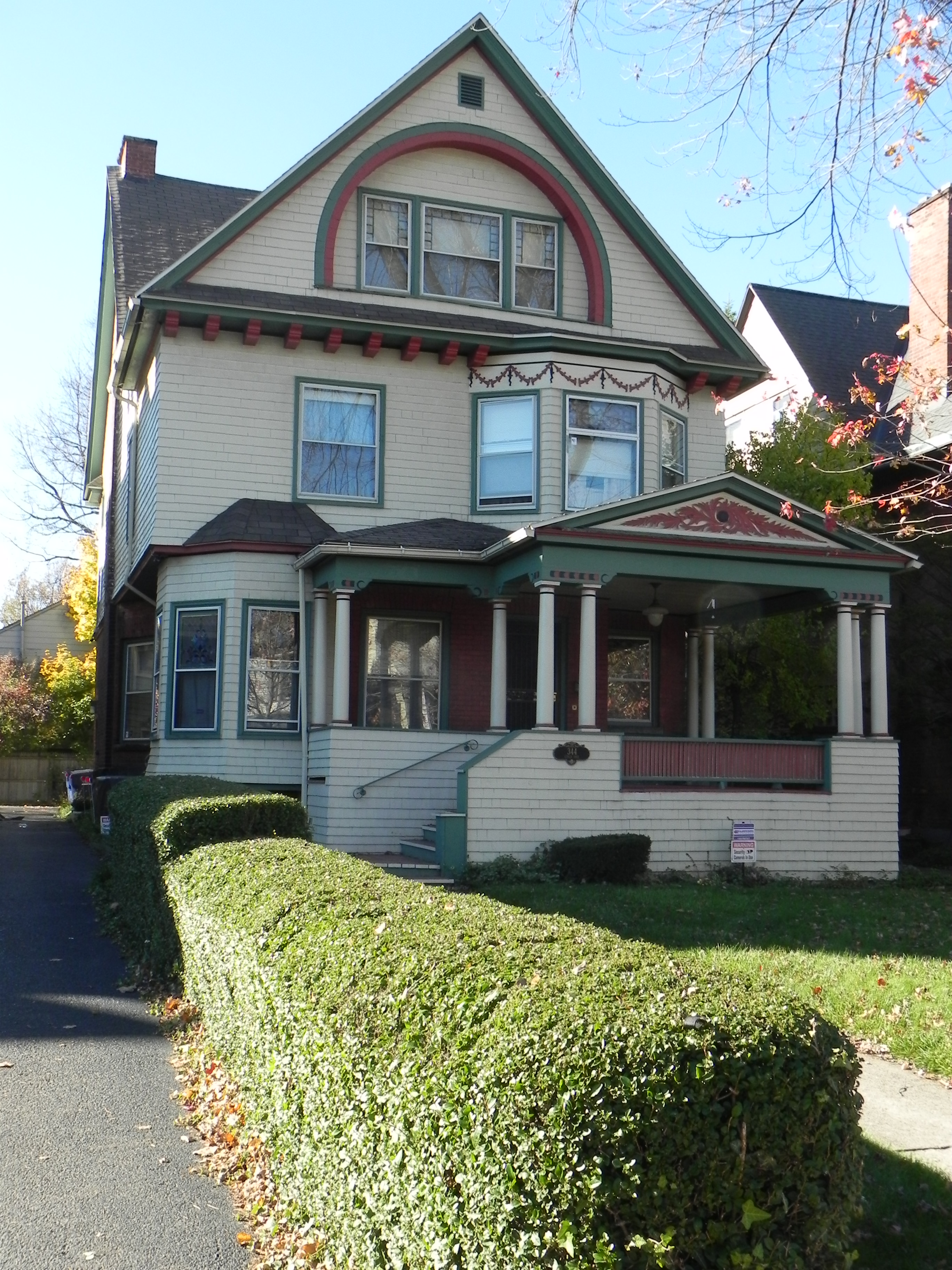
Mayor Brown’s recent press release echoes the promises made throughout the Green Code process that the new zoning code would encourage buildings “that fit our historic city patterns.” But the latest edition of the proposed Uniform Development Ordinance would eliminate the very features of the current zoning ordinance that have reinforced and preserved the historic fabric of the Elmwood Village and nurtured the balance between residential and non-residential uses: substantial limits on the intensity and scale of commercial uses on Elmwood Avenue.

DSCN6994 DSCN6997

Some specific concerns: 

A.  Placement of most of Elmwood Ave. in the so-called N-2C “Mixed-Use Center” Zone is inconsistent with the historic fabric of the Elmwood Village.

With the exception of its intersection with Lafayette Ave., all of Elmwood Ave. starting just north of W. Ferry St. and extending to Forest Ave. has been designated an N-2C “Mixed-Use Center” zoning district. The description of the N-2C zone in the Green Code sounds innocuous enough:

“The N-2C zone addresses mixed-use, walkable centers of Buffalo’s most compact neighborhoods, many of which were fully developed before the automobile became prominent.” 

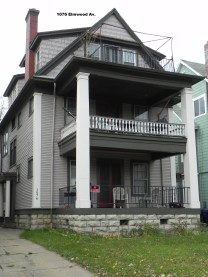
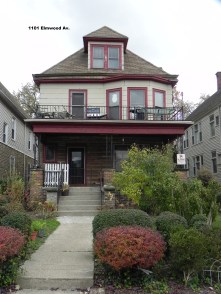
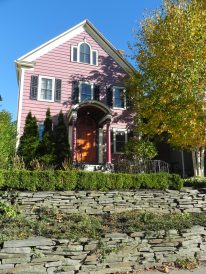
But labeling this integral stretch of the Elmwood Village N-2C ignores the character and scale of the existing buildings, and, thereby, the unique charm that has made this neighborhood so attractive.  N-2C allows 5-story commercial buildings – with the decidedly unattractive moniker of “Commercial Block” – despite the fact that the predominant height in this area is 2 to 3 stories.  The N-2C zone also prohibits the construction of houses, whether detached or attached, despite the prominence throughout this portion of the Elmwood Village of free-standing residential structures.
Exh 10 - 1101 Elmwood Ave. 11-06-13  647 Elmwood 11-04-15

Exh 23 1076 Elmwood Ave. 11-06-13 DSCN6932

B.  The height and scale of “Commercial Block” buildings is inconsistent with the character of the Elmwood Village, and will adversely impact residences on abutting streets.

BGC- Commercial Block form  

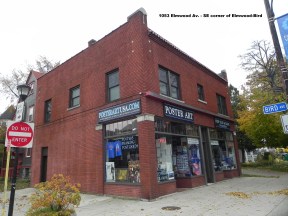
As currently written, the Green Code would allow so-called “Commercial Block” buildings up to 5 stories in height, and as wide as 120 feet in those areas of Elmwood Avenue zoned N-2C. In contrast, the proposed maximum height of Commercial Block buildings on the stretch of Hertel Avenue between Delaware Ave. and Starin – a so-called N-2E zone – is a more reasonable 3 stories.
 Exh 17 - 1053 Elmwood 11-06-13 DSCN2378

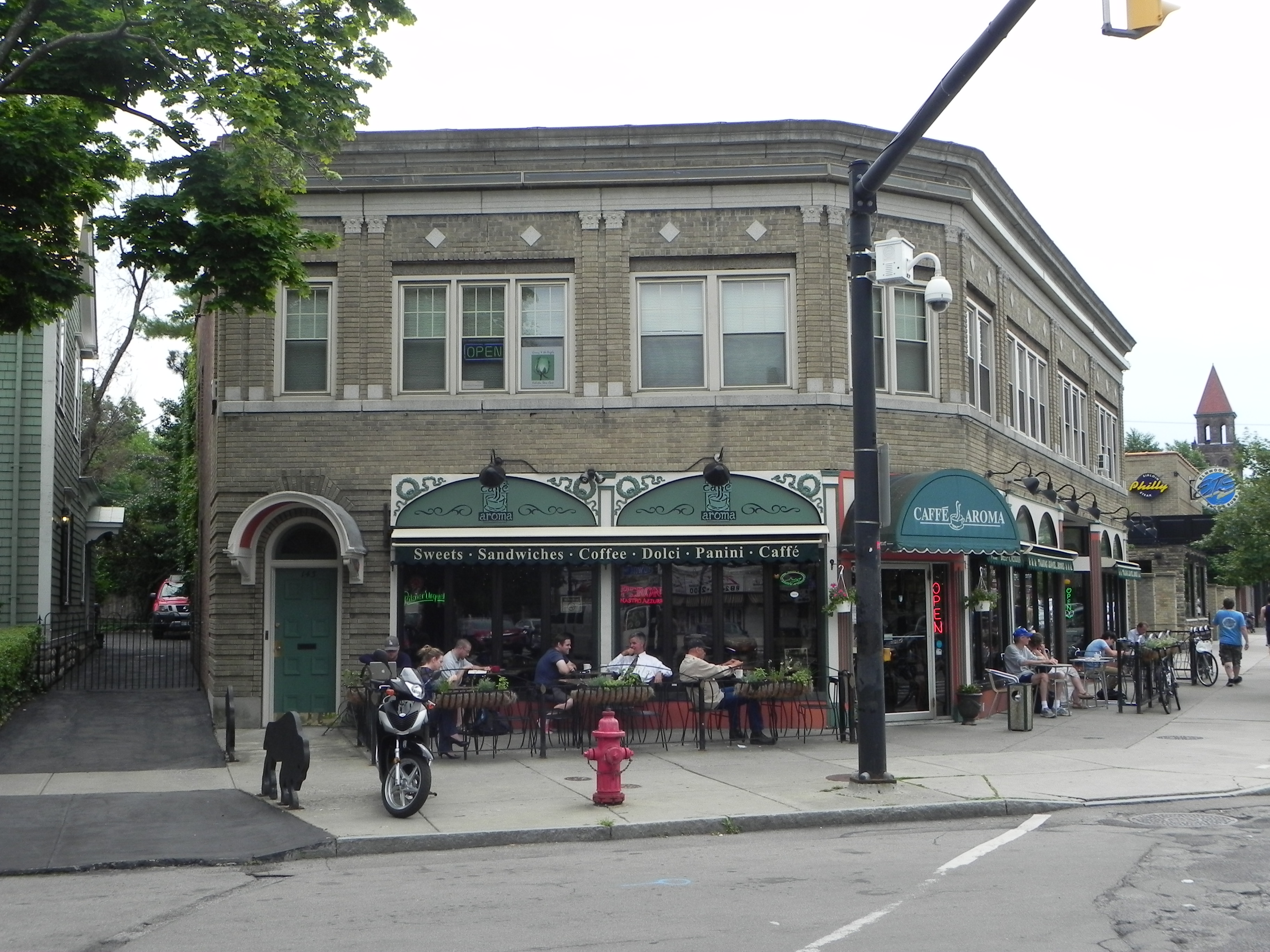
While the current maximum width of lots in N-SC – 120 feet – is a substantial improvement over the inexcusable 225-foot maximum in the Green Code’s May 2014 draft, it is still totally inconsistent with the Elmwood Village. A 5-story commercial block building 120-feet in width built on a typical Elmwood Avenue lot 140 feet deep [such as would occur at the southeast corner of Elmwood and Forest] would contain nearly 75,000 square feet of floor area. In contrast, the two-story iconic building that Café Aroma shares with Talking Leaves book store at the southeast corner of Elmwood and Bidwell Parkway has 7,500 sq. ft. of floor area:
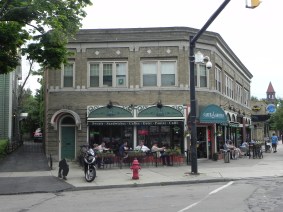
Cafe Aroma-Talking Leaves 141 Bidwell

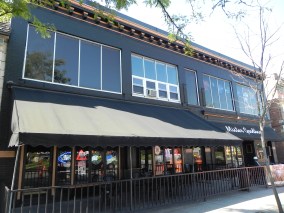
Mr. Goodbar is a 2-story building with a total of 6,930 sq. ft.:
DSCN2405

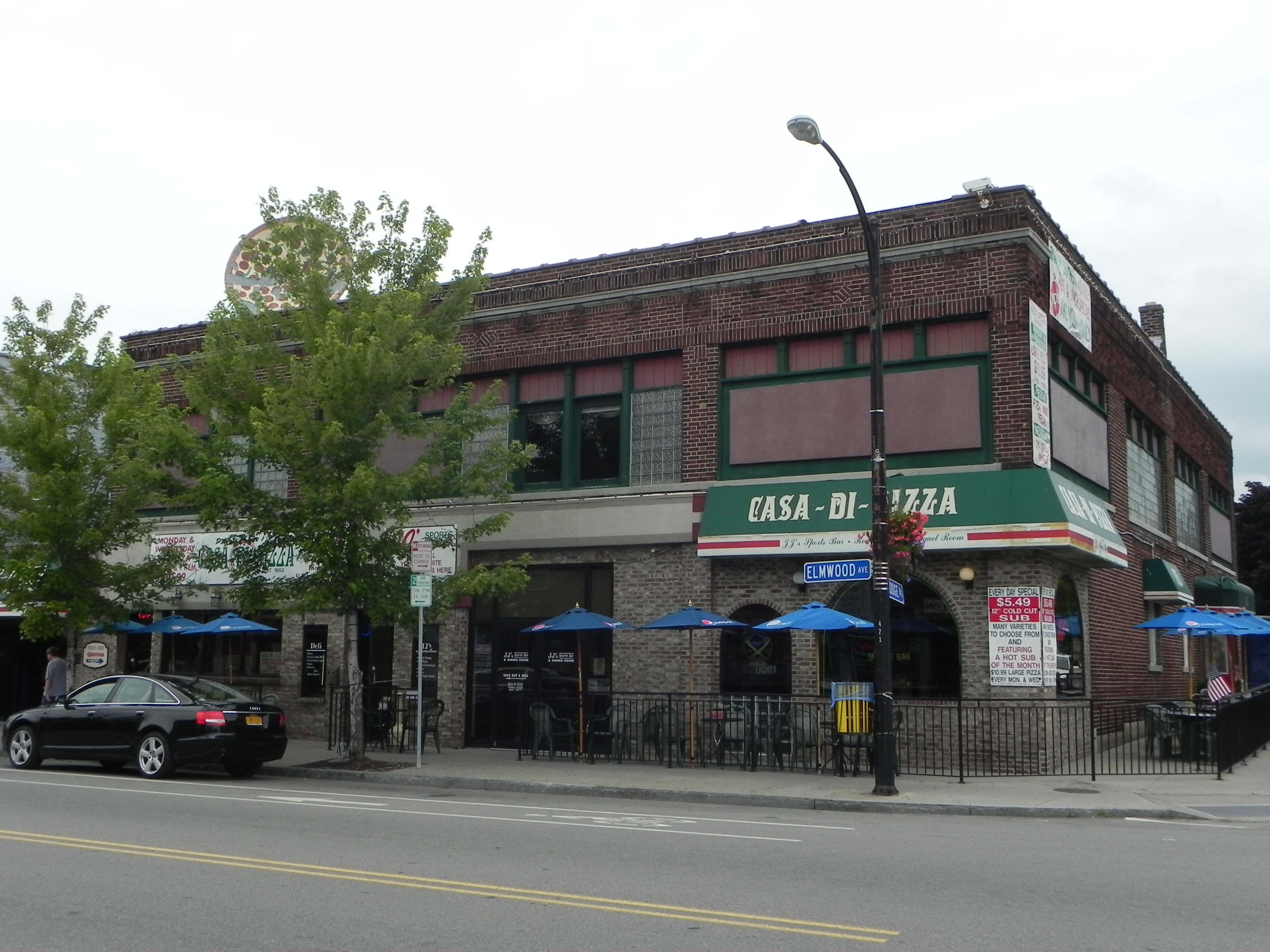
And Casa-Di-Pizza, also two-stories in height, sits on a 64-foot wide lot and weighs in at less than 11,500 square feet.

Casa-Di-Pizza

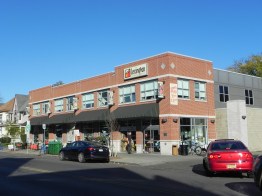
Even the Lexington Co-op’s more recent building at Elmwood and Lancaster is only 8,800 sq. ft.
Lexington Co-op 11-04-15

As currently written, the draft Green Code generally requires a zero-foot rear yard for Commercial Block buildings – NO BACK YARD! In response to outcries from neighboring property owners on abutting residential streets, the current version requires a minimum rear yard setback of “10% of lot depth if rear lot line abuts an N-2R, N-3R, N-4-30, or N-4-50 zone.” While a slight improvement, this feeble buffer would subject residents – such as a group of prior clients of mine on Granger Place – to a 5-story commercial building a mere 14 feet from their rear yards, replacing what have historically been the back yards of 2-family residential structures. 

C. Allowing 120-foot wide Commercial Block buildings will hasten speculation and demolition of the characteristic Elmwood Village structures.

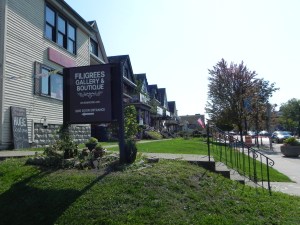
It is not only the incongruent scale of the “Commercial Block” buildings envisioned by the draft Green Code that threatens the historic fabric of the Elmwood Village. Many of the lots in the Elmwood Village are only 30 to 40 feet wide. Allowing buildings 5-stories tall and 120 feet wide would encourage speculators to purchase and demolish rows of century-old residential structures – the essence of the Elmwood Village’s character.  And, as noted above, the Mayor’s proposed development ordinance would prohibit construction of any new dwellings – whether in the form of attached or detached houses – on Elmwood Avenue, despite the historic neighborhood’s blend of residential and commercial structures.
    DSCN2326  DSCN1490

D. The Green Code further threatens the scale and character of the Elmwood Village by eliminating the strict limitations on the size of commercial establishments that were established in the mid-1970s pursuant to the protective provisions found in the “E-B” special zoning district.

In the mid-1970s, Buffalo’s Common Council wisely took steps to protect the stability and viability of the portion of Elmwood Avenue that is now popularly known as the Elmwood Village – starting at Virginia Street and heading north to Forest Avenue – by enacting a “special zoning district” known as the Elmwood Avenue Business District (E-B). The legislation’s purpose [found at Section 511-86(B) of the current City of Buffalo Zoning Ordinance] was expressed as follows:

Legislative intent. The Common Council finds that the stability and continued viability of this area as a sound residential, commercial and cultural area of the City is threatened by the overdevelopment and expansion of bars, taverns, restaurants, takeout food shops and other commercial enterprises which threaten the continuation of the essentially unique and continuing viability of this area. The Common Council further finds that the encroachment and expansion of enterprises of his nature have given rise to traffic congestion, hazards to the life and safety of pedestrians and motor vehicle passengers and operators, extensive illegal parking, excessive noise, vandalism and trespass and damage to public and private property. Further, this condition has created annoyance and interference with the rights of residents of the neighborhood to their right to peaceful enjoyment of their property and an invasion of their rights of privacy. By creating this special zoning district, the Common Council of the City of Buffalo intends to create a compatible balance between the legitimate commercial interests and the lawful interests of the residents of this area.

A critical mechanism used in the E-B zoning requirements to create “a compatible balance” between the legitimate interests of residents and businesses was the following limitation on the size of a commercial establishment:

“Maximum floor area for a single business outlet; 2,500 square feet on any single floor or 5,000 square feet total floor area in any single building.”

This restriction on the size of new business establishments has contributed to the unique charm and attractiveness of the Elmwood Village, and its recognition by the American Planning Association as one of the ten “Great Neighborhoods in America.”

Despite the undoubted success of the Elmwood Village as a thriving urban community, the draft Green Code would drastically alter the existing balance between the quality of life of residents and commercial activity.  In stark contrast to the 2,500 square feet “on any single floor” maximum created in the E-B district legislation, the latest Green Code draft sets the limit for “ground floor commercial space” in the Elmwood Village at 10,000 square feet, and provides no limits for an entire building or business.  Relaxation of restrictions on the scale of commercial activity will jeopardize the essence of the Elmwood Village.

[Note:  I addressed the adverse impacts of the proposed Green Code on the Elmwood Village in greater depth in a May 2014 post:  https://withallduerespectblog.com/2014/05/20/buffalo-green-code-developers-given-green-light-on-elmwood-avenue/.]  

E. By its inflexible insistence on zero front-yard setbacks, the proposed Green Code will eliminate the green front lawns that grace a substantial number of Elmwood Avenue lawns.

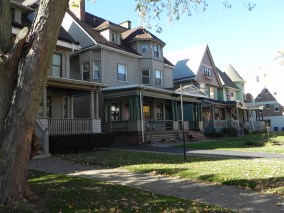
In sharp contrast to the inviting green lawns that have adorned so many of the Elmwood Avenue properties, the proposed zoning law mandates – in the name of “walkability” –  that all structures be built right at the sidewalk with zero setback.  Once again, such a requirement adversely impacts the fabric and feel of the Elmwood Village.

Exh 12 - 1091 Elmwood Ave. 11-06-13  DSCN6931

DSCN2025 DSCN6936

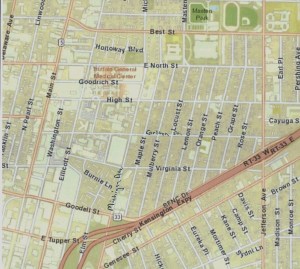
6.  Rather than protect the low-income residents of McCarley Gardens and the Fruit Belt neighborhood from encroachment by the Buffalo Niagara Medical Campus, the draft Green Code would increase the threat and pace of displacement and gentrification.

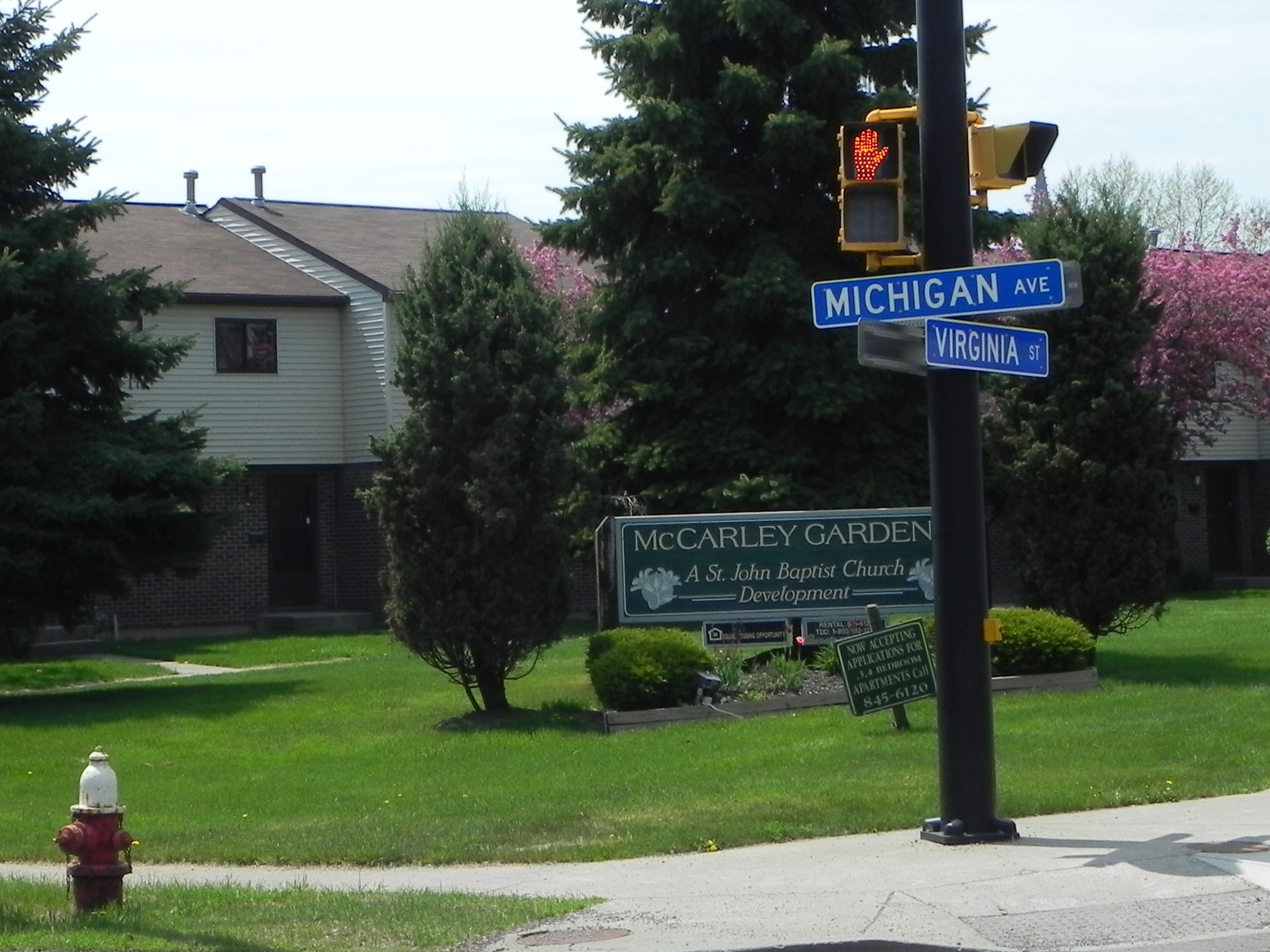
The draft Green Code classifies the McCarley Gardens site at the corner of Michigan Avenue and Virginia Street as a “Residential Campus.”   While at first glance that may sound reassuring to the 140+ families living in the predominately black, low-income townhouse development in the shadows of the Buffalo Niagara Medical Campus, the details suggest otherwise.

McCarley Gardens

In the hands of ardent “mixed use” proponents, the term “residential” no longer means what Buffalonians might think.  The Brown Administration’s land use plan does little, if anything, to protect the current residents from being pushed out of their homes, in order to make way for new and profitable development, by proposing creation of a “mixed use” campus.  By virtue of the types of uses that would be allow on the so-called “Residential Campus,” the Green Code as currently drafted provides a major incentive for developers to purchase and demolish McCarley Gardens.  The 23 townhouse buildings could be profitably replaced with an up-scale project that could include everything from medical clinics, residential care facilities, professional offices, and retail and service establishments, to hotels, restaurants (with outdoor dining and live entertainment), and taverns.

Additionally, the draft Green Code’s lengthy list of non-residential uses and sizeable buildings permitted alongside the medical campus and on the predominately residential streets of the Fruit Belt neighborhood will fuel the speculative purchase of properties and gentrification – the displacement of the current homeowners and tenants in the historic community to the east of the medical campus.
BNMC and Fruit Belt A0001

DSCN4362 DSCN4763

The Green Code is now in the hands of Buffalo’s Common Council.  We can only hope that each one will soon be able to answer the question:  So, what activities could occur on my block if the Green Code is enacted?

With All Due Respect,

Art Giacalone

Note: A version of this post was published in the October 29 – November 4, 2015 weekly edition of ARTVOICE at http://artvoice.com/issues/v14n43/news_green_code.

DSCN1076

Buffalo’s Common Council must take full responsibility for the proposed Green Code

Posted by Arthur J. Giacalone on October 22, 2015
Posted in: Byron Brown, Green Code. Leave a comment
** It is our city’s legislative body – not Mayor Brown – that possesses the authority and obligation to determine the timetable for public comment and review, and the ultimate content of Buffalo’s new zoning and development law.”

Mayor Byron W. Brown’s “Green Code team” issued a “MEDIA ALERT/PHOTO OPPORTUNITY” advisory this morning for a media event at 2:00 pm this afternoon at Larkin Square.  Following a full-year of no public activity concerning the proposed new zoning/land use law, the Mayor is announcing today’s official filing of the Buffalo Green Code with the Common Council, and proclaiming the start of “the formal public comment period under the State Environmental Quality Review Act (SEQRA).”

With all due respect, Your Honor, the Common Council members are the elected officials with the authority to decide the timetable for review of the proposed new law, not you.  And, the Common Council, not the Mayor or his Office of Strategic Planning, has the power and responsibility for determining the final version of a comprehensive set of regulations that will significantly impact Buffalo residents, voters, and taxpayers for generations.

1 Yellow

I look forward to reviewing and objectively assessing the latest version of the draft Green Code – from the perspective of a lawyer who has spent a quarter-century protecting the quality of life of Buffalo residents – as soon as the public is provided access to the document.  [You can read my commentary regarding the May 2014 version of the draft Green Code here and here and here.]   Meanwhile, something seems totally out-of-whack with the Mayor’s announcement that the Common Council will initiate the formal public comment period “upon acceptance of the Green Code at its October 27th regular meeting.”

According to law, the SEQRA “comment period” [which can be as short as 30 days] does NOT commence when the “lead agency” receives the proposed new legislation [that is, the proposed Green Code]. The SEQRA comment period starts when the lead agency has completed a Draft Environmental Impact Statement [DEIS].   So, unless the Mayor’s Office of Strategic Planning has prepared a DEIS, and is delivering that voluminous document along with the proposed Green Code to the Common Council today, the Common Council will not, in fact, be in a position to initiate the formal public comment period under SEQRA on October 27th.

I apologize for the technical nature of what follows, but several important legal points must be kept in mind:

(1) According to the SEQRA regulations, the “lead agency” is “an involved agency PRINCIPALLY RESPONSIBLE … for approving an action.” An “involved agency” means a state or local agency “that has jurisdiction to … approve … an action.” Due to the fact that the proposed action [the adoption of the Green Code] is a legislative act that only the Common Council has the authority to approve, under law, the Common Council is obligated to serve as “lead agency”, not the Office of Strategic Planning, or the City Planning Board, or any other agency or board.

(2) NY’s courts have consistently held that a lead agency may NOT lawfully delegate the responsibility of making SEQRA determinations to another agency and, by doing so, insulate itself from the environmental review process [that is, actually thinking about the impacts of the proposed legislation].

(3) According to the SEQRA regulations, the function of a DEIS is to provide “a means for agencies, project sponsors and THE PUBLIC to systematically consider significant adverse environmental impacts, alternatives and mitigation.” A DEIS must “evaluate ALL reasonable alternatives.”

(4) According to the SEQRA regulations and numerous appellate court decisions, the environmental review under SEQRA is supposed to take place “at the earliest possible time,” that is, when there is still sufficient flexibility in deciding the scope and content of the proposed action. To say the very least, it is awfully late in the decision-making process – the point when the Mayor’s team believes that it has the final version of the Green Code – to be performing the mandated environmental review.

If I were a member of the media and today’s photo provided an opportunity to ask questions, here are some of the questions I would have for Mayor Brown, Executive Director Mehaffy and Council President Pridgen:

(1) Who is the “lead agency” for the proposed Green Code? [And, “City of Buffalo” is NOT specific enough.]

(2) Has the DEIS been completed? If so, who prepared it?

(3) Why has the Mayor’s team waited to this late point in the Green Code drafting process to provide the Common Council and the public with the DEIS?

(4) When and how will the public have access to (a) the proposed Green Code, and (b) the DEIS?

With All Due Respect,

Art Giacalone

Pimping the Peace Bridge – Buffalo News can’t resist the urge

Posted by Arthur J. Giacalone on October 20, 2015
Posted in: Buffalo News, Environmental Justice, Peace Bridge. 1 Comment

** But its latest “build it and they will come” campaign for a companion bridge disregards the facts and the law. **

The Buffalo News editorial staff certainly is persistent. For years, they have shamelessly hawked the concept of a new bridge between Buffalo, New York and Fort Erie, Ontario, while refusing to responsibly address the adverse impacts the existing Peace Bridge has on the adjacent residential community.

High asthma rate study area

Back in 2008, when plans for a so-called “signature” span were prudently scuttled, Western New York’s largest newspaper demanded “an iconic bridge”, and impudently proclaimed, “We are One Buffalo. We do not have to settle for second-rate.”

Three years later, when the Peace Bridge Authority announced that neither a new bridge, nor a “grand plaza” on the U.S. side, would be happening, a truculent editorial asked supporters of a dramatic new span “to remain on duty” and to continue the quest for “the ultimate goal” – delivery of a new bridge.

DSCN3189

This past week, the BN’s uncontrollable desire to preach the need – and, from its perspective, the right to a new bridge – was re-aroused. It didn’t take much. The stimulus this time was a recent comment by the Peace Bridge Authority’s Canadian chairman – Anthony M. Annunziata – asserting the need for a new companion span between Canada and the U.S.

Without missing a beat, the Buffalo News October 16th editorial elevates Annunziata’s words to near-mythic proportions, proclaiming that the Canadian chairman’s utterance has brought “the idea of a companion span to the Peace Bridge explod[ing] into public consciousness again.” Such hyperbole (rather than informed reflection) can be expected from an insufferable new-bridge-addict. But a more realistic response is the one expressed by New York State Assemblyman Sean M. Ryan, D-Buffalo. As reported in an October 10, 2015 article in the Buffalo News, Ryan characterized Annunziata’s suggestion as “careless,” suggested that the removal of the threat of eminent domain and construction of a new bridge has helped bring a measure of stability to the adjoining West Side neighborhood, and opined: “Clearly, Chairman Annunziata has gone rogue.”

In contrast to the reality-check provided by Assemblyman Ryan, the BN editorial team instinctively asserts – without any objective support – the potential for “huge” benefits for Western New York if a companion span is built. Readers are assured that Buffalo and Western New York will “thrive” when delays at the Peace Bridge are reduced and Canadians overcome their “avoidance behavior” and once again flock to the U.S. to shop and entertain themselves.

The Buffalo News isn’t about to let hard facts moderate it’s proselytizing. While “new bridge” proponents previously justified calls for a new bridge by pointing to statistics reflecting an increasing number of vehicles utilizing the international crossing, the opposite is true today. As acknowledged in the October 16th opinion piece, vehicular traffic at the Peace Bridge is down significantly. Traffic numbers available at the bridge’s website show that automobile trips between Buffalo and Fort Erie have declined nearly 37% between 2003 and 2014.

From the BN’s perspective, however, reduced traffic at the Peace Bridge is now a reason to construct a second span. If you build a companion bridge, the argument goes, our Canadian neighbors will be freed from their debilitating fear of long lines and delays, and once again have the strength and confidence to regularly visit Western New York’s stores, eateries, and entertainment venues.

This simplistic scenario not only underestimates the intelligence and psychological resilience of Canadians, it disregards the statement in the October 10, 2015 article that average wait times in 2015 for Canada-bound autos crossing the Peace Bridge is a mere 2.3 minutes [that’s 138 seconds], and 5.1 minutes for U.S.-bound autos [that’s 306 seconds]. Such delays can hardly explain the “avoidance” phenomenon heralded by Chairman Annunziata and the BN editorial team, and do not begin to justify the expense, disruption, and environmental costs of constructing and operating a new bridge.

Even if we assumed for the sake of argument that the scenario envisioned by the Buffalo News and other supporters of a new bridge somehow matches reality, there exists no basis in law to treat the international crossing as it is viewed by the author(s) of BN’s editorial – nothing more than another cog in Western New York’s economic development engine to be stimulated and subsidized by state and federal money.

The Peace Bridge Authority, as noted at its website, is an international entity “created pursuant to a compact entered into by the State of New York, with the consent of the United State Congress, and by the Government of Canada.” The international compact, approved by Congress in 1934, and amended with the approval of Congress in 1957, mandates a self-sustaining facility that relies solely upon funds it collects in the operation of its properties (such as tolls, rentals, commissions) to cover not only operating expenses, but “all capital replacements, reconstructions and improvements.”

In light of the restrictions contained in the international compact, dreams of a companion for the old Peace Bridge – whether iconic, twin, or merely functional – should be put on hold unless and until traffic levels are sufficient to generate the funds needed to fill a “capital improvement” piggy bank. And, even then, any proposal to build a new bridge will have to be preceded by an environmental review that performs two critical functions: a thorough and objective assessment of potential adverse impacts of such a span on human health, the character of the surrounding neighborhood, traffic patterns, noise, migrating birds, etc.; and, a detailed evaluation of all reasonable alternatives (including the removal of all truck traffic from the international crossing between Buffalo and Fort Erie).

With All Due Respect,

Art Giacalone

Really, Sam Hoyt and George Maziarz together on an “Obscure Hydropower Panel”?

Posted by Arthur J. Giacalone on October 13, 2015
Posted in: Andrew Cuomo, Buffalo News, Corporate Welfare, Development, ECHDC, Geirge Maziarz, Political Contributions, Sam Hoyt, Waterfront. Leave a comment

** It’s bad enough that we have unaccountable agencies and boards with the power to disburse millions of dollars in corporate welfare. It is even more problematic for our legal and governmental systems when elected officials appoint to these entities political cronies with histories of poor judgment and ethical lapses. **

It came as a bit of a shock to read the front page article in the October 12, 2015 Buffalo News by political reporter Robert J. McCarthy. Beneath the headline, “Maziarz cleared background check amid investigation – Sources say federal prosecutor is backing off former state senator,” McCarthy reports that the state senate confirmed the appointment last January of former state senator George D. Maziarz “to an obscure hydropower panel” – the New York State Economic Development Power Allocation Board (EDPAB). That action was preceded, according to the article, by “the required State Police background check.”

The newsworthy aspect of the October 12, 2015 story escapes me. The Maziarz appointment was announced ten months ago during the agency’s December 15, 2014 board meeting. At best, the Buffalo News article leaves a reader uncertain whether the former senator’s appointment to the state panel has had any impact on an investigation begun last year by U.S. Attorney Preet Bharara into then-senator’s use of campaign funds. At worst, the headline and front-page report seems to imply that the former senator’s “successful background check” has removed him from legal scrutiny.

Regardless of its purpose, the October 12th article motivated me to investigate the current makeup of EDPAB, and led me to the discovery that Sam Hoyt – who serves as President of Empire State Development’s Western Region, and vice-chair of the Peace Bridge Authority – is also chairman of EDPAB. Further digging also led to uncovering the following: In 2012, NY’s legislature created an even more-obscure hydropower panel, the Western New York Power Proceeds Allocation Board.

The announcement last year that George Maziarz would retire as of December 31, 2014 did not sadden me. In fact, I have made it clear ever since I observed his behavior in 2010-2011 – regarding the proposed Verizon Wireless data center in the Niagara County Town of Somerset – that I do not have a very high opinion of the former state senator [and, I’m pretty certain that the feeling is mutual]. For example:

– The former senator’s banal cheerleading and failure to critically assess the telecommunication giant’s project and intentions, as well as his unflinching support for an estimated $626 million package of “financial aid” for Verizon from NYPA and the Niagara County IDA in exchange for – at best – 200 jobs, reflected poor and misguided judgment.

– His refusal to ask whether a better location in more urban portions of Niagara County (such as abandoned brownfield sites), coupled with his receipt of sizeable campaign contributions in 2008–2010 from the owner of the Somerset parcel, and in 2010 from Verizon, raised questions concerning the manner in which his official actions were impacted by political contributions.

View looking N from Babcock grounds A

– Public vilification by Mr. Maziarz of my client, a 75-year-old widow who owned farmland across the road from the proposed site, for asserting her rights under New York’s zoning and environmental review laws, demonstrated both a mean-spiritedness and a misunderstanding and disdain for the rights of average citizens and property owners. His false and public accusation – archived in a March 21, 2011 video clip for “The New York State Legislative Report” – that I had sought out my client and used her as a “pawn” in furtherance of an unidentified party’s interests, shows a reckless and dangerous disregard of the truth unacceptable in a public servant. [In fact, when my client’s daughter contacted me in a panic two days prior to a public hearing before the Somerset town board, and asked me if I could attend the hearing on her mother’s behalf, I embarrassingly told her that I had no idea where the Town of Somerset was located.]

p-p WNY map with cites-hwys-miles

My writings here and in various op-ed pieces also reflect the fact that I do not think highly of Sam Hoyt, for (among other things) his role in spearheading Gov. Andrew Cuomo’s policy of deception and abuse of power at the Peace Bridge. Neither George Maziarz, nor Sam Hoyt, would clear my background check for any government position that requires sound judgment and impeccable ethical credentials.

So the thought of Hoyt and Maziarz comprising two of four members of the EDPAB board is downright disconcerting. In theory, the power allocation board’s primary role is to serve as a “watchdog” on behalf of the public, ensuring that the New York Power Authority (NYPA) uses its financial clout within the requirements and criteria prescribed by law. Sadly, that “dog” has refused to bare its teeth, much less bite.

CCI083015_0004

More specifically, it is my opinion that EDPAB exhibited a willingness in 2010 to disregard both the law and ethics when it rubberstamped a request for $105 million to fund development at Buffalo’s Canalside. What follows is a detailed summary of what occurred in February 2010 – taken from an unanswered email that I sent in September 2010 to then-editor of the Buffalo News, Margaret M. Sullivan:

     In need of additional funding for the Canal Side project, the project sponsors, Empire State Development Corporation [ESDC] and its local subsidiary, ECHDC, asked NYPA to provide an “Industrial Incentive Award” [IIA] of $3.7 million per year for 20 years to help finance the project. There were two basic problems with ESDC/ECHDC’s request. Pursuant to NYPA’s annual Economic Development Plan, IIAs were only available to industrial companies in NYS “at identifiable risk of closure or relocation to another state.” The Canal Side project, and its long-pursued “destination retailer,” Bass Pro, obviously did not fit that criteria. Additionally, NYPA’s annual Economic Development Plans had never included a 20-year funding proposal. Despite these defects, NYPA asked its oversight agency, EDPAB, to approve the proposed funding package for the Canal Side project.

     On February 2, 2010, EDPAB held a special meeting, by video conference, for the sole purpose of considering NYPA’s funding proposal for the Canal Side project. The EDPAB Chairman, Kenneth Schoetz, participated in the video conference from the 95 Perry Street office suite of ECHDC and his employer, ESDC, the agency that had requested the Industrial Incentive Award for the waterfront project. Mr. Schoetz, who had previously served as ESDC’s Acting Upstate Chairman, held the position of ESDC’s “Senior Vice President of Regional Offices” on February 2, 2010. Despite the fact that the proposal under consideration represented a radical departure from prior EDPAB policies, requiring EDPAB to revise the then-current Economic Development Plan to extend it from 2016 to 2029, and to add a new “permissible use” to the list of uses of Industrial Incentive Awards, Chairman Schoetz chose not to recuse himself from participating in the discussion and voting on the proposal. In fact, he provided the third and decisive vote required by statute to approve the resolution.

     Plaintiffs in Goldman, et al. v. Bass Pro Outdoor World, L.L.C., et al. (NYS Supreme Court, Erie Co., Index No. 7723/2010), contend that Mr. Schoetz’s dual role, as EDPAB Chairman and ESDC’s Senior Vice President, created a disqualifying conflict of interest, or, at a minimum, the appearance of impropriety. Responding to that claim, Mr. Schoetz has provided a sworn affidavit to the Court in which he denies any impropriety and states:

 There is no conflict of interest nor even the appearance of impropriety here. It is common for public bodies with similar missions to have cross involvement… The purpose of having an ESD employee serve on EDPAB is to promote cooperation and consistency in economic development decisions. [Emphasis added.]
The so-called “cross involvement” touted by then-Chairman Schoetz, and the “cooperation and consistency” that he says it promotes, help to explain the often narrow, myopic perspective of agencies such as NYPA and Empire State Development (and its subsidiaries, such as Erie Canal Harbor Development Corporation). Such inbreeding also helps to accelerate the public’s loss of confidence in the integrity and wisdom of the economic development process.

Given their past history, Sam Hoyt and George Maziarz are not likely to make decisions in their capacity as EDPAB board members that will help restore the public’s faith in government decision-makers – unless, perhaps, U.S. Attorney Preet Bharara is available to babysit.

With All Due Respect,

Art Giacalone

Even the Buffalo News sees “a need for caution” concerning Waterfront plans

Posted by Arthur J. Giacalone on October 9, 2015
Posted in: Buffalo News, Byron Brown, City of Buffalo, Development, ECHDC, Green Code, Sam Hoyt, Waterfront. Leave a comment

** Given the DNA and prior history of the Erie Canal Harbor Development Commission, and the secrecy and duplicity that have tainted the Buffalo Green Code process, Western New Yorkers who desire a waterfront where open space, parks and nature’s beauty prevail must be ever vigilant and skeptical. **

The October 2, 2015 editorial in the Buffalo News is an eye-opener.  In the not-too-distant past, our region’s largest newspaper characterized the now-defunct Bass Pro big-box project as “the key” to turning Buffalo’s waterfront “into a destination for visitors and tourists alike.”  It even expressed admiration for the “fortitude” shown by the Erie Canal Harbor Development Corporation (ECHDC) leaders in striving for nearly a decade to bring Bass Pro to Canalside.

In what is hopefully a genuine reversal in position, the recent Buffalo News opinion piece recognizes “a need for caution” when considering the latest plans for Canalside –  which include not only a children’s museum, historic carousel, shops and restaurants, but also office space and residences.  Fear of an incremental loss of open space at Canalside appears to have been fueled by comments made by Sam Hoyt (ECHDC board member and ally of Gov. Andrew Cuomo) that Canalside has “some of the most valuable, developable property” in upstate New York, and by Brendan R. Mehaffy (head of Mayor Byron Brown’s Office of Strategic Planning) that “Canalside is nowhere near its potential.”

In response, the publication’s editorial team acknowledges that “part of the attraction of Canalside is its expanse of urban green space, hard against the lake,” and reminds the problematic Mr. Hoyt, that the use of real estate highly coveted by developers, such as Canalside, as a park may well be “its higher purpose.”

While these statements by the Buffalo News are a welcome change in attitude, skepticism and extreme vigilance, not mere caution, are required when assessing the short-term and long-term plans recently made public for both the Inner Harbor’s Canalside district and the Outer Harbor.  If there is to be a realistic chance of avoiding an ever-increasing encroachment by commercial development, proponents of a Buffalo waterfront where open space and parkland are the first priority must recognize the true nature of such a threat as reflected in the following facts:

First, the ECHDC’s heritage and genetic makeup is pro-development, not pro-parkland.  Searching for ways to turn real property and natural resources into private development and profits is an inclination and preference that runs deep in its bones.  As expressed in its “Erie Canal Harbor” brochure, ECHDC is a subsidiary of Empire State Development, “the states chief economic development agency.”

Second, from its earliest days, as demonstrated in a 2007 “Pre-Development Agreement” crafted by ECHDC leaders and representatives of the Benderson development companies, an extremely cozy relationship has existed between leaders of the harbor development corporation and their anointed developers.  For example, the Bass Pro-era pre-development agreement envisioned Benderson developing the Donovan block, Webster block, Aud block, and “certain Historic Block Improvements.”  ECHDC was to fund the entire cost for three parking ramps to service the Benderson improvements, and “acquire title to all parcels required for the Benderson Improvements.”  Once acquired, ECHDC was to “deed such parcels to Benderson, for ten dollars.”  [Yes, ten bucks!]

Third, substantial legal questions were raised in 2010 (and, unfortunately, were left unanswered) regarding the propriety of the $105 million grant from the New York Power Authority to ECHDC which remains the major source of funding for Canalside.  The “Industrial Incentive Award” buttressing inner harbor development was intended for “a business in serious, long-term distress,” and not retail stores, office space, or residences.  And, raising significant conflict-of-interests concerns, the decisive vote approving the $105 million transfer of NYPA funds to Canalside was made by a member of a NYPA-controlled allocation board who was also a high-ranking official with ECHDC’s parent agency, Empire State Development.

[Note:  A detailed description of the legal claims and factual background asserted in a 2010 lawsuit that I brought on behalf of six Buffalonians – to challenge the use of public friends to lure Bass Pro to the Buffalo waterfront – entitled Goldman, et al. v. Bass Pro Outdoor World, L.L.C., et al., NYS Supreme Court, Erie Co., Index No. 7723/2010, is set forth in the Verified Petition/Complaint.]

Fourth, despite its well-publicized embrace of a “lighter, quicker, cheaper” approach to Canalside development, the leadership of ECHDC did not hesitate to support construction of the massive HarborCenter project at the edge of Canalside.  The publicly-subsidized development, with its towering 205-room hotel, 850-space parking ramp, pair of NHL-sized hockey rinks, bars and restaurants, was approved by ECHDC without first requiring preparation of an environmental impact statement.  Had the mandates of the State Environmental Quality Review Act (SEQRA) been followed, an EIS would have provided an opportunity to objectively explore alternatives and mitigation measures – and simultaneously provide the public with a mechanism for direct input – with the goal of limiting adverse impacts on Canalside’s pre-existing L-Q-C activities.

Fifth, Mayor Byron Brown’s “Buffalo Green Code” team demonstrated its allegiance to political expediency, rather than enhancement of Buffalo’s waterfront, in the spring of 2014. Plans were announced to realign historic Erie Street to reopen vistas from downtown to the Erie Basin Marina area. However, weeks earlier, without any public acknowledgement, the Brown Administration modified the draft Green Code to allow Carl Paladino’s Ellicott Development Company the right to construct a 14-story tower on land located precisely where it will obstruct the view from a realigned Erie Street to the waterfront.

Sixth, far away from the public’s eye, ECHDC and city officials have incorporated Outer Harbor development into the Buffalo Green Code planning process.  Despite claims of transparency, the ECHDC’s updated “blueprint” is the product of behind-closed-doors negotiations during an eleven-month period when the public was excluded from any direct involvement in the planning process.  Nonetheless, the ECHDC leadership seeks to legitimize its vision by referencing the “transparent City Green Code process.”

In the very near future, we will all have an opportunity to exercise vigilance concerning future plans for Canalside and the Outer Harbor.  Mayor Brown’s Office of Strategic Planning now says that it will deliver the final version of the proposed Buffalo Green Code to members of the City’s Common Council (the ultimate decision-makers) on or about October 22nd.

With careful scrutiny, we will hopefully uncover what the powers-that-be propose for Buffalo’s waterfront.  In reviewing what will be a massive document, we must pay close attention to the types of commercial and non-parkland activities the ECHDC and Mayor Brown envision for so-called “open space” areas and adjoining parcels.  And, we must be especially suspicious of any discretionary authority the ECHDC and/or Office of Strategic Planning retain for unspecified future development.

With All Due Respect,

Art Giacalone

Note:  Buffalo’s long-tenured, multi-talented and remarkably prolific environmental advocate, Jay Burney, was kind enough to republish this post at his always informative, and often beautiful, “GreenWatch” blog at The Public:  http://www.dailypublic.com/articles/10102015/greenwatch-all-due-respect-art-giacalones-perspective-newest-echdc-outer-harbor.

Buffalo’s Billionaires – hailed as “philanthropists” – profit at the public’s expense.

Posted by Arthur J. Giacalone on September 23, 2015
Posted in: Buffalo News, City of Buffalo, Corporate Welfare, Development, Jacobs Family, Political Contributions, Terry Pegula. 1 Comment

** By embracing – rather than eschewing – corporate welfare/crony capitalism, the Pegula and Jacobs families help perpetuate a political system where corporate money speaks much more loudly than the voices of average citizens. **

Terry Pegula, co-owner – with his wife Kim Pegula – of the Buffal Sabres, Buffalo Bills, and HarborCenter, was introduced as a “true Buffalo philanthropist” at the September 21st grand opening of the Marriott hotel, an imposing structure at the edge of Buffalo’s “lighter, quicker, cheaper” Canalside.  One week earlier, a Buffalo News editorial touted “the absolute dedication” of Jeremy M. Jacobs Sr. “toward this community” following his family’s $30 million gift to the University at Buffalo medical school.  An accompanying article on September 14 referred to the family’s “philanthropy” as transformational, noting that the Jacobs clan had provided the second largest donation in UB history “behind only a $40 million gift made anonymously in 2011 by a late local doctor.”

HarborCenter rendering

Undoubtedly, a $30 million donation – regardless of its tax-deductible status, and whether or not it represents less than one percent of Mr. Jacobs’ estimated $4 billion net worth – is staggering.  From my perspective, however, a “philanthropist” is a person who does more than make a generous gift – she or he actively promotes human welfare and social reform.

Jeremy Jacobs, with his billions, and Terry Pegula, reported by Forbes as having an estimated $4.6 billion net worth, were recently in a position to demonstrate a true commitment to the future of Western New York.  As billionaires, the Jacobs and Pegula families could afford construction of their respective downtown Buffalo projects without the necessity of financial assistance in the form of real property tax abatements, sales tax credits, and other manner of corporate welfare.  Proceeding without taxpayer-funded aid would have set a significant example for other well-heeled developers, and would have constituted a highly visible first step in restoring a semblance of integrity to our political system.  But, motivated perhaps by a sense of entitlement, Buffalo’s Billionaires chose profit over the promotion of political reform and human welfare.

As reported in November 2013 by WGRZ-TV:

Despite being owned by one of the Nation’s wealthiest citizens, a Buffalo-bred company won hundreds of thousands of dollars in tax breaks Monday, to ensure it stays in the Queen City for foreseeable future. The Erie County Industrial Development Agency (ECIDA) board of directors voted unanimously to grant Delaware North, owned by billionaire Jeremy Jacobs, $807,000 in sales tax abatements, so that it can move its corporate headquarters from the Key Center, approximately two blocks to a new $80 million building proposed by Uniland Development at the corner of Delaware Avenue at Chippewa.

Notably, the vote approving $800,000 in tax breaks [chump-change for a man worth four billion] was preceded by a less-than-philanthropic warning from the senior Jacobs son, Jerry Jacobs Jr., that Delaware North would find it “hard to turn down” a better offer from another city if it failed to receive the financial assistance it had requested. Equally disconcerting, Gov. Andrew Cuomo directly interceded on behalf of Delaware North and, as reported by the Buffalo News, “placed a call to CEO Jeremy Jacobs Sr. to assure him that his administration will do what it can to keep Delaware North in Buffalo.”

250 Delware Ave rendering

What is most troubling about the Governor’s call to “philanthropist” Jacobs is the fact that the Buffalo billionaire had made a $50,000 donation in June 2010 to Mr. Cuomo’s campaign, and contributed an additional $11,250 to Andrew Cuomo in August 2014 during the Democratic primary skirmish between the incumbent Governor and challenger Zephyr Teachout.

Note: Ms. Teachout, a Fordham University law professor and staunch critic of government corruption, had the following to say in an op-ed piece printed in the Buffalo News just weeks after Mr. Jacobs generously donated to Mr. Cuomo’s campaign:

                                                …

Western New York cannot afford to repeat the mistakes it made generations ago when businesses placed profits over clean air, clean water and the health of residents. The Buffalo Billion must be allocated without favoritism, and the selection process should be transparent. Winners must include local companies and small businesses that truly need the assistance to grow. Certainly the commitment of 20 percent of the Buffalo Billion to one project, RiverBend – a project that has repeatedly changed in size and scope – should be carefully re-evaluated.

It may only be a coincidence, but it is demoralizing for competing companies, taxpayers and residents to learn that two prominent Buffalo developers, LP Ciminelli and Uniland Development, were awarded major developer status for two Buffalo Billion projects following sizable contributions to Andrew Cuomo’s 2014 campaign. 

Meanwhile, the Pegulas (frackers who who made their fortune in oil and natural gas) possess the wealth needed to spend a total of $1.6 billion to purchase the Buffalo Sabres and Buffalo Bills and develop HarborCenter. And, as expressed by a longtime confidant of the billionaire couple, they were “not upset at all” that the final price tag for constructing “something very special” alongside Buffalo’s Inner Harbor exceeded initial projections by approximately $40 million.

Perhaps the higher final price for HarborCenter “was not a concern” for these Buffalo newcomers because they are receiving public assistance totaling around $57 million to further their for-profit venture. They applied for, and received at taxpayers’ expense, a thirty-seven-million-dollar corporate welfare package for the HarborCenter project, described in the following manner by the Buffalo News:

… The ECIDA approved a nearly $37 million tax incentive package that includes $28 million in property tax breaks over 10 years, $7.5 million in sales tax savings and $1.2 million in mortgage-recording tax breaks.

The Pegulas also applied for and were granted $20 million in brownfield tax credits by the State of New York, despite the fact that there is scarcely anything in the public record to suggest that protection of the public health or the environment mandated special treatment and cleanup of the former “Webster Block” site. [For a more detailed discussion of the brownfield tax credits granted to the Pegulas please see my earlier posting at https://withallduerespectblog.com/2015/04/02/buffalos-harborcenter-did-not-need-or-deserve-brownfield-tax-credits/.]

Oddly, the media appear eager to downplay the financial aid that the Pegulas have received in furtherance of the HarborCenter development. Chris Caya, the usually reliable WBFO reporter, refers to “a relatively small public subsidy” in his recent report, identifying “$35 million in tax breaks,” but failing to reference the additional $20 million in brownfield tax credits. Similarly, Buffalo News reporter Jonathan D. Epstein, felt the need to favorably contrast HarborCenter and UB’s new medical school, Kaleida’s new women and children’s hospital, and SolarCity at Riverbend, mentioning the $37 million ECIDA hand-out but leaving out a dollar amount when referring to state brownfield credits:

… Only the University at Buffalo’s new Jacobs School of Medicine and Biomedical Sciences ($375 million), the John R. Oishei Children’s Hospital ($270 million) and the factory for SolarCity at Riverbend in South Buffalo ($250 million) are more expensive. And all three of those are public-sector projects, with far more government support than the tax breaks – $37 million from the Erie County Industrial Development Agency plus state brownfields tax credits – that the Pegulas received…

But I do not want to understate the political donations made by the Pegulas. New York State records show that between September 13, 2013 and October 25, 2014 – a mere 13-month period – Kim and Terry Pegula made personal contributions totaling $67,000 to Gov. Andrew Cuomo.

There is no way we can rationally deny the ugly fact – so aptly captured by Buffalo News political cartoonist Adam Zyglis on September 18, 2015 – that Buffalo is indeed a “Tale of Two Cities,” with a spruced up waterfront and a morally-unacceptable poverty rate. Given this reality, we need billionaire philanthropists who will refuse to partake in corporate welfare and, instead, work toward a political system where the voices of Buffalo’s average citizens can be heard over the deafening roar of corporate money. I won’t hold my breath.

With All Due Respect,

Art Giacalone


Mayor Brown, why is the “Buffalo Green Code” stuck on the slow track?

Posted by Arthur J. Giacalone on September 8, 2015
Posted in: Byron Brown, City of Buffalo, Development, Green Code. Leave a comment

** Mayor Brown, you boasted in 2012 that the Buffalo Green Code would “help build a new foundation for Buffalo’s economy” and “revolutionize the way Buffalo does business.”  Twelve months ago, city residents were urged (with three exclamation points!!!) by your Office of Strategic Planning to submit their written comments no later than October 6, 2014 so that the proposed new zoning and development law could be presented to the City’s Common Council by the end of 2014, and a vote on its adoption held by March 2015.

Byron Brown photo

Despite all the anticipation and hyperbole over a project you once described as “literally rewriting Buffalo’s ‘development DNA’”, there has been virtual silence from City Hall since October 2014 regarding a five-year effort one local newspaper claimed “could become a signature achievement of [your] administration.”  In fact, the official Buffalo Green Code “Event Calendar” had its last posting on October 8, 2014, and there are no “Upcoming Events” listed for the remainder of 2015.

So why, Mayor Brown, has your pet project disappeared from public view?  I seriously doubt that the tight-lipped staff at City Hall will be allowed by you, their Boss, to publicly express the true reason for the slow-tracking of a process you once claimed would “fast-forward[ ] Buffalo’s regulatory framework into the 21st century.”  And I’m pretty certain you won’t be giving me a call to confide in me.  [Just in case:  (716) – 687-1902 is the number, whenever it is convenient for you.]

If I were an optimist, I might think that your Office of Strategic Planning has been diligently working the past 11 or 12 months to remedy the many problems in the June 2014 Green Code draft.  As I addressed at greater detail in an October 2014 posting, once you look beyond the Green Code’s bells-and-whistles, you have a proposed zoning and land use law that empowers developers at the expense of the City of Buffalo’s residents.  In case you missed my blog entry (as well as the cover story in ArtVoice last October), my greatest concerns were as follows:

  1. Despite seemingly countless “information meetings” and workshops held by the Green Code Team, the typical Buffalonian – and, perhaps, Common Council member – is still not in a position to readily determine how the proposed zoning code would impact their homes and neighborhoods.
  2. The draft Green Code would bring more uncertainty – not less – to Buffalo’s residential neighborhoods.
  3. The draft Green Code would allow commercial and non-traditional residential activities on virtually every residential street.
  4. Under the proposed Green Code, even Buffalo’s most exclusive streets and neighborhoods would experience encroachment by non-residential uses and non-traditional residential activities.
  5. The “Special Use Permit” – a zoning device used more than 240 times in the draft Green Code – provides much less protection to nearby residents and property owners than zoning amendments and variances.
  6. The Green Code Team fails to adequately explain why the proposed new law emphasizes “Form” – the types of buildings – over “Function” – how the buildings will be used.
  7. The draft Green Code allows large commercial buildings with little or no setbacks on residential street without providing any meaningful protection for nearby residents.
  8. The Green Code Team has broken its promise to the residents of the Elmwood Village to preserve the character of neighborhoods and encourage development consistent with prevailing patterns.  [Also see my July 17, 2014 post.]
  9. Rather than protect the low-income residents of McCarley Gardens and the Fruit Belt neighborhood from encroachment by the Buffalo Niagara Medical Campus, the draft Green Code would increase the threat and pace of displacement and gentrification.
  10. The proposed elimination of all minimum parking requirements is unfair to existing businesses and nearby residential neighborhoods.

AV Mixed-Up Uses

Unfortunately, past experience with City Hall has not left me in an optimistic frame-of-mind.  I am more inclined to agree with the reason suggested to me by a friend who also is a close observer of the Buffalo Green Code process.  He believes that you did not want your developer-friendly [that is, resident-unfriendly] proposal to be a topic of discussion among Common Council candidates and the general public during the fall 2015 primary and election season.

That being the case, I guess we should expect a notice in early December that a public hearing on the proposed Buffalo Green Code will be held before the Common Council on December 22, 2015, a very inconvenient time for a vast majority of Buffalonians.  Convenient or not, I plan to be there.

With All Due Respect,

Art Giacalone, City of Buffalo resident

Posts navigation

← Older Entries
Newer Entries →
  • CATEGORIES

  • March 2026
    M T W T F S S
     1
    2345678
    9101112131415
    16171819202122
    23242526272829
    3031  
    « Nov    
  • DISCLAIMER

    This blog is provided for general informational purposes only. It should not be construed as legal advice and is not intended to be a substitute for legal counsel. Persons requiring legal advice should retain a properly licensed lawyer. No attorney-client relationship will be formed based on use of this site and any comments or posts to this blog will not be privileged or confidential. *************** This blog's author, Arthur J. Giacalone, does not intend or consider the communications at this blog to be ATTORNEY ADVERTISING. The primary purpose of the communication is not for the retention of Mr. Giacalone's legal services. [See definition of "Advertisement" at Part 1200, Rules of Professional Conduct, Rule 1.0(a).] Nonetheless, in case the proper authorities choose to treat this web site as ATTORNEY ADVERTISING, the street address, phone number and email address of the law office of Arthur J. Giacalone are: 17 Oschawa Avenue, Buffalo, New York 14210; (716) 436-2646; AJGiacalone@twc.com.
Blog at WordPress.com.
With All Due Respect
Blog at WordPress.com.
  • Subscribe Subscribed
    • With All Due Respect
    • Join 62 other subscribers
    • Already have a WordPress.com account? Log in now.
    • With All Due Respect
    • Subscribe Subscribed
    • Sign up
    • Log in
    • Report this content
    • View site in Reader
    • Manage subscriptions
    • Collapse this bar
 

Loading Comments...