With All Due Respect

Photos and musings by Arthur J. Giacalone

  • About The Author
  • About This Blog
  • Pre-WADR Archives

Things aren’t DUCKY along Buffalo’s waterfront

Posted by Arthur J. Giacalone on August 31, 2016
Posted in: Buffalo Billion, City of Buffalo, ECHDC, Sam Hoyt, SEQRA, SolarCity, Terry Pegula, Waterfront. 1 Comment

This past weekend the problem was massive traffic jams near Buffalo’s Canalside. But the omissions that helped to create vehicular gridlock on a pleasant summer evening may result someday in more dire consequences for Buffalo’s Lake Erie shoreline.

As reported by WIVB-TV on August 29, 2016, the presence of a massive rubber duck is being blamed for hours of traffic gridlock on a pleasant summer evening:

The world’s largest rubber duck was a huge hit. Officials say it’s the most popular attraction to ever come to Canalside. But the big crowds caused a traffic nightmare at the waterfront.

Rubber Duck at Canalside

[Uncredited photo of “World’s Largest Rubber Duck” from Erie Canal Harbor Development Corporation’s website .]

Don’t blame the duck. The guilty parties are the state and local officials who have failed to do the thoughtful planning they were obliged to do each time a new development project was being considered for Buffalo’s waterfront.

While public officials have expressed concern over the weekend gridlock, they have not acknowledged what they could have done to prevent the unintended creation of Buffalo’s largest parking lot.

Sam Hoyt, regional president of Empire State Development (the state agency most involved in development of the city’s waterfront), told WGRZ-TV that ESD takes seriously the public’s concerns over congestion, and then exclaimed, “… [W]e’re thrilled with the popularity of Buffalo’s waterfront.”

Sam Hoyt

Mr. Hoyt’s sentiments were echoed in a Buffalo News August 31st editorial entitled “Growing Pains – Gridlock during waterfront events is an indicator of a city on the mend”:

… [T]he main point to be taken from the weekend’s gridlock is that people want to come to the Buffalo waterfront. It was all but unthinkable just a few years ago. Today, it is so popular that organizers will have to plan their events more carefully. And, what’s the problem with that?

With all due respect, let me tell you what the problem is:  State and local officials have consistently failed to follow the intent and purpose of SEQRA [the State Environmental Quality Review Act] when considering new development along Buffalo’s waterfront. They have opted for expedited approval of projects – such as HarborCenter – rather than gathering useful information through the Environmental Impact Statement [EIS] process.

In 2012 and 2013, both Buffalo’s Common Council – while deciding whether to transfer ownership of the “Webster block” from the city to the Pegulas – and the Erie Canal Harbor Development Corporation (a subsidiary of Empire State Development) – when deciding whether to modify its Canalside development plans to allow for the construction of HarborCenter – had the legal authority (and, I would argue, obligation) to require the HarborCenter developers to prepare an EIS.  They decided instead to issue a “Negative Declaration” and claim that HarborCenter, with its multiple hockey rinks, hotel, restaurants, night club, retail space, etc., etc., would not adversely impact the environment – including traffic levels.

Asking the Pegulas – deep-pocket owners who did not have the option of building a similar three-rink hockey complex any place else – to prepare an EIS to address, at a minimum, traffic impacts in and around its proposed project, would have provided a framework to perform four important functions:

(1) objectively assess potential cumulative traffic impacts of the various Canalside projects and activities;

(2) carefully consider alternative projects and activities for the parcel, including a reduction in the scale of the proposed HarborCenter;

(3) realistically identify mitigation measures to reduce or eliminate potential traffic problems; and

(4) provide the public with a meaningful opportunity to offer informed comments to assist the government agencies in making its decision whether to go forward with the project as proposed.

The failure to fully and effectively utilize SEQRA to address potential Canalside traffic congestion is certainly disappointing. But what is truly disconcerting – and inexplicable – is how an obscure state agency, the SUNY College of Nanoscale Science and Engineering (CNSE), has placed in jeopardy the future health and sustainability of the Buffalo River and Buffalo’s Outer Harbor.

CSNE – an entity under the control of Gov. Andrew Cuomo and totally unaccountable to the residents of the City of Buffalo – approved the largest piece of the “Buffalo Billion” program, the Buffalo High-Tech Manufacturing Innovation Hub @ RiverBend, in May 2014 without the preparation of an Environmental Impact Statement.

As I explained in greater detail in a posting a year ago:

Under law, an EIS is presumed necessary whenever a project would physically alter 10 or more acres of land, or exceed construction of 240,000 square feet of non-residential facilities.  Nonetheless, the Cuomo administration knowingly circumvented the safeguards built into SEQRA by approving construction of a 90-acre, 1-million square-foot complex in a highly sensitive area in May 2014 without preparation of an EIS.

The decision to place RiverBend’s Innovation Hub along the Buffalo River prior to conducting the proper environmental review to determine if the site is appropriate for such activities was inexcusable.  The by-products of manufacturing solar panels at the RiverBend site have never been identified publicly.  We cannot rationally and responsibly research, develop, and manufacture “clean energy” products if the processes involved could harm the surrounding environs, including the fragile Lake Erie shoreline.

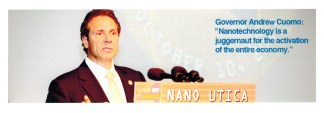
The College of Nanoscale Science and Engineering – which, since September 2014, is also known as SUNY Polytechnic Institute (SUNY Poly) – has the distinction of praising “the vision and leadership of Governor Andrew Cuomo” in the very first sentence of its website’s “About Us” page. Its Home page also boasts a photo of our Governor proclaiming, “Nanotechnology is a juggernaut for the activation of the entire economy.”

Andrew Cuomo - juggernaut

Sadly, for the future of the Buffalo River and the Lake Erie shoreline, CSNE has not been a juggernaut for the protection of the environment in Western New York.  As a sobering omen of what may lie ahead as a result of a state agency – in the midst of a gubernatorial election campaign – failing to conduct a thorough environmental review, CSNE has recently encountered a bit of a problem. According to a SEQRA notice filed with the State DEC, slag materials “containing low levels of technology enhanced naturally occurring radioactive material (TENORM)” were excavated during redevelopment activities at the RiverBend site.  CSNE has proposed “placing the material over an approximate 10 + acre area of the 90 acre Project Site followed by placement of a demarcation layer and covering…”.

Not surprisingly, consistent with its decision not to prepare an EIS for the entire 90-acre, 1-million square foot manufacturing project, CSNE has issued a Negative Declaration claiming that the on-site placement of this radioactive material will not adversely impact the environment. [Note: There is still time for an appropriate agency to challenge the Negative Declaration in an Article 78 proceeding in State Supreme Court.]

There’s no duck to blame for this problem. But I do know a number of turkeys masquerading as public officials who should be held accountable.

Jessica Santillo with Turkey Survivors 11-25-14

With All Due Respect,

Art Giacalone

“Little Summer Street” – An Antidote to “23-Story-Tower Syndrome”

Posted by Arthur J. Giacalone on July 31, 2016
Posted in: City of Buffalo, Elmwood Village, Gerald A. Buchheit Jr.. Leave a comment

DSCN7537

DSCN7540

DSCN7550

DSCN7556

DSCN7562

DSCN7563

DSCN7568

DSCN7578

DSCN7572

DSCN7586

DSCN7588

DSCN7590

DSCN7593

DSCN7595

DSCN7597

DSCN7600

DSCN7604

DSCN7608

DSCN7610

With All Due Admiration,

Art Giacalone

P.S.  If you are curious, click here for Property Information for Little Summer St. parcels.

Reasons exist to question the “waterfront bona fides” of U.S. Representative Brian Higgins

Posted by Arthur J. Giacalone on July 21, 2016
Posted in: Brian Higgins, City of Buffalo, Development, Gerald A. Buchheit Jr., Political Contributions, Waterfront. Leave a comment

Some may think it’s sacrilegious to question Congressman Brian Higgins’ good faith and sincerity when it comes to development of Buffalo’s waterfront. In a recent column expressing a grudging endorsement of developer Gerry Buchheit’s 23-story tower proposed for the former Freezer Queen site, Buffalo News columnist Donn Esmonde goes so far as to proclaim, “There is no questioning Higgins’ waterfront bona fides.” And Mr. Esmonde doesn’t stop there. He makes the following assertion: “For the record, there is no record of political contributions to [Higgins] from Buchheit or other project principals.”

[Note:  On July 25, 2016, the following correction was added to Mr. Esmonde’s June 11, 2016 column:  (Correction: A June 11 Donn Esmonde column on the proposed Outer Harbor waterfront tower inaccurately described campaign contributions to Rep. Brian Higgins. According to federal campaign records, since 2006 developer Gerald Buchheit and principals from project partner R&P Oak Hill Development donated a total of $29,400 to Higgins.)]

It turns out that the public has plenty of reasons to wonder whether, in the words of the Buffalo News columnist, the U.S. representative from South Buffalo “simply believes the apartment tower is a good idea.”  Mr. Esmonde’s assertion that there are no records of political contributions from the 23-story tower developer to Congressman Higgins is false.  The Federal Election Commission records show that Gerald A. Buchheit has contributed generously to Brian Higgins’ prior campaigns. [Mr. Esmonde could have done his own “Transaction Query By Individual Contributor” by simply inserting “Buchheit” and “Gerald”.]

FULL DISCLOSURE: I represent four local environmentalists and activists who are challenging the City of Buffalo’s approvals for Mr. Buchheit’s 324-foot tower in a State Supreme Court proceeding known as Wooster et al. vs. Queen City Landing, LLC et al. I am so appalled by the City’s disregard for the protections built into the State’s environmental review process and the City’s zoning and planning laws that I am providing my legal services for free. In 2004, my East Aurora front lawn proudly displayed a sign in support of Brian Higgins while he successfully ran for the 27th Congressional district seat. When redistricting left me with Chris Collins as my Congressman, I could not help but long for the days when Brian represented my family in Washington, D.C. But now I am a South Buffalo resident, Mr. Higgins is once again my Congressman, and I am taking a closer look at what is happening in and around Buffalo’s Outer Harbor. Given the fact that we are not talking about a “virtual” 23-story tower – but a real threat to the significant and fragile natural habitat that adjoins Western New York’s Lake Erie shoreline – I feel compelled to hold a South Buffalo legend to the highest ethical standards.

LWRP map detail - natural resources

Between 2006, when Gerry Buchheit did not yet own the former Freezer Queen site and donated $2,000, and 2013, when Buchheit’s Queen City Landing, LLC, owned the Outer Harbor parcel and he contributed $5,200, Brian Higgins’ campaign committee was the beneficiary of $21,600 in contributions from Mr. Buchheit.

Information available from the Center for Responsive Politics at www.OpenSecrets.org helps to place the size of Gerry Buchheit’s political contributions into context. The $5,200 donated in 2013 by Mr. Buchheit (who identified his employer as Accent Stripe, Inc., and his occupation as contractor) makes the developer of the 23-story tower project the 21st largest contributor to Brian Higgins’ campaign. The $5,200 contributed individually by Buchheit exceeds the total amount donated during 2013-2014 campaign cycle to Mr. Higgins by individuals affiliated, for example, with each of these organizations: Bricklayers Union, Communications Workers of America, International Longshoremens Association, National Fuel Gas Corp., Teamsters Union, United Auto Workers, Kaleida Health, General Motors, and Lockheed Martin.

But Gerry Buchheit is not the only principal affiliated with Queen City Landing’s 23-story tower project who generously donated to Brian Higgins’ 2013-2014 campaign. R & P Oak Hill Development – through its President, Melissa Garman Baumgart, and related companies, such as 3556 Lakeshore, LLC – is functioning as both general contractor and Buchheit’s partner in developing Queen City Landing. Between 2011 and 2014, individuals identified as R & P Oak Hill “partners” gave political contributions to Brian Higgins totaling $7,800.00.  According to the OpenSecrets.org website, R & P Oak Hill Development’s $4,000 contribution to Brian Higgins’ 2013-2014 campaign made Mr. Buchheit’s business partner Congressman Higgins’ 43rd biggest contributor that election cycle.

The combined $9,200 contributions Mr. Higgins received in 2013-2014 alone from the individuals and companies hoping to profit from the 23-story tower project are enough, when viewed in isolation, to cause inquiring citizens – if not Donn Esmonde or the Buffalo News editorial board – to question the Congressman’s “waterfront bona fides.” But there is another, broader reason to wonder whether Brian Higgins’ support for the Queen City Landing proposal is motivated by something other than a belief that Mr. Buchheit’s project was simply a “good idea.” According to the Center for Responsive Politics, two of the three industries to have contributed the largest amounts to date to the Brian Higgins for Congress 2015-2016 election campaign (a staggering, combined total of $68,500) are the building trade unions and industrial unions.

The size of the political contributions received by Mr. Higgins from the 23-story tower’s principals and the unions whose members would be expected to work at the development site provides a likely answer to the inquiry: “Why would a U.S. Congressman feel compelled to write a three-page letter in support of the proposed Queen City Landing development at 975 and 1005 Fuhrmann Boulevard?” It also might explain why the man Donn Esmonde refers to as “the figurative father of a revived Outer Harbor” would submit a correspondence that:

(a) fails to address the project’s likely impacts on the Outer Harbor’s natural environment and significant fish and wildlife habitats – despite having “SEQRA Comments re Queen City Landing Proposal” as its “Re” line; and,

(b) contains inaccurate assumptions more suitable to expression by Mr. Buchheit’s lawyers than a conscientious and objective public servant.

Here are several of the questionable assertions in the Congressman’s letter of support:

** Mr. Higgins opening paragraph expresses his “understanding that a public comment period has commenced pursuant of the provisions of the State Environmental Quality Review Act (SEQRA).” There never was a “public comment” period pursuant to SEQRA due to the City Planning Board’s issuance of a Negative Declaration. The Congressman could have corrected his misunderstanding by contacting either City officials or the respected environmentalists who sought his assistance in addressing the harmful impacts of the 23-story tower proposal. He apparently did neither, and, more importantly, did not urge the SEQRA “lead agency” to require preparation of an Environmental Impact Statement (EIS) to ensure that potential adverse environmental effects could be objectively assessed and properly mitigated.

** The Congressman concludes that the fact that the former Freezer Queen parcel is “privately held” means that “fewer levers of control are available to government actors who would seek to influence the outcome of this proposal.”  This assertion – mirroring arguments made by Mr. Buchheit’s legal team – ignores the prominent and productive role SEQRA’s EIS process is intended to play, whether or not the property is in public or private hands.  It also disregards the significant discretionary power available to both the City Planning Board (through the design and site plan review process), and the City of Buffalo Common Council (through the Buffalo Coastal Special Review District’s restricted use permit process).

** Mr. Higgins seemingly accepts the developer’s claim that lowering the proposed height of the tower would “debas[e] the financial underpinning of the project” given the “higher rents which the higher floors would command.”  Perhaps the Congressman’s 21st best campaign contributor shared with him something not seen by City officials or the public, a market feasibility study. If not, the U.S. Representative for the 26th Congressional District owes his constituency – the public and the electorate – a reason to trust the unsupported assertions of a developer who in 2008 and again November 2015 claimed that he could profitably develop the site by retrofitting the existing Freezer Queen building and adding a penthouse floor.

Freezer Queen site tower

** Congressman Higgins – recognizing that the Green Code’s call for a six-story height limitation at the 975-1005 Fuhrmann Blvd. site has not yet been enacted into law – states that “it is not clear to me what leverage exists to legitimately restrict the proposed height of this structure.” Had Mr. Higgins contacted someone with knowledge of the City’s zoning law (other than, perhaps, Mr. Buchheit’s counsel), he would have learned that the Buffalo Coastal Special Review District provisions expressly give the Common Council the authority to determine the height of any building constructed along the Lake Erie shoreline. That, in my book, is an awful lot of leverage.

I am not thrilled to be doing it, but, in light of the above, I feel compelled to question Brian Higgins’ waterfront bona fides.  [Note:  This is not the first time I have written a post expressing my disappointment in the Congressman from South Buffalo:  https://withallduerespectblog.com/2014/02/08/wnys-most-influential-person-ignores-health-issues-at-peace-bridge/.]

With All Due Respect,

Art Giacalone

P.S.  Donn Esmonde’s term – “figurative father” – makes me think of “godfather,” which brings to mind the following quote from Francis F. Coppola’s The Godfather Part III:  “All my life I kept trying to go up in society to where everything higher up was legal, straight.  But the higher I go, the crookeder it becomes.  Where the hell does it end.”  (Michael Corleone [Al Pacino] to his sister Connie [Talia Shire].)

Defining Moment for Chris Scanlon and Buffalo’s Common Council

Posted by Arthur J. Giacalone on June 20, 2016
Posted in: Christopher Scanlon, City of Buffalo, Development, Gerald A. Buchheit Jr., SEQRA, South Buffalo. Leave a comment

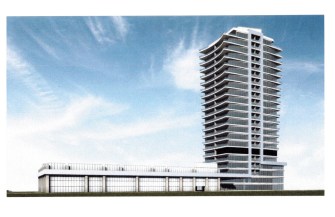
WGRZ reported on June 17th that South District Christopher Patrick Scanlon is leaning toward voting “yes” on the proposed 23-story Queen City Landing project at the former Freezer Queen site on the Outer Harbor. The upcoming decision – which could take place as early as June 22nd – will determine the face and character of Buffalo’s waterfront for generations.

Chris Scanlon has not provided me with any substantial feedback to the communications that I have been sending to him – as my South District legislator – and the entire nine-member Common Council the past few months (although I certainly have tried to constructively provide legal and factual analysis – here’s one example). So now I am sending this open letter to Council Member Scanlon with a series of questions I hope he will consider:

Dear Council Member Scanlon,

It has been five years since you were appointed to fill the South District Common Council seat vacated by State Assemblyman Mickey Kearns. I have little doubt that you are sincerely committed to work in the best interests of the residents in your district, including your wife and young son, and the City of Buffalo as whole. The decision you will make regarding the proposed Queen City Landing project will be a defining moment in your career. Before you cast your vote, I urge you to consider the following questions and comments:

First, what best symbolizes the legacy you wish to leave behind for the City of Buffalo, a sterile and controversial 23-story tower, or an Outer Harbor where nature thrives and city residents and visitors can get away from urban development and enjoy the beauty and serenity of the Lake Erie shoreline?

As you are well aware, two of your fellow Council members – David Francyk and David Rivera – have characterized the Queen City tower as too tall and aesthetically-challenged. Whether or not you agree with that assessment, a vote to allow this project to go forward will alter for generations the character and feel of the Outer Harbor. You must seriously consider what your vision is for Buffalo’s future, and act accordingly.

Freezer Queen site tower

DSCN6842

Second, who do you believe should be determining the future of Buffalo’s Outer Harbor, a private developer with a less-than-consistent track record, or the Common Council speaking on behalf of the entire city?

As Buffalo’s legislative body, you and your fellow Common Council members have a duty under the “Buffalo Coastal Special Review District” process to protect our city’s waterfront from the threat of “inconsistent development” or “inadequately controlled development.” Just this past February, the Common Council – including yourself – adopted the city’s official goals and policies for waterfront development, the Local Waterfront Revitalization Program [LWRP].

Does your vote for the LWRP mean anything? Can you truly reconcile the vision for Buffalo’s Outer Harbor embraced by the LWRP – with its goals of protecting the scenic quality of the coastal area; enhancing the enjoyment and appreciation of visitors to the Outer Harbor’s parks, marina, walkways and nature preserves; preserving and improving state- and locally-designated natural habitats; avoiding disruption of bird migration “to the maximum extent practicable”; and, reusing industrial heritage resources, such as the former Freezer Queen facility – with the plan proposed by Queen City Landing, LLC, and its principal, Gerald A. Buchheit, Jr.?

LWRP map detail - natural resources

Mr. Buchheit’s history of proposing projects and then abandoning them may be unrivaled, even if you choose to disregard his “ambitious plan” in 2002 – when his casino development group, Northstar Development Corp., owned the Statler Towers – to convert the Convention Center and the first two floors of the Statler Towers to casino space, construct a parking tower, and develop an entertainment/restaurant/retail complex stretching along the block between Delaware Avenue and Franklin Street.

The Orchard Park businessman (who has generously contributed to the Republic party as well as Gov. Andrew Cuomo) has twice – in 2008 and again in 2015 – proposed to reuse the existing Freezer Queen building and construct a luxury condominium project. Here’s is how Buffalo Rising described Buchheit’s 2008 plans:

“Buchheit is a former owner of the Statler. He sold the property to Bashar Issa … He purchased the Freezer Queen property for $3 million at a November 2007 auction.  In March 2008, Buchheit announced plans to create as many as 130 condos in the building and additional residential buildings and a hotel on surrounding land.  Those plans (below) stalled out with a sputtering economy.”

Buchheit's 2008 plans

And here’s Buffalo Rising’s description of Buchheit’s July 2015 plans:

“A plan to convert the vacant Freezer Queen complex at the north end of the Small Boat Harbor is back with a new design.  Property owner Gerry Buchheit is partnering with R&P Oak Hill on the $40 million Queen City Landing project that will start with the conversion of the six-story building into 120 apartments priced at $2,000/month and up.  Future phases would include new residential buildings and possibly a hotel on the 20-acre site. The development team is working with Trautman Associates to design the project.  Plans call for retrofitting the existing building to create one and two-bedroom units ranging in size from 1,200 to 1,500 sq.ft. of living space. The main floor will house a mix of restaurant, bar, and fitness center tenants. The remaining floors will contain the residential units featuring floor-to-ceiling glass, high ceilings, and balconies. Plans also call for penthouse residences added atop the existing structure, and a resident club house with roof top terrace.  Covered parking is planned.”

Buchheit's 2015 plans

In July 2015, the Buffalo Business Journal noted that “the existing 6 story building provides limitless views of the lake, downtown, and more” [so, I must ask, who needs a 23-story tower?]. It also provided the following priceless quotes from Gerry Buchheit:

“Now is the time,” Buchheit said Thursday while revealing his proposed plans at an event sponsored by Business First… “We envision this as a local hot spot,” Buchheit said. “This could be a regional example of a community can re-imagine its waterfront.”

As you know, Mr. Buchheit’s representatives obtained approvals from the City of Buffalo for both his 2008 and 2015 plans. Then each project was abandoned.

Note:  Mr. Buchheit now claims that he must demolish – and not reuse – the existing Freezer Queen building because the structure sits in a 100-year FEMA floodplain.  It was sitting in the same floodplain in 2008 and 2015.  Are we to believe, on the one hand, that Mr. Buchheit presented his 2008 and 2015 plans to the City of Buffalo without taking into consideration the hazards of building in a floodplain, or, on the other hand, that he is using the floodplain as an excuse so that he can build a 23-story monument to his ego?     

As South District Council Member you must objectively ask: Is this is the person to whom one can confidently entrust the future of Buffalo’s Outer Harbor?

Third, are you able to identify any meaningful mitigation measures incorporated into the Queen City Landing project to reduce adverse aesthetic and environmental impacts?

WGRZ’s June 17th report included the following quote:

“In a phone interview on Friday evening, Councilman Scanlon said he is leaning toward voting ‘yes’ on the project. ‘If you look at what the Planning Board was doing, as lead agency, in determining that it didn’t need a full Environmental Impact Statement… I think the Planning Board, in their role as lead agency, they didn’t feel it needed one based on everything they looked at,’ Scanlon said. ‘The issues that were raised, legitimate or non-legitimate, by the public or other people, I think they felt they were mitigated by the developer’s plans.’”

Frankly, I am unaware of any meaningful mitigation measures. Are you able to identify any of the supposed mitigation reflected in the developer’s plans?

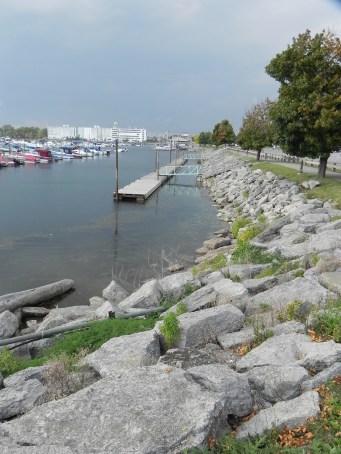
Do you know what, if anything, was done to lessen the adverse aesthetic impact of viewing a 23-story, 324-foot building from the vantage point of boaters or restaurant patrons at the adjacent Small Boat Harbor, or from walkers at nearby Greenway Nature Trail or Tifft Nature Preserve?

What mitigation measures, if any, were taken to protect scenic coastal vistas?

Has the developer done anything to change the plans to ensure the safety and convenience of bikers and pedestrians using the public bike path who will be forced to deal with one vehicle entering or exiting the Queen City Landing driveway as often as once every 16 seconds (and, that is the intrusion across the bike path before Mr. Buchheit builds the additional 10-story apartment tower he plans for the rear of the parcel)?

Did the City Planning Board assess how a shorter building might be less disruptive to seasonal bird migration than the proposed 23-story tower?

What mitigation measures were added to ensure that the proposed 400,000-square-foot mixed-use development project – that will include a nightclub, restaurants, and other outdoor activities, and generate thousands of motor vehicles daily – will not adversely impact nearby fishing hot spots, fish spawning and bird nesting sites, and sensitive natural habitats?

LWRP map detail rec areas - LEGEND

Did the developer incorporate the request by Congressman Brian Higgins to “eliminate the negative impacts associated with putting a parking garage (three stories high and 277 feet long) along the water’s edge”?

Lastly, do you agree with the absurd statement at page 4 of the City Planning Board’s Negative Declaration that the 324-foot structure will NOT negatively impact the Outer Harbor’s aesthetic resources and coastal views because it is “a stand-alone building”?

Fourth, are you allowing yourself to be swayed by pressure being placed on you and other Council Members by Mayor Byron Brown’s administration, other elected officials, the media, or business interests?

I keep hearing rumors – from every direction – that you and the other members of the Common Council are being pressured to say “Yes” to this project? Are the rumors true?

Can you assure residents of the South District and throughout the City of Buffalo that your vote for or against the project – or insistence that the building be substantially reduced – will be made based on the requirements of the city’s zoning code and impacts on the environment, and not as a result of political pressure?  Your legacy will depend on it!

With All Due Respect,

Art Giacalone

One Vehicle Every 16 Seconds!

Posted by Arthur J. Giacalone on June 12, 2016
Posted in: City of Buffalo, Gerald A. Buchheit Jr., Waterfront. Leave a comment

Dear Common Council Members,

Go ‘head, flip-off the thousands of birds that might get killed,

Forget the echo of Buffalo’s industrial heritage that will be lost,

And, turn a blind eye to the waterfront views that will be ruined,

But do you really want one-vehicle-every-16-seconds crossing the Outer Harbor bike path? 

Please say “No” to the 23-story tower at the old Freezer Queen site!

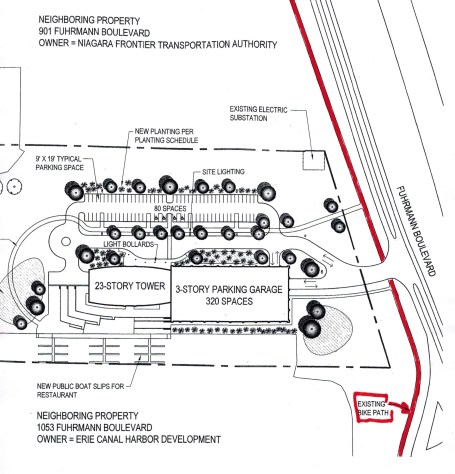
Here is the developer’s site plan showing the proposed entrance/exit to the Queen City Landing project crossing the adjacent public bike path:

Bike Path intrusion

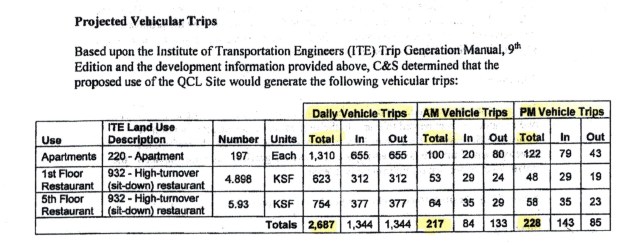
And here is an excerpt from the developer’s traffic analysis indicating that the proposed 400,000-square-foot project would generate 228 vehicles entering or exiting the development during PM peak hours, 217 vehicles during the AM peak hours, and an average of 2,687 vehicles daily:

Trip Generation table

220 vehicles per hour equates to 3.66 vehicles per minute, or approximately one vehicle every 16 seconds crossing the public bike path.

Walk Your Bike

With All Due Respect,

Art Giacalone


Planning Board’s approval of 23-story tower disregards the Common Council’s policies and goals for Buffalo’s waterfront

Posted by Arthur J. Giacalone on June 5, 2016
Posted in: City of Buffalo, Gerald A. Buchheit Jr., Waterfront. 4 Comments

It was a mere four months ago that Buffalo’s Common Council adopted what appears to be the city’s official goals and policies for waterfront development.  The nine-member legislative body approved a resolution the accepted as “complete” the City of Buffalo’s Draft Local Waterfront Revitalization Program [LWRP] on February 2, 2016, and Buffalo’s multi-faceted vision for its coastal area was forwarded to the New York State Department of State for review.  [Draft LWRP approval 02-02-2016]  As succinctly noted in the 177-page document, “The LWRP policies set general goals for the city’s waterfront as a whole and specific goals for portions of the waterfront that have notable characteristics.” [LWRP, p. “84”]

LWRA Boundary

LWRA Boundary - detail

The City Planning Board has chosen to turn a blind eye to the Common Council’s vision. On May 31, 2016, by a 5 to 1 vote, the administrative body – coaxed on by the City’s Director of Planning, Nadine Marrero – approved the 23-story, mixed-use tower project proposed for the former Freezer Queen site on Buffalo’s Outer Harbor. The project is sponsored by Queen City Landing, LLC, whose principal, Orchard Park businessman Gerry Buchheit, once had grandiose plans for the iconic Statler Towers.  [See BUCCHEIT- NORTHSTAR in Bankruptcy Court re Statler.]

The LWRP policies and goals provide the Common Council with the framework for assessing the impacts of a 23-story, 400,000-square-foot project on Buffalo’s evolving Outer Harbor.

The Common Council has an opportunity to correct the Planning Board’s misguided approval of the massive Queen City Landing project.

As the City of Buffalo’s legislative body, the nine elected Council Members – and not the City Planning Board, the Buffalo News editorial staff, or social media commentators – have the authority to determine what is the appropriate use of this Fuhrmann Boulevard site. Currently pending before the Common Council is Mr. Buchheit’s application for a “restricted use permit” under the “Buffalo Coastal Special Review District” ordinance,  found at Section 511-67 of the city’s zoning code.  [See Buffalo Coastal Special Review District]  The purpose of the Coastal Review law is expressed in the following provision:

City of Buffalo Code, Chapter 511 Zoning

Section 511-67 Buffalo Coastal Special Review District

A.(2). Legislative intent.

(a) The Common Council finds that the stability, economic viability and future prosperity of the Buffalo coastal area is being threatened by inconsistent development and by uses not related to the coastal area.

(b) The Common Council further finds that inadequately controlled development may jeopardize a balance of residential, commercial, port-related industrial and public access uses and thus adversely affect the welfare and economic well-being of the City and its residents.

(c) The Common Council therefore finds that future development shall be controlled by the creation of a special zoning district. [Emphasis added.]

In my opinion, the Queen City Landing project is the very embodiment of the “inconsistent” and “inadequately controlled” development the Coastal Review law was meant to restrict.

Here are a number of points I hope the Common Council members will carefully consider:

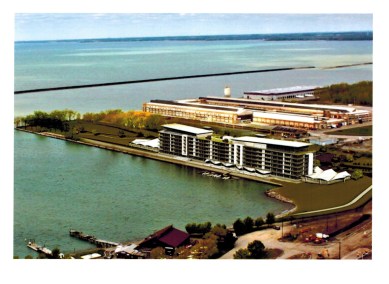
A.  The LWRP provides a specific development concept for the former Freezer Queen site that reuses the existing building while adding a floor or two.

The document approved by the Common Council in February 2016 provides a detailed development concept and rendering for the former Freezer Queen site, one remarkably similar to the plan for which Gerry Buchheit received site plan approval from the City Planning Board in October 2015:

LWRP - Freezer Queen site

Equally important, the LWRP expressly envisions a “build out” at the Freezer Queen site that includes “Building Reuse,” not the demolition of the existing structure as planned by Mr. Buchheit. [LWRP, p. “25”]

B. Reuse of the existing Freezer Queen facility coincides with the LWRP goal of protecting and enhancing structures and sites that are of significance to the community’s history, architecture or culture.

In sharp contrast to Mr. Buchheit’s desire to demolish the Freezer Queen warehouse and manufacturing building, the LWRP adopted by the Common Council calls for the protection, enhancement and restoration of structures, districts, areas or site “that are of significance in the history, architecture, archeology or culture of the state, its communities or the nation.“

The LWRP requires, “in addition to compliance with historic preservation laws,” consideration of impacts on “Buffalo waterfront heritage themes,” which include “Waterfront industrial heritage resources.”  Both the existing structure at the Freezer Queen site, and the adjacent Ford Terminal Complex (a/k/a Terminals “A” and “B”), are among the sites listed in the LWRP as possessing “waterfront heritage resources” reflecting the industrial history of the Outer Harbor. [LWRP, pp. “8” and “9”] This recognition is consistent with the inventory in the “BUFFALO HARBOR Brownfield Opportunity Area” Nomination Document, which specifically identifies the existing Freezer Queen facility as eligible for the State and National Registers of Historic Places.

DSCN7167

C.  Protecting the overall scenic quality of Buffalo’s coastal area – including unique waterfront landscapes such as marinas, piers, wharfs and mooring areas, waterfront sunsets, and the Great Lakes Seaway Trail Scenic Byway – is an important LWRP policy.

The scenic quality of Buffalo’s waterfront is an aesthetic resource protected by the goals and policies of the city’s LWRP.  Proposed projects within Buffalo’s waterfront revitalization area – such as the proposed Queen City Landing development – must be scrutinized to determine whether they are consistent with the goals of protecting and enhancing scenic views, whether the view is natural or manmade, and whether it has local or state-wide significance. [LWRP p. “9”, “16”]

In determining whether a proposed project will further or hinder the LWRP policy objective of preventing impairment of the scenic quality of a waterfront resource, one has to consider whether the development includes “the addition of structures which because of siting or scale will reduce identified views or which because of scale, form or materials will diminish the scenic quality of an identified resource.” [See LWRP’s Buffalo Waterfront Assessment Form (LWRP BWAF), p. “8”.]

The LWRP adopted by the Common Council on February 2, 2016 expressly identifies the following scenic resources that are to be protected and enhanced:

– Unique waterfront landscapes such as marinas, piers, wharfs and mooring areas. [LWRP, p. “9”] The waterfront landscapes identified in Buffalo’s LWRP include the following Outer Harbor resources: Wilkeson Point, the NYPA Outer Harbor Marina, the Small Boat Harbor (with its 1,042 boat slips), and Gallagher Beach. [LWRP, pp. “134” and “135”] In the words of the LWRP: “Buffalo’s marinas are the heart of the community’s engagement with its water.” [LWRP, p. “158”]

DSCN6832 DSCN6689

– The Buffalo portion of the Great Lakes Seaway Trail National Scenic Byway. [LWRP, p. “9”] The LWRP describes the Great Lakes Seaway Trail as follows: “… [A] 518 mile National Scenic Byway that follows the shores of Lake Erie, the Niagara River, Lake Ontario, and the St. Lawrence River. Within the City of Buffalo, the Great Lakes Seaway Trail follows Niagara Street south to Niagara Square, then south on Delaware Avenue to Route 5 and south to the City line.” [LWRP, p. “158”]

– Waterfront sunsets. As noted in the LWRP: “Located at the eastern end of Lake Erie, Buffalo is the only Great Lakes city to enjoy a view of the sun setting over water.” [LWRP, p. “158”]

D.  The Common Council must objectively decide whether the intrusion of a 23-story tower will significantly diminish the enjoyment and appreciation experienced by visitors to the Outer Harbor’s parks, marinas, walkways, and nature preserves that lie within the tower’s expansive viewshed.

The City Planning Board did not conduct a meaningful assessment of the potential adverse impact of the proposed 23-story tower (and three-story parking facility) on the scenic quality of Buffalo’s coastal area prior to approving Mr. Buchheit’s project. Rather, its SEQRA Negative Declaration provides the following unconvincing and conclusory statement:

“Impacts on Aesthetic Resources

Without question the proposed Project is a visually significant deviation from the existing structures in the area. The existing Freezer [Queen] Building is 6-stories tall and the proposed tower will be 23 [stories]. The height of the structure (324’) will be second only to the existing wind farm to the south and on a par with other taller buildings in the urban core. As a result, the proposed building will be a significant visual change from the existing structures.

While the building is located adjacent to Lake Erie, a visual and recreational resource for the area, it is not anticipated to negatively impacts [sic] views despite the degree of change from existing conditions. The proposed structure is a stand-alone building and given the vast stretches of open, publically-owned [sic] lands adjacent to it, the overall viewshed will not be significantly impacted. Therefore, the Planning Board has determined that the Project will not have any significant adverse impacts on aesthetic resources.”
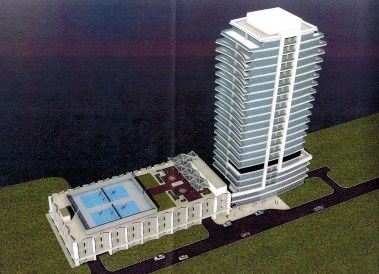
Bird's Eye View from Fuhrmann Blvd.

The Planning Board reached a conclusion that defies logic, and abruptly ended the review mandated by SEQRA by issuing a Negative Declaration. Nonetheless, the Common Council has the separate authority and obligation to analyze the proposed project pursuant to the city’s Coastal Review law to determine whether the proposed 23-story tower is the type of “inconsistent development” that may threaten the stability and jeopardize the balance of uses in the Outer Harbor area. Part of that analysis, given the goals and priorities of the LWRP, should include an assessment of the adverse visual and aesthetic impacts of the proposed Queen City Landing project on the Outer Harbor’s designated aesthetic resources lying within the tower’s viewshed.

Note: A viewshed is the geographical area that is visible from a location. It includes all surrounding points that are in line-of-sight of that location and excludes points that are beyond the horizon or obstructed by terrain and other features (e.g., buildings, trees). Conversely, it can also refer to area from which an object can be seen.

DSCN7220

Note: The 324-foot tower, with a footprint of approximately 17,500 square feet, would exceed the height of downtown’s HarborCenter by more than 80 feet.

The State DEC has prepared a helpful manual, “Assessing and Mitigating Visual Impacts“, that would provide Council Members with guidance on how to conscientiously identify the relevant inventory of aesthetic resources/scenic landscapes/sensitive places that may be adversely impacted by the proposed development; determine whether the presence of the 23-story tower would have a significant detrimental effect on the perceived beauty of the Outer Harbor or diminish the public’s enjoyment and appreciation of the coastal area’s scenic resources; and, assess whether there are any practicable mitigation measures that would adequately eliminate or reduce the adverse impacts.  [See DEC Visual Impacts manual.]

Note: The DEC manual states that consideration must be given to off-site light migration, glare and “sky-glow” light pollution, as part of the assessment of adverse aesthetic impacts. This requirement brings to mind the following land use policy included in the proposed Green Code’s Land Use Plan, under the heading “Protect natural assets”: “Minimize impacts of artificial light on natural systems, and help restore visibility in the night sky.” [Land Use Plan (October 2015) at p. “38”]

Mitigation measures identified in the DEC manual include, for example, relocation of a component of the project to another place within the site; screening, camouflage or disguise; use of building materials that do not shine or reflect light; and, a substantial reduction in the height of the structure.

This latter mitigation measure is of particular relevance under the Coastal Review law given the Common Council’s authority to determine the height of any structure built within the coastal review district:

City of Buffalo Code, Chapter 511 Zoning

Section 511-67 Buffalo Coastal Review District

                                    …

(A)(5) Height restrictions. Any application under Subsection A(4) above shall include maximum heights involved in any use seeking to be established or extended under this subdivision. Such maximum height shall be subject to the approval of the Common Council and, once approved, shall not be exceeded.

E.  The City Planning Board allowed itself to be hoodwinked by the sponsor’s misleading and wholly inadequate “migratory bird assessment,” and, in doing so, disregarded the LWRP’s policy calling for “avoidance of disruptions to bird migration to the maximum extent practicable”.

In order to rationally measure the adverse impact Mr. Buchheit’s 23-story, 274,000-square-foot glass and metal tower is likely to have on the migratory bird population that traverse the Buffalo waterfront, one must, at a minimum, know the flight paths of migrating birds, the seasonal patterns of the migrations, and the extent to which the bird populations are moving during the day or at night. It would also make sense to know to what extent, if any, the existing six-story, unlit Freezer Queen building has been an obstruction to migrating birds.

Once armed with such information, a consultant – and a government agency – could then attempt to honestly and objectively assess the adverse impacts a 324-foot tall tower, constructed of glass and metal, would likely have on migrating birds. A conscientious assessment would also analyze the extent to which adverse impacts would be lessened if the proposed building were to be lowered to varios heights.

The City Planning Board did not ask for, and the sponsor of the proposed project did not submit, any such information or analysis prior to the May 31st approval of the 23-story tower. Instead, the Planning Board received a two-and-a-half page “Migratory Bird Assessment & Consultation” report from Mr. Buchheit’s ecological consultant, DIEHLUX, LLC.  [See Migratory Bird report] That correspondence does two basic things:

(1) it lists a variety of building design “best practices” that the developer might “potentially incorporate” into the design of the building to lessen the likelihood of migratory bird impacts; and

(2) it provides the following statement apparently meant to suggest that a 23-story tower would have less of an adverse impact on bird populations than a residence or low-rise building:

“… DIEHLUX, LLC cannot rule out that transient migratory birds may occasionally be impacted by this structure during peak migration periods. However, according to recent studies such as Bird-building Collisions in the United States by S.R. Loss, the majority of bird/glass collisions occur at low-rise (1-3 story) buildings (56%) and urban/rural residences (44%). Less than 1% were noted at high rises.”

The City’s Planning Board did not ask Mr. Buchheit’s representatives for additional information. Neither the City’s planning office staff, nor the Planning Board, asked for an estimate of how many migrating birds would be killed by the proposed tower, or a comparison between deaths occurring at the existing Freezer Queens facility and the likely change in numbers if the proposed 324-foot tower were built.

The Planning Board also failed to ask for clarification of the above-quoted statement in the DIEHLUX, LLC report, or, apparently, for a copy of the entire study prepared by S.R. Loss. Had such a request been made, and had the entire 16-page report been available for the public to review, it would have been clear just how misleading it was for the developer’s consultant to imply that high-rise buildings were less of a threat to migrating birds than buildings three or fewer stories in height.

A review of the entire article written by Scott R. Loss (who is employed by the Migratory Bird Center, Smithsonian Conservation Biology Institute, National Zoological Park, Washington, D.C.) [see S.R. Loss article] reveals the following poignant facts:

** The report estimates that between 365 and 988 million birds are killed annually by building collisions in the United State, making building collision mortality one of the top sources of direct anthropogenic mortality of birds in the U.S.

** The report’s mortality estimates may be conservative because data from buildings that cause exceptionally high annual rates of collision were removed from the analysis before extending average rates to the scale of the entire U.S. Hundreds to greater than one thousand birds per year have been found at intensively monitored buildings in or near areas with a high concentration of birds during migration (such as Buffalo’s waterfront revitalization area).

** High-rises cause the lowest total number of bird deaths for one simple reason: there are relatively few buildings taller than eleven (11) stories in height when compared to the number of detached residences and mid-rise buildings. Despite causing the lowest total mortality, high-rises had the highest median annual mortality rate.

** Mortality rates have been found to increase with the percentage and surface area of buildings covered by glass, and with the amount of light emitted from windows.

** Several species exhibit disproportionately high vulnerability to collisions regardless of building type. Seven species that are disproportionately vulnerable to building collisions are national Birds of Conservation Concern and 10 are listed regionally.

** Nearly all high-risk species for low-rise and high-rise buildings are migratory. Compared with resident species, migratory species traverse longer distances, use a greater diversity of habitat types, and encounter more building types and total buildings during the annual cycle. Additionally, migratory species are attracted to large lighted buildings during their nocturnal migration; this attraction causes a large amount of mortality at low-rises and high-rises as birds either immediately collide with lighted buildings or become entrapped before later dying of collision or exhaustion.

** Despite the critical importance of reducing mortality at residences, mitigation measures targeted at a relatively small number of buildings with high per-building mortality rates (e.g., some high-rises and low-rises) will likely result in large per-building reductions in mortality and therefore may represent a cost-efficient starting point for reducing mortality.

Buffalo’s Planning Board (with the exception of Cynthia Schwartz, who opposed both the ending of the SEQRA review without a Draft Environmental Impact Statement, and approval of the project) should be embarrassed by its superficial review of the migratory bird issue. In taking such a cavalier approach to the question of adverse impacts on migrating birds, the administrative board ignored the following policy expressed in the LWRP: “Avoidance of disruptions to bird migration to the maximum extent practicable.” This policy was made a part of the LWRP to not only protect migrating birds, but to also protect and enhance the Lake Erie-Niagara River food web. [LWRP, pp. “3”, “12”]

F.  The LWRP seeks to protect, preserve and improve publicly owned areas identified as habitats of state and local significance, as well as the Niagara River Globally Significant Important Bird Area (GSIBA).

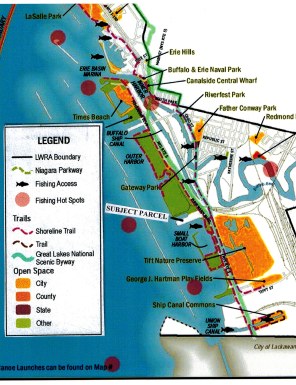
The LWRP recognizes that Buffalo’s waterfront area is home to a variety of State-designated coastal fish and wildlife habitats. Habitat designation is based on the area’s fish and wildlife population levels, species vulnerability, ecosystem rarity, human use and replaceability. Three of the State-designated habitats are located in close proximity to the former Freezer Queen site: Times Beach, the Small Boat Harbor and Tifft Nature Preserve. [LWRP, pp. “111” – “114”]
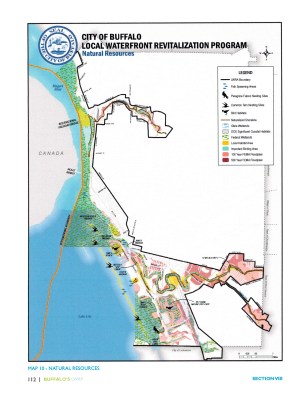
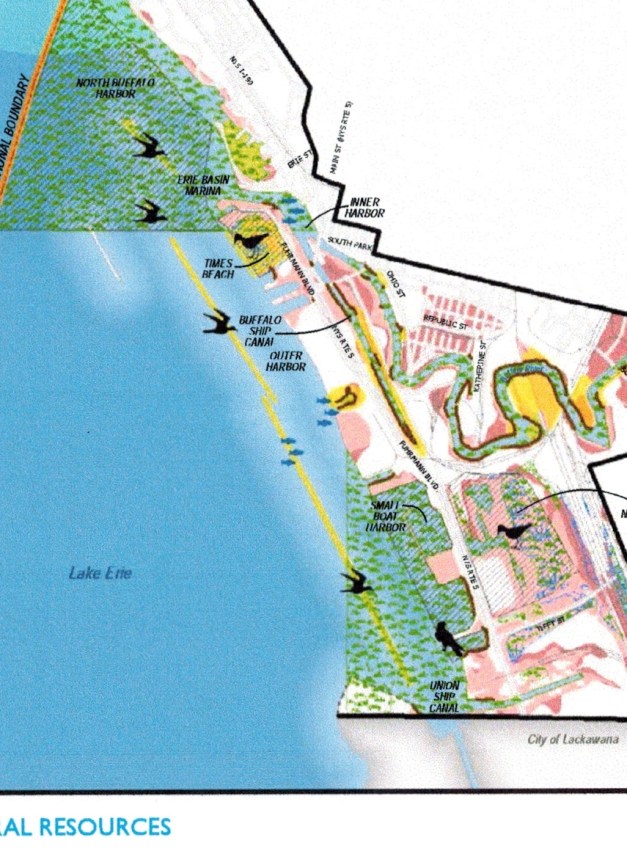
LWRA Natural Resources

LWRA Natural Resources detail

The LWRP also highlights the presence on the Buffalo waterfront of the “Niagara River Globally Significant Important Bird Area” (GSIBA), stating that this is “a rare designation given by National Audubon to only 71 other sites in the world.”  [Click here for details about the Niagara River GSIBA.]  Accordingly to the LWRP, the Niagara River GSIBA supports one of the world’s most spectacular concentrations of gulls, hosts a remarkable diversity and abundance of waterfowl, and supports breeding colonies of many bird species. It is also the host to an exceptional diversity of migratory songbirds during spring and fall migrations. [LWRP, pp. “115” – “116”] Not surprisingly, then, the LWRP calls for the protection and enhancement of the Niagara River GSIBA.

Niagara River GSIBA

The Freezer Queen site may not lie within the defined area of the Niagara River GSIBA, but it is part of the gateway to that significant area.  Likewise, the 20-acre site may not itself be a designated habitat, but it is part of the Outer Harbor’s interconnected environment.  Despite these critical facts, the Planning Board – taking its cue from the developer – has overlooked two concepts that are integral to the goals and policies embraced by the Common Council:

First, the LWRP takes a holistic approach to waterfront revitalization, working to balance inter-dependent interests and “build a sustainable waterfront economy, community and environment.”

Second, Buffalo’s waterfront revitalization area serves as “an informal regional wildlife preserve” where the Lake Erie-Niagara River food web must be protected and rebuilt. [See, “Goal 1. Holistic Coastal Program” at LWRP p. 3; “Goal 7. Protect and Rebuild the Lake Erie/Niagara River Food Web” at LWRP, p. 11.]

The integral role played by the designated coastal fish and wildlife habitats near the Freezer Queen site cannot be overstated.

The Small Boat Harbor is “the largest, most obvious nursery area for numerous harbor and lake species on the Erie County shoreline,” and “provide(s) valuable food resources for many species of waterfowl and migratory birds.” It attracts concentrations of these birds during spring and fall migrations, with some species remaining until the harbor freezes in early to mid-winter. Prior to ice-up, the Small Boat Harbor serves as a refuge and feeding area for some of the larger concentrations of waterfowl in the North Buffalo Harbor (located at the head of the Niagara River). [LWRP, pp. “113” – “114”]

Times Beach Nature Preserve – located one mile southwest of downtown Buffalo – is a 55-acre fish and wildlife habitat. Due to its location on the eastern end of Lake Erie, it is “a critical geographical feature for bird migration north in the spring and south in the fall,” where more than 220 species of birds have been observed. [LWRP, p. “111”]

Buffalo’s LWRP expressly calls for the protection and enhancement of the Niagara River GSIBA, and asks that any review of a proposed project consider two critical factors:

(a) “Protection and enhancement of bird habitat areas;” and

(b) “Avoidance of disruption to bird migration to the maximum extent practicable.” [LWRP, p. “12”]

Of equal importance, the LWRP acknowledges that its policies seeking to rebuild the Lake Erie-Niagara River food web, and to protect, preserve, and improve coastal fish and wildlife habitats of both state-wide and local significance, “will also contribute to the protection of the City’s globally significant bird area, and rare, threatened and endangered species.” [LWRP, pp. “11” and “12”]

In light of the paramount role played by the Small Boat Harbor and Times Beach in the overall well-being of Buffalo’s waterfront ecology, the two-and-a-half-page migratory bird “assessment” submitted on behalf of Queen City Landing, LLC, and the Planning Board’s anemic assessment of “impacts on plants and animals,” are woefully deficient.

G.  The Common Council must objectively decide whether the traffic and activities that would be generated by the proposed 400,000-square-foot, mixed-use facility will significantly diminish the enjoyment, appreciation, and safety of visitors to the Outer Harbor, in particular, users of the public bike path that runs along the frontage of the project site.

Developers and their consultants strive to limit the assessment of a proposed project’s traffic impacts to a technical discussion of “Levels of Service” (LOS) and highway “capacity.” While that may be a useful gauge of adverse impacts for a project a developer wishes to build at, say, the corner of Elmwood Avenue and W. Delevan, we are dealing here with a totally different situation. The mammoth Queen City Landing project is proposed for an Outer Harbor site located between nature-enhanced areas such as the Greenway Nature Trail, Wilkeson Point, and Times Beach to the north, and the Small Boat Harbor and Gallagher Beach to the south. For many a Buffalonian and visitor, the preferred route by foot or bicycle between the various Outer Harbor destinations is the public bike path that runs along the frontage of the former Freezer Queen site.

The traffic analysis submitted on behalf of Queen City Landing to the City Planning Board estimates that the 197 apartments and two restaurants proposed by the developer would generate 217 vehicles entering or exiting the site during the AM peak hour, 228 vehicles entering or exiting the site during the PM peak hour, and a total of 2,687 vehicles entering or exiting the property on the typical weekday.

To phrase this another way, Outer Harbor visitors traversing the public bike path adjacent to the front of the Queen City Landing development would experience the following:

** During the morning peak hour, a vehicle entering or exiting the site every 16.6 seconds.

** During the afternoon peak hour, a vehicle entering or exiting the site every 15.8 seconds.

** And, if we were to make the admittedly unrealistically assumption that traffic coming in or out of the Queen City Landing development would be evenly spread out over a 24-hour period, a vehicle entering or exiting the site every 32 seconds, twenty-four hours a day.
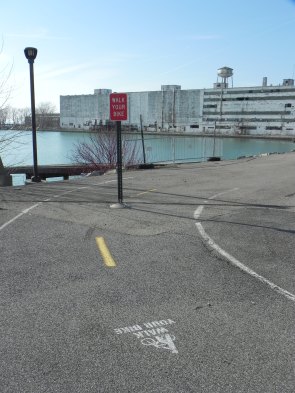
DSCN7230

Given the potential conflict such a constant traffic flow would create for individuals, families, and groups seeking pleasure, exercise, and the unique waterfront experience offered by the Outer Harbor amenities, the Common Council must decide the extent to which Mr. Buchheit’s proposal – if not substantially reduced in scale – will hinder attainment of the following LWRP policies:

– Protect, maintain and increase the levels and types of access to public water-related recreation resources and facilities. [LWRP, p. “13”]

– Water dependent and enhanced recreation shall be given priority over non-water-related uses along the coast. [LWRP, p. “13”]

With All Due Respect,

Art Giacalone

Guess what Gerry Buchheit has in common with Jeremy Jacobs Sr. and the Pegulas?

Posted by Arthur J. Giacalone on June 1, 2016
Posted in: Andrew Cuomo, City of Buffalo, Development, ECHDC, Gerald A. Buchheit Jr., Jacobs Family, Political Contributions, SEQRA, Terry Pegula, Waterfront. 5 Comments

It may be a mere coincidence, but Gerald A. Buchheit, Jr. – the developer behind the 23-story tower proposed for the former Freezer Queen site – has something in common with billionaires Jeremy M. Jacobs, Sr. and Kim and Terry Pegula.  They all have given large donations to Governor Andrew Cuomo and all have received an environmental “free pass” for recent Buffalo projects.

Restoring Trust - gray photo0001

The State Environmental Quality Review Act [SEQRA] presumes that a major development project may have a significant adverse impact on one or more aspect of the environment.  For that reason, SEQRA anticipates that a major project – referred to as a “Type I action” – will require preparation of a Draft Environmental Impact Statement [DEIS].  Fortunately for these campaign contributors, the City’s Planning Board and the Erie Canal Harbor Development Corp. [a state-created entity] fast-tracked the approval process for each developer’s recent project, and issued a “Negative Declaration.”  By doing so, the SEQRA process was abruptly ended, and, as a result, Mr. Jacobs, the Pegulas, and, now, Mr. Buchheit, were able to circumvent any meaningful environmental review or public scrutiny, as well as the expense and delay accompanying the DEIS process.

As I addressed in a September 2015 post in greater detail [see https://withallduerespectblog.com/2015/09/23/buffalos-billionaires-hailed-as-philanthropists-insist-on-profiting-at-the-publics-expense/], Mr. Jacobs made a $50,000 donation in June 2010 to Andrew Cuomo’s gubernatorial campaign (and, also contributed $11,250 to Mr. Cuomo in August 2014 during the Democratic primary skirmish between the incumbent Governor and challenger Zephyr Teachout).  In between the two political donations, the City Planning Board issued a Negative Declaration for the new headquarters of the Jacobs family’s Delaware North company – located at the corner of Chippewa Street and Delaware Avenue – eliminating the need for a DEIS.

250 Delware Ave rendering

New York State records show that in 2013 and 2014 Kim and Terry Pegula made personal contributions totaling $67,000 to Gov. Andrew Cuomo.  The Pegulas’ massive waterfront project – HarborCenter – was approved by the Cuomo-controlled ECHDC without the requirement of a DEIS.

HarborCenter rendering

Despite his apparent preference for the Republican Party and its candidates, Gerry Buchheit wrote a $25,000 check to Andrew Cuomo’s campaign fund in June 2015.  The prior year, he had made a post-primary donation of $5,000 to Gov. Cuomo’s running mate, Kathy Hochul.  [See Buchheit Donations.]  On May 31, 2016, the City Planning Board issued a Negative Declaration for Buchheit’s Queen City Landing project, concluding the environmental review process for the controversial Outer Harbor tower.

Bird's Eye View from Fuhrmann Blvd.

It has not yet occurred, but odds are awfully good that Mr. Buchheit will soon have something else in common with Buffalo’s billionaire developers – financial assistance for his project through the State’s Brownfield Cleanup Program.  The State Department of Environmental Conservation – which acquiesced to the City Planning Board’s request to make the SEQRA determinations for Buchheit’s Outer Harbor project – currently is reviewing Queen City Landing’s dual applications for brownfield assistance.

Plenty of coincidences around here.

With All Due Respect,

Art Giacalone
 

South Buffalo’s Botanical Gardens – A Great Diversion on a Chilly Sunday in May

Posted by Arthur J. Giacalone on May 15, 2016
Posted in: South Buffalo. 1 Comment

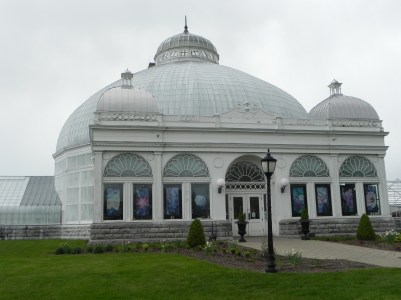
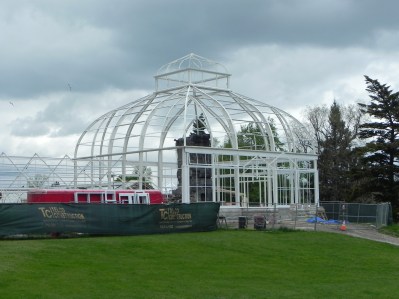
If you’re looking for my post “NY’s System of Selecting Judges Isn’t the Only Obstacle to Assuring an Ethical Judiciary,” you can find it here. If you were hoping to find “A Brooklyn neighborhood’s anti-gentrification program provides lessons – pro and con – for Buffalo’s politicians,” click here. But if you don’t mind a change of pace after a windy, raw mid-May weekend, here’s a bouquet of photos I took at one of Buffalo’s (actually, South Buffalo’s!) finest spots, the Buffalo and Erie County Botanical Gardens:

DSCN7390

[Click on one of the following photos for a slide show.]

DSCN7259
DSCN7263
DSCN7280
DSCN7282
DSCN7284
DSCN7290
DSCN7295
DSCN7300
DSCN7302
DSCN7305
DSCN7307
DSCN7314
DSCN7321
DSCN7325
DSCN7328
DSCN7329
DSCN7335
DSCN7337
DSCN7338
DSCN7341
DSCN7342
DSCN7344
DSCN7345
DSCN7346
DSCN7347
DSCN7348
DSCN7352
DSCN7356
DSCN7358
DSCN7363
DSCN7366
DSCN7368
DSCN7373
DSCN7374
DSCN7375
DSCN7380
DSCN7382
DSCN7385

[Click on one of the above photos for a slide show.]

DSCN7388

With All Due Respect,

Art Giacalone

P.S.  And there’s more to come at the BG:

DSCN7241


NY’s System of Selecting Judges Isn’t the Only Obstacle to Assuring an Ethical Judiciary

Posted by Arthur J. Giacalone on May 11, 2016
Posted in: Judiciary, Professional Ethics. Leave a comment

[A version of this post has been published in the May 18, 2016 edition of the The Public at http://www.dailypublic.com/articles/05182016/all-due-respect-problem-judge-selection.]

[A drastically slimmed-down version of this post was graciously and, perhaps, courageously published at page two of the summer edition ECBA’s Bulletin April 2009 AJG letter of the Erie County Bar Association’s BULLETIN by its Editor, Bonnie D. O’Brian: .]

New York’s unique system of selecting candidates for the general trial level judges – Supreme Court Justices – is truly troubling.

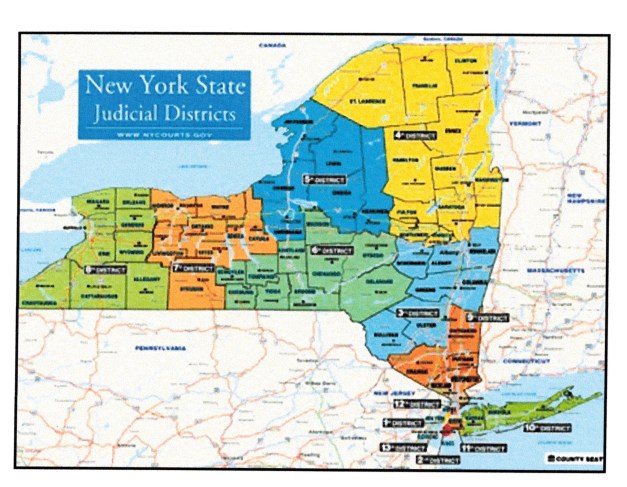
Ninety-five years ago, New York ceased using a primary election process for selecting candidates for Supreme Court Justices, and replaced it with party conventions in each of the state’s thirteen judicial districts. The political parties select the candidates for Supreme Court Justice (who are elected to 14-year terms) at conventions composed of delegates elected by party members.

NYS Judicial Districts Map

This unconventional method for selecting the state’s most powerful trial judges – the men and women making decisions that directly impact the lives of New York’s citizens, corporations, and government agencies – is universally scorned. A recent editorial in the Buffalo News, under the headline “Corrupt system of selecting judges creates the potential for criminal activity,” called it a “wretched corruption-inducing system.” According to Western New York’s largest newspaper, “[I]n New York, judicial candidates practically have to prostrate themselves before party leaders and influential players in order to win a place on the bench.”

In 2003, New York City Mayor Michael R. Bloomberg was a bit more diplomatic, but equally biting. Suggesting that a lack of rigorous merit-based selection standards endangered the public’s trust and respect for the courts, then-Mayor Bloomberg correctly noted that the existing convention system allowed party leaders to virtually handpick the winning judicial candidates. In his words, “There is nothing wrong with being politically active, but knowing where the local clubhouse is should not be a prerequisite for becoming a judge.”  [See Bloomberg’s comments at pages “3” and “4” of a NYC Bar report.]

Perhaps the best known expression of disdain for New York’s judicial selection process came in 2008 from the pen of the Hon. Stephen Breyer, Associate Justice of the United States Supreme Court. While concurring with Justice Scalia’s opinion of the court in NYS Bd. of Elections v. Lopez Torres – which held that New York’s system for choosing party nominees for State Supreme Court does not violate the First Amendment – Justice Stevens, joined by Justice Souter, made the following observation:

     “While I join Justice SCALIA’s cogent resolution of the constitutional issues raised by this case, I think it appropriate to emphasize the distinction between constitutionality and wise policy. Our holding with respect to the former should not be misread as endorsement of the electoral system under review, or disagreement with the findings of the District Court that describe glaring deficiencies in that system and even lend support to the broader proposition that the very practice of electing judges is unwise. But as I recall my esteemed former colleague, Thurgood Marshall, remarking on numerous occasions: ‘The Constitution does not prohibit legislatures from enacting stupid laws.’”

Having spent forty years appearing before dozens of New York State Supreme Court Justices – on behalf of clients ranging from state prisoners, average citizens concerned about land use and environmental matters, and, on occasion, municipalities – I can state unequivocally that New York’s flawed method for selecting judges has not prevented some remarkably intelligent and ethical men and women from ascending to the bench. On the other hand, my clients and I have been subjected to some questionable conduct and decision-making over the years at the hands of Supreme Court Justices who are the product of this “wretched, corruption-inducing system.” [See, for example, two past posts at this blog:  https://withallduerespectblog.com/2014/01/13/and-on-the-410th-day-the-abuse-of-discretion-ended/ and https://withallduerespectblog.com/2015/04/09/justice-and-even-the-appearance-of-justice-eludes-peace-bridge-neighbors/.]

But New York’s judicial selection process is not the only problem for any New Yorker who, in the words of the Buffalo News, “cares about an upright judiciary and honest government.” From my perspective, the self-regulation and self-policing of the judiciary has contributed to an environment where less-than-ethical judges can get away with behavior that erodes the public’s trust and confidence in the courts:

  1. Judge as sole arbiter of recusal.

There are only a handful of circumstances where New York judges are expressly prohibited from handling a court case. A judge may not be involved in litigation where he or she is a party to the action, or has been attorney or counsel to one of the parties, or has a financial interest in the lawsuit, or is related by blood or marriage within the sixth degree to any party to the controversy. [See NYS Judiciary Law Section 14 – Disqualification of a judge.]

In the words of New York’s highest court, absent such legal disqualification, “[A] Judge is generally the sole arbiter of recusal,” and recusal – a judge’s decision to disqualify himself or herself from handling a case – is “a matter of personal conscience.” [See, Judge as sole arbiter of recusal.]

In all but the rarest cases, it is the judge who is asked by a party to recuse himself or herself from a case due to the appearance of impartiality who gets to ultimately decide whether disqualification is called for. This is reality despite the fact that New York’s rules governing judicial conduct state that, “A judge shall disqualify himself or herself in a proceeding in which the judge’s impartiality might reasonably be questioned,” and the Court of Appeals has consistently urged judges “to avoid even the appearance of partiality,” and “to err on the side of recusal in close cases.”

Ironically, as a result of this legal principle, a judge who possesses a high standard of ethics and is sensitive to even the appearance of impartiality will recuse himself or herself even if he or she is not actually biased or prejudiced for or against a party. And a jurist who actually is biased or who has closed his or her mind in considering the issues that are raised by a case, generally can get away with denying such bias or prejudice, and refuse to disqualify himself or herself.

Note: “Impartiality” is defined in the rules governing judicial conduct as the “absence of bias or prejudice in favor of, or against, particular parties or classes of parties, as well as maintaining an open mind in considering issues that may come before the judge.”

  1. NY lawyers are not required to report judicial misconduct.

The American Bar Association has authored a model code setting forth rules of professional conduct for attorneys. [See http://www.americanbar.org/groups/professional_responsibility/publications/model_rules_of_professional_conduct.html.]

In the chapter entitled, “Maintaining The Integrity Of The Profession,” the model code requires a lawyer to report to the appropriate authority another lawyer’s violations of the Rules of Professional Conduct, AND a judge’s violation of applicable rules of judicial conduct. More precisely:

Maintaining The Integrity Of The Profession Rule 8.3 Reporting Professional Misconduct

(a) A lawyer who knows that another lawyer has committed a violation of the Rules of Professional Conduct that raises a substantial question as to that lawyer’s honesty, trustworthiness or fitness as a lawyer in other respects, shall inform the appropriate professional authority.

(b) A lawyer who knows that a judge has committed a violation of applicable rules of judicial conduct that raises a substantial question as to the judge’s fitness for office shall inform the appropriate authority.

(c) This Rule does not require disclosure of information otherwise protected by Rule 1.6 or information gained by a lawyer or judge while participating in an approved lawyers assistance program.

Most states have adopted the ABA model rules, requiring lawyers to report ethical violations of another lawyer AND of judges. Incredibly, New York State has refused to follow the model code on this crucial issue. Rather, New York’s Rules of Professional Conduct has replaced ABA Rule 8.3(b) with the following tepid language, merely requiring a lawyer to cooperate when the appropriate authority demands information:

(b) A lawyer who possesses knowledge or evidence concerning another lawyer or a judge shall not fail to respond to a lawful demand for information from a tribunal or other authority empowered to investigate or act upon such conduct.

[Compare New York’s approach with examples from other states: Reporting Judicial Misconduct.]

This approach weakens, rather than reinforces, the integrity of the legal profession and the judiciary.

  1. The State Commission on Judicial Conduct’s record and confidentiality rules discourage complaints against judges.

According to its 2016 annual report, the New York State Commission on Judicial Conduct [SCJC] is the “independent agency” designated by the New York State Constitution to review complaints against judges and justices of the State Unified Court System, and, “where appropriate,” render public disciplinary determinations of admonition, censure or removal from office. As expressed by the SCJC, its objective is to “enforce high standards of conduct for judges, who must be free to act independently, on the merits and in good faith, but who also must be held accountable should they commit misconduct.” Four of the Commission members are judges, five are lawyers, and one is a layperson. [See nyscjc.2015annualreport.]

As noted above, New York lawyers are not required to report judicial misconduct to the SCJC, no matter how blatant or substantial the unethical behavior may appear. Given that fact, it is an extremely difficult decision for an attorney who has witnessed what she or he believes is misconduct by a judge, or whose clients bemoan behavior that appears to them to be biased or partial, to file a complaint with the SCJC. The reluctance of the professionals most likely to experience or observe firsthand judicial misconduct to file a complaint with the sole authority established to review and act on such complaints is reinforced by the following realities:

First, the chances that a complaint will lead to disciplinary “action” against a Judge is extremely low. In 2015, the last year records are available, the SCJC took an “action” – that is, admonished, censured or removed a judge – twelve [12] times, despite having reviewed 2,130 new or pending complaints. That is approximately one-half of one percent.  Of those 2,130 complaints, 1,780 were “dismissed on first review or preliminary inquiry” without the Commission authorizing a formal investigation. In 2013, despite receiving 1,770 complaints, the SCJC took zero [0] actions against a judge – that is, not one judge was admonished, censured or removed.  Of the 1,770 complaints received that year, 1,593 were “dismissed on first review or preliminary inquiry” without the Commission authorizing an investigation.  [For further details, see NYSCJC Statisitcs.]

Second, lawyers rarely file complaints with the SCJC. For example, in 2015, only seventy-nine [79] of the 1,959 new complaints were filed by lawyers. The 79 complaints constituted only four percent [4%] of the total received by the SCJC.

Third, due to confidentiality rules, a person whose complaint with the SCJC is dismissed will not be told whether the complaint was tossed out “on first review or preliminary inquiry,” or after a formal investigation. And the complainant will not know if the object of the complaint – the Judge accused of misconduct – was informed of the complaint.

This last point places a lawyer who is considering whether or not to file a complaint, while he or she is in the midst of a court proceeding before the offending Judge, in an extremely awkward and potentially adverse position. The lawyer will not know whether the Judge is aware of the complaint, and, therefore, might feel vindicated by its dismissal and free to retaliate against the lawyer and his or her clients. The lawyer additionally will not know whether the Commission, notwithstanding the dismissal of the complaint, has issued what is called a “letter of dismissal and caution” with comments, suggestions and recommendations with respect to the complaint.

The lawyer’s lack of information regarding the extent of the investigation and the Commission’s actions leaves the attorney uncertain about her or his ability to effectively represent future clients before the same Judge, and results in a chilling effect on the lawyer’s desire and willingness to file a future complaint with this Commission.

A final point: As a result of a process where information about complaints filed against a specific judge is available to the public only where the SCJC investigation leads to formal disciplinary action against the judge, a judge with a pattern of questionable behavior may misleadingly appear to have an unblemished record – despite a history of complaints.

All in all, New York does not seem adequately concerned about ensuring its citizens an ethical judiciary.

With All Due Respect,

Art Giacalone

A Brooklyn neighborhood’s anti-gentrification program provides lessons – pro and con – for Buffalo’s politicians

Posted by Arthur J. Giacalone on May 5, 2016
Posted in: City of Buffalo, Fruit Belt, Gentrification, Green Code, SEQRA. Leave a comment

Note:  A version of this piece was published in the May 6, 2016 edition of City & State Insider:  http://nyslant.com/article/opinion/east-new-york-plan-could-be-blueprint-for-preventing-gentrification-in-buffalo.html.%5D

On April 20, 2016, the Big Apple’s City Council adopted rezoning plans for a 190-block area in Brooklyn – called the “East New York” neighborhood. The New York Times’ editorial staff characterized the legislative action as “saving a New York neighborhood from gentrification.”  Such praise may be premature and overstated. Community activists claim that measures do not go far enough to protect current low-income residents from displacement.  Regardless, the “East New York” plan provides Buffalo’s Common Council with an excellent framework for tackling a subject that was shamefully ignored by Mayor Byron Brown’s Office of Strategic Planning when developing the proposed “Green Code” (officially known as the Unified Development Ordinance).

ENY - land use map

This blog has previously expressed concerns regarding the adverse impact of the expanding Buffalo Niagara Medical Campus on the nearby low-income communities, and aspects of the Green Code that – if not modified or eliminated – would accelerate gentrification. [See, for example, my “gentrification with justice” post, as well as my piece on the “unjust and unlawful disregard of Fruit Belt residents.”]  I have also described my frustration with the City of Buffalo’s long history of non-compliance with the letter and spirit of the State Environmental Quality Review Act [SEQRA].  The recent approach taken by Mayor Bill de Blasio’s administration regarding gentrification underscores just how poorly Buffalo residents and low-income neighborhoods are being treated.

The Draft Generic Environmental Impact Statement [DGEIS] prepared by Buffalo’s Office of Strategic Planning – accepted in February without any changes by the Common Council – fails to address or acknowledge the issue of gentrification and involuntary displacement of low-income residents when new development brings more affluent individuals to an existing neighborhood. [Perhaps you’ll have better luck than I have in finding that proverbial needle in the DGEIS haystack: DGEIS – Green Code – accepted 02-16-16 .]

That was not the case in NYC.  Although its lead agency ultimately concluded that the proposed rezoning was not expected to result in a significant adverse impact with respect to direct or indirect displacement of residents, the Final Environmental Impact Statement [FEIS] for the East New York rezoning plan includes a detailed analysis of the potential for residential displacement in its chapter addressing “Socioeconomic Conditions.” Note:  The FEIS also looked at the potential for direct and indirect “business displacement.”

An even starker contrast is found in the effort taken by the respective cities to include within their new zoning laws provisions to protect against what the New York Times called “the crushing rents and tenant displacement” that can transform working-class neighborhoods.  The proposed Green Code, now under consideration by Buffalo’s Common Council Members, does not appear to contain any measures meant to directly curtail the undesirable impacts associated with gentrification.

In contrast, Mayor de Blasio’s recently adopted “East New York Community Plan” – which includes a zoning proposal, strategies for housing and affordable housing, opportunities for business and growth, and plans for new and improved community services – contains the following tools intended to save the Brooklyn neighborhood from gentrification:

** A new mandatory inclusionary housing law that requires developers in rezoned areas to set aside up to 30 percent of units in new buildings for lower-rent apartments. Additionally, the de Blasio administration hopes to extract enhanced levels of affordability from new construction through tax breaks and subsidies.

[Note: The de Blasio administration considers housing “affordable” if a household spends no more than a third of its total income on housing costs. Critics claim that what is being called “affordable housing” will be too expensive for the vast majority of current residents, and that encouraging new development would continue to drive out long-time residents.  See this chart and that chart for a breakdown of projected dwelling units and data regarding “area median income.”]  

** Preservation of the existing neighborhood character by continuing to allow low-scale homes and row houses on residential side streets.

[Note: The 190-block neighborhood includes more than 11,000 residential units, with the majority of the units comprising one- and two-family houses, and with 70 percent of the units housed within smaller residential buildings containing five or fewer units. According to the Coalition for Community Advancement, “52% of East New Yorkers are Black and 37% are Hispanic.”]

CCI042516

** A $12 million small homes preservation fund to protect the neighborhood’s dwindling stock of one- and two-family homes with loans and grants for major systems repairs and to allow a “whole home retrofit” to increase energy efficiency, enhance living conditions and reduce operating costs.

** Preservation of existing affordable housing by preserving all existing government-assisted housing, and enhancing marketing and outreach efforts to owners of buildings that are not currently government assisted.

** A commitment to set aside some of the new commercial spaces for discounted rates for local entrepreneurs.

** Reduction of proposed building heights on the neighborhood’s commercial streets, and the scaling back on proposed industrial zoning changes that residents feared would push out factories and machine shops in favor of hotels and music venues.

** Capital investment by the City of $267 million to construct a new 1,000-seat school, a community center and child-care center, and to improve sidewalks and playgrounds, and broadband Internet access for businesses and free public Wi-Fi.

** Protection of tenants by targeting code enforcement and increasing the number of housing inspectors, providing free legal representation to East New York tenants facing harassment, and working with the new Tenant Harassment Task Force to take action against landlords who harass.

** Promotion of local economic development by designing programs to support small businesses and community facilities located in affordable housing developments, expand opportunities for minority- and women-owned businesses in the affordable housing development industry, and explore opportunities to connect local residents to career training and job opportunities in affordable housing.

These “tools” may not all be workable in Buffalo, or appropriate for inclusion in the proposed Buffalo Green Code. But they provide an excellent starting point for discussion and analysis by Buffalo’s Common Council, residents and business leaders as the Queen City moves closer toward preparation of a “final” environmental impact statement, and the legislative body for New York State’s second largest city decides whether to adopt, modify, or reject the proposed new zoning and development ordinance.

There is no logical reason for Buffalo’s belated anti-gentrification discussion to only consider the measures adopted for East New York. Fairness dictates that effective steps be developed to ensure that the number of new housing units characterized as “affordable” are actually affordable and accessible to Buffalo’s low-income families. And consideration should be given to other potential anti-displacement measures, such as the following new tax policies and programs promoted by Brooklyn’s Coalition for Community Advancement:

+ Good Neighbor Tax Credit – to provide tax abatement to owners of 2 to 4 family homes that maintain the tenancy of low income renters

+ Lower water and sewer fees – for owner-occupied small homes owned by a low income family.

+ Moratorium on tax lien sales of liens on owner-occupied 1-4 homes, and the availability of options to low-income owners to enter into agreements that debt will be paid in full when the property is sold, transferred, or refinanced, or entry into an agreement to maintain affordable rents for their rental units in exchange for reducing or forgiving debt.

+ Flip tax – impose higher real estate transfer taxes on 1 to 4 family homes that are owned less than 12 months and where sales price is greater than 100% of original purchase price.

+ Cease and Desist Zone – prohibit solicitation of owners by brokers, realtors and speculators.

CCI042516_0001

With All Due Respect,

Art Giacalone


Posts navigation

← Older Entries
Newer Entries →
  • CATEGORIES

  • February 2026
    M T W T F S S
     1
    2345678
    9101112131415
    16171819202122
    232425262728  
    « Nov    
  • DISCLAIMER

    This blog is provided for general informational purposes only. It should not be construed as legal advice and is not intended to be a substitute for legal counsel. Persons requiring legal advice should retain a properly licensed lawyer. No attorney-client relationship will be formed based on use of this site and any comments or posts to this blog will not be privileged or confidential. *************** This blog's author, Arthur J. Giacalone, does not intend or consider the communications at this blog to be ATTORNEY ADVERTISING. The primary purpose of the communication is not for the retention of Mr. Giacalone's legal services. [See definition of "Advertisement" at Part 1200, Rules of Professional Conduct, Rule 1.0(a).] Nonetheless, in case the proper authorities choose to treat this web site as ATTORNEY ADVERTISING, the street address, phone number and email address of the law office of Arthur J. Giacalone are: 17 Oschawa Avenue, Buffalo, New York 14210; (716) 436-2646; AJGiacalone@twc.com.
Blog at WordPress.com.
With All Due Respect
Blog at WordPress.com.
  • Subscribe Subscribed
    • With All Due Respect
    • Join 62 other subscribers
    • Already have a WordPress.com account? Log in now.
    • With All Due Respect
    • Subscribe Subscribed
    • Sign up
    • Log in
    • Report this content
    • View site in Reader
    • Manage subscriptions
    • Collapse this bar
 

Loading Comments...